- 210 pages
- English
- ePUB (mobile friendly)
- Available on iOS & Android
eBook - ePub
About this book
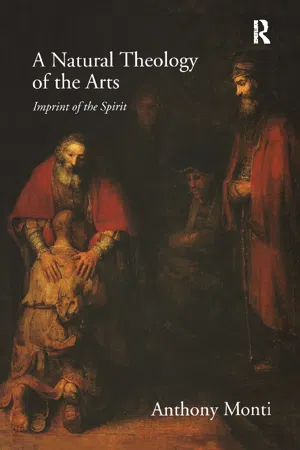
A Natural Theology of the Arts contends that the arts are theological by their very nature and not simply when they are explicitly religious - thereby constituting a distinctive kind of 'natural theology'. Borrowing from science the stance of 'critical realism' to justify truth claims in art and theology, it argues that works of art are complex metaphors that convey the 'real presence' of God, even when not labelled as such. Citing numerous examples from literature, painting, and music - including Shakespeare's King Lear, Vermeer's Young Woman with a Water Jug, Rembrandt's Return of the Prodigal Son, and Stephen Cleobury's experiences performing Bach's St Matthew Passion and Britten's Rejoice in the Lamb - the author concludes that works of art anticipate the new creation, thereby suggesting a Trinitarian account of the God present in the creation and reception of such works.
Trusted by 375,005 students
Access to over 1.5 million titles for a fair monthly price.
Study more efficiently using our study tools.
Information
Topic
Theology & ReligionSubtopic
ReligionChapter 1
Addressing the Crisis in the Humanities
To observe that the humanities are currently in a state of crisis has become so commonplace to sound almost clichéd. Yet however ‘much-observed and much discussed’,1 this state of crisis continues to elude all efforts at resolution. Indeed, it has merely persisted and grown ever deeper.
Quite simply, the humanities no longer believe in themselves; as Daniel E. Ritchie observes, ‘the common academic-in-the-ivory-tower is no longer persuaded that literature has something unique to teach us about life’.2 Whether by desperately aping the methodological rigour of the physical sciences through spinning out ever more arcane theory or, equally futilely, by attacking the objectivity of those very physical sciences (as we shall see in the next chapter) to justify their own existence, these attempts by the humanities to sustain themselves are unmistakable signs of exhaustion. Colleges and universities allow themselves to be driven by consumer demand; ‘The customer is always right’, rather than ‘Veritas’, becomes the guiding principle. Other such signs are moves by colleges and universities away from the teaching of literature toward instruction in ‘communication skills’, pathetic attempts by college administrators to justify a liberal arts core curriculum in ‘value-added’ (that is, economic) terms and equally pathetic resorts to such terms by arts institutions to justify continued (though ever-diminishing) funding by the government and private donors. Above all, there is the manifest vacuity of so much contemporary art itself which, observes the Cambridge theologian Brain Hebblethwaite, ‘demonstrates the emptiness and arbitrariness of a sensibility bereft of contact with the real'3 No wonder, then, that fewer and fewer students pursue the humanities and that they meet with less and less public support. For if the humanities do not believe in themselves, why should anyone else believe in them?
To understand how the humanities could have reached such a crisis, however, we must probe beyond these obvious symptoms of exhaustion. For as the theologian Colin Gunton observes, ‘our treatment of the arts betrays the symptoms of a deep-seated moral predicament as the result of which we know how to behave neither toward each other nor toward the world’.4 It is to this ‘moral predicament’, therefore, that we must now turn.
This moral predicament is the inevitable outcome of various trends that have come to dominate humanistic study on both sides of the Atlantic, trends that are frequently lumped together under the title ‘postmodernism’ – a title that has spawned a vast cottage industry of commentary that is itself symptomatic of the crisis. As a result, and because of the very nature of the trends it embraces, the term ‘postmodernism’ is notoriously elusive; the following definition is as concise and clear as any I have come across:
Postmodernists see representation and reality as overlapping, because conventions of representation or language (‘signification’) are learned and internalized so that we experience them as real ... For the postmodernist, then, nothing we can do or say is truly ‘original’, for our thoughts are constructed from our experience of a lifetime of representation, so it is naïve to imagine a work’s author inventing its forms or controlling its meaning. Instead of pretending to an authoritative originality, postmodernism concentrates on the way images and symbols (‘signifiers’) shift or lose their meaning when put in different contexts (‘appropriated’), revealing (‘deconstructing’) the processes by which meaning is constructed. And because no set of signifiers, from art to advertising, is original, all are implicated in the ideologies (themselves patterns of language or representation, hence, ‘discourses’) of the cultures that produce and/or interpret them.5
Consequently, Daniel Ritchie explains, for such ideological criticism:
the role of education is not to discover new truth, to evaluate one’s own beliefs self-critically, or to engage students in an open-ended conversation about the good life. Rather, its goal is to persuade students that ideological criticism accounts for virtually every significant occurrence, from the law and literature of the eighteenth century to current problems of labor and domestic violence.6
Whatever else may be said of postmodernist trends, therefore, they share one crucial feature: a tendency to question the very notion of an original, independent truth or reality to which the arts, morality, or indeed any kind of ‘discourse’ could refer. No wonder, then, that as Peter Fuller observes, ‘Postmodernism knows no commitments’.7
Yet to date most attempted defences of the humanities – as often as not, from people outside of academe – have failed to match the power and persuasiveness of postmodernist critiques of ideology (which are not, after all, without at least some elements of – dare I say it? – truth!). As Ritchie notes, ‘many defenses of the humanities lack the depth of their ideological opponents because the ideologues, to their credit, explicitly make clear the presuppositions that guide their work’.8 Furthermore, he notes, most defenders of the humanities ‘generally cannot offer a convincing alternative’:
Some recent critiques of higher education have pointed out the flaws of the ideological approaches and ended there, apparently assuming that the next step is obvious – a backward movement to the ‘traditional curriculum’. But this solution is both unattractive and unexciting. One cannot attract others for very long simply by pointing out the repellent features of the other side. If humanistic literary study cannot be presented as more rewarding than the ideological varieties, it will die.9
Of all of the postmodernist ideological critiques, the most rigorous, thoroughgoing, and devastating critique of our claims to know reality, and the one most influential upon humanistic studies (if not upon professional philosophers!) has been deconstruction; and it is the high priest of deconstruction, Jacques Derrida, who has given most pointed expression to the basis of the critique. According to Derrida, until now we have lived in what he calls ‘the age of the sign’, an age which is ‘essentially theological’, for ‘the intelligible face of the sign remains turned to the word and the face of God10 – that is, signs (including, but not limited to, words) depend upon God as their ultimate guarantee of stable meaning. Yet, Derrida maintains, we are no longer in the age of the sign, for we can no longer take for granted a divine guarantee or ‘presence’ behind meaning and form. As George Steiner explains, ‘deconstruction teaches us that where there is no “face of God” for the semantic marker to turn to, there can be no transcendent or decidable intelligibility. The break with the postulate of the sacred is the break with any stable, potentially ascertainable meaning of meaning’.11
The above comments are derived from a highly controversial book that Steiner, himself a world-renowned literary critic, wrote in 1989 in response to deconstruction and related postmodern trends. In Real Presences, which has inspired a volume of essays in response (see below), Steiner asserts that the meaning and truth of literature, the visual arts and music can no longer be sustained on purely secular terms in the face of today’s critical attacks on the very notion of an independent reality or ‘presence’. What deconstruction in particular demonstrates, according to Steiner, is the need to go beyond purely secular terms if we are to assert the meaning and truth of any discourse, and of the arts in particular: ‘The issue is, quite simply, that of the meaning of meaning as it is reinsured by the postulate of the existence of God.’12
Steiner, however, turns deconstruction on its head. Rather than conceding that there is ‘only the play of sounds and markers amid the mutations of time’, leading to ‘a rigorously consequent nihilism or nullity’,13 Steiner challenges what Nietzsche, deconstruction and other postmodernist movements take for granted as their inheritance from modernity; that God is nothing more than ‘a phantom of grammar, a fossil embedded in the childhood of rational speech’.14 This inheritance from modernity is aptly described by the art critic, Suzi Gablik, in her devastating indictment of modernism:
One of the tyrannies of the secular world view, and the penetration of rationalism into all spheres of life, is that it has become virtually impossible to raise serious questions about the existence of God, or any transcendent realm. We have learned not only to disapprove, but also to ridicule, the significance of the sacred, and to trivialize spiritual themes in which we ‘can no longer’ believe. This loss of symbolic resonance is the peculiar degeneration of consciousness from which we suffer as a culture, and it both defines and limits the conditions of our existence.15
Instead of taking this inheritance from modernity for granted as do the postmodernists, we must, Steiner maintains, postulate the existence of God in order to account adequately for our experience of meaning in general and, in particular, for our experience of the ‘real presence’ of an Other beyond ourselves in the poem, the painting or the symphony:
So far as it wagers on meaning, an account of the act of reading, in the fullest sense, of the act of the reception and internalization of significant forms within us, is a metaphysical and, in the last analysis, a theological one. The ascription of beauty to truth and to meaning is either a rhetorical flourish, or it is a piece of theology. It is a theology, explicit or suppressed, masked or avowed, substantive or imaged, which underwrites the presumption of creativity, of significance in our encounters with text, with music, with art. The meaning of meaning is a transcendent postulate.16
For Steiner, therefore, ‘The questions: “What is poetry, music, art?”, “How can they not be?”, “How do they act upon us and how do we interpret this action?” are, ultimately, theological questions’, for it is ‘poetry, art and music which relate us most directly to that in being which is not ours’.17
This is a splendid assertion, one with which many (this author among them) will be in sympathy. However, to make the assertion is one thing, and to sustain it quite another. Steiner recognizes this and maintains that, to sustain his assertion, we must resort to what he calls ‘the postulate outside proof, the leap to foundational images’, just as we do in science and in ‘every essential aspect of human existence’.18 As a result, Steiner’s argument has a strong Kierkegaardian and Barthian flavour to it, with repeated references to the ‘leap’ or ‘wager on transcendence’ and choosing (Karl) Barth over (Roland) Barthes as our guide.19
Unfortunately, it is this very characteristic of Steiner’s argument that has made it vulnerable to critics, including those otherwise sympathetic to his critique of deconstruction. In the volume of essays responding to Steiner alluded to above, Robert R Caroll, in an essay entitled ‘On Steiner the Theologian’, observes, ‘one wants a...
Table of contents
- Cover Page
- Title Page
- Copyright Page
- Table of Contents
- List of Figures
- Foreword
- Preface
- Acknowledgements
- Chapter 1 Addressing the Crisis in the Humanities
- Chapter 2 The Epistemology of Critical Realism
- Chapter 3 Natural Theology and the Metaphysic of Flexible Openness
- Chapter 4 Natural Theology, Metaphor and Art
- Chapter 5 Rumours of‘Real Presences’ Reconsidered
- Chapter 6 Art as Natural Theology: An Eschatological and Trinitarian Understanding
- Epilogue: A Question of Taste
- Works Cited
- Index
Frequently asked questions
Yes, you can cancel anytime from the Subscription tab in your account settings on the Perlego website. Your subscription will stay active until the end of your current billing period. Learn how to cancel your subscription
No, books cannot be downloaded as external files, such as PDFs, for use outside of Perlego. However, you can download books within the Perlego app for offline reading on mobile or tablet. Learn how to download books offline
Perlego offers two plans: Essential and Complete
- Essential is ideal for learners and professionals who enjoy exploring a wide range of subjects. Access the Essential Library with 800,000+ trusted titles and best-sellers across business, personal growth, and the humanities. Includes unlimited reading time and Standard Read Aloud voice.
- Complete: Perfect for advanced learners and researchers needing full, unrestricted access. Unlock 1.5M+ books across hundreds of subjects, including academic and specialized titles. The Complete Plan also includes advanced features like Premium Read Aloud and Research Assistant.
We are an online textbook subscription service, where you can get access to an entire online library for less than the price of a single book per month. With over 1.5 million books across 990+ topics, we’ve got you covered! Learn about our mission
Look out for the read-aloud symbol on your next book to see if you can listen to it. The read-aloud tool reads text aloud for you, highlighting the text as it is being read. You can pause it, speed it up and slow it down. Learn more about Read Aloud
Yes! You can use the Perlego app on both iOS and Android devices to read anytime, anywhere — even offline. Perfect for commutes or when you’re on the go.
Please note we cannot support devices running on iOS 13 and Android 7 or earlier. Learn more about using the app
Please note we cannot support devices running on iOS 13 and Android 7 or earlier. Learn more about using the app
Yes, you can access A Natural Theology of the Arts by Anthony Monti in PDF and/or ePUB format, as well as other popular books in Theology & Religion & Religion. We have over 1.5 million books available in our catalogue for you to explore.