eBook - ePub
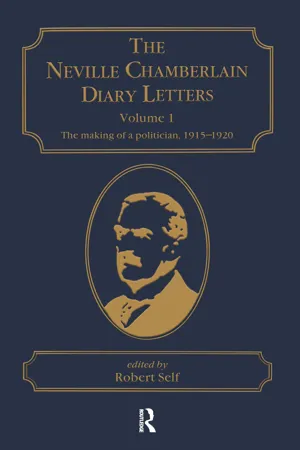
The Neville Chamberlain Diary Letters
Volume 1: The Making of a Politician, 1915–20
- 458 pages
- English
- ePUB (mobile friendly)
- Available on iOS & Android
eBook - ePub
About this book
As a primary source of historical evidence and insight, it is difficult to overstate the value and importance of Neville Chamberlain's diary letters to his sisters. They represent the most complete and illuminating 'insider' record of British politics between the wars yet to be published. From 1915 Chamberlain wrote detailed weekly epistles to his sisters until his death in 1940; a confidential account of events covering the quarter of a century during which he stood at the very centre of Conservative and national politics. Beyond the fascination of the historical record of people and events, these letters are extremely valuable for the remarkable light they throw upon the personality and character of the private man lurking behind the austerely forbidding public persona.
Trusted by 375,005 students
Access to over 1.5 million titles for a fair monthly price.
Study more efficiently using our study tools.
Information
Subtopic
World HistoryIndex
History1 Neville Chamberlain (1869–1940): The Man and his Diary Letters
I
Neville Chamberlain was a truly pivotal figure in British politics between the wars. After four dynamic years as a member of the council, Chamberlain began his first term as Lord Mayor of Birmingham in November 1915. Within little more than a year he was thrust reluctantly on to the national stage as head of the hastily-formed Department of National Service – a brief, ill-fated venture which left him with an intense and enduring contempt for Lloyd George’s character and methods. Entering the Commons in 1918 at the age of almost fifty, Chamberlain swiftly established a formidable claim to advancement. The fall of the Lloyd George coalition in October 1922 provided the opportunity for a meteoric rise from Postmaster-General, via the Ministry of Health, to the Treasury within only ten months. Thereafter, Chamberlain remained at the very centre of national politics until his death. The principal architect of Baldwin’s ‘New Conservatism’ in opposition during 1924, as Minister of Health between 1924 and 1929 he gave policy substance to the promise of progressive Toryism. As Conservative Chairman during the party crisis of 1930–31 he played a central role in defending Baldwin’s leadership from internal and external attack. As the economic slump deepened, he played an equally crucial part in determining the outcome of the 1931 political crisis. Thereafter he rapidly emerged as the dominant personality within the National Government as Chancellor of the Exchequer between 1931 and 1937, and then as Prime Minister. Even after his fall from the premiership in May 1940, he still exercised considerable influence and authority within both the party and the Churchill coalition until his sudden death from cancer in early November that year. By any standard, this was a record of remarkable prominence and achievement. Yet for all that was achieved, Neville Chamberlain often still remains a profoundly underrated, misjudged and misunderstood figure.
One obvious explanation for this misunderstanding is that perceptions of Chamberlain’s long career have been fundamentally blighted by the ultimate failure of his policy of appeasement. Ministers, and even more so Prime Ministers, are judged on their record and few could pretend that Chamberlain’s very personal form of diplomacy in pursuit of peace was anything other than an abject failure in its primary objective – whatever the crucial secondary benefits it conferred upon a nation gravely ill-prepared for war. As he confessed to the Commons on the outbreak of war: ‘Everything I have worked for, everything that I have hoped for, everything that I have believed in during my public life, has crashed into ruins’.1 Contemporaries and posterity have judged him accordingly. Few who lived through these events remained unmoved or dispassionate. A more balanced evaluation of the man and his broader career has thus inevitably been obstructed by the fact that Chamberlain’s name has become synonymous with the ambivalent and rapidly-changing emotions generated by ‘Munich’ and the disastrous drift into total war. As Lord Salter observed almost thirty years after Chamberlain’s death, he presents ‘a problem of personal assessment of unusual difficulty. The personality is so deeply submerged under the policy for which he bore the first responsibility … the feelings towards him, and the opinions about him of his contemporaries, were so divergent and so passionate that the man himself, his real nature and quality, will be hard to recapture and convey’.2
1 Parliamentary Debates: House of Commons Debates, Fifth Series (hereafter H.C. Debs, 5s), 351 col. 292, 3 September 1939.
2 Arthur Salter, Slave of the Lamp: A Public Servant’s Notebook (London, 1967), 142.
By common consent, had Chamberlain retired or died in 1937 instead of just three years later, he would have gone down in history as a great peace minister – a radical but realistic social reformer, a supremely talented administrator and the driving force behind many of the National Government’s underestimated successes of the early and middle 1930s.3 Instead, at the age of almost seventy he became Prime Minister, to be dismissed by posterity as ‘an outstanding example of the leader whom the current of world events carried out of his depth’.4 Although as Chancellor of the Exchequer from 1931 Chamberlain must bear a heavy responsibility for the lamentable state of national defence, by his accession to the premiership in 1937 he led a nation with singularly few realistic policy options open to it. The skill with which he played the limited cards dealt to him has been the subject of intense controversy ever since. Yet, too often, the critics who survived to denigrate his memory preferred to suggest that he could have been playing with an alternative, imaginary deck of cards in which there were nothing but aces. Moreover, they often did so to conceal their own share in the failures of these years whether from the Opposition benches or Chamberlain’s own. Either way, the final three years of his life tend to dominate perceptions of the man and his reputation. ‘It has been Neville Chamberlain’s fate’, one anti-appeaser noted with an atypical generosity of spirit, ‘to be first obsequiously praised and then extravagantly abused’.5
3 Ibid., 148. Also H. Macmillan, Winds of Change, 1914–1939 (London, 1966), 520–21; Viscount Simon, Retrospect (London, 1952), 278; Earl of Swinton, Sixty Years of Power: Some Memories of the Men who Wielded it (London, 1966), 108.
4 Swinton, Sixty Years of Power, 108.
5 Macmillan, Winds of Change, 521.
Chamberlain was acutely aware that the failure of his policy towards the dictators would overshadow his many other achievements.6 Such fears were well founded. ‘Poor Neville will come badly out of history’, Churchill is once supposed to have quipped, ‘I know, I will write that history’. In his deeply coloured but highly influential account of The Gathering Storm (1948), Churchill characterised Neville Chamberlain as ‘an upright, competent, well meaning man’ possessed of ‘a narrow, sharp edged efficiency within the limits of the policy in which he believed’ but fatally handicapped by limited vision, inexperience of the European scene and a deluded confidence in his own omniscience. Churchill’s critical verdict proved remarkably persistent. In the aftermath of mass unemployment, appeasement and total war, Neville Chamberlain was castigated as the most culpable of all the ‘Guilty Men’ – a naively complacent mediocrity whose failure of imagination, vision and nerve at the Treasury, and later in the conduct of foreign affairs, helped to sustain the pessimistic mood of collective self-doubt which supposedly characterised this decisive stage in national decline.7
6 N. Chamberlain to Ida Chamberlain, 25 May 1940 and to Hilda Chamberlain, 1 June 1940, Neville Chamberlain MSS NC18/1/1158–59. Also Diary, 4 October 1940, NC2/24A.
7 W.S. Churchill, The Second World War, Vol I: The Gathering Storm (London, 1948), 173, 199; A.L. Rowse, The Later Churchills (London, 1958), 462–66.
For many even today, the abiding popular image of a man whose public career spanned a quarter of a century from the middle of the Great War to the first year of an even greater one thus remains that of a tragicomic figure standing at Heston airport with a rolled umbrella and a worthless piece of paper inscribed with the legend ‘Peace in our Time’. As such, Chamberlain remains misunderstood and underrated; to be written off as a vain, ignorant, deluded bourgeois whose true stature and reputation are too easily dismissed with Lloyd George’s malicious jibe that he was ‘a good Lord Mayor of Birmingham in a lean year’.8 Indeed, for later generations, Chamberlain’s name entered the international political lexicon as a byword for the naive blunderings of a well-intentioned provincial who was ‘contemptuous of experts’ who mentioned facts he didn’t agree with.9
8 Both the attribution and phrasing vary considerably. Most credit it to Lloyd George but some attribute it to Churchill including F. Williams, A Pattern of Rulers (London 1965), 140. Oswald Mosley, My Life (London, 1968), 176, erroneously claims an ‘adequate Lord Mayor’ for Birkenhead.
9 See Crossman Diary, 6 April 1956, for an American journalist describing the Eisenhower administration as ‘a Chamberlain regime’, Janet Morgan (ed.), The Backbench Diaries of Richard Crossman (London, 1981), 485.
Since the mid-1960s much scholarly research has been devoted to an exhaustive re-examination of the foundations and guiding logic behind the policy of appeasement which Chamberlain inherited, and then transformed into the personal strategy with which his name has become indissolubly associated. This movement prompted a wave of sustained ‘revisionism’ during the 1960s, to be followed since the 1980s by various species of ‘counter-revisionist’ interpretation. Yet although these alternative perspectives throw much light upon British foreign policy in this period, they contribute rather less to a better understanding of the character of its principal architect. On the contrary, the entire personality and career of the man is often viewed through the prism of his record and conduct during the final three years of his life while Prime Minister. Such a perspective thus often obscures, even distorts, as much as it illuminate...
Table of contents
- Cover
- Half Title
- Title Page
- Copyright Page
- Table of Contents
- Acknowledgements
- List of Abbreviations
- Chapter 1: Neville Chamberlain, 1869–1940: The Man and his Diary Letters
- Chapter 2: The Making of a Politician, 1915–20
- Chapter 3: ‘We Get Busier and Busier’: Lord Mayor of Birmingham, March 1915–December 1916
- Chapter 4: ‘A Pretty Rotten Time’: Director-General of National Service, December 1916–August 1917
- Chapter 5: ‘A Rather Hard Row to Hoe’: Return to Birmingham and the Road to Westminster, August 1917–December 1918
- Chapter 6: ‘The Fascination of the House of Commons’: Parliamentary Apprenticeship, 1919
- Chapter 7: ‘The “Handy Man” of the House’: Parliamentary Labours and Dilemmas, 1920
- Appendix I: The Chamberlain Household and Family
- Appendix II: Primary Sources Consulted for Volume One
- Index
Frequently asked questions
Yes, you can cancel anytime from the Subscription tab in your account settings on the Perlego website. Your subscription will stay active until the end of your current billing period. Learn how to cancel your subscription
No, books cannot be downloaded as external files, such as PDFs, for use outside of Perlego. However, you can download books within the Perlego app for offline reading on mobile or tablet. Learn how to download books offline
Perlego offers two plans: Essential and Complete
- Essential is ideal for learners and professionals who enjoy exploring a wide range of subjects. Access the Essential Library with 800,000+ trusted titles and best-sellers across business, personal growth, and the humanities. Includes unlimited reading time and Standard Read Aloud voice.
- Complete: Perfect for advanced learners and researchers needing full, unrestricted access. Unlock 1.5M+ books across hundreds of subjects, including academic and specialized titles. The Complete Plan also includes advanced features like Premium Read Aloud and Research Assistant.
We are an online textbook subscription service, where you can get access to an entire online library for less than the price of a single book per month. With over 1.5 million books across 990+ topics, we’ve got you covered! Learn about our mission
Look out for the read-aloud symbol on your next book to see if you can listen to it. The read-aloud tool reads text aloud for you, highlighting the text as it is being read. You can pause it, speed it up and slow it down. Learn more about Read Aloud
Yes! You can use the Perlego app on both iOS and Android devices to read anytime, anywhere — even offline. Perfect for commutes or when you’re on the go.
Please note we cannot support devices running on iOS 13 and Android 7 or earlier. Learn more about using the app
Please note we cannot support devices running on iOS 13 and Android 7 or earlier. Learn more about using the app
Yes, you can access The Neville Chamberlain Diary Letters by Robert Self in PDF and/or ePUB format, as well as other popular books in History & World History. We have over 1.5 million books available in our catalogue for you to explore.