- 196 pages
- English
- ePUB (mobile friendly)
- Available on iOS & Android
eBook - ePub
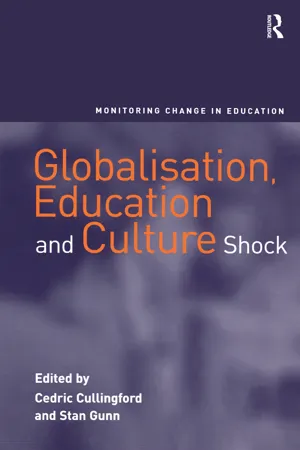
Globalisation, Education and Culture Shock
About this book
How has globalisation affected educational thought and practice? This volume presents a fascinating exploration of the impact of globalisation on education. The authors consider the changes - sometimes subtle, sometimes revolutionary - that arise when ideas, practices and experiences are discussed and analysed by people of contrasting cultural backgrounds. Through a series of case studies, they examine the dilemmas and contradictions, as well as the new ideas and opportunities, that globalisation offers to individuals, to states and to intellectual cultures. Key areas of discussion include: ¢ The effects of globalisation on individuals ¢ The contradictions embedded in the process of globalisation - especially in the economic sphere ¢ The impact on education of globalising ideas, thoughts and values ¢ The relationship between globalisation and culture.
Trusted by 375,005 students
Access to over 1.5 million titles for a fair monthly price.
Study more efficiently using our study tools.
Information
Subtopic
Social PolicyChapter 1
Introduction
Stan Gunn
The term globalisation is used in a variety of ways. These include the emergence of supranational institutions which threaten the powers of the nation state, the impact of economic change on a world wide scale and changes in technology and communication which impact on the culture of nation states. At a fundamental level globalisation is concerned with change. Increasingly individuals and their culture cannot be disconnected from the world in general. Changes in many cultural practices and beliefs have been induced by improved technologies and in the context of the world as a whole rather than within separate nation states that in the past enjoyed considerable autonomy. The changes created by the forces of globalisation impact on individuals and groups and can be assimilated, modified or rejected by them. The changes are not in one direction, for example from the West to the rest of the world, and they are not only concerned with the present but also the future. A clash of cultural values is inevitable where new ideas and values are introduced in some form whether it is at an organisational or institutional level or in the individual's own psyche. The changes may be induced by powerful groups who exercise control over large organisations or by individuals or groups who have some form of political power base even though they command limited resources. It is not that change is new but the extent and the speed of change which gives globalisation its distinguishing characteristics. Inevitably culture and therefore education is influenced. The processes of globalisation have produced a reconsideration of the aims of education, the content of education, the processes or methods by which it is delivered and the ways in which the outcomes are assessed.
Harrison (2002) in a political context analyses globalisation from an orthodox point of view. The process is seen to comprise of three main influences technology, global finance and the decline of the nations state's power. Technological innovation has made the transmission of information, people and goods very rapid. Global finance and the transfer of money and the trading in shares, currencies and futures can happen not only very quickly but 24 hours per day and can be instigated from anywhere in the world. The establishment of global free markets leads to improved efficiency in industry and an improvement in standards of living but the influence of national economies and governments has been undermined. Giddens (1990) pointed to the influence of globalisation on social relationships and suggested that globalisation was '....the intensification of world-wide social relationships which link distinct localities in such a way that local happenings are shaped by events, occurring miles and miles away and vice versa'. Robertson (1992) contended that the process of globalisation is not necessarily complete in terms of producing a homogeneous world and that 'globalisation is ....best understood as indicating the problem of the form in terms of which the world becomes 'united' but by no means integrated'. Globalisation is seen by these authors as a series of long term processes which occur unevenly across the world, processes which affect and influence people's knowledge, thoughts, attitudes and actions and which also impact on the material conditions under which people live. Maguire (1999) recognises the emergence of a global economy but also points to a transnational cosmopolitan culture and international social movements which give rise to pressure for change. He along with Robertson avoids the prediction of whether this leads to homogeneity or heterogeneity within cultures. Alexander (2000) in a review of the concept of globalisation suggests that globalisation consists of two elements: global and economic independence and competitiveness and the limitless potential of informational and communications technology. He draws attention to the lack of 'acknowledgement of the human and social downside of these developments, especially for those – individuals, groups, nations, states, continents even – who will neither be beneficiaries not participants'. Held et al (2000) comment that 'there can be little doubt that one of the most directly perceived and experienced forms of globalisation is the cultural form' (p. 327). He argues that people, objects and ideas have always moved around the world and that cultures have always been modified or changed by these.
Changes in telecommunications are seen as one of the more dominant influences in the process of globalisation. It is argued (see for example, Held et al (2000) and Burbules and Torres (2000)) that there has been a qualitative and quantitative change in the intensity and scope of telecommunications in the last decades of the twentieth century and that this has produced considerable social change. Transmitting information has become cheaper and faster on a world wide scale than ever before. This has led, for example, to an increase in international business connections and an increase in the number of tourists and migrants but also and perhaps more importantly it has demanded shared language and linguistic competences. While some languages dominate in particular areas of the world e.g. the old colonial languages of English, French, Portuguese and Spanish, the dominant world language in communications is English. It has become dominant in business communications, politics, administration, academic communications, safety, technology and science and advertising. The effect of the media, in particular music, television and cinema, and tourism has been significant. Alongside the technological innovations in communications, global economic restructuring has occurred. This has led to the development of the economic integration of national economies, an international division of labour, increasing internationalization of trade and changes in labour and capital relationships and working practices. The ways in which products are produced and marketed has an effect on the culture of nation states.
It can be argued that the processes involved in globalisation are not new although Alexander (2000) in an educational context does not acknowledge this in his analysis and points to the very different contexts in which education has operated in the past. The differences between Held et al (2000) and Alexander (2000) lie in the speed of change and the context rather than the process. Held et al (2000) propose three categories of argument about the nature and impact of globalisation: the hyperglobalisers who predict the homogenisation of the world under Western consumerism or American popular culture, transformationals who advocate the mixing of cultures to produce new cultural hybrids and those who are concerned with the impact of contemporary cultural globalisation on national communities. Held et al conclude that all three approaches are limited by the absence of a systematic framework to describe the flow of culture across and between societies, a lack of understanding of the impact of historical questions and the lack of distinction between changes in national cultural identity and values and the processes and context of their formation. It is argued that cultural globalisation is the changing context and means whereby national cultures are produced and reproduced. This occurs through the movements of objects, signs and people across regions and intercontinental space. Historically the movement of people was the most important and influential agent in cultural transmission and this was followed by the movement of objects e.g. books, written records and cultural artefacts and latterly the improvement in communications. The effects of cultural globalisation can be demonstrated through the extent, intensity and the velocity which the ideas and images can be transmitted.
To support this analysis Held et al (2000) examine in an historical context the influence of religion and empire. World religions, in particular Islam and Christianity, have been able to move from their place of origin and convert other religions and overthrow other cultures. They often achieved this by being in alliance with dominant states and political and economic elites. Christianity started to have a world wide influence with the colonial and military expansion of the European nations in the sixteenth and seventeenth centuries. This was aided by the development of writing and texts which assisted the transmission of values and ideas and the establishment of institutions and hierarchies which produced effective ways of influencing other cultures. Buddhism and Hinduism did not extend on a global scale in that they were limited to South and East Asia but they did establish similar frameworks which cut across cultural and linguistic boundaries. Give the contemporary theory whereby migration and the diffusion of values, doctrines and beliefs related to religious beliefs can be and are globally transmitted, the impact on and implications for education are significant.
In the case of empire new cultural ideas are imposed through the threat or use of force and political dominance. Held et al (2000) argue that this is a simplistic explanation which ignores the ways in which emulation and diffusion work alongside imposition. Cultural practices are often assimilated through repeated contact and adapted at a local level. These cultural practices require institutions which create, transmit, reproduce and receive cultural messages or practices which include modes of transportation as well as communication. The technologies involved in transportation and communication require social organisations. In education a minimal requirement is linguistic competence which is reflected in the establishment of colonial educational establishments but there is also the necessity of institutions to teach new competences, skills and knowledge to the indigenous population. A new form of stratification develops related to the new institutions and the technologies since these are not readily available to all. In this sense the process of globalisation is often incomplete in that not all are active participants in the process. Let us take the example of the Romans who generated and reproduced a trans-imperial ruling class which was a political community which had shared cultural values, beliefs and aesthetics and which persisted after the decline of the empire. The export and import of educational ideas and the establishment of institutions to transmit them is not new. The transmission of British ideas and cultural practices was transmitted through the development of the colonial educational systems and the content that they purveyed. These remain virtually unchanged in some of the former colonies where the children of local elites are educated in models of the English public school using English curriculum materials. These schools were and still are seen as places where the elites of tomorrow are cultivated. The control exerted by elites is one of the major criticisms of the process of globalisation as the majority of people are perceived to be passive receivers and consumers rather than critical appraisers and adaptors of that on offer and this applies not only to education but also to economic, religious and political elites. However, cultural power has also played a role in the development of empire and the ruling elites have been influenced by movements upwards rather than imposition downwards. Held et al (2000) cites the influence of the Christian church in the Roman Empire to support this point of view. Held et al (2000) go on to argue that 'Contemporary cultural globalisation is associated with several developments: global infrastructures of an unprecedented scale, generating an enormous capacity for cross-border penetration and a decline in the cost of their use; an increase in the intensity, volume and speed of cultural exchange and communication of all kinds; the rise of Western popular culture and inter business communication as the primary content of global cultural interaction; the dominance of culture multinationals in the creation and ownership of infrastuctures and organizations for the production and distribution of cultural goods; and a shift in the geography of global cultural interaction departing in some significant ways from the geography of the pre-Second World War global order.' (p. 341) Globalisation is seen as pervasive and all consuming.
The processes, concerns and fears and hopes associated with cultural change are not limited to the concept of globalisation. In the late 1960s and early 1970's futurology became an accepted academic discipline in some universities. The future and what it is possible to achieve, what will probably be achieved and what preferably will be achieved has been a constant source of speculation both in the past and present. Alvin Toffler (1970) in Future Shock put it this way:
Every society faces not merely a succession of probable futures, but an array of possible futures, and a conflict over preferable futures. The management of change is the effort to convert certain possibles into probables, in pursuit of agreed-on preferables. Determining the probable calls for a science of futurism. Delineating the possible calls for an art of futurism. Defining the preferable calls for a politics of futurism, (p. 41 5).
Although the process of globalisation may not be directly determined by these in an overt way, the practice almost certainly is, even though these underlying assumptions may go untested and unchallenged. The concern for globalisation, education and culture shock is about who decides what is possible, what is probable and what is preferable. The political context cannot be ignored.
One of the defining characteristics of globalisation is the speed of change in a global context. Toffler (1970) examined the effects of the acceleration of change and what he termed 'future shock' in an American context. He referred to 'the shattering stress and disorientation that we induce in individuals by subjecting them to too much change in too short a time' (p. 12) and the lack of knowledge about 'adaptivity either by those who call for and create vast changes in society, or by those who supposedly prepare us to cope with those changes' (p. 12). The purpose of his text was to help people and American society in particular to cope more effectively with change and to increase the understanding of how man responds to it. A distinction is drawn between the rate of change and the direction of change. The rate of change is seen to be as important, and more important in some cases, than the direction of change. The more rapid the change the more disorienting it is for the individual. Allied to the idea of 'future shock' is the concept of 'culture shock'. 'Culture shock is the effect that the emersion in a strange culture has on the unprepared visitor...It is what happens when the familiar psychological cues that help an individual to function in society are suddenly withdrawn and replaced by new ones that are strange and incomprehensible' (p. 19). Culture shock for Toffler (1970) has two facets. It is not only the imposition of a new culture on an old one but also the shock experienced by the individual when placed in an unfamiliar culture when the original culture of the individual is no longer there and causes a breakdown in communication, a misreading of reality and an inability to cope. It is arguable that Toffler (1970) exaggerated the problems created by rapid change but nevertheless many of the processes he describes are pertinent and applicable to the effects of the process of globalisation and adaptation to change and their implications for education in a world wide context.
Toffler (1970) saw education as one of the means of ameliorating the problems created by future shock. Education can be considered to be the transmission of the values and accumulated knowledge of society. As societies become more and more complex, the nature of education and the means of transmission become more and more institutionalised and less related to daily life. Learning in formally established institutions allows the learner to leam far more about their culture than they are able to do through observation and imitation. As complexity within and between cultures increases and knowledge expands, the greater the importance placed on education by society. This is accompanied by a desire by society to exert greater control on education through the formulation of the overall aims and objectives of education, the content to be transmitted, the organisation and strategies involved in this transmission and the ways in which all these are seen to be accountable. This description of the nature of education is based on that given by the Encyclopaedia Britannica (2003). It depicts a series of stages through which the form of education changes and responsibility for education passes more and more from the parents, to the community, to the state. With increasing wealth there is increasing expenditure on education but also increasing accountability. This can be seen as a transient model since if wealth becomes global and there is ample expenditure on education for all, will education take on a less 'economic' based approach and a more 'liberal' form? The Britannica based definition describes the process involved in the development of educational systems but it fails to show the importance of whose or what values and content are transmitted. The United Nations in 1997 defined education as being '...fundamental to enhancing the quality of human life and ensuring social and economic progress' (United Nations, 1997). This definition equally emphasises the process, albeit stressing the quality of life for people, but ignores the challenge of whether there are, could be or should be a common set of values, ideas, attitudes and opinions which are transmitted or whether education is designed to produce cultural diversity or a mixture of the two. Both the Britannica and United Nations descriptions of the process of education allude to economic criteria. While it is acknowledged that economic wealth and the surplus it can create fund education, there is an implicit assumption that it is the economic system that drives the educational system without recognition of the values and methods of the economic system itself. Education in its 'primitive' sense, that is that provided by the family and community on an almost chance basis, is seen to have 'lesser' values than those expressed explicitly and implicitly by a sophisticated 'economic' based education system. Avis (1997) in a discussion of contemporary Post-Compulsory Education in Great Britain makes a similar point when he says '... a common sense surrounding the nature of the economy and education, resulting in the construction of a framework that we can all buy into, a set of ideas taken for granted unproblematically' (Avis, 1997). There is an implicit view that if economic success i.e. wealth is achieved then a social and educational Utopia will be achieved automatically.
Earlier Toffier (1970) saw education in the United States in the following way, '...the whole idea of assembling masses of students (raw materials) to be processed by teachers (workers) in a centrally located school (factory) was a stroke of industrial genius. The whole administrative hierarchy of education, as it grew up, followed the model of industrial bureaucracy. The very organisation of knowledge into permanent disciplines was grounded on industrial assumptions.' Further on he comments 'The most criticised features of education today – the regimentation, lack of individualisation, the rigid systems of seating, grouping, grading and marking, the authoritarian role of the teacher – are precisely those that made mass public education so effective an instrument of adaptation for its place and time.' He sees the emphasis on education for industry and economic survival and the industrial models of managing schools, teachers and learning as creating the conditions which give rise to the pernicious aspects of future shock and failing to give the receivers of education in this form a means of avoiding it.
Many of the characteristics of educational practice outlined by Toffler are still present in educational thought and practice today along with some of the anticipated outcomes. His responses to the predicted rapidly changing society and technology change emphasise the need for education to produce people 'who can make critical judgements, who can weave their way through novel environments, who are quick to spot new relationships in the rapidly changing reality ...(and who) can adapt to continual change' (p. 364). The form of schooling would change for an increasing number of children of highly educated parents as the use of computer aided learning would enable the children of these parents to spend less time in the classroom and more time in the home. Schools would provide tuition in areas which students could not learn on their own or in the home. He forecasts lifelong learning and questions the administration of an education system which is based on industrial models of bureaucracy. He sees the need for a unifying system of skills but skills which require the student to learn to manipulate data rather than just retain it and learn how to learn. The curriculum would support this in terms of its diversity and creative view of content and would not be presented as if it were value free. Diversity in the curriculum is seen as insurance against our inability to predict the future in much the same way as genetic diversity ensures the preservation of the species. This model however is not without its dangers if there is a lack of balance between standardization and variety in the curriculum. Toffler points out...
Table of contents
- Cover
- Half Title
- Title
- Copyright
- Contents
- List of Figures and Tables
- List of Contributors
- Preface
- 1 Introduction
- 2 The Concepts of Globalisation and Culture
- 3 Globalisation as Education? Images of Other Countries
- 4 Local Knowledge and Globalisation: Are they Compatible?
- 5 Cross-Cultural Transference in Educational Management
- 6 Broader Horizons and Greater Confidence: UK Students Learning from Mobility
- 7 Overseas Students in Higher Education
- 8 Cultural Shock or Cultural Acquisition? The Experiences of Overseas Students
- 9 Students' Perceptions of Lifestyle Changes in a Remote Community Following the Availability of New Technologies
- 10 Globalisation, Cultural Diversity and Teacher Education
- 11 Teachers, Globalisation and the Prospect for Self-Education
- 12 Concluding Remarks
- Name Index
- Subject Index
Frequently asked questions
Yes, you can cancel anytime from the Subscription tab in your account settings on the Perlego website. Your subscription will stay active until the end of your current billing period. Learn how to cancel your subscription
No, books cannot be downloaded as external files, such as PDFs, for use outside of Perlego. However, you can download books within the Perlego app for offline reading on mobile or tablet. Learn how to download books offline
Perlego offers two plans: Essential and Complete
- Essential is ideal for learners and professionals who enjoy exploring a wide range of subjects. Access the Essential Library with 800,000+ trusted titles and best-sellers across business, personal growth, and the humanities. Includes unlimited reading time and Standard Read Aloud voice.
- Complete: Perfect for advanced learners and researchers needing full, unrestricted access. Unlock 1.5M+ books across hundreds of subjects, including academic and specialized titles. The Complete Plan also includes advanced features like Premium Read Aloud and Research Assistant.
We are an online textbook subscription service, where you can get access to an entire online library for less than the price of a single book per month. With over 1.5 million books across 990+ topics, we’ve got you covered! Learn about our mission
Look out for the read-aloud symbol on your next book to see if you can listen to it. The read-aloud tool reads text aloud for you, highlighting the text as it is being read. You can pause it, speed it up and slow it down. Learn more about Read Aloud
Yes! You can use the Perlego app on both iOS and Android devices to read anytime, anywhere — even offline. Perfect for commutes or when you’re on the go.
Please note we cannot support devices running on iOS 13 and Android 7 or earlier. Learn more about using the app
Please note we cannot support devices running on iOS 13 and Android 7 or earlier. Learn more about using the app
Yes, you can access Globalisation, Education and Culture Shock by Stan Gunn, Cedric Cullingford in PDF and/or ePUB format, as well as other popular books in Politics & International Relations & Social Policy. We have over 1.5 million books available in our catalogue for you to explore.