eBook - ePub
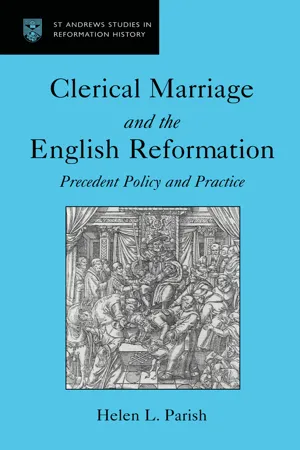
Clerical Marriage and the English Reformation
Precedent Policy and Practice
- 288 pages
- English
- ePUB (mobile friendly)
- Available on iOS & Android
eBook - ePub
About this book
This volume is an examination of the debate over clerical marriage in Reformation polemic, and of its impact on the English clergy in the second half of the sixteenth century. Clerical celibacy was more than an abstract theological concept; it was a central image of mediaeval Catholicism which was shattered by the doctrinal iconoclasm of Protestant reformers. This study sets the debate over clerical marriage within the context of the key debates of the Reformation, offering insights into the nature of the reformers' attempts to break with the Catholic past, and illustrating the relationship between English polemicists and their continental counterparts. The debate was not without practical consequences, and the author sets this study of polemical arguments alongside an analysis of the response of clergy in several English dioceses to the legalisation of clerical marriage in 1549. Conclusions are based upon the evidence of wills, visitation records, and the proceedings of the ecclesiastical courts. Despite the printed rhetoric, dogmatic certainties were often beyond the reach of the majority, and the author's conclusions highlight the chasm which could exist between polemical ideal and practical reality during the turmoil of the Reformation.
Trusted by 375,005 students
Access to over 1.5 million titles for a fair monthly price.
Study more efficiently using our study tools.
Information
Chapter One
'This act is in this country a monster': Clerical Marriage in England during the Reformation
The legalization of clerical marriage in England was, in the words of H.C. Lea, 'a process of far more intricacy than in any other country which adopted the Reformation'.1 For the best part of a century, Lea's work has been the standard history of celibacy in the church, and his account of sixteenth-century legislation on the issue is still widely accepted. The prohibition on clerical marriage, it is argued, persisted as a consequence of Henry VIII's doctrinal conservatism, and was lifted only reluctantly in 1549.2 The discipline of celibacy was enforced in the English church for the best part of two decades after the break with Rome, and was tolerated rather than welcomed in the Elizabethan church. However, the question of the validity of clerical marriage remained controversial throughout the period. Thomas More's preoccupation with Luther's marriage ensured that the issue of clerical marriage was a central feature of the polemical literature of the 1520s. The official policy of the Henrician church was made clear in the following decade: throughout the 1530s, celibacy was enjoined upon the clergy in successive statutes and proclamations. Preaching and polemic in defence of clerical marriage continued, and a number of clergy, both secular and regular, took wives. In 1534, John Rastell petitioned Cromwell for the lifting of the prohibition on clerical marriage,3 and such demands became increasingly vociferous. Writing to Lady Lisle in November 1535, Anthony Waite claimed, 'it is preached here that priests must have wives', alongside unorthodox opinions on purgatory, and demands for communion in both kinds.4 Two months later, in a description of the state of the English church, the imperial ambassador drew attention to the publication of Gardiner's De Vera Obedientia, and noted 'clerks are allowed to marry'.5 Ortiz was only half right. Clerks had indeed married, but there is nothing to suggest that they were permitted in law to do so. A royal proclamation of 1535 threatened to deprive married priests of their benefices, and further condemnation of clerical marriage was to follow.6
In June 1536, the Lower House of Convocation protested against the spread of heresy, listing the belief 'that Priests shuld have wiffes' among the most contentious errors.7 Their fears were grounded in reality. When deprived of his benefice and examined for heresy in the reign of Mary, the parson of Hadleigh, Rowland Taylor, confirmed that he had been married for some twenty-nine years, making him one of the first priests in England to marry.8 Hadleigh had a longstanding tradition of heterodox dissent by 1554, and Diarmaid MacCulloch argues that the Marian regime rapidly identified the community as a threat.9 In 1528, John Tyball confessed that he had preached that every priest should have a wife, and had persuaded Friar Meadow, a Greyfriar of Colchester, to abandon his religion and marry.10 Other religious houses were similarly affected. John ap Rice wrote to Cromwell in October 1535, describing the situation in the abbey of Walden and the conduct of the abbot, 'a man of good learning', who had 'secretly contracted marriage, because, though he might not do it by the laws of men, he might do it lawfully by the laws of God for avoiding of more inconvenience'. Only seven monks remained in the house, the abbot having persuaded the rest that there was 'no sanctity in monkery'.11 Appealing to Cromwell for mercy, the abbot described his wife, identified by Wriothesley as one 'mistress Bures, nun of the minories', as his 'remedy'.12 Such assertions would not have been out of place in the works of Luther or Tyndale. Monastic vows were condemned as idolatrous by evangelical polemicists, and the argument from 1 Corinthians 7 that marriage was a remedy for fornication was a favoured text.13
In a letter to the duke of Suffolk in June 1537, Sir Thomas Tyrell protested that the vicar of Mendlesham 'brought home his woman and children to his vicarage, openly declaring he is married to her. This act is in this country a monster, and many grudge at it.' The vicar, he claimed, had stated that the king was aware that he was married, and therefore no action had been taken to separate him from his 'wife'. Tyrell was concerned that the 'crime' should be dealt with, on the grounds that it offered a poor example to other 'carnal priests', and might encourage others to marry.14 In August 1538, Adam Lewes, another priest with Mendlesham connections, informed the authorities in Rye that he knew of a hundred other priests who had married.15 Such reports were almost certainly exaggerated, but Lewes's statement suggests that the fears of conservatives, and the king himself, were not unfounded; more recently, the inhabitants of Mendlesham in Suffolk have been described as 'striking in their continuity of religious dissent', perhaps encouraged by the attitude of their preists towards the traditions of the church.16
The vicar of Mendlesham was clearly mistaken in the belief that the king would sanction his marriage. Henry VIII's attitude to clerical marriage had been set out in no uncertain terms throughout the 1530s. In 1536 the bishops were ordered to investigate incidents of clerical marriage in their dioceses, and Henry VIII condemned those clergy who 'have p[re]sumed to mary themselfs, contrarye to the custome of o[u]r churche of England'.17 The break with Rome was not to be accompanied by the relaxation of all Roman discipline, and clerical celibacy was established as a feature of the historical English church. The bishops were instructed to make 'secret enquiry', and any married clergy were to be apprehended, or brought to the attention of the Council. The duty of the bishops to investigate clerical marriage was hardly compatible with the archbishop of Canterbury's own situation.18 However, the enforcement of clerical celibacy is in keeping with the sentiments expressed in the article on marriage in the Bishops' Book of 1537:
Christ seemeth to exhort such as he shall endue with the grace and virtue of continence, wherby they shall be able to abstain from the works of matrimony to continue sole and unmarried.19
The passage was not a ringing endorsement of clerical celibacy, but it did assert that celibacy was a state which some could attain. Further action was taken against married clergy in November 1538. A royal proclamation prohibited marriage to the clergy, and threatened those who had already married with the loss of their benefices.20 The king's personal concern over the issue is clear from the alterations that he made to the draft of the proclamation. The original draft opened with a declaration that the king was aware that a 'fewe nombre' of clergy, 'being prestes as well religious', had taken it upon themselves to marry, contrary to the vow they had made on receiving orders. Henry amended the text, adding that such marriages were contrary to 'the holsu[m]e monission off saint Palle ad Thimotheu[m] ad Titu[m] and ad Cori[n]theos bothe first and seco[n]de and also to the opinions of meny of the olde faders and expositers of Scripture'.21 Fearing that their example would encourage other clergy to marry, Henry ordered that priests who had already married should be expelled from their benefices and 'reputed as laye p[er]sonnes', and threatened those clergy who married after 1538 with imprisonment.
Despite the proclamation of 1538, the debate on clerical marriage continued. Wriothesley claimed that preachers continued to defend clerical marriage, even in the presence of the king, and clergy continued to marry.22 Indeed, the actions of Cromwell were not altogether consistent with the policy of his king. In 1536, the Welsh clergy petitioned Cromwell, requesting that they be allowed to retain their 'hearth companions', in accordance with tradition. While clerical marriage was technically illegal in Wales, it is clear that some clergy had at least entered into a 'civil marriage' through public betrothal, and that they regarded these marriages as binding. Such unions were sometimes welcomed by the laity; in their petition, the priests complained that they could find no lodging because men feared for the safety of their wives and daughters. The Welsh clergy presumably believed that Cromwell would be sympathetic to their plight.23
Their hopes would have been boosted by Cromwell's action in commending the preaching of a married priest who had been deprived of his orders to the abbot of Reading. In his reply, the abbot argued that while the man might be learned, 'he cannot but instil like persuasion of marriage, and that would be but occasion of slander, the laws standing as they do yet', and refused to act upon the recommendation.24 The following year, a Winchester priest wrote to Cromwell, ...
Table of contents
- Cover
- Half Title
- Title
- Copyright
- Contents
- Foreword
- Acknowledgements
- Abbreviations
- Introduction
- 1 'This act is in this country a monster': Clerical Marriage in England during the Reformation
- 2 Celibate Priesthood or Married Ministry? The Testimony of the Bible
- 3 'Good and Holy Men': Clerical Marriage and the Example of the Early Church
- 4 'Disunity and Innovation': The Example of the Mediaeval Church
- 5 Clerical Celibacy as a Mark of the Antichrist in English Reformation Polemic
- 6 A Compulsion From Which They Should Be Set Free: Vows of Celibacy and the English Reformation
- 7 'Massinge and that cannot agre together': Clerical Marriage and the Eucharist in English Reformation Polemic
- 8 'That they might better attend to the ministration of the gospel': Clerical Marriage in England, 1549-70
- Conclusion
- Appendix Diocesan Maps
- Bibliography
- Index
Frequently asked questions
Yes, you can cancel anytime from the Subscription tab in your account settings on the Perlego website. Your subscription will stay active until the end of your current billing period. Learn how to cancel your subscription
No, books cannot be downloaded as external files, such as PDFs, for use outside of Perlego. However, you can download books within the Perlego app for offline reading on mobile or tablet. Learn how to download books offline
Perlego offers two plans: Essential and Complete
- Essential is ideal for learners and professionals who enjoy exploring a wide range of subjects. Access the Essential Library with 800,000+ trusted titles and best-sellers across business, personal growth, and the humanities. Includes unlimited reading time and Standard Read Aloud voice.
- Complete: Perfect for advanced learners and researchers needing full, unrestricted access. Unlock 1.5M+ books across hundreds of subjects, including academic and specialized titles. The Complete Plan also includes advanced features like Premium Read Aloud and Research Assistant.
We are an online textbook subscription service, where you can get access to an entire online library for less than the price of a single book per month. With over 1.5 million books across 990+ topics, we’ve got you covered! Learn about our mission
Look out for the read-aloud symbol on your next book to see if you can listen to it. The read-aloud tool reads text aloud for you, highlighting the text as it is being read. You can pause it, speed it up and slow it down. Learn more about Read Aloud
Yes! You can use the Perlego app on both iOS and Android devices to read anytime, anywhere — even offline. Perfect for commutes or when you’re on the go.
Please note we cannot support devices running on iOS 13 and Android 7 or earlier. Learn more about using the app
Please note we cannot support devices running on iOS 13 and Android 7 or earlier. Learn more about using the app
Yes, you can access Clerical Marriage and the English Reformation by Helen L. Parish in PDF and/or ePUB format, as well as other popular books in History & World History. We have over 1.5 million books available in our catalogue for you to explore.