- 256 pages
- English
- ePUB (mobile friendly)
- Available on iOS & Android
eBook - ePub
About this book
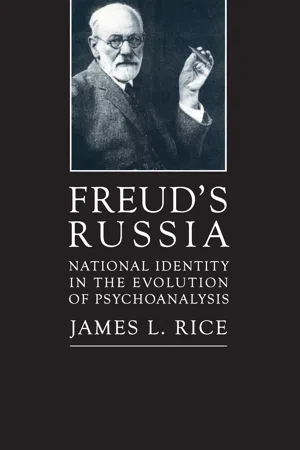
Freud's lifelong involvement with the Russian national character and culture is examined in James Rice's imaginative combination of history, literary analysis, and psychoanalysis. 'Freud's Russia' opens up the neglected "Eastern Front" of Freud's world--the Russian roots of his parents, colleagues, and patients. He reveals that the psychoanalyst was vitally concerned with the events in Russian history and its nineteenth-century cultural greats. Rice explores how this intense interest contributed to the evolution of psychoanalysis at every critical stage.Freud's mentor Charcot was a physician to the Tsar; his best friends in Paris were gifted Russian doctors; and some of his most valued colleagues (Max Eitingon, Moshe Wulff, Sabina Spielrein, and Lou Andreas-Salome) were also from Russia. These acquaintances intrigued Freud and precipitated his inquiry into the Russian psyche. Rice shows how Freud's major works incorporate elements, overtly and covertly, from his Russia. He describes Freud's most famous case, the Wolf-Man (Sergei Pankeev), and traces how his personality fused, in Freud's imagination, with that of Feodor Dostoevsky. Beyond this, Rice reveals the remarkable influence Dostoevsky had on Freud, surveying Freud's extensive library holdings and sources of biographical information on the Russian novelist.Initially inspired by the Freud-Jung letters that appeared in 1974, 'Freud's Russia' breaks new ground. Its fresh perspective will be of significant interest to psychoanalysts, historians of European culture, biographers of Freud, and students of Dostoevsky in comparative literature. It is a major work in fusing European intellectual history with the founding father of psychoanalysis.
Trusted by 375,005 students
Access to over 1.5 million titles for a fair monthly price.
Study more efficiently using our study tools.
Information
1 Vaterlandslosigkeit
On account of certain events which had occurred in the city of Rome, it had become necessary to remove the children to safety, and this was done.... I was sitting on the edge of a fountain and was greatly depressed and almost in tears. A female figure—an attendant or nun—brought two boys out and handed them over to their father, who was not myself. The elder of the two was clearly my eldest son.... This dream was constructed on a tangle of thoughts provoked by a play which I had seen, called Das neue Ghetto [The New Ghetto]. The Jewish problem, concern about the future of one’s own children, to whom one cannot give a fatherland of their own, concern about educating them in such a way that they can move freely across frontiers—all of this was easily recognizable among the relevant dream-thoughts.
—Freud (from the analysis of his dream “My Son, the Myops,” published in The Interpretation of Dreams)
By early modern times the paternal ancestors of Freud were living in Lithuania. He believed that persecution of the Jews had forced them to retreat eastward from the Rhineland in the fourteenth or fifteenth century. Of their subsequent route to Eastern Europe nothing is known. Freud’s short “Self Portrait” published in 1925 tells us only that his forefathers began making their way back west “from Lithuania, through Galicia to German Austria, in the course of the 19th century.”1 The passing reference to Lithuania (Litau) is a key to the historical background of Freud’s Russia and its personal significance for him.
Freud’s chronology of the exodus from Lithuania presents his family history in a greatly condensed form. Gravestone inscriptions in the Jewish cemetery at Galician Buczacz indicate that his direct lineage had settled there by the early eighteenth century.2 At that time Buczacz was about forty miles from the Russian border, on Polish land north of the Carpathians, which was annexed by Austria in 1772 and renamed Galicia. In compliance with Austrian law, the surname Freud was first adopted in 1787. No way has yet been found to trace the genealogy back to branches of the family left behind in Lithuania or elsewhere. Undoubtedly there were a great many such kinfolk, and some of them must have appeared in Vienna from time to time throughout Freud’s life, in the vast and ever-growing emigration of Jews from the Russian Empire. These Ostjude play a diverse role in the psychoanalytic liter-ature—as tragic victims, as comic stereotypes, and as revolutionaries. For Freud they also summoned up images of a dark and savage ancestral terrain. But we are getting ahead of the story.
The Lithuania of Freud’s ancestors was acquired piecemeal by the Russian Empire toward the end of the eighteenth century, through the partitions of Poland. The region includes the ancient cities of Vilna and Kovno (Vilnius and Kaunas in modern Lithuania), as well as Grodno, Minsk, Pinsk, Vitebsk, and Mogilev (now administered by the Belorussian Republic). Freud’s father came from a line of merchant Wanderjude, who in their day must have known all these commercial centers. Jews comprised only 10 percent of the general population in the Lithuanian provinces, but in the cities they were a major cultural force. For example, by the late nineteenth century Mogilev was 40 percent Jewish and Pinsk 67 percent. The Russian regime assigned the whole territory to the Pale of Jewish Settlement (in 1804). Here, in the era of pogroms (from 1881), anti-Semitic atrocities under tsarist and Bolshevik rule became notorious worldwide. Although the name “Lithuania” was suppressed by Russia after 1840, it was preserved by Lithuanian nationalists and in popular Western usage. Freud perceived the historical Lithuania of his ancestors in the light of subsequent violence and, as we shall see, with a conscious sense of “there but for the grace of God go I.” In Civilization and Its Discontents, published in 1930, he foresaw the eventuality of genocide in Russia at the hands of the Communists. This view of human tragedy and destiny emerged from decades of personal and clinical experience, in which the problem of Russian national character played a significant role.
Two figures of importance in defining Russia for Freud were directly connected with the Lithuanian provinces. Max Eitingon, who became his righthand man in the international psychoanalytic movement, was born in 1881 in Mogilev, a city near the Russian Orthodox heartland. All his life Eitingon remained active in Russian emigré circles and served Freud as a source of Russian culture. It was he, for example, who presented Freud with the complete works of Dostoevsky in 1910. Dostoevsky himself traced his family roots to Pinsk, and his daughter Aimée in her memoir (published as Dostojewski, geschildert von seiner Tochter in 1920), endowed him with a mythic lineage of “Lithuanian” origin.3 This ethnic embellishment lends a fitting symmetry to Freud’s dialogue with Dostoevsky, an episode to which in due course we shall return.
Freud’s mother, Amalie Nathansohn (1835-1930), had many close relatives in Russia. She was born in Brody, a notorious smuggling town then on the Russian border of Galicia, where her father’s family had lived as prominent merchants and rabbinical scholars since the seventeenth century. One of Amalie’s uncles (not identified) raised six children somewhere in Russia, and two of her older brothers settled permanently in Odessa: Hermann, a broker (1822-1895), and Nathan (born about 1825).4 Amalie herself—regarded by her grandson Martin as “a typical Polish Jewess” and “certainly not what we would call a ‘lady’,” but quick of wit and highly intelligent—spent part of her childhood in Odessa.5 Then she moved with her parents to Vienna—in time for her to applaud the role of Jewish students in the Revolution of 1848, which she recalled with enthusiasm. Recent research suggests that her brothers Hermann and Nathan themselves participated in the Vienna uprising, and escaped arrest only by returning to Odessa, where they evidently prospered.6
Sigmund Freud’s cousin Simon (the son of Hermann Nathansohn) was an officer in the Austrian army who later made his home in Odessa. He appears, in uniform, with Sigmund and others in a family photo of 1876. In 1883, he had his bank remit a sum of money to Freud’s sister Anna for her wedding, a gesture that Sigmund Freud privately criticized as indelicate and “really not much from a rich uncle.”7 This suggests that the source of the funds was ultimately his Uncle Hermann, the Odessa broker. Freud’s reproach was an ironic jest that cut two ways (that is, what a vulgar way to give money—and so little of it!) for the amusement of his own bride-to-be. It has been suggested (from evidence in an unpublished letter written by Freud’s son Oliver) that Hermann was in fact the uncle “loved and honored” who figures in The Interpretation of Dreams.8 Freud’s other Odessa uncle, Nathan, had a daughter who married a doctor. One of course wonders whether they somehow contributed to the early appreciation of psychoanalysis in the Odessa medical community (1909). In any event, it is evident that the Odessa family connection remained vital through most of Sigmund Freud’s life. His maternal grandmother, Sara Nathansohn née Wilenz, moved back to Odessa to live with one of her sons, and there remained, it is said, to a very great age.9 And his mother, frequently consulted by Freud on matters of intimate family history when he was writing The Interpretation of Dreams, was visited at least weekly by her son until her death in 1930. The exceptional closeness of his maternal bond helped keep the family ties with Russia alive in Freud’s consciousness, and nourished his revolutionary idealism, which lasted (with growing reservations) into the early years of the Stalin era.10
Two of Freud’s close relatives who lived in Rumania engaged in commercial ventures across the Russian border. One of these was Uncle Josef of Jassy, a younger brother of Freud’s father, who concluded his Russian enterprises as a convicted felon in 1865. After serving four years in an Austrian prison, he lived until 1897 in Vienna. His story, which understandably made a strong impression on Freud, deserves a more leisurely telling below. The other kinsman in Rumania was Moriz Freud of Bucharest (1857-1920), a distant cousin who in 1886 married Freud’s sister Marie. In a letter of 1898 Freud half-jokingly referred to Moriz as “half-Asiatic” (with manners, that is, smacking too much of the eastern hinterlands) and “suffering from pseudologica fantastica.”11 In Freud’s authorized biography by Ernest Jones, we are told that his father in old age seized “a momentary hope” and traveled to Russia on some unknown business transaction. It was in July 1883 that “a Rumanian cousin got the old man to travel to Odessa.” This might have been Moriz Freud, or one of Uncle Josef’s sons. The enterprise promised to yield perhaps “a few hundred gulden” (says Jones), but it fell through.12 There were indeed people in Odessa, as we have seen, on whose help Jacob Freud might have counted, such as his wealthy brother-in-law Hermann Nathanson. The nature of his business in Russia, however, remains unknown—like the nature of Jacob Freud’s livelihood in general during his decades in Vienna. No matter what he hoped to accomplish in Odessa, a Jewish merchant’s trip to Russia at that time, just two years after the assassination of Tsar Alexander II and the outbreak of pogroms that followed, has a certain aura of adventure about it, especially for a man of nearly sixty-eight years who had lived quietly (so far as we know) in Vienna for a quarter century. Had Freud’s father, in his earlier active traveling days as a cloth merchant, made trips to Russia? In all likelihood, but the sources are silent on this point, and leave it to one’s imagination to sketch in the purpose of Jacob Freud’s late quixotic journey. No doubt the imagination of Sigmund Freud followed his father across the border of the Russian Empire in 1883.
Freud’s earliest published dicta on the Russian state appear in a letter of 15 August 1877 to an old boyhood friend, Eduard Silberstein. Here he berated the Russian ruling class and particularly the Romanov dynasty, in the following terms:
I have nothing against the Russians. I even loved them a priori. They impress me from afar, and moreover I know nothing about them, I have in mind instead only the nation, the ruling circles, and above all the Romanovs, those insane rulers, bad citizens, and untalented soldiers, those apes of the Berlin corporal who boasts of victories! I don’t know enough to hate them, and only console myself with the fact that they are digging their own grave. The times call for one to become a [bomb-throwing] Petroleur.13
The historical context of these striking remarks can be readily reconstructed. Silberstein for several years had resided in Rumania (Braila), On 24 April 1877, Russia declared war against the Ottoman Empire, and in June the Russian army crossed the Danube. Led by Grand Duke Nicholas and the tsar himself, they suffered major defeats and by midsummer pressed the Rumanian army to join forces with them. The war thus directly menaced Freud’s relatives in Rumania, and of course his friend Silberstein. The language of Freud’s outburst was perfectly apt for the political moment. His muted and prophetic death wish for the tsar caught the spirit of the times. In less than four years Alexander II was assassinated, after a dozen or more unsuccessful attempts that had begun in 1865.
War and revolution were dominant historical themes of Freud’s Russia, to underscore an obvious fact. To be sure, as a schoolboy he had eagerly studied the military history of ancient civilizations (idolizing Hannibal, as he later noted), and the Austria of his day also afforded many lessons in the art and futility of war. In July 1866, when Freud was ten and lived in Vienna, the decisive battle of the Austro-Prussian War was fought at Königgrätz (Hradec Králové), the defeated Austrian army retreating some eighty miles to Olmütz (Olomouc), within forty miles of Freud’s birthplace in Moravia.14 The schoolboy followed the campaign, marking the positions on a map with flags.15 Twenty years later, as a doctor in the reserves, Freud himself was on maneuvers at Olmütz. In a psychological and actual sense of which he was keenly aware, this region was Freud’s personal homeland. Here was a beloved countryside, here remained lifelong family friends, and here thanks to his Czech nanny and her children he had been raised bilingually up to the age of three.16 These facts and some of their long-unconscious ramifications—such as the Czech nanny who was his “instructress in sexual matters” during early childhood—are reconstructed in The Interpretation of Dreams and letters of that period.17 Not long ago it came to light that Freud once planned to take a position in Prague, a city that played an imposing role in his psyche.18 One may suggest that a certain latent empathy for Czech nationalism was part of Freud’s complex political nature.19 But in his youth he shared his father’s enthusiasm for Bismarck and the ideal of German unification, and as a medical student in the 1870s he was a Pan-German activist.20 The rise of public anti-Semitism in the 1880s redefined his world view toward its mature ambivalence. Discussing the prospect of war with Giles de la Tourette at Charcot’s salon in 1886, Freud...
Table of contents
- Cover Page
- Half Title
- Title Page
- Copyright
- Acknowledgments
- Introduction
- 1. Vaterlandslosigkeit
- 2. Physician to the Tsar
- 3. Counterfeit Rubles
- 4. Russian Material
- 5. Th e Wolf-Man—Analysis Interminable
- 6. Dostoevsky in Freud’s World
- 7. Russische Innerlichkeit
- 8. “Dostoevsky and Parricide”
- 9. Ein Stock mit zwei Enden
- Epilogue: Back to Barbarism
- Photo Essay
- Bibliography
- Index
Frequently asked questions
Yes, you can cancel anytime from the Subscription tab in your account settings on the Perlego website. Your subscription will stay active until the end of your current billing period. Learn how to cancel your subscription
No, books cannot be downloaded as external files, such as PDFs, for use outside of Perlego. However, you can download books within the Perlego app for offline reading on mobile or tablet. Learn how to download books offline
Perlego offers two plans: Essential and Complete
- Essential is ideal for learners and professionals who enjoy exploring a wide range of subjects. Access the Essential Library with 800,000+ trusted titles and best-sellers across business, personal growth, and the humanities. Includes unlimited reading time and Standard Read Aloud voice.
- Complete: Perfect for advanced learners and researchers needing full, unrestricted access. Unlock 1.5M+ books across hundreds of subjects, including academic and specialized titles. The Complete Plan also includes advanced features like Premium Read Aloud and Research Assistant.
We are an online textbook subscription service, where you can get access to an entire online library for less than the price of a single book per month. With over 1.5 million books across 990+ topics, we’ve got you covered! Learn about our mission
Look out for the read-aloud symbol on your next book to see if you can listen to it. The read-aloud tool reads text aloud for you, highlighting the text as it is being read. You can pause it, speed it up and slow it down. Learn more about Read Aloud
Yes! You can use the Perlego app on both iOS and Android devices to read anytime, anywhere — even offline. Perfect for commutes or when you’re on the go.
Please note we cannot support devices running on iOS 13 and Android 7 or earlier. Learn more about using the app
Please note we cannot support devices running on iOS 13 and Android 7 or earlier. Learn more about using the app
Yes, you can access Freud's Russia by James L. Rice in PDF and/or ePUB format, as well as other popular books in Psychology & History & Theory in Psychology. We have over 1.5 million books available in our catalogue for you to explore.