- 376 pages
- English
- ePUB (mobile friendly)
- Available on iOS & Android
eBook - ePub
Vivaldi's Music for Flute and Recorder
About this book
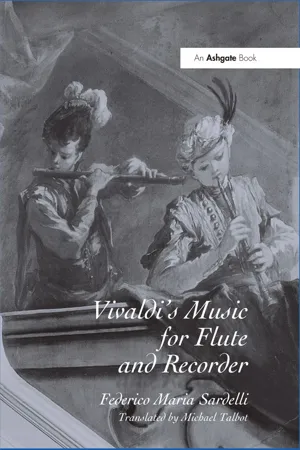
Federico Maria Sardelli writes from the perspective of a professional baroque flautist and recorder-player, as well as from that of an experienced and committed scholar, in order to shed light on the bewildering array of sizes and tunings of the recorder and transverse flute families as they relate to Antonio Vivaldi's compositions. Sardelli draws copiously on primary documents to analyse and place in context the capable and surprisingly progressive instrumental technique displayed in Vivaldi's music. The book includes a discussion of the much-disputed chronology of Vivaldi's works, drawing on both internal and external evidence. Each known piece by him in which the flute or the recorder appears is evaluated fully from historical, biographical, technical and aesthetic standpoints. This book is designed to appeal not only to Vivaldi scholars and lovers of the composer's music, but also to players of the two instruments, students of organology and those with an interest in late baroque music in general. Vivaldi is a composer who constantly springs surprises as, even today, new pieces are discovered or old ones reinterpreted. Much has happened since Sardelli's book was first published in Italian, and this new English version takes full account of all these new discoveries and developments. The reader will be left with a much fuller picture of the composer and his times, and the knowledge and insights gained from minutely examining his music for these two wind instruments will be found to have a wider relevance for his work as a whole. Generous music examples and illustrations bring the book's arguments to life.
Trusted by 375,005 students
Access to over 1.5 million titles for a fair monthly price.
Study more efficiently using our study tools.
Information
Subtopic
MusicaPART I
THE RECORDER AND FLUTE IN ITALY IN VIVALDI’S TIME
Chapter 1
The Emancipation of the Recorder and Flute
It is hard to trace the history of flutes (of all types) and their performers in Italy during the first half of the eighteenth century. Following a practice that in Italy persisted up to the 1770s or thereabouts, flautists were equated almost totally with oboists and were identified as such. This lack of precise identification stemmed from a long tradition of polyinstrumentalism that only at the end of the century began to give way to a separation of the function and idiom of each instrument, due in part to the crystallization of the classical orchestra, in which flute and oboe parts, entrusted to different players, were heard simultaneously. However, even as early as the first years of the eighteenth century some of these woodwind players – in Italy as elsewhere – achieved recognition for their merits as performers on the flute or recorder (in Italian the single, generic term flauto denotes both instruments equally) and became virtuosos of the instrument who disseminated works especially written for it. Such players included most notably Michel de La Barre and his successor Jacques Hotteterre ‘Le Romain’, Michel Blavet, Jacques Lœillet, Johann Joachim Quantz, Giovanni Platti and Giovanni Battista Ferrandini. Between the last years of the seventeenth century and the first years of the eighteenth there emerged in France a distinct fashion for the flute. In 1707 we find Hotteterre openly referring to this vogue in justification of his new treatise:
| Comme la Flute Traversiere, est un Instrument des plus agréables, & des plus à la mode, j’ay cru devoir entreprendre ce petit ouvrage.1 | Since the transverse flute is among the most pleasant and fashionable of instruments, I thought it my duty to undertake this short work. |
In Italy, on the other hand, the flute’s emancipation from the domination of the oboe seems, to judge from the infrequency of mentions of early flautists or of works written for their instrument, to have lagged behind in comparison with France or Germany. Nikolaus Delius writes:
| La penuria di notizie sui flautisti in Italia non induca però a pensare che non ve ne fossero. Innanzitutto bisogna considerare che i suonatori di legni acuti erano, nelle orchestre, primariamente degli oboisti che, all’occorrenza, potevano passare al flauto. Era normale chiamare oboisti questi musicisti. […] Contrariamente alle importanti famiglie di oboisti (Besozzi, Sammartini, Ferlendis), il flauto in Italia non ha, inizialmente, alcun rappresentante di fama.2 | The sparseness of references to flautists in Italy should nevertheless not lead to a conclusion that there were none. One must remember, first, that players of high woodwind instruments in orchestras were generally oboists who, when the occasion demanded, could switch to the flute. It was normal to call such players ‘oboists’. […] In contrast to the prominent dynasties of players of the oboe (Besozzi, Sammartini, Ferlendis), we initially find, in Italy, no leading champion of the flute. |
Although we are ignorant of the names of many of the earliest virtuosos, there is no lack, going back as far as the last years of the seventeenth century, of occasions on which the recorder or the flute was used as an autonomous, named instrument. From 1698, the transverse flute appears in musical performances given by the Ruspoli household,3 and from that moment onwards, the flute – almost always in its transverse form – appears in numerous Roman academies, and especially in connection with the festivities accompanying the competitions sponsored by the Accademia del Disegno di San Luca.4 Among the concertos by Giuseppe Valentini preserved today at Manchester in the Henry Watson Music Library we find a ‘Concerto con VV. Obuè e Flauti’ and a ‘Concerto con Flauti è Violini è Corni da Caccia a bene placito’.5 These works may well go back to a period, in the years leading up to 1714, when the composer held an appointment in the cappella of Michelangelo Caetani, Prince of Caserta. This supposition is supported by Valentini himself, who in sonnets of his own composition accompanying his Concerti grossi, Op. 7, of 1710 writes of the ‘Suono di Flauto, & Oboe’ (playing of the flute [and/or recorder] and oboe) at the Prince’s court.6 Likewise originating from the Roman orbit are the works for recorder – and the first for transverse flute to have a confirmed Italian origin – by Niccold Francesco Haym,7 as well as the extensive repertory for the recorder by Robert Valentine alias Roberto Valentini.8 From these early mentions it is evident that both instruments were commonly employed in Italy, even if their players were invariably identified as oboists. A case in point is the performance of Handel’s oratorio La resurrezione (Rome, 1708), whose score requires two flutes and two recorders, but of whose players no trace exists in the payment lists, which mention only four oboists.9
Notes
1Jacques Hotteterre ‘Le Romain’, Principes de la flute traversiere, ou flute d’Allemagne […], Paris: C. Ballard, 1707, Preface.
2Nikolaus Delius, ‘Note sulla tecnica e sulla musica flautistica nel ’700 in Italia’, Bollettino della Società Italiana del Flauto Traverso Storico, 1, 1998, 6–14, at 7.
3Saverio Franchi has recently discovered documents that establish the presence in Rome of Jacques Hotteterre, whom the Ruspoli family employed as a flautist between October 1698 and July 1700 alongside the Neapolitan flautist and composer Domenico Laurelli. See Saverio Franchi, ‘Il principe Ruspoli: l’oratorio in Arcadia’, in idem (ed.), Percorsi dell’oratorio romano. Da ‘historia sacra’ a melodramma spirituale, atti della giornata di studi (Viterbo, 11 settembre 1999), Rome: IBIMUS, 2002, pp. 246–316, at 280–81.
4See: Hans Joachim Marx, ‘Die “Giustificazioni della casa Pamphilij” als musikgeschichtliche Quelle’, Studi musicali, 12, 1983, 121–87; Ursula Kirkendale, ‘The Ruspoli Documents on Handel’, Journal of the American Musicological Society, 20, 1967, 222–73; Franco Piperno, ‘Anfione in Campidoglio. Presenza corelliana alle feste per i concorsi dell’Accademia del Disegno di S. Luca’, in Sergio Durante and Pierluigi Petrobelli (eds), Nuovissimi studi corelliani. Atti del Terzo Congresso Internazionale (Fusignano, 4–7 settembre 1980), Florence: Olschki, 1982, pp. 151–208.
5See Paul J. Everett, The Manchester Concerto Partbooks, New York and London: Garland, 1989; these are the concertos numbered 28 and 51, respectively, in Everett’s catalogue.
6The question of the scoring and destination of Valentini’s concertos with wind instruments is discussed by Everett (op. cit.) and also in Michael Talbot, ‘A Rival of Corelli: the Violinist-Composer Giuseppe Valentini’, in Sergio Durante and Pierluigi Petrobelli (eds), Nuovissimi studi corelliani, pp. 347–65, as well as in Enrico Careri, ‘Giuseppe Valentini (1681–1753). Documenti inediti’, Note d’archivio per la storia musicale, n.s., 5, 1987, 69–125. The present state of knowledge is summarized in Stefano La Via, ‘Il Cardinale Ottoboni e la musica’, in Albert Dunning (ed.), Intorno a Locatelli, Lucca: Libreria Musicale Italiana, 1995, pp. 319–526, at 361–63.
7The son of a German astronomer, Haym was born in Rome and worked there as a composer and cello virtuoso up to 1701. His Sonate à tre, cioè violini, flauti, violoncello e basso per il cembalo came out in 1704 from Estienne Roger in Amsterdam. The subsequent VISonate da camera a flautotraversa [sic], hautbois o violino solo di N.F. Haym e M. Bitti (Amsterdam: E. Roger [1708–12]), constitute the first Italian collection for the transverse flute ever to achieve publication.
8Disguising his English origin, Robert Valentine naturalized himself as ‘Valentini’, giving his name on the title-pages of his compositions as ‘Roberto Valentini, Inglese’ in order to avoid confusion with other composers called Valentini, the most famous of whom was Giuseppe, born in Florence, but who included also a Francesco and a Francesco Antonio. Valentine’s ten published opera for recorder (or, in one instance, transverse flute) testify to the vitality of these instruments in early-eighteenth-century Italy.
9See Kirkendale, ‘The Ruspoli Documents on Handel’, 257.
Chapter 2
Straight and Cross Flutes
It has to be recognized straight away that in Italy, during the first three decades of the eighteenth century, the term ‘flauto’ means, almost automatically, the ‘straight’ flute, or recorder. This practice stands in stark contrast to that in Germany and France. In Dresden – to cite a no...
Table of contents
- Cover
- Half Title
- Title Page
- Copyright Page
- Table of Contents
- List of Plates
- List of Tables
- List of Numbered Music Examples
- Preface
- Translator’s Note
- Conventions and Abbreviations
- Part I: The Recorder and Flute in Italy in Vivaldi’s Time
- Part II: Vivaldi’s Music for Recorder and Flute
- Inventory of the Works for Recorder and Flute by Antonio Vivaldi
- Bibliography
- General Index
- Index to the Vivaldi Works Mentioned
Frequently asked questions
Yes, you can cancel anytime from the Subscription tab in your account settings on the Perlego website. Your subscription will stay active until the end of your current billing period. Learn how to cancel your subscription
No, books cannot be downloaded as external files, such as PDFs, for use outside of Perlego. However, you can download books within the Perlego app for offline reading on mobile or tablet. Learn how to download books offline
We are an online textbook subscription service, where you can get access to an entire online library for less than the price of a single book per month. With over 1.5 million books across 990+ topics, we’ve got you covered! Learn about our mission
Look out for the read-aloud symbol on your next book to see if you can listen to it. The read-aloud tool reads text aloud for you, highlighting the text as it is being read. You can pause it, speed it up and slow it down. Learn more about Read Aloud
Yes! You can use the Perlego app on both iOS and Android devices to read anytime, anywhere — even offline. Perfect for commutes or when you’re on the go.
Please note we cannot support devices running on iOS 13 and Android 7 or earlier. Learn more about using the app
Please note we cannot support devices running on iOS 13 and Android 7 or earlier. Learn more about using the app
Yes, you can access Vivaldi's Music for Flute and Recorder by Michael Talbot,Federico Maria Sardelli in PDF and/or ePUB format, as well as other popular books in Mezzi di comunicazione e arti performative & Musica. We have over 1.5 million books available in our catalogue for you to explore.