- 648 pages
- English
- ePUB (mobile friendly)
- Available on iOS & Android
eBook - ePub
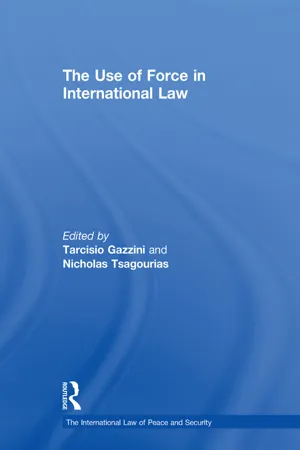
The Use of Force in International Law
About this book
This volume of essays examines the development of political and legal thinking regarding the use of force in international relations. It provides an analysis of the rules on the use of force in the political, normative and factual contexts within which they apply and assesses their content and relevance in the light of new challenges such as terrorism, weapons of mass destruction and cyber-attacks. The volume begins with an overview of the ancient and medieval concepts of war and the use of force and then concentrates on the contemporary legal framework regulating the use of force as moulded by the United Nations Charter and state practice. In this regard it discusses specific issues such as the use of force by way of self-defence, armed reprisals, forcible reactions to terrorism, the use of force in the cyberspace, humanitarian intervention and the responsibility to protect. This collection of previously published classic research articles is of interest to scholars and students of international law and international relations as well as practitioners in international law.
Part I
Ancient-Medieval
[1]
War, Peace, and International Law in Ancient Greece
Greek Civilization begins with a great poem celebrating war, the Iliad. This work’s strength and beauty emanate largely from the fact that Homer does not hide the terrible face of the conflict between Achaeans and Trojans. Heroes fight and die on the battlefront before the walls of Ilium, the city which will one day be taken amidst a bath of blood. But all is not tragedy and pain in this hermeneutically inexhaustible story. The bard reserves the poem’s final song to relate an act of reconciliation that belongs among the most moving and inspiring in world literature. Under the cover of night, King Priam, a desolate and unarmed old man, approaches Achilles’ tent as a suppliant, with the consent of the gods, to reclaim, for appropriate burial and funerary rites, the body of his son Hector, whom Achilles still keeps as testimony of his victory and vengeance. Overcoming his legendary wrath, Achilles concedes to Priam’s supplication with a display of recognition and pity. The work thus concludes with a funeral celebrating the fallen hero, the greatest of the Trojans, and according him a measure of poetic justice that cannot but bring us a sense of relief.
George Steiner (1984: 242–43) says that
The more one experiences ancient Greek literature and civilization, the more insistent the suggestion that Hellas is rooted in the twenty-fourth Book of the Iliad. There are not many primary aspects of Greek moral, political, rhetorical practice which are not incipient in and, indeed, given unsurpassed imaginative formulation by, the night encounter of Priam and Achilles and the restoration of Hector’s body. Much of what Greek sensibility knew and felt about life and death, about acceptance of tragic fate and the claims of mercy, about the equivocations of intent and of mutual recognition which inhabit all speech between mortals, is set out in this climactic, most perfect part of the epic.
There is, of course, an essential harmony between this song and Sophocles’ Antigone, that pinnacle of Hellenic tragedy in the Classical Period. But three centuries before Sophocles, the singers of tales already understood that all military confrontations must obey a set of limits and rules, for as Antigone puts it, men are obliged to respect the unwritten and unfailing statutes of divine law (Ant. 454–55). And they are also compelled to search for reconciliation, provisional or definitive, beyond the imperatives of war.
Interestingly, the Iliad’s conclusion contains, along with Achilles’ return to civilized order (to humanitas, as a reader of Cicero would have said), a complete retraction of his earlier position, when, at the culminating moment of his duel with Hector, he had rejected any accord with his opponent. The proposal the Trojan leader had offered conformed to a fundamental principle of the Greek code of war:
But come here, let us call the gods to witness, for they will be the best witnesses and guardians of our covenants: I will do you no violent maltreatment if Zeus grants me strength to endure and I take your life; but when I have stripped from you your glorious armor, Achilles, I will give your dead body back to the Achacans; and so too do you (Il. 22.254–59).
Achilles’ immediate response had been a vow to fight to the bitter end:
Hector, talk not to me, curse you, of covenants. As between lions and men there are no oaths of faith, nor do wolves and lambs have hearts of concord but plan evils continually one against the other, so is it not possible for you and me to be friends, nor will there be oaths between us till one or the other has fallen, and glutted with his blood Ares (22.261–67).
In other words, Achilles had announced that his personal conflict with this enemy, the killer of Patroclus, was situated at the margins of culture, in a natural state of brute force and simplicity, unmediated by cultural norms, and dominated by blind formlessness and moral chaos. The emblem of this chaos within the Iliad, as James Redfield has indicated (1975: 183), is the anti-funeral: the dead are stripped and left to the scavengers, “a prey to dogs and a feast for birds” (Il. 1.4–5).
Both the Iliad and the Odyssey conclude with scenes of reconciliation fostered by the gods who for their part have had to make an effort to overcome their own differences about the fates of the mortals. In the first poem, the private compromise between the two leaders has no political or military consequences, as it is limited to the retrieval of Hector’s body, and does not end the hostilities (although it does serve symbolically to reaffirm the civilized condition of Achilles – that almost superhuman, ambiguous son of a god and a mortal). In the case of Odysseus, as we shall see shortly, the avenger’s pact with the dead suitors’ relatives will once again bring peace (eirene) and prosperity to Ithaca or, if we prefer, the end of civil discord (stasis) and the deactivation of the logic of vendetta (which is further complicated in this case by its international ramifications). Both episodes might be read as metaphors of Greek political history in its totality. In effect, the dynamics of war – with its multiple ways of suspending and overcoming conflict – along with the precariousness of peace, in the framework of intra-communal and inter-Hellenic dissensions, constituted the great argument of this history, from the Homeric epic to the Hellenistic period.1
The Institutionalization of International Relations: Friendship, War, and Reconciliation
War represented a structural component of the Greco-Roman world, as much or more than slavery or agriculture; from Herodotus to Xenophon and from Thucydides to Polybius, Greek historiography is above all political-military history. Any college graduate with a degree in Classical Studies understands this fact, and there are even surveys that elucidate for us the chain of conflicts to the end of the Hellenistic Period.2 It is important, however, not to oversimplify the complexity of international relations by generalizing on the basis of its most dynamic actors, that is, precisely those the extant historical sources inform us about. Hellenic communities found themselves involved in armed conflicts in a variety of ways, a crucial fact which unfortunately remains insufficiently emphasized in the most recent studies on Greek political history. There were many poleis and federal states (koina) that found a way to keep themselves out of the great confrontations, pursuing a policy of neutrality (Alonso 1987, 2001), or concluding compromises with Greek superpowers (as did the Aegean cities of the Delian League, who freed themselves from military service in exchange for a monetary contribution), or even waging an indirect war. Argos and Corcyra offer well-known examples of abstinence from war during most of the fifth century, as do Megara in the fourth or Rhodes and Athens in some periods of the Hellenistic era (Habicht 1997: 173ff.). Prior to the prominent role it would play in the second half of the third century, the Achaean Confederacy presented an enviable case of splendid isolation. There were entire regions, like Aetolia, Epirus, or Crete, that refused to participate in the great conflagrations of the classical age, anchored as they were in policies of neutrality and non-alignment which do not lack certain present-day analogues. The same could be said for the colonial world occupied by Greek cities – Libya, the Black Sea region, Magna Graecia. Certainly, many of these areas experienced periods of hostilities of a more or less local character, but the fact is that these cannot have been important enough for our historical sources to pay them much attention.
We should therefore remain critical toward generalizations and occasional phrases on the phenomenon of war that we read in the works of some Greek philosophers (Phillipson 1911: 167–68, 173). They thought that war should be considered a natural and inevitable state inherent in both human and animal life on earth. Heraclitus called war the father of all things, in the sense that it is the fundamental principle causing all change and development (22 B53 in Diels and Kranz 1961). And so Cleinias, at the beginning of Plato’s Laws (626a), addressing the Athenians on the subject of Cretan institutions and assuming that strife is inevitable for attaining political exclusiveness and national self-realization, says: “In reality every city is in a natural state of war with every other, not indeed proclaimed by heralds, but perpetual.” In the “Melian Dialogue,” the Athenian ambassadors, not without sophistry, say that the rule of the strongest, operative in nature, always prevails over law in governing relations between peoples. That well-known discussion between Melians and Athenians (Thucydides 5.84–116) might induce us to conclude that the Law of the Jungle defined interstate relations in Hellas. Yet not even those most convinced of the prevalence of a naturalist ideology of war among the Greeks (like Momigliano 1960) would be willing to subscribe to this conclusion. The problem with such sharp and doctrinary pronouncements, typical of Greek theoretical thinking (although less of historiography), is that they have contributed to confusing modern authors.3
Here it is necessary to mention Bruno Keil (1916: 5ff.). In a celebrated study, he defended the idea that during the first centuries of Greek history peace was nothing but a contractual interruption of the normal state of war between the poleis, little more than a respite, and that after the expiration of an international treaty the parties returned automatically to their natural situation of “war of all against all” (bellum omnium contra omnes). A decisive point for Keil was the fact that the word eirene did not emerge as a legal term in diplomatic language until the fourth century, with the ...
Table of contents
- Cover
- Half Title
- Title Page
- Copyright Page
- Table of Contents
- Acknowledgements
- Series Preface
- Introduction
- Part I Ancient-Medieval
- Part II League of Nations Era
- Part III United Nations Era
- Part IV Terrorism, Weapons of Mass Destruction and Information Warfare
- Part V Humanitarian Intervention and the Responsibility to Protect
- Name Index
Trusted by 375,005 students
Access to over 1.5 million titles for a fair monthly price.
Study more efficiently using our study tools.
Frequently asked questions
Yes, you can cancel anytime from the Subscription tab in your account settings on the Perlego website. Your subscription will stay active until the end of your current billing period. Learn how to cancel your subscription
No, books cannot be downloaded as external files, such as PDFs, for use outside of Perlego. However, you can download books within the Perlego app for offline reading on mobile or tablet. Learn how to download books offline
Perlego offers two plans: Essential and Complete
- Essential is ideal for learners and professionals who enjoy exploring a wide range of subjects. Access the Essential Library with 800,000+ trusted titles and best-sellers across business, personal growth, and the humanities. Includes unlimited reading time and Standard Read Aloud voice.
- Complete: Perfect for advanced learners and researchers needing full, unrestricted access. Unlock 1.5M+ books across hundreds of subjects, including academic and specialized titles. The Complete Plan also includes advanced features like Premium Read Aloud and Research Assistant.
We are an online textbook subscription service, where you can get access to an entire online library for less than the price of a single book per month. With over 1.5 million books across 990+ topics, we’ve got you covered! Learn about our mission
Look out for the read-aloud symbol on your next book to see if you can listen to it. The read-aloud tool reads text aloud for you, highlighting the text as it is being read. You can pause it, speed it up and slow it down. Learn more about Read Aloud
Yes! You can use the Perlego app on both iOS and Android devices to read anytime, anywhere — even offline. Perfect for commutes or when you’re on the go.
Please note we cannot support devices running on iOS 13 and Android 7 or earlier. Learn more about using the app
Please note we cannot support devices running on iOS 13 and Android 7 or earlier. Learn more about using the app
Yes, you can access The Use of Force in International Law by Nicholas Tsagourias, Tarcisio Gazzini in PDF and/or ePUB format, as well as other popular books in Law & International Law. We have over 1.5 million books available in our catalogue for you to explore.