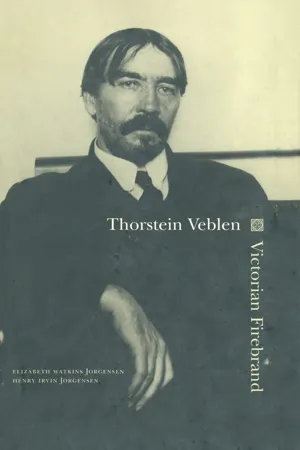
- 320 pages
- English
- ePUB (mobile friendly)
- Available on iOS & Android
eBook - ePub
About this book
A definitive biography of the man who coined the expression "conspicuous consumption". Based on newly released archival sources, this book sets the facts straight on more than 60 years of myths and misinformation concerning the highly regarded economist and sociologist.
Tools to learn more effectively

Saving Books

Keyword Search

Annotating Text

Listen to it instead
Information
1
Introduction
Thorstein Veblen, a dangerous man, challenged the eternal verities of America at the turn of the century. His Theory of the Leisure Class, which came out in 1899, is still in print and will be in print at the turn of another century. Although his ideas were shocking to the Victorian-era conscience, they are no less shocking to many today, because they undermine the consumerist values inherent in the great American rat race.
Albert Einstein said Veblen was the only contemporary scientific writer, other than Bertrand Russell, to whom he owed “innumerable happy hours.”1
For a century America has been in denial about Veblen’s ideas. They conflicted with the “American dream” of “winning” through perching atop a mountain of expensive possessions and becoming the envy of the neighbors. They conflicted with the American golden rule to love thy neighbor as thyself, although you may have to knife him to get to the top. Veblen’s piercing insights were incompatible with the old-fashioned dream. It was easier to dismiss Veblen as a wacky eccentric, a womanizer, and a lecher.
Along with Mary Wollstonecraft, Henrik Ibsen, Edward Bellamy, Alexandre Dumas the younger, and John Stuart Mill, Veblen condemned the modern oppression of women. He scorned the idea that an upper-class woman’s place was to be a parlor ornament and a clothes horse, to show off her rich husband’s exemplary financial status. Like Ibsen, he understood women’s desire to have absorbing work to do on their own. In fact, he felt that women were superior beings who had been unappreciated down through the ages. It is time that this part of Veblen’s thinking be emphasized, as it has been largely overlooked.
Since he is a lost man, buried underneath a sanitary landfill of lies and half-truths, the information that has recently been made available about him in the archives of Columbia University, the University of Chicago, and Carleton College should be assessed.
These give us a new picture of Veblen. Yes, he was tall, muscular, and darkly handsome. Yes, he was extremely attractive to women. But was he the sexual adventurer portrayed by John dos Passos, and many of Veblen’s modern followers, who seem to have accepted this version of his intimate life?2 Or was he a Christ-like visionary pilloried and persecuted by an eccentric harpy who played by Victorian procrustean bed rules? Or, again, could he be more accurately likened to a hero in an old Norse myth—one who, as Edith Hamilton puts it in her book, Mythology, “laughs while his foes cut his heart out of his living flesh [and thus] shows himself superior over his conquerors.” He says to them in effect, “You can do nothing to me, because I do not care what you do.”
So perhaps the conventional economists have obliterated Veblen and his challenging ideas, but is he safely dead? Could he still be laughing at us somehow? Will his ideas continue to haunt us for another 100 years?
2
University of Chicago Beginnings
Thorstein Veblen, the Columbian Exposition, and the new University of Chicago were launched almost simultaneously.1 The fair and the university were to usher “a new era into Chicago.” Veblen eventually was to usher in a new era in thinking. The flamboyant exposition contrasted painfully with the somber university, which was built of grey limestone in the English Gothic style. The Divinity School was still being erected only a few hundred yards from the ferris wheel and the “Street in Cairo” with its gyrating belly-dancers. The tawdriness of the Midway contrasted strangely with the pristine grey towers symbolizing a medieval-like withdrawal from the world of the flesh.
The fair was popularly called “The White City” as most of the exhibition buildings were white and some were vast.
They showed, according to writers Robert Herrick and Theodore Dreiser, that America prized beauty as much as big money and raw power, and that if America put its mind to it, it could come out on top in the fields of art and architecture, too. The fair proved that American life did not have to be ugly, makeshift, and haphazard—America could darned well accomplish whatever it set its sights on!2
One of the keynotes of the fair was the existence of the Woman Building, designed by women. It housed “evidences of women’s abilities.” “For the first time,” it was said, “Woman publicly came into her own.”3 “Woman’s hour has struck,” as one speaker put it.4
How little the oratory was based on reality was shown by the fact that the University of Chicago, which opened “to six hundred students of both sexes, with an endowment of… seven millions of dollars” (founded by John D. Rockefeller, who contributed $35 million to the university over a period of twenty years), had no dormitories at all for women students. “The Woman’s Club [of Chicago] at once collected funds for the construction of a building which contained] not only sleeping-rooms but parlors, a large hall, a dining room, library and gymnasium.”5 So much for the year of the woman!
Unfortunately, in 1893, Chicago was gripped by a deep depression. Never a clean or lovely site from the beginning, the city seemed disreputable and a shambles compared to the white walls and towers of the Columbian Exposition. Many visitors were, to say the least, unfavorably impressed.
After the fair closed, several thousand souvenir hunters vandalized the grounds. The next day, a large number of unemployed or homeless, who had been occupying some of the empty buildings, started a fire, whether by accident or design. It spread from building to building. “It was,” the Chicago Tribune said, “the greatest pyrotechnic display of the Fair, lighting up the area like a midsummer’s day at noon.” Twenty thousand spectators stood around gaping and applauding, especially when statuary fell into the “icy lagoon … The statue of the Republic ‘seemed to stand in the midst of it all like a giant silhouette, with uplifted arms as if appealing for help. The wind blew furiously, and now and then made great rifts in the smoky wall, revealing the blood red skeleton of arch and column.”6
“Herrick wrote, ‘The skeleton that had been heroically shoved into the closet all that summer, the skeleton of financial panic, now stalked forth. There were unemployed men by the hundreds of thousands in the cold streets that cold winter and even the prosperous citizens were quaking in the throes of ‘hard times.’”7 Homeless people were sleeping on the steps of the city hall and the floors of the police stations.
In 1894, Coxey’s Army marched on Washington, DC. These jobless troops from all over the West were composed, some said, of hoboes, tramps, radicals, and foreign immigrants. Thirteen of the “armies” started out for Washington. On top of this there was the Pullman strike. George Pullman, president of the Pullman Palace Car Company, had reduced wages to 75 percent of the previously paid amount, but had not decreased the rents paid by the workers in his company housing. The strike cut the number of unobstructed rail lines entering Chicago from twenty-four to six. Chicago trade was in deadlock.
With all this going on, the university students were looking for answers, or at least some new way to solve old problems. Maude Radford Warren, later a well-known novelist, described a university scene that contrasted markedly with the turmoil downtown: “I remember … the first time I saw him. I was an undergraduate, walking along Cottage Grove Avenue with a friend who said, ‘There is Veblen.’ Mr. Veblen was walking in the center of a body of six students and I’ll never forget those silhouettes: they were all poking their heads forward, eager to lose not a word.”8
The younger instructors became instant Veblenites, and “the older ones [also became Veblenites] as fast as they could adjust themselves.”9 “We thought he had hidden resources,” a woman student wrote, “too precious for everyday life—but no one got very near to him… manifestly, he knew his power.”10
One student in Veblen’s Chicago classroom described the effect his lectures had on him:
Although his genius was largely ill-expended on my then 18-year-old immaturity, I distinctly recall that [the student next to me] used to commonly nudge me in class hours at the time of a particularly telling thrust (and they were rapier-like) that Veblen had just delivered, and [my classmate] would whisper usually: “Isn’t he a keen boy?” or something to that effect.
Professor Veblen (we never called him doctor, as I recall it) then looked the part of a thorough-bred scholastic. He looked as if he had an odor to him of his subject. He was steeped in it. He droned in his speech and never rocked from an even keel of steady and easy discourse. He was a master mind. In appearance he was lean, brown and bearded to an almost Van Dyke style. There was nothing studied in his make up. His charm lay in a natural grace. He had vigor without effort, ease without languor … He lounged in his chair on a raised platform in front of our class of 3 or more students and seemed to coin his words as they came, nothing from memory, no cut and dried fossilized jewels of economic lore from some other master of economic laws. He discovered his as he went along.
… I sat in class in rapt… attention. His periods and demeanor were not to be lost by gluing one’s eyes to his notebook in transcription. He was not oratorical, far from bombastic, nothing of a so-called radical and never dreamed of sensationalism … He was always a star and his light will never dim.11
Another student was delighted, because Veblen would come to class looking wan and dragged out from a long night’s work, heave a weighty tome of some obscure German text on the desk, and turn the pages
with nervous yellow fingers. In a low croaking tone he began a recital of village economy among the early Germans. Presently he came upon some unjust legal fiction imposed by rising nobles and sanctioned by the clergy. A sardonic smile twisted his lips, blue devils leaped in his eyes. With mordant sarcasm, he dissected the tortuous assumption that the wish of aristocrats is the will of God. He showed similar implications in modern institutions. He chuckled quietly. Then, returning to history, he continued the exposition.12
Veblen had become a “character,” a wonderful campus character, and as such, among the students, was beloved and cherished.
This was his first job teaching in a college. When the new president of the rich, new university raided the eastern colleges to set up a faculty that would give Chicago instant status as a rival of the best of the Ivy League, he grabbed, among others, J. Laurence Laughlin, head of the Economics Department at Cornell. Laughlin, who recognized talent when he saw it, even though coming from one who listened to a different drummer, brought along his promising student, Veblen, starting him out on the lowest academic rung at less than $600 a year. Soon, however, Laughlin decided that, with all the controversy arising over day-to-day economic events on the labor front, his department should have a course on socialism, and he assigned Veblen the job of teaching it. It was later said that Veblen was “the only man who would be permitted to lecture on socialism at the University of Chicago.”
“This was partly a joke,” said ex-student Harriet Bement, “but not entirely so, for Dr. Veblen was ‘safe’ in that he expressed himself with the greatest impartiality on any radical economic doctrine, in class, certainly, and I do not recall it differently in private conversation. He represented both sides and argued both sides and left you to make your choice”13 His course on socialism was as concerned with anthropology, prehistoric man and woman, Icelanders, Vikings, medieval history, and Darwin’s theories as it was with the present day.
Later, an ex-Missouri student, Isador Lubin, said: “Regarding Veblen’s economic philosophy … I never saw evidence of animus or personal dislike of the economic system or of the people who ran the system … Capitalism to him was a system which he was trying to analyze as a scientist would analyze a rock of a certain geologic age, or a doctor or physiologist would analyze the human body to see how it functioned.”14 In analyzing socialism he had a similarly detached attitude.
A Chicago student wrote:
The one statement which he emphasized very strongly, and which is not found in any of his books, was that socialism was impossible until the desire for the common good could be substituted in the mind of the common man (which is everyone) for the desire for private advantage at the expense of whomever it might concern. I also remember his stating that at the present rate of progress he thought at least a thousand years would be required to make the substitution.”15
Still, there were those who felt that this pesky new socialism should be ignored until it went away, such as the president of the university, William Rainey Harper. The tone at Chicago was somewhat Baptist, as one-third of the board of trustees were Baptists and the university was supposedly a continuation of the old “Baptist University of Chicago.”16 Harper was head of the theology dep...
Table of contents
- Cover
- Half Title
- Title
- Copyright
- Contents
- Acknowledgments
- Photos
- 1. Introduction
- 2. University of Chicago Beginnings
- 3. The Immigrants
- 4. Carleton
- 5. Tampering with the Sacrament
- 6. Student Relations
- 7. Miss Hardy
- 8. “The Wind on the Heath”
- 9. “The Wind on the Heath Has Fallen Dead”
- 10. Chicago, 1896-1899
- 11. A Book to Be Read for Amusement?
- 12. Triggs and Mrs. Triggs
- 13. Out of Chicago
- 14. The Comer of Indecision
- 15. Stanford
- 16. Where the Rolling Foothills Rise
- 17. A Dossier of Positive Statements
- 18. His Last Few Days of Honor and Competence
- 19. The Station to Nowhere
- 20. Miss Havisham Takes the Stand
- 21. Happily Ever After
- 22. World War I Ends
- 23. A Land Where Even the Old Are Fair?
- 24. “I Will Arise and Go Now”
- 25. After All
- Appendix
- Notes
- Bibliography
- Index
- About the Authors
Frequently asked questions
Yes, you can cancel anytime from the Subscription tab in your account settings on the Perlego website. Your subscription will stay active until the end of your current billing period. Learn how to cancel your subscription
No, books cannot be downloaded as external files, such as PDFs, for use outside of Perlego. However, you can download books within the Perlego app for offline reading on mobile or tablet. Learn how to download books offline
Perlego offers two plans: Essential and Complete
- Essential is ideal for learners and professionals who enjoy exploring a wide range of subjects. Access the Essential Library with 800,000+ trusted titles and best-sellers across business, personal growth, and the humanities. Includes unlimited reading time and Standard Read Aloud voice.
- Complete: Perfect for advanced learners and researchers needing full, unrestricted access. Unlock 1.4M+ books across hundreds of subjects, including academic and specialized titles. The Complete Plan also includes advanced features like Premium Read Aloud and Research Assistant.
We are an online textbook subscription service, where you can get access to an entire online library for less than the price of a single book per month. With over 1 million books across 990+ topics, we’ve got you covered! Learn about our mission
Look out for the read-aloud symbol on your next book to see if you can listen to it. The read-aloud tool reads text aloud for you, highlighting the text as it is being read. You can pause it, speed it up and slow it down. Learn more about Read Aloud
Yes! You can use the Perlego app on both iOS and Android devices to read anytime, anywhere — even offline. Perfect for commutes or when you’re on the go.
Please note we cannot support devices running on iOS 13 and Android 7 or earlier. Learn more about using the app
Please note we cannot support devices running on iOS 13 and Android 7 or earlier. Learn more about using the app
Yes, you can access Thorstein Veblen by Elizabeth Jorgensen,Henry Jorgensen in PDF and/or ePUB format, as well as other popular books in Business & Business General. We have over one million books available in our catalogue for you to explore.