- 182 pages
- English
- ePUB (mobile friendly)
- Available on iOS & Android
eBook - ePub
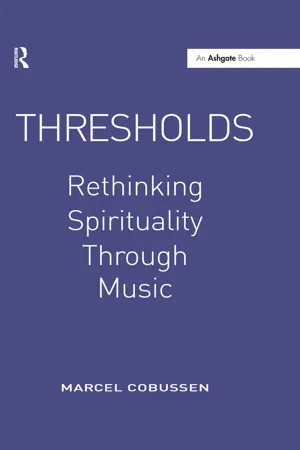
Thresholds: Rethinking Spirituality Through Music
About this book
In Thresholds Marcel Cobussen rethinks the relationship between music and spirituality. The point of departure is the current movement within contemporary classical music known as New Spiritual Music, with as its main representatives Arvo P John Tavener, and Giya Kancheli. In almost all respects, the musical principles of the new spiritual music seem to be diametrically opposed to those of modernism: repetition and rest versus development and progress, tradition and familiarity versus innovation and experiment, communication versus individualism and conceptualism, tonality versus atonality, and so on. As such, this movement is often considered as part of the much larger complex called postmodernism. Joining in with ideas on spirituality as presented by Michel de Certeau and Mark C. Taylor, Cobussen deconstructs the classification of the 'spiritual dimensions' of music as described above. Thresholds presents an idea of spirituality in and through music that counters strategies of exclusion and mastering of alterity and connects it to wandering, erring, and roving. Using the philosophy of Martin Heidegger, Georges Bataille, Jean-Fran's Lyotard, Jacques Derrida and others, and analysing the music of John Coltrane, the mythical Sirens, Arvo P and The Eagles (to mention a few), Cobussen regards spirituality as a (non)concept that escapes categorization, classification, and linguistic descriptions. Spirituality is a-topological, non-discursive and a manifestation of 'otherness'. And it is precisely music (or better: listening to music) that induces these thoughts: by carefully encountering, analysing, and evaluating certain examples from classical, jazz, pop and world music it is possible to detach spirituality from concepts of otherworldliness and transcendentalism. Thresholds opens a space in which spirituality can be connected to music that is not commonly considered in this light, thereby enriching the ways of approaching and discussing music. In orde
Trusted by 375,005 students
Access to over 1.5 million titles for a fair monthly price.
Study more efficiently using our study tools.
Information
Subtopic
MusicThreshold 1
The Desert in the Desert*
ON a dark desert highway, cool wind in my hair. Warm smell of colitas, rising up through the air. Up ahead in the distance, I saw a shimmering light. My head grew heavy, and my sight grew dim. I had to stop for the night. There she stood in the doorway; I heard the mission bell, and I was thinking to myself – this could be Heaven or this could be Hell. Then she lit up a candle, and she showed me the way. There were voices down the corridor; I thought I heard them say …1
you shake your head. Although a fresh breeze brushes against your face, its coolness is in vain. You are too tired. Your sight is no longer reliable; the eye/I is no longer in control. Everything becomes vague, unclear …
Everything? No, your ears are taking over. “The world is not for beholding. It is for hearing. It is not legible, but audible,” Jacques Attali already declared in 1977 (Attali 1985: 3).
The ears easily identify the sounds coming from a distance: a mission bell and – though less clear – some mysterious human voices. The bell and the voices mark a threshold, the boundary between here and there, a ‘there’ that can be almost anything: another or an unknown world, heaven or hell … The music represents itself as and presents itself at the juncture between the here and the there, the threshold where one sheds the mastery of the eye/I. Sounds have their own distinctive relational qualities in the placing and spacing of experiences. Can ‘Hotel California’ be understood as the recognition of sound as a modality of knowing and being in the world? Can this song make us rethink the meaning, nature, and significance of certain experiences, of certain values and firmnesses? Does interaction with the sonic material of ‘Hotel California’ offer new possibilities to address issues of place, identity, belonging, memory? …
‘Hotel California’ announces … announces what actually? The practice of interpretation fails, precisely in its indefinite dissemination.2 The song seems both to provoke and frustrate each interpretative pathway. It not only establishes itself within a difference in relation to all meaning; it produces its difference in making us believe that it contains hidden meaning. The lyrics lead one to suppose that one should understand something different from what one is given to hear … A diabolical temptation … To pretend to conceal is to seduce discourse, to give rise to it and simultaneously lead it astray. This is, however, precisely a way of positing otherness, the otherness of music, of outwitting interpretative colonizations, and of keeping, preserved from meaning, the pleasure of listening …
“Last thing I remember, I was running for the door. I had to find the passage back to the place I was before ...”3
The secret of ‘Hotel California,’ the secret of all music perhaps, is to make you believe that it possesses some sayable secret. But writing can never be an entrance of meaning into music, an entry by way of the nameable; that door is blocked. The meaning of music lies in the keeping-at-a-distance of writing, reading, interpreting …4
“You can check out any time you like, but you can never leave …”5
*The title of this Threshold comes from Jacques Derrida’s book Acts of Religion in which he states that the desert is an aporetic place, the most an-archic or an-archivable place: it is without a guaranteed entrance or way out, without a border region of which the map is predictable and the program is calculable. The ‘desert in the desert’ refers to a relation to the world, a relation to ‘the other,’ a spiritual relation perhaps, that is irreducible to knowledge, “there where one neither can nor should see coming what ought or could-perhaps-be yet to come. What is still left to come” (Derrida 2002: 47).
1 ‘Hotel California,’ Words & Music by Don Henley, Glen Frey & Don Felder © 1976 Cass County Music, Red Cloud Music and Fingers Music. All rights administered by Warner/Chappell Music Ltd, London W6 8BS. Reproduced by permission.
2 On the web you can find many interpretations of ‘Hotel California.’ The Eagles themselves do not give a decisive answer as to what the lyrics mean. In an interview, guitar player and vocalist Glenn Frey says: “It is just all one shot, not necessarily, you know, just sort of strung together, and you sort of draw your own conclusions from it. So we are sort of trying to expand our lyrical horizons and just try to take out something in the bizarre.”
3 ‘Hotel California,’ Words & Music by Don Henley, Glen Frey & Don Felder © 1976 Cass County Music, Red Cloud Music and Fingers Music. All rights administered by Warner/Chappell Music Ltd, London W6 8BS. Reproduced by permission.
4 For this short meditation, I am greatly indebted to Michel de certeau’s book The Mystic Fable, especially pp. 50–5.
5 ‘Hotel California,’ Words & Music by Don Henley, Glen Frey & Don Felder © 1976 Cass County Music, Red Cloud Music and Fingers Music. All rights administered by Warner/Chappell Music Ltd, London W6 8BS. Reproduced by permission.
Threshold 2
A Short Prelude to Music and Spirituality
YOU are on a threshold. The threshold of entering a book. And you have already crossed many before you arrived here; you have already dealt with many obstacles. It is impossible to say how many thresholds a book has: physical, psychological, economical, aesthetic, ethical, political, disciplinary, social, intellectual, cultural, temporal, and spatial ones (and all these on the levels of production, distribution, and reception) – the more you consider thresholds, the more of them you are aware of. Which is exactly one of the motivations for writing this book: to (re)think thresholds, to (re)think borders and limits, to (re)think the passage from one to the other, to pass through the passage, to stand still in and dwell upon the space between one and the other, between inside and outside, between here and there.1 Because that is where a threshold can be located – located in a non-place, an a-topos, a space between, borderline and middle simultaneously.2 a threshold – like a prelude – is a para-site: an undecided zone between inside and outside, neither here nor there, and, simultaneously, both here and there, both in and out. Inside and outside join and separate to form an undecidable play of perpetual displacement. The undecidability of the threshold’s identity eradicates any thinking in clear oppositions, any binary ordering. A threshold joins by separating and separates by joining.3 Furthermore, thinking thresholds means to abandon the idea that this ‘third term’ can ever be sublated by a dialectical method. The space between, the threshold, is the leaving of a remainder that cannot be thought within the framework of Western logocentrism, based on a dualistic logic; or, to state it more firmly, it is exactly what escapes this logocentric order. The book you are about to enter starts from the question: what does the preceding mean for our relation with music and spirituality.
This is what I have done: writing (on) thresholds. Thresholds in a twofold sense: on the one hand, a threshold is part of a necessary opening leading from one place to another, a point of passage, a site of invitation, a mark of hospitality, such as when a groom carries his bride across the threshold of his house; on the other hand, the threshold is a stumbling block, a signal of discontinuity, a border, a checkpoint that not everybody can simply pass through without a certain effort. Admission and impediment – both are at work here; the one and the other, the one in the other, inseparable. Thresholds are ambivalent, because they constitute the medium in which opposites are opposed; they are the movement, the locus, and the play: (the production of) difference.
You are on the threshold of entering a book. or are you already in? did you already pass one or more thresholds? and are others already appearing? known or unknown? Expected or unexpected? Easy or difficult thresholds?
Let us consider this book as a house, a hotel perhaps, a place with many rooms where you can roam endlessly, returning to earlier starting points, plotting new routes, but also pulling down certain walls and moving furniture from one room to another. o f course, you know that one does not necessarily gain access to a work of architecture by following the order of its production. you cannot even be sure that this house is built in the customary order, starting at its foundations and finishing at the roof ridge. Like so many others, this Prelude announces in the future tense (‘this is what you are going to read’) the conceptual content or significance of what will already have been written. in other words, from the viewpoint of this threshold (which is of course never the first one), which recreates an intention-to-say after the fact, the text exists as something written – a past – which, under the false appearance of a present, hidden, omnipotent author (in full mastery of his product), is presenting to you, the reader, as her or his future (Derrida 1981: 7). Time is always already out of joint when you enter a book. Like in music. Or in spirituality.
So, the book as a house, a hotel. With many rooms. And many occupants or temporary visitors. Many specters too: some hardly audible, others more prominently present even when they don’t raise their voice. Rooms with different signatures, different functions, different atmospheres, different colors. a nd different sounds: every room in this book-house has its own music. One could say that each room has a different timbre in a twofold way. First, the conversations that are going on are held by different visitors. While some of the participants appear in more than one room, they will have other interlocutors so that their contributions will generate new resonances and reverberations. Second, the atmosphere in every room is determined to a great extent by the music which indicates and influences the direction the discourse will take. Still, it all takes place in one house, in this house, albeit an open house.
The topic that connects these various contributions: thresholds! So, I must already recant my earlier statement concerning rooms, because the house you are about to enter, that you have already – perhaps without noticing – entered, seems to consist only of thresholds, or – a word Borges uses – ‘vestibules.’ The thresholds are discussed on thresholds: there are only thresholds here, only borders, only a middle. Only beginnings too: everything begins on a threshold. The question posed in this house is if we are ever actually able to cross a threshold to enter a room with stable walls and dimensions. perhaps we are always already condemned or invited to dwell on thresholds. Always on the way from the one to the other, from here to there, from now to later, that is, always detained, moving in a space between. Coming and going. Coming and going. Coming and going. Like music. Never there.
The threshold is an entrance, a beginning, which must not be confused with an origin. In one sense, every beginning has always already begun. In another sense, a beginning is unending.4 With origins erased and conclusions never come to, we are left to roam, wander, and err along a margin that is ever the ‘middest’ (M. Taylor 1984: 98). So here we are: in the middle, that is, on the sill of a book that is supposed to be about music and spirituality, spirituality in music, spiritual music, musical spirituality. Rethinking spirituality through music, rethinking music through spirituality.5 Which immediately raises the legitimate questions: what is meant by both music and spirituality, and, especially, by their mutual relation? What is this becoming spiritual of music and becoming musical of spirituality? How does one read these movements, this diagonally traversing of ...
Table of contents
- Cover
- Half Title
- Title
- Copyright
- Contents
- List of Music Examples and Tables
- Acknowledgements
- THRESHOLD 1 The Desert in the Desert
- THRESHOLD 2 A Short Prelude to Music and Spirituality
- THRESHOLD 3 Stories
- THRESHOLD 4 New Spiritual Music
- THRESHOLD 5 Between Heaven and Earth
- THRESHOLD 6 Sirens
- THRESHOLD 7 Language, Spirituality, Music
- THRESHOLD 8 Wanderings
- THRESHOLD 9 The Abyss
- THRESHOLD 10 Silence
- THRESHOLD 11 Listening to Music
- THRESHOLD 12 Para-spirituality
- THRESHOLD 13 The Bridge and the Laugh
- Bibliography
- Index
Frequently asked questions
Yes, you can cancel anytime from the Subscription tab in your account settings on the Perlego website. Your subscription will stay active until the end of your current billing period. Learn how to cancel your subscription
No, books cannot be downloaded as external files, such as PDFs, for use outside of Perlego. However, you can download books within the Perlego app for offline reading on mobile or tablet. Learn how to download books offline
We are an online textbook subscription service, where you can get access to an entire online library for less than the price of a single book per month. With over 1.5 million books across 990+ topics, we’ve got you covered! Learn about our mission
Look out for the read-aloud symbol on your next book to see if you can listen to it. The read-aloud tool reads text aloud for you, highlighting the text as it is being read. You can pause it, speed it up and slow it down. Learn more about Read Aloud
Yes! You can use the Perlego app on both iOS and Android devices to read anytime, anywhere — even offline. Perfect for commutes or when you’re on the go.
Please note we cannot support devices running on iOS 13 and Android 7 or earlier. Learn more about using the app
Please note we cannot support devices running on iOS 13 and Android 7 or earlier. Learn more about using the app
Yes, you can access Thresholds: Rethinking Spirituality Through Music by Marcel Cobussen in PDF and/or ePUB format, as well as other popular books in Media & Performing Arts & Music. We have over 1.5 million books available in our catalogue for you to explore.