eBook - ePub
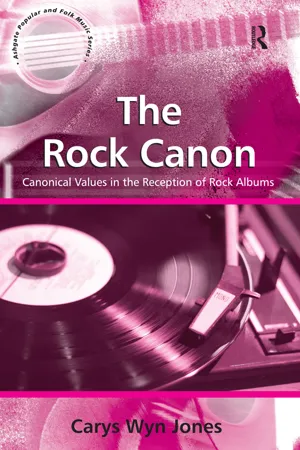
The Rock Canon
Canonical Values in the Reception of Rock Albums
- 182 pages
- English
- ePUB (mobile friendly)
- Available on iOS & Android
eBook - ePub
About this book
Canons are central to our understanding of our culture, and yet in the last thirty years there has been much conflict and uncertainty created by the idea of the canon. In essence, the canon comprises the works and artists that are widely accepted to be the greatest in their field. Yet such an apparently simple construct embodies a complicated web of values and mechanisms. Canons are also inherently elitist; however, Carys Wyn Jones here explores the emerging reflections of values, terms and mechanisms from the canons of Western literature and classical music in the reception of rock music. Jones examines the concept of the canon as theorized by scholars in the fields of literary criticism and musicology, before moving on to search for these canonical facets in the reception of rock music, as represented by ten albums: Bob Dylan's Highway 61 Revisited, The Beach Boys' Pet Sounds, The Beatles' Revolver, The Velvet Underground's The Velvet Underground & Nico, Van Morrison's Astral Weeks, Marvin Gaye's What's Going On, The Rolling Stones' Exile on Main St., Patti Smith's Horses, The Sex Pistols' Never Mind the Bollocks: Here's the Sex Pistols, and Nirvana's Nevermind. Jones concludes that in the reception of rock music we are not only trying to organize the past but also mediate the present, and any canon of rock music must now negotiate a far more pluralized culture and possibly accept a greater degree of change than has been evident in the canons of literature and classical music in the last two centuries.
Trusted by 375,005 students
Access to over 1.5 million titles for a fair monthly price.
Study more efficiently using our study tools.
Information
Subtopic
MusicChapter 1
Defining the Canon
In the last thirty years there has been much interest, conflict and uncertainty created by the word ‘canon’. The concept of the canon is unfamiliar to many, especially those outside of academia; however, the idea of the canon is embodied in every reference to ‘a classic’, in lists of ‘all-time greats’ and in the habitual reverence of hallowed and ancient wisdom.
Put simply, a canon is the collection of works and artists that are widely accepted as the greatest in their field. These are the works and artists that are studied in schools and universities, performed in concert halls and displayed in galleries. These works are passed down from one generation to the next, and the artists are celebrated in histories and honoured with centennials. In Western literature the canon includes the works of Chaucer, Shakespeare and Tolstoy; in art, Botticelli, Rembrandt and Picasso; and in classical music, Bach, Beethoven and Brahms. However, such a reductive account of history and culture masks a complex and contradictory set of values and mechanisms that have been passed down over the years in the form of the canon.
The word ‘canon’ has meant many things over the years (including ‘reed’ or ‘rod’ or ‘rule’), but as John Guillory recounts, it first came to signify a ‘list of texts or authors, specifically the books of the Bible and of the early theologians of Christianity’, in the fourth century AD. This early canon determined what was worthy of attention; in effect ‘early Christianity had to decide what its “truths” were, what it was going to teach its followers.’1 Once these ‘truths’ were established, the biblical canon became highly resistant to change; and much of the weight, authority and power of the word ‘canon’ can be traced back to these roots in religion. Therefore canons retain a residual aura of morality and unquestionable greatness.2
However, today’s canons are no longer primarily those of religion. Since the twentieth century, use of the word canon has become more generally secular, but also more loosely defined. Rather than one (religious) canon, today we have many. As Charles Altieri comments:
There are personal canons and official canons, canons for what one needs to know and canons for undermining all one is told one needs to know – and each of these classes has several subdivisions. There are probably even canons for bathroom reading. Canons, then, reveal the same diversity and flexibility we find in the self’s affairs.3
Yet this multitude of modern canons cannot hope to serve a similar social role, nor engender the same unquestioning respect, as the early canon of Christianity. Any comparison made between today’s canons and the now closed biblical canon therefore requires a degree of caution.
Some of the uncertainty surrounding the concept of the canon is attributable to the term itself. Although the concept of the ‘great’ artist and the ‘classic’ work (or ‘masterwork’) has been around for centuries, the term ‘canon’ is a relatively recent addition to the vocabulary of literary criticism, and so its varied and often confused usage (especially outside of academia) is understandable. General use of the word ‘canon’ as a collection of prized works has only become common in the last 30 years, and even now this is only one possible understanding of the word.4
Adding to the confusion is the fact that the canon in any one discipline is not a fixed set of works (like the Bible), but is instead a forever shifting collocation of works that represents its greatest achievements; what Guillory has referred to as ‘an imaginary totality of works’.5 Given the vagueness associated with the idea of the canon, it is a concept that always requires (re)definition or qualification. The rest of this chapter will therefore seek to define the canon by focusing on the canons of two disciplines, those of Western literature and Western classical music, in order to crystallize the shared characteristics of these canons into a model that will then be employed throughout the rest of the book.
Of the various secular canons now in existence, the canon of Western literature is the oldest and most venerated. It is also the canon that has attracted the most criticism in the last 20 years, since the publication of Canons (1984), a collection of essays edited by Robert von Hallberg that was highly influential in raising the issue of canons in literary and music criticism.6 Most of the issues pertaining to the canon as a concept have been raised with regard to the specific canon of Western literature.
The canon of Western classical music has been influenced by that of literature and yet remains wholly separate, and is therefore an invaluable model for the study of more recent canon formation, especially in the field of music. The musical canon is in its infancy compared to that of literature, and it was only properly established with the rise of musicology and the cult of Beethoven in the nineteenth century.7 However, criticism of the canon in classical music has risen simultaneously with that of the literary canon, with the inclusion of Joseph Kerman’s article ‘A Few Canonic Variations’ in von Hallberg’s Canons.8 This overview of canons will firstly explore why we have canons, then look at how canons are made and what makes a work canonical, before finally addressing the problems surrounding canons in our culture today.
Why Do We Have Canons? – Stories, Influence and the Test of Time
Canons underpin our culture, and yet many people are unaware of what canons are, much less how they came to take their current form. Yet their prevalence today suggests that, if not inevitable, then canons are at least extremely useful. In as much as canons are loosely defined and always require qualification, they are also flexible in their many applications.
A primary function of canons is their ability to bring order to chaos, to essentially tell a story of our cultural history and present it in its most awe-inspiring light. Canons reduce fields down to their essence, thus selecting for us works that are worthy of our attention; this is a necessary function given the vast numbers of works of literature or classical music in existence. In music, Joseph Kerman draws a line between canon and repertory, claiming that ‘a canon is an idea, a repertory a plan of action’; however, there is inevitably some overlap between the two.9 We cannot possibly absorb all the writing and music, not to mention art and dance, ever created, and the canon presents, in effect, a collocation of ‘greatest works’ to experience before you die.
However, although canons can be considered as simplified stories, they are also narratives of some complexity.10 Hugh Kenner makes the point that ‘our canon … is something we shape by our needs and our sense of what is complexly coherent.’11 Or, as Frank Kermode comments, ‘There is … a powerful notion, perhaps one could even call it a myth, that somehow everything hangs together and that one can at least begin to show how.’12 The inherently closed structure of stories (and, by extension, canons) runs counter to the current conception of postmodern pluralities, relativism and the fragmentation of culture. Yet such an ordered perspective of history still holds great appeal.
As a collection of exemplary works, canons draw attention to the possibilities of a medium. They also implant the desire to struggle under the weight of the past to achieve comparable greatness. Minor figures in the arts are seen to use canonical works as models; major figures use them as a point of departure. The canon can therefore be regarded as both a model of greatness and a site of ‘conflict between past genius and present aspiration’; in other words a battleground for representation in history.13
The guiding narrative of the canon is therefore usually one of evolution and progress made visible in the progression of its key works. The narrative is dictated by the perceived course of artistic influence over the centuries, history reduced to the story of its greatest artists passing on the torch of inspired invention. However, as Anita Silvers observes, this narrative presents one of the greatest underlying struggles facing the canon, since this story of progress and change is embodied in a concept that promotes stability and stasis.14 While presenting a narrative of progressive evolution, the canon is also used to preserve traditional knowledge and values ‘against the erosion of time and influences from outside the culture’, and to endow a society with a sense of heritage, roots, pride, unity and cultural wealth.15 The literary canon in particular also has a normative semantic role, through which it is capable of sustaining and disseminating complex languages.16 The canon therefore insulates its works and the knowledge and values they represent against change.
Yet this stasis is illusory: every age is (apocalyptically) assumed to be the last, and the most definitive, and so the past shifts time and time again under the hands of new generations of canonical curators (or canonizers) to accommodate the present. Contemporary artists and works that succeed in challenging the hegemony of the canon are invariably subsumed by it over time, and the appearance of stasis is retrospectively restored. However, with such contradictory pressures at work, the canon is ultimately a complex and contradictory structure that is far from stable.17
The Test of Time
Canonical works are revered for their ability to survive the so-called ‘test of time’, a familiar expression that cloaks the very human decisions that go into the survival of any work.18 This test supposedly functions by eliminating ephemeral works, those that are of poor quality or those too specific to their time to be of lasting value. Once a work becomes recognized as part of a canon, its survival is far more assured, since the collective value of the canon is reflected back onto its constituent works in a self-perpetuating cycle. As time passes, the works themselves become more problematically complex as they are taken out of their original context and accrue other meanings and significances, not least through their association with other ‘great’ works in the canon.
The longer a work remains in the canon, the less likely its presence and value is to be questioned, and thus its own deficiencies (by whatever criteria) played down. To this effect, Bloom describes how Shakespeare’s anti-Semitism and patriarchal values, which would have been acceptable at the time, today tend to be glossed over or explained away in discussions of his work.19
In addition, to survive the test of time a work must usually become ‘timeless’. Timeless works must appear to speak to successive generations, and, to this effect, time-contingent elements of works are glossed over or explained in more universal terms. Gradually this leads to the works becoming unpinned from their own time and increasingly associated instead with the other great works in the canon. The canon, therefore, is not formed...
Table of contents
- Cover
- Half Title
- Dedication
- Title Page
- Copyright Page
- Table of Contents
- Contents of Appendix
- General Editor’s Preface
- Acknowledgements
- Introduction
- 1 Defining the Canon
- 2 Aesthetic Criteria and the Work of Art in the Reception of Rock Albums
- 3 Canonical Narratives, Structure and the Test of Time in the Reception of Rock Albums
- 4 The Canonical Values of Rock
- 5 Canonical Discourse and the Question of Authority in Rock
- 6 The Rock Canon and the Future of Canons in our Culture
- Appendix
- Bibliography
- Index
Frequently asked questions
Yes, you can cancel anytime from the Subscription tab in your account settings on the Perlego website. Your subscription will stay active until the end of your current billing period. Learn how to cancel your subscription
No, books cannot be downloaded as external files, such as PDFs, for use outside of Perlego. However, you can download books within the Perlego app for offline reading on mobile or tablet. Learn how to download books offline
We are an online textbook subscription service, where you can get access to an entire online library for less than the price of a single book per month. With over 1.5 million books across 990+ topics, we’ve got you covered! Learn about our mission
Look out for the read-aloud symbol on your next book to see if you can listen to it. The read-aloud tool reads text aloud for you, highlighting the text as it is being read. You can pause it, speed it up and slow it down. Learn more about Read Aloud
Yes! You can use the Perlego app on both iOS and Android devices to read anytime, anywhere — even offline. Perfect for commutes or when you’re on the go.
Please note we cannot support devices running on iOS 13 and Android 7 or earlier. Learn more about using the app
Please note we cannot support devices running on iOS 13 and Android 7 or earlier. Learn more about using the app
Yes, you can access The Rock Canon by CarysWyn Jones,Carys Wyn Jones in PDF and/or ePUB format, as well as other popular books in Media & Performing Arts & Music. We have over 1.5 million books available in our catalogue for you to explore.