- 288 pages
- English
- ePUB (mobile friendly)
- Available on iOS & Android
eBook - ePub
About this book
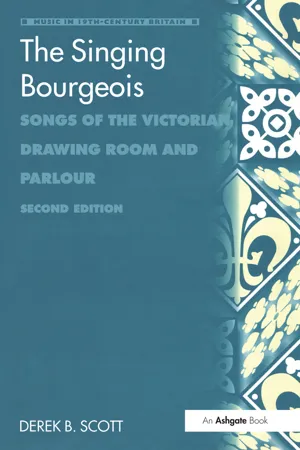
First published in 1989, The Singing Bourgeois challenges the myth that the 'Victorian parlour song' was a clear-cut genre. Derek Scott reveals the huge diversity of musical forms and styles that influenced the songs performed in middle class homes during the nineteenth century, from the assimilation of Celtic and Afro-American culture by songwriters, to the emergence of forms of sacred song performed in the home. The popularity of these domestic songs opened up opportunities to women composers, and a chapter of the book is dedicated to the discussion of women songwriters and their work. The commercial success of bourgeois song through the sale of sheet music demonstrated how music might be incorporated into a system of capitalist enterprise. Scott examines the early amateur music market and its evolution into an increasingly professionalized activity towards the end of the century. This new updated edition features an additional chapter which provides a broad survey of music and class in London, drawing on sources that have appeared since the book's first publication. An overview of recent research is also given in a section of additional notes. The new bibliography of nineteenth-century British and American popular song is the most comprehensive of its kind and includes information on twentieth-century collections of songs, relevant periodicals, catalogues, dictionaries and indexes, as well as useful databases and internet sites. The book also features accompanying downloadable resources of songs from the period.
Trusted by 375,005 students
Access to over 1.5 million titles for a fair monthly price.
Study more efficiently using our study tools.
Information
Subtopic
Music1 The Foundations of the Drawing-room Genre
The multifaceted edifice of bourgeois 'popular song' was built upon foundations laid in the eighteenth century: the most important of these were the English opera, the collections of arrangements of 'traditional airs' and the Table Entertainments pioneered by Dibdin. The not insignificant part played by nonconformist hymns will be considered elsewhere in this book, as will the influence in mid-century of Afro-American music. Bourgeois song was obviously indebted to aristocratic musical practice and to the cosmopolitan musical character of eighteenth-century London. In the first half of the century rich merchants aped the manners of the upper class. An interest in the art patronized by the aristocracy was a proof of social distinction for the upwardly mobile. Hogarth satirized this behaviour and depicted in Marriage à la Mode, 4 (1745), a merchant's daughter who aspires to upper-class values by listening to a castrato singer and collecting 'decadent' art objects. The court remained the focal point of musical activity during the reign of George II, although the first regular series of public subscription concerts started in 1729 at Hickford's Room in James Street. The nobility inherited a music tradition almost completely bound to either the church liturgy or the court ceremonial, and in the early 1700s they supplemented it by importing Italian opera seria.
The flowering of opera in Naples, which occurred slightly later than in Venice, provided the model for imitation in Hanover, London, and Vienna. The most popular of all Italian operas in London, Il Trionfo di Camilla, Regina de Volsci, was originally written for Naples in 1696 by Giovanni Bononcini (1670-1747). It received 111 performances from 1706-28 but always either completely in English or in a mixture of English and Italian. It therefore came to be considered an English opera and had just concluded a successful run in the English Opera Season at Lincoln's Inn Fields Theatre before The Beggar's Opera opened there in 1728. The enormous success of the latter, a work pointedly intended to appeal to the middle class, demonstrated the potential size of the new audience for a composer who, like Handel, would be willing to make appropriate concessions. Bononcini abstained from pursuing this opportunity, being more inclined towards the private concerts of the aristocracy in Britain and Europe.
The work which established Italian opera in its native tongue in London was Handel's Rinaldo (1711). London was a cosmopolitan town, the home of many Italian musicians, Handel himself, as a German who acquired fame writing Italian operas for the English, personally testifies to this cosmopolitan character. Aaron Hill, the director of the theatre in the Haymarket, had concocted a libretto from bits of Tasso and Ariosto and suggested Handel set it to music when he met him in London on his first visit to England. Handel agreed, so it was speedily translated into Italian by Giacomo Rossi.
Handel was successful in providing aristocratic entertainment but his real sympathies lay with the bourgeoisie. Although he received royal patronage, he never held an official court position and was often out of favour with certain members of the aristocracy whose resentment became overt when they organized a rival 'Opera of the Nobility' in 1734. During the 1700s Handel was increasingly aware of the possibility that a large commercial public might be catered for by a new art-form. The public reactions to The Beggar's Opera and Carey and Lampe's burlesque The Dragon of Wantley (1737) showed wide-spread scorn for opera seria which was damaging his box-office receipts. His solution was to blend the music of Italian opera, the German Passion, and the English choral tradition, to create an original and eventually highly successful hybrid, the English oratorio. In Italy the term meant, more or less, a concert performance of a sacred opera during Lent, when the Pope had decreed that opera houses were to be closed. Handel pleased the middle class by using English as the language of his oratorios, and the biblical subject matter was more to their taste than that of the opera. In a period of expanding empire it was easy to identify with God's chosen people and their heaven-sent victories. In the seventeenth and eighteenth centuries the major European countries were engaged in commercial wars for the control of overseas markets. Britain's sea-power was crucial, so it is no surprise to learn that the patriotic song 'Rule, Britannia!' dates from this time (1740). By the end of the Seven Years War (1763) Britain had outstripped her rivals in the building of a colonial empire and had secured both North America and India.
The traditional court composer's commemoration of a victory would be a work like Handel's 'Dettingen Te Deum', written to celebrate the fortunate outcome of the last great charge in British history led by the king himself, at the battle of Dettingen in 1743 (his horse having accidentally bolted in the direction of the enemy). Now, Handel also had an alternative means of response to national conflict and chose to celebrate the victory over the forces of feudalism at Culloden, in an oratorio, Judas Maccabeus (1746). Prince Charlie was the grandson of the dethroned monarch James II, and the focal point of pro-Stuart sympathy among the aristocracy. The true patriot was called upon to reject feudalism in the cause of establishing a middle-class democracy. It is ironic that an old song revitalized for the cause in the 1740s, 'God Save the King', probably originally referred to 'the king over the water' (still suggested by 'Send him victorious', and in an early version the epithet 'true-born'). Handel identified with the aims of middle-class liberals, having for ever turned his back on feudal Germany and become naturalized as English in 1726. Judas Maccabeus caught the bourgeois mood and was to be one of his most regularly performed pieces. The English are represented by the Israelites who are fighting a Roman aristocracy, and the Duke of Cumberland (alias 'the butcher') is undoubtedly intended for comparison with the divinely favoured eponymous hero.
It is worth while pondering the kind of freedom for which English soldiers were being asked to sacrifice their lives, if need be. The agrarian revolution had destroyed the ancient village communities, and the system of co-operative husbandry had been replaced by individual farming. Furthermore, the effect of the Enclosure Movement was to dispossess small tenants and cottagers in the interests of capitalist farmers. The result of political reformation meant that people were more and more bound together by self-interest rather than gaining freedom. The liberty being fought for was the freedom to sell one's own labour-power or hire that of others, depending on whether one owned or had been stripped of property. After the suppression of the '45 rebellion, the Highland chiefs were, in Dr Johnson's description, changed from 'patriarchal rulers' to 'rapacious landlords'.1 In the later eighteenth century enforced clearances took place in the Highlands to make room for profitable sheep-farming.
The Tightness of the Protestant religion is strongly hinted at in the Rev. Morell's libretto (despite the obvious anomaly that the Israelites worship a tribal deity), with the anti-papist slant of the cries of 'down with the polluted altars' and the recommendation to hurl 'priests and pageants' to 'the remotest corner of the world' in order to avoid deception by 'pious lies'. The enemy Rome also suggests Catholicism and its association with the Jacobite cause. Performers in oratorio, of course, were not under the same suspicion of popery as those in Italian opera.
The religious revival which took place in the later eighteenth century was important to the emerging industrial bourgeoisie. Methodism began to acquire respectability, and the middle class in industrial areas took advantage of the organizing experience to be gained from Methodist meetings which relied upon lay leadership and devolution of responsibility. Success in industry was also more likely to result from the sort of skills that were emphasized in Dissenting schools. The subject of nonconformism and its influence on bourgeois song is treated later.
Before the industrial revolution, middle-class town-dwellers were merchants, artisans, or shopkeepers. Social change was set in motion by the cotton industry, and the inventions of Arkwright and Crompton which, together with Watt's steam-engine, created the factory system. Because of steam power the British coal deposits were of immense significance, and scores of mines were opened. The mining of copper and iron was needed, too, for the production of the machinery itself. Arkwright was a typical example of the new industrial hero: he was a Preston barber in 1768, a mill owner in 1771, and thereafter he was continually adding to his accumulation of capital the royalties he received from machinery built to his patents (whether or not the invention he had patented was actually one of his own). When British industrial production figures began to climb, war was once more to prove a decisive factor in crushing foreign competition and securing captive markets (1 793—1815).
A transformation in political and intellectual life is indicated by the birth of classical economics: Adam Smith attacked mercantilism and advocated free trade in Book IV of The Wealth of Nations (1776) and, according to Engels, 'reduced politics, parties, religion, in short everything to economic categories.'2 In music the effects of bourgeois democratic ideas were seen in a deliberate popularization and simplification of style. Even a composer like Haydn, who had spent most of his life in employment at the Esterhazy court, working within the traditions of aristocratic musical entertainment, reveals his republican sympathies by deliberately accommodating himself to this 'democratic' tendency in his London Symphonies of 1791-5 (e.g. the slow movement of the Surprise Symphony, No. 94). He also wrote twelve canzonets to English words, one of which, 'My Mother Bids Me Bind My Hair', became a firm favourite in the drawing-room repertoire. Haydn was much influenced by the music of Handel which he heard, and the kind of simple descriptive effects that can be traced from a work like Handel's Israel in Egypt to Haydn's The Creation were again a beloved feature of bourgeois song.
The middle class did not reach a position of political dominance overnight, but significant milestones were 1832, when the Reform Bill was passed, the boom in railway investment (essential for the development of capital-goods industries like iron and coal) which helped to shake off the 1842 depression, and the repeal of the Corn Laws in 1846. The importance of the Reform agitation was the new polarization of class antagonism between labourers and capitalists (rather than labourers and aristocracy) which followed. E. P. Thompson in The Making of the English Working Class3 sees Chartism as the inevitable result, and so, incidentally, did Disraeli:
In treating the House of the Third Estate as the House of the People, and not as the House of a privileged class, the Ministry and Parliament of 1831 virtually conceded the principal of Universal Suffrage ... its immediate and inevitable result was Chartism.4
The importance of riding out the 1842 depression was that afterwards Britain was no longer dependent on one main industrialized sector, and the ensuing boom years were a contributing factor in setting English unrest apart from that on the continent in 1848. The importance of the repeal of the Corn Laws was that it gave a victory to the industrial bourgeoisie over the landed aristocracy, leaving the latter economically and politically weaker.
The English opera
The work which pointed most clearly to the cultural appetite of the growing urban middle class and set in motion major changes in operatic entertainment was The Beggar's Opera by John Gay (1685-1732). It was in every respect the antithesis of opera seria: instead of gods and heroes the characters were highwaymen and prostitutes; instead of broad spans of embellished melody the tunes were simple and direct; instead of a falsetto the protagonist was a tenor, a rarity in opera seria. Gay satirized the court and aristocratic entertainment at the same time as he carefully instilled into his work a moral purpose which, while designed to appeal to the taste of a middle-class audience, was calculated not to offend the aristocracy at large.
Ironically, Gay had really written a play rather than an opera and originally intended the songs to be sung entirely without accompaniment. When Colley Cibber refused him the opportunity of performances at Drury Lane, it was John Rich, at whose theatre in Lincoln's Inn Fields the piece was first seen in 1728, who persuaded Gay to allow his resident musical director Johann Pepusch to provide accompaniments. This alteration of Gay's plans did not work to the play's advantage throughout. The pace of Act 3: scene 13, for instance, where Macheath sits in the condemned cell drinking and singing snatches of ten different songs, is seriously impeded. In consequence of its being a last-minute decision, Pepusch's arrangements are fragmentary and sketchy, and because of this the unusual convention arose that all revivals of the work became musically 'updated'. Arne and then Bishop, who both produced later versions, were among the first to build a tradition which has lasted to the present day. Frederic Austin's 1920 arrangement of the score, which ran for over three years at the Lyric Theatre, Hammersmith, has been the most acclaimed revival so far this century. The Beggar's Opera also provided the stimulus for Brecht and Weill's revolutionary landmark in the history of modern musical theatre, Die Dreigroschenoper, written to commemorate the bicentenary of Gay's pioneering drama in 1928. This time, however, the shafts of political satire were aimed from the perspective of the proletariat rather than the bourgeoisie.
The source for the majority of Gay's tunes was the collection Pills to Purge Melancholy5 by the bawdy Restoration poet Tom Durfey (or, spelt in the quasiaristocratic manner he preferred, D'Urfey). This fact is clear because they are cited by the names they bear in this collection, even when they exist under different titles elsewhere. Most of the Scottish songs are from Thomson's Orpheus Caledonius,6 to which Gay's patroness, the Duchess of Queensbury, subscribed. Many other songs are originally from theatrical productions, and among them are simple, tuneful pieces by Purcell, Eccles, Leveridge, and even Handel and Bononcini. They are sometimes not simple enough, however, as the incorrect version of Handel's march from Rinaldo demonstrates. No doubt the reason for this error was that it was notated from memory, either from its regular performance by the band of the Royal Horse Guards, or its previous parody as a tavern song, 'Let the Waiter Bring Clean Glasses'. Gay may have been entirely unaware that he had convert...
Table of contents
- Cover
- Half Title
- Dedication
- Title
- Copyright
- Contents
- Acknowledgements
- Introduction to the First Edition
- Introduction to the Second Edition
- 1 The Foundations of the Drawing-room Genre
- 2 The Growth of the Market for Domestic Music
- 3 The Rise of the Woman Ballad Composer
- 4 Cultural Assimilation
- 5 Sacred Songs
- 6 Promoters, Publishers, and Professional Performers
- 7 A Best-selling Formula?
- 8 Nationalism and Imperialism
- 9 Hegemony
- 10 Continuity and Change
- 11 Music and Social Class
- Notes
- Glossary of Musical Terms Used in the Text
- Select Bibliography
- Song Index
- General Index
Frequently asked questions
Yes, you can cancel anytime from the Subscription tab in your account settings on the Perlego website. Your subscription will stay active until the end of your current billing period. Learn how to cancel your subscription
No, books cannot be downloaded as external files, such as PDFs, for use outside of Perlego. However, you can download books within the Perlego app for offline reading on mobile or tablet. Learn how to download books offline
Perlego offers two plans: Essential and Complete
- Essential is ideal for learners and professionals who enjoy exploring a wide range of subjects. Access the Essential Library with 800,000+ trusted titles and best-sellers across business, personal growth, and the humanities. Includes unlimited reading time and Standard Read Aloud voice.
- Complete: Perfect for advanced learners and researchers needing full, unrestricted access. Unlock 1.5M+ books across hundreds of subjects, including academic and specialized titles. The Complete Plan also includes advanced features like Premium Read Aloud and Research Assistant.
We are an online textbook subscription service, where you can get access to an entire online library for less than the price of a single book per month. With over 1.5 million books across 990+ topics, we’ve got you covered! Learn about our mission
Look out for the read-aloud symbol on your next book to see if you can listen to it. The read-aloud tool reads text aloud for you, highlighting the text as it is being read. You can pause it, speed it up and slow it down. Learn more about Read Aloud
Yes! You can use the Perlego app on both iOS and Android devices to read anytime, anywhere — even offline. Perfect for commutes or when you’re on the go.
Please note we cannot support devices running on iOS 13 and Android 7 or earlier. Learn more about using the app
Please note we cannot support devices running on iOS 13 and Android 7 or earlier. Learn more about using the app
Yes, you can access The Singing Bourgeois by Derek B. Scott in PDF and/or ePUB format, as well as other popular books in Media & Performing Arts & Music. We have over 1.5 million books available in our catalogue for you to explore.