eBook - ePub
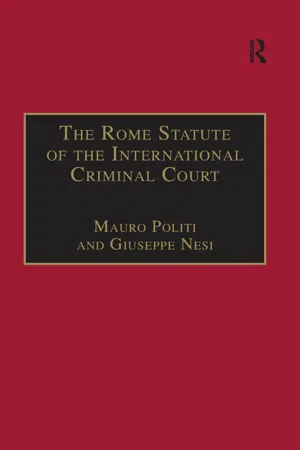
The Rome Statute of the International Criminal Court
A Challenge to Impunity
- 340 pages
- English
- ePUB (mobile friendly)
- Available on iOS & Android
eBook - ePub
The Rome Statute of the International Criminal Court
A Challenge to Impunity
About this book
This book focuses on the Statute of the International Criminal Court, gathering contributions by leading scholars and diplomats. It examines the main features of the Statute, highlighting its strengths and weaknesses, the role of the ICC in the international protection of human rights and the impact of the ICC Statute on the international criminal justice system. It also offers an evaluation of the prospect for the functioning of the ICC in the future.
Trusted by 375,005 students
Access to over 1.5 million titles for a fair monthly price.
Study more efficiently using our study tools.
Information
THE INTERNATIONAL CRIMINAL JUSTICE SYSTEM AFTER THE ROME CONFERENCE
18. The Preventive and the Repressive Function of the International Criminal Court*
A Introduction/General Remarks
I Present Situation and Tendencies
The present situation in wide parts of former Yugoslavia mirrors an important aspect of the tension between the primary purpose of criminal law, to prevent crimes and its secondary function, to repress and punish in cases where prevention with regard to the crime committed has failed to fulfil its function. Crimes against humanity and war crimes, committed there, in Rwanda and in several other places all over the world, as well as many other appearances of crimes, remind us daily that criminality on the domestic and international level is a social disease, the sources of which have to be researched and abolished, if prevention should reach its highest degree of effectiveness. Therefore, the challenge to impunity, heading our Conference here in Trento, is a challenge to all of us and on every occasion.
Both functions of criminal law are expressly mentioned in Article 28 of the Rome Statute1 in the context with the power of military commanders or other superiors “to prevent or repress … crimes … committed by forces under his or her effective command and control, or effective authority and control”.2 In this context, those two functions are meant as alternatives, both of which are of equal importance with regard to crimes under international law and on the domestic level. But persons who, due to their position of power, for instance, as “Head of State or Government”, could prevent such crimes best, may have participated in one way or another in their commission. They, therefore, may not be interested in the prosecution of such crimes on the national or the international level, especially, when otherwise they personally may have to face punishment.
This peculiarity of crimes under international law has already been expressed in the Report of the Carnegie Endowment for International Peace with regard to the causes and responsibilities concerning the Balkan Wars 1912-1913. The Commission concluded that one word from those in power would have stopped all belligerent struggles and the atrocities committed during these events.3 This result raises the question, how persons, equipped with such a power, can be motivated to speak this one word? Can those addressed by Article 27 be personally persuaded or forced by armed attacks against their State, to put their foot down to prevent (further) crimes? Is it sufficient to merely threaten them with such reactions or with prosecution and punishment by the community of nations, if they keep silent, and thus support such crimes by not interfering? May the mere expectation, to be held individually responsible by the international community, influence their behaviour? Could such an expectation lead to unpredictable reactions to restore peace or, on the contrary, to an intensified abuse of power and thereby increase the number and gravity of crimes committed, ordered or not sufficiently suppressed? For instance, someone facing prosecution before an international Court may perhaps hold the opinion that he has not much to lose, but may gain a lot, perhaps, even avoiding criminal responsibility, when continuing a programme of ethnical cleansing. Can such a danger of increasing criminality serve as a justification to stop or even eliminate such persons by force? Are the rules to admit self-defence and defence of others applicable, especially those demanding that countermeasures are only allowed if they stop the illegal attack for sure?4
Besides, on the domestic level it is discussed, whether the traditional penalties, especially imprisonment, are at all adequate means to “fight” criminality or if there are others more effective, like those summarized by the concept of diversion? Is what may be helpful on the national level, also effective in the field of international criminal law or, are there peculiarities in the appearances of crimes under international law, which demand an independent solution apart from national criminal justice systems? Is it the position of power, often held by perpetrators of the so called core crimes, the classical Nuremberg crimes, aggression, crimes against humanity, including genocide, and war crimes, that makes the situation different and unpredictable? On the domestic level, security forces and the police are more or less present on the spot to prevent and, if necessary, to investigate criminality. But there are no such executive forces of the international community in places where crimes under international law are committed. On the contrary, persons who could exercise these functions, like military commanders and other superiors, as mentioned in Articles 27 and 28, may even have ordered or tolerated, and thus promoted such crimes.
Where are the limits of using force against those responsible for the commission of such crimes, in order to stop their continuation or impunity of the perpetrators? NATO bombing led to a rapidly intensified commission of such crimes in Kosovo and did not stop them even after more than 50 days of attacking. Was this not predictable? Dictators may judge upon the end of their time in power differently, especially when committing crimes of concern to the international community as a whole, in order to preserve their position of power as long as possible.
Must it be taken for granted, that persons in charge of such power will not put their foot down to stop all atrocities, if they are sure that they have to face prosecution and trial immediately after their opponents or the international community gets hold of them? Who can get close to them or dare to speak up to change their minds? Psychological warfare cannot guarantee success as long as it is not based on well founded studies on the relevant types of perpetrators, accomplices and victims of crimes under international law.
II Prevention, Deterrence and Repression
Prevention, deterrence and repression are, all three, rather complex concepts. The Tenth UN Congress on the Prevention of Crime and the Treatment of Offenders, held in Vienna, 10-17 April 2000, therefore, has dealt, besides other issues, with “Effective Crime Prevention: Keeping Pace with new Developments”.5 The broad spectrum of ideas, research and approaches in a merging world, which has been presented there, cannot be dealt with here. This, and the subject matter of our Conference is justification for limiting my presentation to specific aspects of crimes under international law and their expression in relevant international legal documents.
1 The Diversity of Concepts to “Fight” Criminality
It is the aim of criminal law to serve as ultima ratio for the protection of legally accepted values and interests. All concepts to “fight” criminality agree that the most effective way to achieve this aim is to prevent crimes from being committed at all. Such a result may be obtained only by combined efforts, for instance, by diminishing the sources of crimes, by educating and motivating all citizens to obey the law, and by deterring potential perpetrators. Failing this, criminal law can only ex post contribute to the prevention of such crimes by preventing recidivism and a repetition of such crimes by other persons. To prevent, therefore, means to hinder the commission of crimes right from the beginning, but also to stop their commission at any stage before the crime has been completed and caused harm or continue to do so.
All these aspects describe actions to “fight” criminality. “Deterrent” means, according to Black’s Law Dictionary, “anything which impedes or has the tendency to prevent; e.g. punishment is a ‘deterrent’ to crime”.6 While to “deter” and to “prevent” are rather neutral verbs, covering all possible influences on potential perpetrators, others imply some pressure on persons to avoid that crimes can or will be committed (again).
“Suppression” describes “to put a stop to all things actually existing”, including to achieve an “end by force”.7 The word “repressing” has the same root. However, it emphasizes a process, necessarily following the act to be suppressed. In this sense the “International Convention for the Suppression of Terrorist Bombings” refers to all methods and means, available and suitable to fight all social appearances of terrorism. It refers, accordingly, in paragraph 5 of its Preamble, to “legal provisions on the prevention, repression and elimination of terrorism” and, in paragraph 9, to “effective and practical measures for the prevention of such acts of terrorism and for the prosecution and punishment of their perpetrators”. Similar wording can be found in other international documents and confirm that prosecution and punishment are measures of repression and, at the same time, belong to the broad scale opened by the word oppression, thus including prevention.8
2 Interrelationship between Different Approaches
All these expressions describe means, methods and measures to avoid violations of legally protected values and interests. Because of this common goal, all Delegations at the Rome Conference 1998 agreed that there could be no peace without justice, especially given the capacity of justice to foster reconciliation and to deter the commission of future crimes and notwithstanding the regrettable tendency of criminal justice to occasionally take on the appearance of retribution and revenge.
However, all means approach this common goal from different angles. One depends on the stages of human behaviour, developing as a continuous, complex process towards the completion of the crime and appearing as a social disease upon which society has to react. Even though decisiveness and strength may be most effective, there are various criteria, to limit the admissibility and suitability of means, methods and measures for “fighting” criminality.
Whatever means are chosen, their effectiveness should be evaluated in advance, if possible by empirical research. All reactions to crimes, interfering with individual rights and liberties, ought to be measured on their suitability “to contribute to the prevention” of crimes under international law. The legal permission of self-defence shows, for this reason, a very detailed scale of prerequisites to justify even an individual prevention of crime by force.
In addition, all criminal means and measures have to be proportional to the threatening violations of legally protected values and interests, they react upon and to the aim to be achieved with their help, for instance, preservation or restoration of peace and security of mankind. This is, in principal, expressed, for instance, in Article 17 paragraph 1, subparagraph (d), according to which “the Court shall determine that a case is inadmissible where: … (it) is not of sufficient gravity to justify further action by the Court”.9
Equally important is that all proceedings have to respect the rights and liberties of suspects, accused and sentenced persons as much as the applicable law does not (expressly) permit limitations as unavoidable.
Considering the stages through which crimes and the procedures for their investigation and prosecution develop, prevention in the broadest sense should be promoted practically at all phases.
The mere planning and preparation of crimes is, in general, not punishable, except in very rare cases,10 and may be difficult to detect. But, taking influence at such an early stage can be one of the most effective ways to prevent crimes; because no concrete harm has yet been done nor are specific values directly endangered. The period of time in which such an influence can be taken effectively, may be short or long. Anyhow, it appears to be worthwhile to concentrate already at this stage on corresponding cases, because successful interferences then prevent for sure violations of legally protected values and interests.
The attempt to commit a crime is, in general, the stage at which the punishability of a behaviour starts, independent of the fact, in which way an attempt may be defined. To deter from further action at that stage means that a more or less conc...
Table of contents
- Cover Page
- Title Page
- Copyright Page
- Contents
- List of Participants
- Editors’ Preface
- Message of the Secretary-General of the United Nations
- Welcome Addresses
- THE INTERNATIONAL CRIMINAL COURT: ITS MAIN FEATURES
- THE INTERNATIONAL CRIMINAL COURT AND THE INTERNATIONAL PROTECTION OF HUMAN RIGHTS
- THE INTERNATIONAL CRIMINAL JUSTICE SYSTEM AFTER THE ROME CONFERENCE
- PROSPECTS FOR THE FUNCTIONING OF THE INTERNATIONAL CRIMINAL COURT
Frequently asked questions
Yes, you can cancel anytime from the Subscription tab in your account settings on the Perlego website. Your subscription will stay active until the end of your current billing period. Learn how to cancel your subscription
No, books cannot be downloaded as external files, such as PDFs, for use outside of Perlego. However, you can download books within the Perlego app for offline reading on mobile or tablet. Learn how to download books offline
Perlego offers two plans: Essential and Complete
- Essential is ideal for learners and professionals who enjoy exploring a wide range of subjects. Access the Essential Library with 800,000+ trusted titles and best-sellers across business, personal growth, and the humanities. Includes unlimited reading time and Standard Read Aloud voice.
- Complete: Perfect for advanced learners and researchers needing full, unrestricted access. Unlock 1.5M+ books across hundreds of subjects, including academic and specialized titles. The Complete Plan also includes advanced features like Premium Read Aloud and Research Assistant.
We are an online textbook subscription service, where you can get access to an entire online library for less than the price of a single book per month. With over 1.5 million books across 990+ topics, we’ve got you covered! Learn about our mission
Look out for the read-aloud symbol on your next book to see if you can listen to it. The read-aloud tool reads text aloud for you, highlighting the text as it is being read. You can pause it, speed it up and slow it down. Learn more about Read Aloud
Yes! You can use the Perlego app on both iOS and Android devices to read anytime, anywhere — even offline. Perfect for commutes or when you’re on the go.
Please note we cannot support devices running on iOS 13 and Android 7 or earlier. Learn more about using the app
Please note we cannot support devices running on iOS 13 and Android 7 or earlier. Learn more about using the app
Yes, you can access The Rome Statute of the International Criminal Court by Mauro Politi,Giuseppe Nesi in PDF and/or ePUB format, as well as other popular books in Law & International Law. We have over 1.5 million books available in our catalogue for you to explore.