- 392 pages
- English
- ePUB (mobile friendly)
- Available on iOS & Android
eBook - ePub
About this book
This volume explores the way in which composers, performers, and critics shaped individual and collective identities in music from Europe and the United States from the 1860s to the 1950s. Selected essays and articles engage with works and their reception by Richard Wagner, Georges Bizet (in an American incarnation), Lili and Nadia Boulanger, William Grant Still, and Aaron Copland, and with performers such as Wanda Landowska and even Marilyn Monroe. Ranging in context from the opera house through the concert hall to the salon, and from establishment cultures to counter-cultural products, the main focus is how music permits new ways of considering issues of nationality, class, race, and gender. These essays - three presented for the first time in English translation - reflect the work in both musical and cultural studies of a distinguished scholar whose international career spans the Atlantic and beyond.
Trusted by 375,005 students
Access to over 1.5 million titles for a fair monthly price.
Study more efficiently using our study tools.
Information
Subtopic
World HistoryPart One
Music and Politics in Late Nineteenth-Century France
CHAPTER 1
Cette musique sans tradition
WAGNER’S TANNHÄUSER AND ITS FR ENCH CRITICS
Strangely enough, Paris has become the only city, for which I hold a certain interest of curious sympathy…and even today, I prefer it to all other places in the world…I could bring myself, as a cultural-historical study, to go to a new opera by Meyerbeer or Gounod in a Parisian theater, for whose circumstances, abilities, and audience it is calculated; in Berlin, Vienna and Munich I would find this impossible.
RICHARD WAGNER, LETTER
TO KING LUDWIG II OF BAVARIA, 18 JULY 1867
TO KING LUDWIG II OF BAVARIA, 18 JULY 1867
“If God would only bestow such a flop upon me!” According to Richard Wagner, these words were uttered by Charles Gounod soon after the scandalous fiasco of the Parisian premiere of Tannhäuser in March 1861 (see fig. 10.1).1 In February, a month before that fateful event at the Opéra, the chronicler of the Belgian periodical Le guide musical wished for a dispute similar to the scandal surrounding the 1830 premiere of Victor Hugo’s play Hernani, if only to shake the Parisians out of their current complacency and indifference toward the arts. “At least,” he wrote, “it would be life.”2 And the event was lively indeed. Few incidents in music history created such waves—politically, culturally, aesthetically, and biographically—as the three performances of Wagner’s Tannhäuser at the Académie Impériale de la Musique in Paris on 13, 18, and 24 March 1861. Within a couple of days, Wagner’s unsuccessful revisions of his opera for Paris became the subject of legend, and they have remained so ever since.
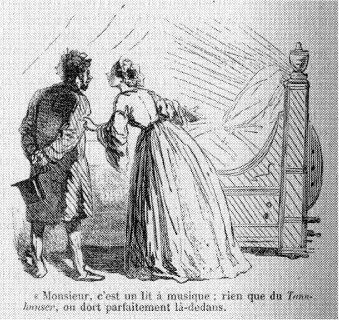
FIGURE 10.1.“Exposition des Baux-Arts appliqués à l’industrie.” Caricature by Cham [Amédée de Noé]. The caption reads: “Sir, this is a musical bed: nothing but Tannhäuser; one sleeps perfectly in it.” L’illustration, 21 November 1863. Courtesy of Duke University Library.
The plot of this tale is all too familiar to music lovers past and present: In the standard telling of the story, Wagner, the greatest German composer since Beethoven, came to Paris to have his Tannhäuser performed on the stage of the Opéra, then the most important music theater in Europe. Unfortunately, the administration of the house asked for revisions, in particular the addition of a ballet in act 2, in order to accommodate the taste of its spoiled audience. Aristocrats habitually attended the opera after dinner in time to see their favorite ballerinas perform onstage before the subsequent, more private entertainment in bed. Wagner, however, steadfastly refused to compromise his artistic integrity on the altar of convention. Nevertheless, as a concession to Parisian taste, he used the presence of a well-trained corps de ballet to revise the Venusberg scene in act 1, significantly enlarging the scope of the bacchanal. Alas: Parisian prejudice prevailed when the members of the Jockey Club were prevented by Wagner’s artistic vision in act 2 from ogling their favorite ballerinas. They took their revenge, whistling and shouting throughout the reminder of the opera, drowning out Wagner’s music with their racket. This scandalous behavior only escalated during the next two performances. A cruel cabal in the French press further encouraged the opera’s rejection by Parisian audiences, and so, after the third evening of the battle, Wagner capitulated in the face of overwhelming hostility. In an open letter to Alphonse Royer, the director of the Opéra, he wrote:
The opposition which has manifested itself against Tannhäuser proves to me how right your observations were, at the beginning of this undertaking, about the absence of a ballet and of other conventions of the stage to which the regular subscribers of the Opéra are accustomed. I regret that the nature of my work has prevented me from conforming to these requirements. Now that the vigor of the opposition against it does not even allow those in the audience who want to hear it to give it the attention necessary for its appreciation, I have no other honorable recourse than to withdraw it.3
A few weeks after the withdrawal of his Tannhäuser from the stage of the Opéra, Wagner left Paris in disgust, never to return to the French capital again. Soon, with the help of King Ludwig II of Bavaria, he established himself first in Munich and then in Bayreuth. In the end, history would prove Wagner right and show the Parisians for what they were: superficial pleasure seekers mired in operatic conventionality who were unable to recognize true art.
My rendering of this tale may seem like a caricature, but for over a century it remained the dominant version circulating in German and Anglo-Saxon literature after it was cemented in Wagner’s own words, first in his report about the premiere for the Deutsche Allgemeine Zeitung in April 1861 and later in his autobiography.4 The Wagnerian master narrative was only slightly revised in France through the documents presented by Georges Servières in his 1895 monograph on the Parisian Tannhäuser.5 This changed, however, when in the 1980s musicologists began to develop two new areas of interest: on the one hand, led by the Berlioz renaissance, scholars began to focus on French nineteenth-century music as an area of research and performance, whether for the music of Gounod, Massenet, or Méhul; and on the other, sketch studies grew into one of the main scholarly projects of the period, expanding traditional work on Beethoven to the examination of sketches by Schumann, Wagner, and Rossini. Thus the iconic Parisian opera scandal of the nineteenth century received fresh attention. In the early 1980s Carolyn Abbate went into the Parisian archives and explored many of the materials relating to the Parisian Tannhäuser. She presented them in two carefully documented source studies that showed for the first time in detail the literary and musical changes Wagner made for the Paris premiere.6 In the mid-1980s Gerald Turbow and Jane Fulcher revised the political aspects of the narrative and revealed that the Jockey Club’s attack in fact served as a pretext for political protest against the patron of the performance, the French emperor Napoléon III.7 Yet even in opening up new alleys of inquiry as regards sources and political reinterpretation, much of the recent scholarly work in effect maintained and even strengthened the century-old Wagnerian master narrative, explaining the reasons for the Parisian rejection of Wagner in political rather than the aesthetic terms of the 1850s, celebrating Wagner the progressive—if not in his own political attitude, then at least in his impact on republican and socialist writers such as Jules Champfleury or avant-garde artists such as Charles Baudelaire—while condemning Wagner’s adversaries and ridiculing his critics with choice quotations and summary dismissal.
In contrast, Manuela Schwartz, in her 1999 study on French reception of Wagner, pointed out that the scandal served to politicize the composer himself, turning him from a cosmopolitan with ambivalent political alliances into a German nationalist.8 In addition, Katharine Ellis’s careful reading of French music criticism illuminates the complexities of the aesthetic debate that has surrounded Wagner’s music since the 1850s.9
Thus, changing the traditional perspective and challenging the Wagnerian master narrative—by taking Wagner’s critics seriously instead of disregarding them as incompetent, spiteful, or reactionary—may well reveal that theirs was not simply an unreflecting hostility toward Wagner and his new musical language, but, rather, a mirror of their deep concerns about the future of opera, the primary genre of French cultural life, its institutional context, and its musical and poetic language.10 Many of the critics went to great lengths to explain to their readers why Wagner’s Tannhäuser represented a wrong turn in opera. A careful and close reading of Parisian criticism surrounding Wagner’s second Parisian sojourn shows in fact that the notorious nature of Wagner’s own theories and music served as a prism that turned a spotlight onto a deep-seated polemical undercurrent about the nature of French opera, especially because Wagner was not French. Therefore any perceived danger to the genre could be discussed in time-tested terms of national difference rather than internal artistic conflict.
Wagner in Paris
The story of Wagner’s Parisian Tannhäuser began long before the ill-fated premiere in March 1861. It goes back to the young Richard Wagner’s first visit to Paris, between 1839 and 1842, when he tried to establish himself as an opera composer in the musical capital of the nineteenth century. Cherubini, Meyerbeer, Spontini, and Rossini had shown that foreign composers could impose themselves on the French musical stage. In 1840 Wagner came close to placing his Liebesverbot with the Théâtre de la Renaissance, but he lost out to Donizetti’s L’ange de Nisida.11 That same year, inspired by a short story by Heinrich Heine, Wagner sketched the outline for a one-act opera on the topic of the Flying Dutchman that was intended as a one-act curtain-raiser for a ballet at the Opéra such as Giselle.12 Although the Opéra’s administration was interested in the subject, it had other artists in mind to create the work, and 9 November 1842 saw the premiere of Pierre-Louis Dietsch’s fantastic opera in two acts, Le vaisseau fantôme, ou Le maudit des mers.13
When Wagner returned to Paris twenty years later, in September 1859, he was no longer an unknown hopeful from Germany, but a controversial chef d’école. In particular, after the publication around 1850 of the so-called Züricher Kunstschriften—Art and Revolution (1849), The Artwork of the Future (1850), and Opera and Drama (1851)—he had become one of the most discussed composers alive. In 1852 François-Joseph Fétis dedicated a series of articles to Wagner’s theoretical “system,” whose terms would shape the discussion in France for several decades.14 But although the debate about Wagner’s ideas was lively, his music remained virtually unknown in Paris. Thus one of his first acts of self-promotion in Paris was to remedy this lack of musical awareness with three concerts of his own music, which he conducted in January and February 1860. Except for the Tristan Prelude, Wagner played it safe: he selected those extracts from his operas that were the closest to the style of French grand opéra (see table 10.1). His medley from Tannhäuser opened with the march from act 2, the arrival of the guests at the Wartburg, which was modeled on similar marches composed by Meyerbeer and Halévy. After the first concert he added to his program another piece attractive to French tastes that was to become known as the Romance de l’étoile (“O du mein holder Abendstern”). The poetic images, the elegiac tone, the regular phrase structure, and the harp...
Table of contents
- Cover
- Half Title
- Title Page
- Copyright Page
- Dedication
- Table of Contents
- Acknowledgements
- Introduction
- List of Publications
- Part 1. Music and Politics in Late Nineteenth-Century France
- Part 2. Musical Identities in the United States in the 1930s and ’40s
- Part 3. Gender Politics in Music
- Index
Frequently asked questions
Yes, you can cancel anytime from the Subscription tab in your account settings on the Perlego website. Your subscription will stay active until the end of your current billing period. Learn how to cancel your subscription
No, books cannot be downloaded as external files, such as PDFs, for use outside of Perlego. However, you can download books within the Perlego app for offline reading on mobile or tablet. Learn how to download books offline
Perlego offers two plans: Essential and Complete
- Essential is ideal for learners and professionals who enjoy exploring a wide range of subjects. Access the Essential Library with 800,000+ trusted titles and best-sellers across business, personal growth, and the humanities. Includes unlimited reading time and Standard Read Aloud voice.
- Complete: Perfect for advanced learners and researchers needing full, unrestricted access. Unlock 1.5M+ books across hundreds of subjects, including academic and specialized titles. The Complete Plan also includes advanced features like Premium Read Aloud and Research Assistant.
We are an online textbook subscription service, where you can get access to an entire online library for less than the price of a single book per month. With over 1.5 million books across 990+ topics, we’ve got you covered! Learn about our mission
Look out for the read-aloud symbol on your next book to see if you can listen to it. The read-aloud tool reads text aloud for you, highlighting the text as it is being read. You can pause it, speed it up and slow it down. Learn more about Read Aloud
Yes! You can use the Perlego app on both iOS and Android devices to read anytime, anywhere — even offline. Perfect for commutes or when you’re on the go.
Please note we cannot support devices running on iOS 13 and Android 7 or earlier. Learn more about using the app
Please note we cannot support devices running on iOS 13 and Android 7 or earlier. Learn more about using the app
Yes, you can access The Politics of Musical Identity by Annegret Fauser in PDF and/or ePUB format, as well as other popular books in Media & Performing Arts & World History. We have over 1.5 million books available in our catalogue for you to explore.