- 256 pages
- English
- ePUB (mobile friendly)
- Available on iOS & Android
eBook - ePub
About this book
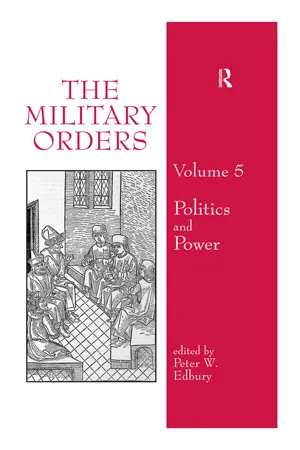
Scholarly interest and popular interest in the military orders show no sign of abating. Their history stretches from the early twelfth century to the present. They were among the richest and most powerful religious corporations in pre-Reformation Europe, and they founded their own states on Rhodes and Malta and also on the Baltic coast. Historians of the Church, of art and architecture, of agriculture and banking, of medicine and warfare and of European expansion can all benefit from investigating the orders and their archives. The conferences on their history that have been organized in London every four years have attracted scholars from all over the world. The present volume records the proceedings of the Fifth Conference in 2009 (held in Cardiff as the London venue was in the process of refurbishment), and, like the earlier volumes in the series, will prove essential for anyone interested in the current state of research into these powerful institutions. The thirty-eight papers published here represent a selection of those delivered at the conference. Three papers deal with the recent archaeological investigations at the Hospitaller castle at al-Marqab (Syria); others examine aspects of the history of the military orders in the Latin East and the Mediterranean lands, in Spain and Portugal, in the British Isles and in northern and eastern Europe. The final two papers address the question of present-day perceptions of the Templars as moulded by the sort of popular literature that most of the other contributors would normally keep at arm's length.
Trusted by 375,005 students
Access to over 1.5 million titles for a fair monthly price.
Study more efficiently using our study tools.
Information
Chapter 1
The Military—Religious Orders: A Medieval 'School for Administrators'?
Karl Borchardt
For the twelfth and thirteenth centuries, the crucial and formative period of the crusades and the military–religious orders, almost all relevant sources are known, even though not all of them are properly edited and interpreted. If someone were to discover and present a source that is entirely new, that would almost cause a sensation. On the other hand, given the vast literature about the crusades and the military–religious orders – and many of the participants in this conference are continuously adding to these publications – it is not easy to find new questions or interpretations from the twelfth- and thirteenth-century sources. No honest scholar can therefore claim to be able to present entirely new ideas about the military-religious orders between 1100 and 1300. And yet, even for this well-studied period, there are important problems that may deserve further research.
The present paper focuses on what one could call the constitutional or administrative history of the military–religious orders. Of course past scholars have not neglected this problem,1 but much of their work has been bedevilled by their legal training and thinking.2 This often results in anachronistic terminology based on later or even modern concepts, and a lack of understanding of the historical situation that conditioned or influenced the development of the orders. Nevertheless, the constitutional and the administrative practices of the military-religious orders have been studied and continue to be studied by a close reading of the relevant sources. There are rules, statutes, and other normative texts of greater or lesser legal authority, which were collected in manuscript form. Specialists discuss the dates and the relations between the manuscripts, for instance the vexed question whether the French or the Latin version of particular Hospitaller or Templar texts deserves precedence. An example is provided by Christian Vogel’s recent PhD thesis on the subject of Templar legislation, ‘Das Recht der Templer’, supervised by Rudolf Hiestand and published in 2007, where the author dates the corpus of Templar retrais, legal decisions by Master and Convent collected in various manuscripts, to the 1190s, half a century later than we had thought.3 Furthermore, there is legal and constitutional terminology in contemporary charters and, to a lesser extent, in contemporary chronicles that can be studied for the history of administration or the history of communication if we want to use this more popular, but somewhat unspecific, paradigm among present-day historians.
Yet communication theory can be as misleading for historians as the older legalistic approach, popular since the nineteenth century as ‘Verfassungs-’ or ‘Rechtsgeschichte’. There are two problems with such studies on the constitutional history of military–religious orders. Firstly, we must not interpret the sources between 1100 and 1300 in the light of later medieval and early modern constitutional history. An officer in charge of a house in the twelfth century should not be called a ‘preceptor’ or ‘commander’ too readily, because it is by no means certain that this officer was appointed and acted in the same way as his namesakes in later centuries. Secondly, it is even more important that we must interpret the sources within their contemporary historical background, since constitutional and administrative innovations were usually introduced to solve new problems created by political, social, economic or other changes. Judith Bronstein, for example, has recently shown that the Hospitallers intensified regional and local administration in response to the post-1187 challenge to organize a steadier flow of support from Europe to the Holy Land.4 Of course we can and should compare the great military-religious orders active in all European countries and regions with other more or less centralized religious orders, especially the big ones such as Cluniacs, Cistercians or Premonstratensians. But learning from Judith Bronstein’s and similar studies, we should always try to explain constitutional life and administrative routine as being shaped by specific historical situations. The general topic of this conference, ‘Politics and Power’, suggests what is needed. Prosopographical data as collected by Jochen Burgtorf in his PhD thesis on the leading officers of the Templars and Hospitallers between 1100 and 1300 are essential.5 But we also need to understand the political and social background. The military–religious orders in the Holy Land responded to varying challenges in ever-changing historical situations, after the failure of the Second Crusade, after the loss of Jerusalem in 1187 and the failure to recover it through the Third Crusade, and after the subjugation of the quasi-independent French nobility by the Capetian monarchy in the middle of the thirteenth century that proved to be the end of the traditional crusades, just to hint at some of these varying circumstances.
These basic facts about the origins and early development of the crusades and the great military–religious orders are well known and here need only a brief summary. In the period under consideration, the crusades were military expeditions privileged by the pope with the prestigious aim of recovering or defending Jerusalem and the Holy Land, although this concept was soon transferred to other theatres of war with the infidel and with the enemies of the church. The role of the reformed late eleventh-century papacy was essential for the emergence of the crusades, as Urban II and his successors took up an idea once propounded by Gregory VII that the papacy should direct Christian milites to the noble and meritorious goal of fighting the enemies of the faith in the East. As many emperors and kings were opposed to the papal programme at that time, the crusades provided Urban II and his successors with an important instrument in establishing their claims as leaders of western Christianity. Although the military–religious orders were not technically crusaders – their members were forbidden to take any vows other than chastity, poverty and obedience in their order – they rose to prominence between 1100 and 1300 as a form of standing militia supporting Jerusalem and the Holy Land. Both the Templars and the Hospitallers had their twelfth-century central headquarters in Jerusalem. They were founded and endowed to support Jerusalem. The Hospitallers and the Order of the Holy Sepulchre were recognized by Paschal II in 1113 and 1114 respectively to provide pilgrims to Jerusalem with alms and shelter. The Templars were founded in probably 1119/20 to protect pilgrims in the vicinity of Jerusalem against Muslim raids. Papal privileges followed and contributed to the rapid growth of these orders, although one should not go as far as Hans Prutz and claim that the Templars and Hospitallers were merely or even primarily instruments of the popes,6 a claim that is sometimes repeated for the Dominicans and the Franciscans founded in the thirteenth century. The popes might protect these new orders against bishops and parish priests, and in return the popes might enjoy personal services or financial support, but the constitutional development of the military–religious orders was always shaped primarily by their own needs and desires.
The Jerusalem-based Hospitallers and Templars were in a special situation, since they had to collect alms in the West, transfer men, material and monies to the East, and soon began to acquire properties in the West in order to support their eastern obligations. In this respect they had similarities with the Augustinian canons of the Holy Sepulchre. But the Hospitallers and Templars both fulfilled much more important tasks for the Latin East, and the pressure to develop new constitutional and administrative devices was much stronger for them. This is probably the reason why the military–religious orders differ significantly from other new religious communities or orders of the twelfth century. General histories of religious orders, among them those by the German historian Gert Melville and his colleagues and pupils published in the series ‘Vita regularis’ since 1996 – there are now almost forty volumes – usually concentrate on Cluniacs, Cistercians or Premonstratensians and tend to mention the military–religious orders only in passing as if Hospitallers and Templars merely imitated these other monastic communities.7 The main purpose of this paper is to question this view.
Compared to Cluniacs, Cistercians or Premonstratensians, the major innovation we have to explain is the prominence of the master and his eastern headquarters. The abbots and monasteries of Cluny, Cîteaux or Prémontré enjoyed prestige among their respective communities. But with the partial exception of Cluny that had some dependent houses governed by priors who were appointed, controlled and sometimes recalled by the grand abbot of Cluny,8 the new ordines – a term developed for Cîteaux early in the twelfth century – were communities of separate houses with their own brethren, their own possessions and their own abbots. The Templars, the Hospitallers and, later on, the other military–religious orders were radically different, because they grew around a prominent eastern headquarters. There the master lived and administered the order’s affairs together with the convent, the community of brethren living in this headquarters.9 From around 1140 onwards the Templar master styled himself Dei gratia and was addressed as venerabilis like any bishop or abbot;10 and the Hospitaller master soon followed this example.11 Yet we should not press this too far, as also subordinate officers such as the Hospitaller prior of St Gilles and the Templar master in Spain were being called Dei gratia at the same time,12 and as the quasi-monarchical position of the master was checked and balanced by the brethren present in the headquarters.13 Important decisions had to be achieved with the consent of the chapter. The conventual chapters gradually evolved into chapters general where, for example, subordinate officers for the administration of possessions outside the headquarters were installed.
The important point, however, is that all these subordinate officers both in the convent and outside were, at least in theory, only lieutenants of the master.14 That is why these officers were called baillis, a term adopted from the Norman, Angevin and Capetian royal or princely administrations. Like the similar term ‘commander’, whose precise origins are not yet clear, this usage emphasizes the fact that the officers were only lieutenants of the master and could be dismissed at any time.15 As in royal or princely administrations, the officers were responsible to the master, were obliged to send subsidies to the headquarters, to hand in reports and submit accounts, and they were subject to visitations. Any important decision such as the alienation of lands needed, at least in theory, permission from the central headquarters. And, at least in theory, new brethren could only be admitted by licence from the central headquarters. Of course the master, or the master together with the convent, might delegate such powers to regional or local officers. yet we should note here the basic difference in comparison with other twelfth-century religious communities or orders where the single house or monastery always retained the right to decide such matters for itself.
In this sense the Templars and the Hospitallers – and not the Cluniacs, Cistercians or Premonstratensians – were the first truly centralized religious orders,16 and that was undoubtedly an important twelfth-century innovation. The debate about the origins of the military–religious orders usually has its focus on their military activities. The recogni...
Table of contents
- Cover
- Half Title
- Title
- Copyright
- Contents
- List of Illustrations
- List of Abbreviations
- List of Contributors
- Editor's Preface
- Introduction
- 1 The Military–Religious Orders: A Medieval 'School for Administrators'?
- PART 1: THE LATIN EAST
- PART 2: HOSPITALLER RHODES AND MALTA
- PART 3: THE BRITISH ISLES
- PART 4: ITALY
- PART 5: NORTHERN AND EASTERN EUROPE
- PART 6: THE IBERIAN PENINSULA
- PART 7: TEMPLAR MYTHOLOGY
- Index
Frequently asked questions
Yes, you can cancel anytime from the Subscription tab in your account settings on the Perlego website. Your subscription will stay active until the end of your current billing period. Learn how to cancel your subscription
No, books cannot be downloaded as external files, such as PDFs, for use outside of Perlego. However, you can download books within the Perlego app for offline reading on mobile or tablet. Learn how to download books offline
Perlego offers two plans: Essential and Complete
- Essential is ideal for learners and professionals who enjoy exploring a wide range of subjects. Access the Essential Library with 800,000+ trusted titles and best-sellers across business, personal growth, and the humanities. Includes unlimited reading time and Standard Read Aloud voice.
- Complete: Perfect for advanced learners and researchers needing full, unrestricted access. Unlock 1.5M+ books across hundreds of subjects, including academic and specialized titles. The Complete Plan also includes advanced features like Premium Read Aloud and Research Assistant.
We are an online textbook subscription service, where you can get access to an entire online library for less than the price of a single book per month. With over 1.5 million books across 990+ topics, we’ve got you covered! Learn about our mission
Look out for the read-aloud symbol on your next book to see if you can listen to it. The read-aloud tool reads text aloud for you, highlighting the text as it is being read. You can pause it, speed it up and slow it down. Learn more about Read Aloud
Yes! You can use the Perlego app on both iOS and Android devices to read anytime, anywhere — even offline. Perfect for commutes or when you’re on the go.
Please note we cannot support devices running on iOS 13 and Android 7 or earlier. Learn more about using the app
Please note we cannot support devices running on iOS 13 and Android 7 or earlier. Learn more about using the app
Yes, you can access The Military Orders Volume V by Peter Edbury in PDF and/or ePUB format, as well as other popular books in History & World History. We have over 1.5 million books available in our catalogue for you to explore.