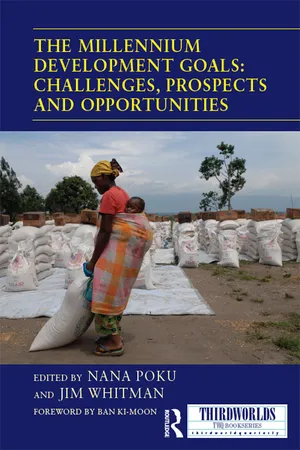
eBook - ePub
The Millennium Development Goals: Challenges, Prospects and Opportunities
- 216 pages
- English
- ePUB (mobile friendly)
- Available on iOS & Android
eBook - ePub
The Millennium Development Goals: Challenges, Prospects and Opportunities
About this book
As the 15-year Millennium Development Goals approach their conclusion, we can now measure their larger successes and failures in more than 'snapshot fashion; and we can begin to consider how best to shape the international development agenda for the coming decades based on what we have learned. But the performance and outlook for the MDGs can neither be reduced to the sum of its eight goals, nor be divorced from international dynamics - the hard interests of states and other actors, and the global dynamics that impact on both. For that reason, this volume balances contextual analysis, the role of formative and constraining forces, the importance of normative considerations and illuminating case studies to deliver a study of the MDGs which has depth and nuance as well as breadth. Poised between judging the recent performance and the future promise of the MDGs, this book is substantial, provocative and timely.This book was published as a special issue of Third World Quarterly.
Trusted by 375,005 students
Access to over 1.5 million titles for a fair monthly price.
Study more efficiently using our study tools.
Information
Introduction
The Millennium Development Goals: challenges, prospects and opportunities
ABSTRACT The prospect for the MDGs cannot be reduced to the sum of the eight goals, divorced from international dynamics, the hard interests of states and the global dynamics that impact on both, or from the complexities and intractability of widespread poverty and its consequences. The legacies and controversies of previous international development initiatives also beset perceptions of, and support for, the MDGs. However, the wholly inclusive nature of the goals give them a unique normative standing and momentum; and the quantitative measures of progress ensure that there is more to the goals than lofty ideals. In addition, the thematic linkages between each of the goals is mutually reinforcing. While not discounting either structural difficulties or the lack of adequate progress in some specifics, it is important not to overlook the political consensus, abundant goodwill and normative momentum that have already been generated in the ten years to date. The answer to the question, ‘How promising is the promise of the MDGs?’ has not yet been answered definitively: there remains good reason for cautious optimism for progress up to 2015–and through revitalized commitment and persistent engagement, well beyond that date.
Sixty years ago the UN Charter pledged to free future generations from the scourge of war, to protect fundamental human rights and ‘to promote social progress and better standards of life in larger freedom’. At the start of the new millennium the world’s governments renewed that pledge: the Millennium Declaration, adopted in 2000, sets out a bold vision, uniting ‘larger freedom’ and human development. The key driver for this was a recognition that, although individual freedom matters, people are restricted in what they can do with that freedom if they are poor, ill, illiterate, discriminated against, threatened by violent conflict or denied a political voice. So the Millennium Declaration holds out the promise of a new pattern of global social policy built on the foundations of greater equity, social justice and respect for human rights. More fundamentally it reflects the shared aspirations of the global human community in a period of sweeping change.
At the centre of the Millennium Declaration are the Millennium Development Goals (MDGs), a set of time-bound and quantified targets for reducing extreme poverty and extending universal rights by 2015; each of the eight goals carries benchmarks for measuring progress. 2010 marks the start of a five-year countdown to the 2015 target date for achieving the MDGs, which includes halving poverty and hunger, arresting diseases and environmental degradation, helping babies survive infancy and educating them in childhood. Because the MDGs specify both a normative pledge and measurable, practical commitments on a scale that is historically unprecedented, they are at the centre of contemporary international, development and Third World studies, encompassing not only the more obvious subject-specific aspects of peace, security and sustainability, but also the links between levels of analysis (especially peoples and states); between norms and policy/practice; and the interplay between the international system and global dynamics, whether natural (infectious diseases) or human (global financial turbulence).
But are the Millennium Development Goals as momentous as the name suggests? They are intended as considerably more than a temporal marker in the patchy history of development to date, but anyone familiar with that history or with shortfalls in emergency disaster relief might reasonably ask: how much promise do the promises hold? After all, the orientation and interests of states retain their familiar contours and, while the MDGs are unimpeachably worthwhile, they could never have escaped political contention, nor do they transcend the kinds of debates that have beset development theory and practice for decades. Moreover, there is no governance of governances—that is, no mechanisms to directly address the preventable human suffering that arises from national and international regulatory systems which, alone and in combination, systematically exclude or disadvantage the poor. The political, financial and other costs of pro-poor reorientations of governance structures rise steeply along a curve from ‘palliative’ to ‘structural’. At the same time, while states in pursuit of their interests extend and accelerate globalising dynamics, they are in turn also affected by them—often in complex and unanticipated ways. This links current global financial turmoil and global food crises, but the similarities are less striking than the contrasts in respect of human impact and capacity to respond. These crises also cast a shadow across the confident expectation in 2000 that the steady improvement in many key development indicators displayed in the previous decade indicated a momentum that was likely to continue. The world in all its complexity now appears to be a good deal less stable and predictable.
The disposition of states in the developed world and the current circumstances they face comprise only part of the MDG prospect. For a start, the developing world is considerably more diverse than global aggregate statistics suggest. Indeed, the demarcations between ‘developed’ and ‘developing’ have been shifting rapidly in recent years: for example, the currency reserves of Brazil, Russia, India and China (BRIC) exceed the funds of the IMF by a factor of six. With these changes has come a recognition that inequalities within states should inform our shared perceptions about the sources of poverty and its ills; and consideration of appropriate arenas, actors and mechanisms to address them. In addition, the levels, kinds and sources of poverty and deprivation even in the most impoverished states vary considerably, as does their political capacity and practical means for addressing them, with the incidence of violent conflict, resource availability and environmental constraints all important variables. The global aggregates which comprise the MDGs are therefore a measure by which the combined effort of all states can be gauged; they leave open the essential work of measuring progress within individual states, on each of the seven substantive goals.
More profoundly the MDGs are based on the principle of partnership: goal eight—‘develop a global partnership for development’—is the only one that is explicitly normative; and it marks a fundamental shift in international commitment to development.
The first seven MDG goals, important though they are both in themselves and as practical, measurable indicators of progress, can obscure the no less important (and in many respects, more daunting) demands of normative commitment—especially to goal eight. This is a point acknowledged at least implicitly in the MDG Gap Task Force Report, the only one of the eight MDGs to be singled out by the UN for special study.
In view of the human meaning and measurable qualities of the other seven goals and their subsidiary targets, the importance of goal eight is perhaps all too easy to overlook; and the practical challenges of reconceiving and acting on the basis of partnership can easily be lost to measurable (if not always sustainable) outcomes. Aside from the very large, structural considerations outlined in the goal eight targets (easing the burden of debt; making world trade more equitable; co-operation with the private sector to make medicine and new technologies more readily available) a top-down, donor-recipient ethos, established and entrenched over many years, is gradually giving way to better considered, better adapted and more finely attuned partnership arrangements. The 2005 OECD Paris Declaration on Aid Effectiveness should probably be regarded as the single most important contribution to the advance of goal eight. But the difficulties of moving from principle to practice remain considerable, as development assistance suffers from two problems: chronic under-financing and poor quality. One primary difficulty is that in countries where partnership would make the largest difference, there are often gaps in the key human and infrastructural resources that would facilitate a more effective alignment of means and ends—and projects to secure managerial and administrative fundamentals are generally less attractive to funders than those which target human suffering more directly (however much difficulty is entailed in determining their effectiveness). International aid remains essential to the full span of investments in human development and returns on that investment can be measured in the human potential encapsulated in the MDGs themselves: averting preventable sickness and deaths, educating all children and overcoming gender inequalities. The MDGs have directed attention to the quality of aid, for which the principal determinant will be the quality of our partnerships.
The MDGs can be distinguished from previous development initiatives by the pledge to develop partnerships for development, the fact that they are a wholly inclusive international campaign, and that quantified measures of progress have been agreed. But do these particulars make it much more likely that they will show results and persist as a viable, practical campaign for the planned 15 year cycle? One answer to this question is that, although the kinds of scepticism that routinely attend so many international pledges were not wholly absent in the case of the MDGs, after 10 years the argumentative focus is not on ‘whether?’ but on ‘how?’ and ‘how best?’. This itself signifies normative momentum—that is, the extent to which the MDGs have become embedded in international, national and popular expectation. Of course, they have attracted disputes both conceptual and practical from the outset, even about the collation and interpretation of the statistical data. Moreover, states and international organisations retain a formidable degree of institutional inertia in respect of their exclusive interests and entrenched ways of operating and, although there has been some very heartening progress on a number of the goals, likely shortfalls are unlikely to be seen as strictly sector-specific. The MDGs have proved to have considerably more than rhetorical force, but less than might have been expected from the combined moral weight of the goals themselves and the unanimity of the international community behind them. The question of whether they will survive past 2015 is less important than what we can accomplish between now and then. Besides, the former is contingent on the latter.
Our editorial position is to regard individual states’ commitment to the Millennium Declaration as having been made in good faith but, when viewed from the perspective of 2015, there is a growing danger that the last five years of the MDGs will go down in history not as a decade of accelerated human development, but as a decade of lost opportunity, half-hearted endeavour and failed international cooperation. 2010, therefore, marks a crossroads. This special edition of Third World Quarterly, produced two thirds of the way through the 15-year MDG campaign, considers both progress and prospect.
We have approached the subject from a thematic perspective, rather than on the basis of a sequence of articles dealing with each of the eight MDGs in turn. This is not only because the UN has itself produced two such reports, but also because a number of the goals are thematically linked (eg child mortality; maternal health; and combating infectious diseases) and, most importantly, because so many of the obstacles to the fulfilment of the MDGs are not procedural but contextual. So, while it is important to take into consideration the studies already conducted under UN auspices and other national and international bodies, and to acknowledge their assessment of progress and shortfalls, what we offer here is not an alternative check-list, but a consideration of the conditions that have beset the MDGs from the start: international and global; structural and dynamic (or long-standing and unforeseen); political, economic and environmental.
The combination of thematic and issue-specific studies in this collection offers a detailed snapshot of the human dynamics at work in trying to enact the MDGs: not only the imprecision and self-serving interests of international politics, but also the difficulties entailed in implementing such a large set of non-programmatic goals wherever in the world concentrations of poverty exist. These studies reveal the creative insight, innovation and adaptability being deployed to deal with issues that invite rapid action but which defy easy comprehension. It is particularly heartening to note the way in which explicit linkages—and some quite shrewd leveraging—have been employed to open out previously discrete, issue-by-issue, specialist silos. This is as it should be. For example, even a superficial reading of the MDGs reveals the gendered dimensions of all the goals, and the linkages between them; much same can be said about health and education: the particulars of ‘larger freedom’, like the outcomes of poverty, are mutually reinforcing. There remain some very large conceptual challenges which cannot be resolved in advance, if at all, not least whether, to what degree or in what forms economic growth is necessary for the elimination of poverty; and how, across the variety of human and physical geographies of poverty, economic growth can be squared with environmental sustainability.
The prospect for the MDGs cannot be reduced to the sum of the eight goals, divorced from international dynamics, the hard interests of states and the global dynamics that affect both, or from the complexities and intractability of widespread poverty and its consequences. The MDGs do not make development work simpler, but they have made it more central, more integral to thinking about international and global security. As a consequence, development is now more political, and that is to the good because the demands of both justice and efficacy oblige us to move beyond charitable impulses, emergency responses and technocratic world views and because the politics of development are now more openly contested, with all concerned parties—governmental, practitioner and academic—conducting their debates at least partly within the all-encompassing arena of the MDGs, and against specific, measurable targets and goals. None of this ensures success, or even progress on a scale commensurate with our declared intentions, nor can we say with any certainty that, after 2015, a refined and still more focused MDG II will be set in place. Countervailing political interests are a constant, much though they rise and diminish with changing circumstances, and the conditions which support national and international stability are increasingly subject to dynamics that are not wholly within state competence to generate and direct (and at times, even detect in a timely fashion). But if states most fear stability becoming a special case of change, the inclusion of the majority of the world’s people into something which meaningfully accords with the term ‘global humanity’ might well come to be seen as self-interested, although at present, the opposite does not appear to be any less likely. What is plain is that, while there are sufficient willingness and resources to continue the work specified in the MDGs, the ethical meaning and practical impact of securing decent living conditions for those whose life chances would otherwise be threatened and stunted reinforces the norm; each strengthening of the norm enables the practical work—a world-encircling virtuous circle. We cannot afford to wait for more propitious circumstances and we cannot cease work because they have diminished.
If not the Millennium Development Goals, then what?
ABSTRACT Even if the MDGs are achieved, the world will still face unacceptably high levels of hunger, morbidity, mortality and illiteracy beyond 2015. Global targets can be drivers of change. The debate about the post-2015 framework should not be about the usefulness of global targets but about their improved architecture and enhanced relevance. After reviewing the good, the bad and the ugly that have happened since the MDGs were created, this article discusses several challenges and pitfalls in the process of defining the post-2015 framework, including the need to formulate the MDGs more clearly as global targets, to maintain their measurability, to focus on ends, to embed equality of opportunity, to include interim targets, and to conduct global summitry differently so as to make it better fit for purpose. A Peer & Partner Group is proposed as the global custodian of the MDGs in order to reduce undue donorship.
The basic criticism levelled against the Millennium Development Goals (MDGs) is that they present a reductionist view of development. They are too limited in scope; their definition is too narrowly focused on the social sectors; their sectoral fragmentation leads to vertical silos; their emphasis on quantification is excessive; and they omit fundamental objectives contained in the Millennium Declaration, such as peace and security, human rights, democracy and good governance.1 The criticism also points out that they fail to underscore universal values such as freedom, tolerance and equality. Too many dimensions are missing (eg human rights and economic growth) or the complexity of the dimensions that are included is missed (eg gender equality and quality of education).
Among their many shortcomings, indifference is not one of them. A decade after they came into existence, the MDGs continue to energise people, mobilise stakeholders and galvanise political leaders. This observation cannot be overlooked when discussing the post-2015 framework.
An ideal set of global targets is one that expresses the many dimensions of human well-being yet includes a limited number of targets; that addresses the complexity of development yet exploits the charm of simplicity; that embodies agreed principles yet allows for quantitative monitoring; that reflects global priorities and universal standards yet is tailored to the domestic situation and local challenges; and that specifies the destination yet spells out the journey for getting there. It is obvious that composing such an ideal set is challenging. It has to combine comprehensiveness with conciseness; complexity with si...
Table of contents
- Cover
- Half Title
- Title Page
- Copyright Page
- Table of Contents
- Citation Information
- Notes on Contributors
- Foreword
- 1. Introduction: The Millennium Development Goals: challenges, prospects and opportunities
- 2. If not the Millennium Development Goals, then what?
- 3. The Millennium Development Goals: back to the future?
- 4. Achieving the MDGs and Ensuring Debt Sustainability
- 5. Millennium Development Goal 1: poverty, hunger and decent work in Southeast Asia
- 6. The ‘Other Diseases’ of the Millennium Development Goals: rhetoric and reality of free drug distribution to cure the poor’s parasites
- 7. Food Security Politics and the Millennium Development Goals
- 8. The ‘AIDS and MDGs’ Approach: what is it, why does it matter, and how do we take it forward?
- 9. The Idea of Partnership within the Millennium Development Goals: context, instrumentality and the normative demands of partnership
- 10. The Millennium Development Goals and Development after 2015
- Index
Frequently asked questions
Yes, you can cancel anytime from the Subscription tab in your account settings on the Perlego website. Your subscription will stay active until the end of your current billing period. Learn how to cancel your subscription
No, books cannot be downloaded as external files, such as PDFs, for use outside of Perlego. However, you can download books within the Perlego app for offline reading on mobile or tablet. Learn how to download books offline
Perlego offers two plans: Essential and Complete
- Essential is ideal for learners and professionals who enjoy exploring a wide range of subjects. Access the Essential Library with 800,000+ trusted titles and best-sellers across business, personal growth, and the humanities. Includes unlimited reading time and Standard Read Aloud voice.
- Complete: Perfect for advanced learners and researchers needing full, unrestricted access. Unlock 1.5M+ books across hundreds of subjects, including academic and specialized titles. The Complete Plan also includes advanced features like Premium Read Aloud and Research Assistant.
We are an online textbook subscription service, where you can get access to an entire online library for less than the price of a single book per month. With over 1.5 million books across 990+ topics, we’ve got you covered! Learn about our mission
Look out for the read-aloud symbol on your next book to see if you can listen to it. The read-aloud tool reads text aloud for you, highlighting the text as it is being read. You can pause it, speed it up and slow it down. Learn more about Read Aloud
Yes! You can use the Perlego app on both iOS and Android devices to read anytime, anywhere — even offline. Perfect for commutes or when you’re on the go.
Please note we cannot support devices running on iOS 13 and Android 7 or earlier. Learn more about using the app
Please note we cannot support devices running on iOS 13 and Android 7 or earlier. Learn more about using the app
Yes, you can access The Millennium Development Goals: Challenges, Prospects and Opportunities by Nana Poku,Jim Whitman in PDF and/or ePUB format, as well as other popular books in Politics & International Relations & Politics. We have over 1.5 million books available in our catalogue for you to explore.