- 558 pages
- English
- ePUB (mobile friendly)
- Available on iOS & Android
eBook - ePub
About this book
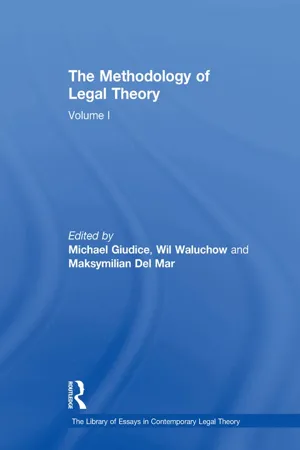
The last decade has witnessed a particularly intensive debate over methodological issues in legal theory. The publication of Julie Dickson's Evaluation and Legal Theory (2001) was significant, as were collective returns to H.L.A. Hart's 'Postscript' to The Concept of Law. While influential articles have been written in disparate journals, no single collection of the most important papers exists. This volume - the first in a three volume series - aims not only to fill that gap but also propose a systematic agenda for future work. The editors have selected articles written by leading legal theorists, including, among others, Leslie Green, Brian Leiter, Joseph Raz, Ronald Dworkin, and William Twining, and organized under four broad categories: 1) problems and purposes of legal theory; 2) the role of epistemology and semantics in theorising about the nature of law; 3) the relation between morality and legal theory; and 4) the scope of phenomena a general jurisprudence ought to address.
Part I
Problems and Aims
[1]
What is Jurisprudence About? Theories, Definitions, Concepts, or Conceptions of Law?
Michael D. Bayles*
Florida State University
Florida State University
Classical writers in jurisprudence such as Thomas Aquinas and John Austin provided definitions of ‘law’. H.L.A. Hart criticized the attempt to address the problems of jurisprudence by a definition of ‘law’. Instead, Hart offered an analysis of the concept of law. Recently, analyst Ronald Dworkin has criticized the project of offering a definition or concept of law as mistaken in principle. Instead, Dworkin advocates developing conceptions of law. What are the differences between definitions, concepts, and conceptions? Are they of the same thing? Are they for the same purposes? If not, what is jurisprudence about?
The argument of this paper is that philosophy of law or jurisprudence (the terms are used synonymously here) seeks to provide theories. However, different purposes generate different kinds of theories which it is important to keep distinct. Much of the dispute between positivism and natural law stems from their proponents seeking different types of theories. Moreover, confusion has resulted from scholars implausibly interpreting one type of theory as another type. Finally, it is important to distinguish different subjects of theories, in particular, those about the legal, legal systems, a law or valid law, and law generally.
The first section briefly distinguishes different types of theories. The next section breifly claims that Aquinas and John Austin presented different types of theories of law and that their definitions of law should be seen as conceptual tools to unify their theories, not as semantic analyses. The third section then discusses Hart’s criticism of definitions of ‘law’ and briefly considers interpretations of his work as offering definitions. The fourth section considers Ronald Dworkin’s attack on semantic theories and what he thinks is the subject matter of jurisprudence. The last major section considers Dworkin’s claim that jurisprudential theories must be normative and that positivism is therefore wrong. Dworkin’s arguments fail, and he and positivists such as Hart can be seen to be offering different kinds of theories.
THEORIES
Legal philosophy provides theories of law, legal systems, validity, and so forth. Theories can have different aims or purposes—to analyze the meaning of terms, to explain, to predict, to evaluate. Semantic theories attempt to provide an analysis of the meaning or use of terms. As understood here, they try to capture actual usage with only minimal suggestions for reform. Some analyses of ‘legal right’ and other legal terms such as ‘contract’ are of this sort.1 Some explanatory theories are conceptual; they try to increase understanding by showing conceptual relations and differences, providing frameworks for interpreting data. They provide ways of seeing how law differs from morality and coercion, how legal systems are structured, and what makes laws valid. They usually explain by giving reasons. Other explanatory and most predictive theories are empirical; they are based on social science. Many economic analyses of law are of this sort, as are those of Weber, Durkheim, and some Marxists. These types of theories often explain by causes rather than reasons. There are also normative jurisprudential theories about what justifies laws. Just as the principle of utility and the categorical imperative provide theories or tests of what makes actions right and wrong, normative jurisprudence provides theories or tests of the justifiability of law. Theories about the harm principle, paternalism, and so on are examples of theories of this sort.2
Many writers in jurisprudence have tried to combine more than one of these purposes into one theory, but there is little reason to expect one theory to serve all these purposes. Explanation and justification are unlikely to go together in law any more than in daily life. A conceptual or causal explanation of Jones’s beating Smith certainly need not provide a justification. Although the two types of explanatory theory might be combined, they are not the same. A conceptual framework for tort law need not explain how it developed or enable one to predict future developments.
The criteria for evaluating jurisprudential theories are probably similar regardless of their aims—consistency, agreement with facts, comprehensiveness, simplicity, and so on. Although a normative theory cannot be tested against facts as an explanatory theory can, a good one cannot rest on false factual claims. A theory of law, such as Dworkin’s, that applies only to liberal, common-law countries is less satisfactory because it is less comprehensive than one that applies to various other legal systems, unless it builds on such a broader theory to indicate what is distinctive of particular types of systems. Simplicity, of course, should not be achieved at the expense of factual accuracy.
Finally, in providing a nonsemantic theory, one might offer a definition, not as encapsulating linguistic usage, but as a stipulative summary of a theory. Long ago Hart wrote that “though theory is to be welcomed, the growth of theory on the back of definition is not.”3 However, definition on the back of theory is not objectionable. Thus, legal philosophy might well offer reformist definitions.
The debate about definitions, concepts, and conceptions of law has been partly muddled by failing to distinguish the particular idea, notion, or subject at issue. At least the following notions should be distinguished. (a) The idea of the legal can be used to distinguish legal norms from other norms. For example, something can be a moral but not a legal requirement or perhaps vice versa. Probably the same idea is involved when one distinguishes law from coercion, for example, “Although I am not legally obligated to do A, my boss will fire me if I don’t.” (b) The idea of a legal system is different. This notion is needed to determine when a legal system exists. For example, years after being driven from the mainland, the government in Taiwan claimed to provide the legal system of China. The notion of a legal system is also needed in analyzing the third notion, (c), that of a law or valid law. This idea helps us discern whether a norm belongs to a particular legal system, say, the laws of Florida rather than those of Georgia. Although we usually have little difficulty on this point, sometimes it is unclear to which system a norm belongs. For example, the Constitution Act, 1981, was passed by the British Parliament but establishes an independent constitution for Canada. To which legal system does this act belong—British, Canadian, or both? One can also be concerned about the individuation of laws. Is the rule of self-defense a separate law, or is it only part of a law prohibiting homicide—an exception to that law? (d) Finally, one can also be concerned with the idea of law generally. Judicial orders, regulations, contracts, wills, principles and so on might be law but perhaps not appropriately called ‘a law’.
DEFINITIONS: AQUINAS AND AUSTIN
Aquinas and Austin clearly provided definitions of law. However, it is doubtful that they presented them as semantic theories. Aquinas used ‘a law’ in a broad sense roughly equivalent to ‘a binding or justifiable norm’. He defined a law as “an ordinance of reason for the common good, made by him who has care of the community, and promulgated.”4 Within this broad definition he included various types of laws—eternal, divine, natural, and human. Thus, his definition was not meant to distinguish human or positive law from ethics; that is done by the specific features of human law—being particular determinations devised by human reason.5 His general purpose was to present a normative theory. He defined ‘law’ to show the unity of justifiable norms. His denial that unjust human laws are really laws was to show that they do not obligate, as is indicated by the title of the article in which he makes the claim—”Whether Human Law binds a Man in Conscience.”6
Like Aquinas, John Austin provided a definition of ‘a law’ broader than that of the state. “A law…[is] a rule laid down for the guidance of an intelligent being by an intelligent being having power over him.”7 This broad definition includes two proper subclasses—divine law and positive or state law. A positive law “is a direct or circuitous command of a monarch or sovereign number in the character of political superior” that obliges to a class of acts or forbearances.8
Austin was probably providing a stipulative definition to suit his purposes.9 His frequent use of the expression “properly so called” indicates his awareness of a wider usage. Unlike Aquinas, Austin was not primarily concerned to demarcate a set of norms that are necessarily justifiable—to provide a normative theory. Indeed, one of his purposes in distinguishing positive from divine law was to indicate that positive laws need not be justifiable. Instead, Austin’s purposes were the conceptual-explanatory ones of distinguishing positive law (the legal) from other matters with which he believed it was frequently confused and thus marking off the subject matter for his subsequent lectures on jurisprudence.10
CONCEPTS: H.L.A. HART
Hart generally rejects the fruitfulness for jurisprudence of definitions of ‘law’. First, he is not concerned with a verbal or semantic definition for people who do not know how to use the term.11 Most people who ask what law is are quite capable of using the term appropriately, yet they are still puzzled about the difference between law and morals or coercion and other matters relating to the “nature” of law.
Second, Hart does not believe that the traditional method of definition by genus and difference will help with these puzzles. This method of definition requires understanding the genus term of which law is a species. However, there are as many puzzles about what an ordinance of reason or command is as there are about what law is. Moreover, Hart contends, this method of definition suggests that some feature or features are common to all instances. Throughout his career, Hart has doubted that is true. He doubts “that in the case of concepts so complex as that of a legal system we can pick out any characteristics, save the most obvious and uninteresting ones, and say they are necessary.”12
Instead of definition by genus and difference, at various places Hart suggests alternative types of definition that might be used. Three of them are pertinent to present purposes. One is to note that a term can identify different parts of a complex activity, for example, railroad stations, railroad tracks, and so on.13 Another is to pick out the standard features of the normal or paradigm instance, recognizing that these features are not necessary and may not be present in nonstandard cases.14 These are cluster definitions; a term is defined by a cluster of characteristics only a subset of which need be present for the term to apply. Some characteristics might be necessary, but they alone would not be sufficient for the application of the term. Finally, Hart distinguishes between the definition of a term and the criteria for its application.15 This point is especially appropriate to principles or rules, such as treating like cases alike, where different criteria of similarity can be used.
In view of the problems that have prompted the question “What is law?” and the difficulties of at least traditional definition, Hart concludes “that nothing concise enough to be recognized as a definition could provide a satisfactory answer to it.”16 Although he discusses cases where legal theorists have had doubts about the application of ‘law’, his purpose “is not to provide a definition of law, in the sense of a rule by reference to which the correctness of the use of the word can be tested.”17 Instead, he seeks to provide an analysis of legal systems and a better understanding of the difference between law, morality, and coercion.
Hart’s reasons for rejecting definitions of law are not overwhelmingly persuasive. He basically provides three: (a) definition by genus and difference does not help because the genus terms are just as problematic; (b) there are no necessary and sufficient conditions for the use of ‘law’; and (c) answers to the puzzles prompting searches for a definition are too long to be a definition. Even Hart recognizes that the first two points are unsatisfactory, because there are other types of definition.18 Thus, the burden of his objection is that the answers to jurisprudential puzzles are too long to be encapsulated in a definition. However, although full answers cannot be contained in a concise definition, it can briefly summarize the essentials of a theory. No one would take Aquinas’s or Austin’s definition as a full statement of his theory, but in explaining their theories to others it is often useful to start with their definitions. One must then, say, for Austin, explain what political superiors, commands, and so on are. Definition as a key to a theory is not objectionable.
Indeed, commentators have found Hart’s own theory to be capable of encapsulation in a definition.19 In particular, Hart seems to provide a de...
Table of contents
- Cover
- Half Title
- Title Page
- Copyright Page
- Table of Contents
- Acknowledgements
- Series Preface
- Introduction
- PART I PROBLEMS AND AIMS
- PART II ISSUES OF SEMANTICS AND EPISTEMOLOGY
- PART III PERSPECTIVES ON MORALITY IN THE THEORY OF LAW
- PART IV ISSUES OF SCOPE AND CONCEPTS
- Name Index
Trusted by 375,005 students
Access to over 1.5 million titles for a fair monthly price.
Study more efficiently using our study tools.
Frequently asked questions
Yes, you can cancel anytime from the Subscription tab in your account settings on the Perlego website. Your subscription will stay active until the end of your current billing period. Learn how to cancel your subscription
No, books cannot be downloaded as external files, such as PDFs, for use outside of Perlego. However, you can download books within the Perlego app for offline reading on mobile or tablet. Learn how to download books offline
Perlego offers two plans: Essential and Complete
- Essential is ideal for learners and professionals who enjoy exploring a wide range of subjects. Access the Essential Library with 800,000+ trusted titles and best-sellers across business, personal growth, and the humanities. Includes unlimited reading time and Standard Read Aloud voice.
- Complete: Perfect for advanced learners and researchers needing full, unrestricted access. Unlock 1.5M+ books across hundreds of subjects, including academic and specialized titles. The Complete Plan also includes advanced features like Premium Read Aloud and Research Assistant.
We are an online textbook subscription service, where you can get access to an entire online library for less than the price of a single book per month. With over 1.5 million books across 990+ topics, we’ve got you covered! Learn about our mission
Look out for the read-aloud symbol on your next book to see if you can listen to it. The read-aloud tool reads text aloud for you, highlighting the text as it is being read. You can pause it, speed it up and slow it down. Learn more about Read Aloud
Yes! You can use the Perlego app on both iOS and Android devices to read anytime, anywhere — even offline. Perfect for commutes or when you’re on the go.
Please note we cannot support devices running on iOS 13 and Android 7 or earlier. Learn more about using the app
Please note we cannot support devices running on iOS 13 and Android 7 or earlier. Learn more about using the app
Yes, you can access The Methodology of Legal Theory by Michael Giudice,Wil Waluchow in PDF and/or ePUB format, as well as other popular books in Law & Jurisprudence. We have over 1.5 million books available in our catalogue for you to explore.