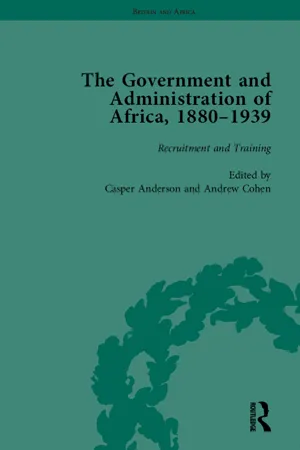
This collection makes available rare sources on the aims, functions and effects of British administration in Africa. Topics examined include: land and urban administration, law and jurisprudence, taxation and administration of natural resources.
eBook - ePub
The Government and Administration of Africa, 1880-1939 Vol 1
- 2,080 pages
- English
- ePUB (mobile friendly)
- Available on iOS & Android
eBook - ePub
The Government and Administration of Africa, 1880-1939 Vol 1
About this book
Trusted by 375,005 students
Access to over 1.5 million titles for a fair monthly price.
Study more efficiently using our study tools.
[Warren Fisher], Report of a Committee on the System of Appointment in the Colonial Office and the Colonial Services, House of Commons Parliamentary Papers [Cmd. 3554] (London: Her Majesty’s Stationery Office, 1930).
PART I.
THE COLONIAL SERVICES.1
THE COLONIAL SERVICES.1
I. The Colonial Empire.
The territories which fall within the sphere of the Colonial Office cover an area of about two million square miles – nearly twice the size of British India – and contain a population of nearly fifty millions – nearly twice the total population of the oversea Dominions. Except for some 160,000 square miles with four millions of people, these territories lie wholly within the tropics.
In these areas the administrative systems are sometimes described as The Colonial Service, as though they constituted a single Service with uniform terms and common conditions. Such an illusion does not survive the most cursory examination. As a matter of fact the Secretary of State for the Colonies has to deal with the affairs of more than fifty distinct governments. Each, whether it deals with a population of many millions in a territory as large as Central Europe, or with a few thousand people in a remote island group, has its own administrative and technical services, its own scales of pay and conditions of leave, passage home, and pensions.
These territories, since they include units of every size and economic importance in every corner of the globe, show a remarkable variety of conditions of life and material equipment. Some have achieved self-government in a greater or lesser degree, while others are under direct official control. They include Colonies proper, which are British territory, Protectorates, Protected States, Mandated territory, Leased territory, and a Condominium. In some of them there is an intelligent and influential public opinion and a well-informed Press, while others remain relics of an earlier world.
In an Empire so widely scattered and so curiously varied, the extent to which the Services of the different territories recruit their staff from the mother country must obviously depend upon their size and wealth and the degree in which they are able to draw for their officials upon the local population.
The Colonial Services have immeasurably increased in importance of recent years, through the remarkable development of many of the Dependencies in material wealth, and consequently in the standard of living, through the wider interests which this increased prosperity has brought to them, and through the greater / mobility of the population owing to improvements in transport. This development is for the most part a very recent thing. The overseas trade of the Dependencies has trebled in the last twenty years. The sum of the Government revenues has increased from ten and a half millions sterling in 1900 to twenty-five and a half millions in 1913, and seventy-two millions in 1927.
This development had already begun in the period immediately preceding the Great War. The years of war were in most respects a time of stagnation. The rate of development was not maintained; there was inevitably a check in recruitment for the Colonial Services; and at the end of the War many Dependencies were in the position of “countries of arrears”. But from the Armistice onward their advance has been rapid. Moreover, the administrative area of the Colonial Empire has been extended through the acceptance by His Majesty of certain ex-enemy territories under the Mandate system.2
Along with the economic development there has been evolved a new sense of responsibility for the welfare and education of the native peoples in the tropical territories and Protectorates of the Crown. It is now a truism that the duty of trusteeship is the guiding principle of Colonial administration, and this principle has a very real application to our enquiry. To a large extent the services which at home are supplied by private or municipal enterprise fall to be carried on in the Dependencies by the Colonial Governments themselves. With the increased resources now available those services are continually extending, not only in connection with the material improvement of life, the preservation of peace and order, improved medical facilities and measures for public health, but in the direction of the provision of education for different types, the study of social anthropology, the revival or protection of native forms of culture, and every activity which can promote moral and intellectual progress.
With these new purposes the public Services have endeavoured to keep pace. In extent and complexity they have grown out of all comparison with their position thirty years ago, or even just before the War. The sum of the expenditure by the Colonial Governments on all their activities in 1929 was estimated at £68,000,000, as compared with an expenditure of £19,000,000 in 1909.* In 1909 the total staffs of all Government branches numbered approximately 93,280, while in 1929 the corresponding figure was 220,770. This contrast was reflected in the figures / of the staff required from this country; in 1909 the appointments made to the Colonial Services from home were 657: in 1929 they numbered 1,076. For a true comparison it should be noted that many classes of appointment which twenty years ago were normally filled from home are now staffed locally. The contrast is not merely a matter of numbers: modern conditions demand also a generally higher standard of personal, educational, and professional qualifications, and in addition the employment of men with scientific and special attainments of a kind not previously to be found in Colonial service.
Bearing these facts in mind, we can appreciate the diversity and complexity of the work for which the Colonial Office is now responsible. The rapidly changing situation overseas has required many developments in the reorganization of that Office, of which we desire to mention in particular three recent instances. The first is the appointment to the Office of specialist advisers on certain subjects: in 1926, a Chief Medical Adviser: in 1927, an Economic and Financial Adviser: in 1929, an Adviser on Tropical Agriculture. The second is the institution of special Standing Committees to secure expert advice on matters of growing importance to the Colonies, such as education, medical research, and tropical agriculture. The third is the institution in 1927 of periodical conferences at the Colonial Office of Colonial Governors, or their deputies, with British Ministers and the principal members of the permanent staff of the Department. We understand that twenty-six Colonial administrations were represented at that Conference, and that the list of subjects on which there was a free exchange of views included such matters as the recruitment and training of Colonial Civil Servants and the whole general conditions of service overseas. This Conference elicited evidence of the highest value, and we shall venture to refer in later pages of this Report to certain of the views recorded in the published summary of its proceedings (Cmd. 2883).3
The Colonial Empire has therefore become a problem of the first magnitude, both on the quantitative and the qualitative side. Its geographical area has been largely extended, its wealth is advancing every year, and the duties of government have been increased in number and immeasurably increased in complexity. On the political side we are labouring to establish a regime which seeks to preserve what is best in the traditional native culture, rather than to provide a cleared ground for the establishment of a ready-made alien polity. Such a purpose demands a high degree of knowledge and understanding on the part of the administrators. On the economic side we have to bring to bear the latest results of scientific research on the development of wealth, which is important not only to the Colonies themselves, but also to the Empire and to the world. Most of the greater problems of the Colonies to-day are problems of applied science. Obviously, in a field so intricate and so fateful, the organization of the Government Services demands the most scrupulous care. /
1909. | 1929. | |
Administration | 1,066,000 | 4,831,000 |
Medical .. | 1,149,000 | 6,211,000 |
Education .. | 557,000 | 3,970,000 |
Public Works | 3,773,000 | 17,713.000 / |
II. The Present System of Appointment to the Colonial Services.
A. THE APPOINTING AUTHORITY.
In the Colonial Regulations there are laid down certain rules of general application to the Dependencies, regarding appointments to public offices, and the limits within which Governors have power to make appointments in the public service of their territory without the prior approval of the Secretary of State. These rules are directions given by the Crown to Governors for general guidance and do not constitute a contract between the Crown and its servants. In general the appointments to public offices are made by letter signed by the Governor or written by his direction, except in the case of Judges of the Supreme Court, who are appointed in His Majesty’s name by an instrument under the Public Seal of the Colony.
The effect of such regulations is that the Governor may make appointments to offices of which the initial emoluments do not exceed £200 a year: to offices with initial emoluments above that figure but less than £400 a year he may appoint provisionally and subject to the Secretary of State’s approval. In neither case, however, does this power of a Governor extend to the selection of persons not resident in the Colony. All appointments to offices of which the initial emoluments exceed £400 a year rest with the Secretary of State.
In certain Dependencies local variations of a minor character have in fact been authorized by the Secretary of State in the direction of extending the Governor’s powers – both in respect of the limit of £400, and of the appointment of persons locally domiciled or domiciled in neighbouring Dominion territory, e.g., appointments to Northern Rhodesia from South Africa, and to the Western Pacific Islands from Australia and New Zealand. In particular Colonies, where there are locally domiciled c...
Table of contents
- Cover
- Half Title
- Title Page
- Copyright Page
- Table of Contents
- Acknowledgements
- General Introduction
- Bibliography
- Editorial Note
- Recruitment and Training
- The Colonial Office List for 1900 (1900), ‘Information as to Colonial Appointments’
- The Dominions Office and Colonial Office List for 1939 (1939), ‘Information as to Colonial Appointments’
- Regulations for His Majesty’s Colonial Service (1911)
- The Land of Death (1887)
- British Medical Journal
- The West African Pocket Book. A Guide for Newly-Appointed Government Officers, 2nd edn (1906)
- Colonies (General), Circular Despatch. Dated 15th February, 1907, Relative to the Part Taken by Ex-Governors of Colonies in the Organization or Direction of Companies Formed to Operate in Territories which they were Recently Administering 1907 (1907)
- Colonial Nursing Association, Tenth Annual Report of the Executive Committee of the Colonial Nursing Association (1906)
- Unpublished Memoir of the Sudan Political Service (1928–54)
- ‘Liaison with Universities in the Self-Governing Dominions’ (1929)
- ‘Memorandum Showing the Progress and Development in the Colonial Empire and in the Machinery for Dealing with Colonial Questions from November 1924, to November, 1928’ (1928)
- ‘Recruitment and Training of Colonial Civil Servants’ (1927)
- Confidential Memorandum by the Governor of the Gold Coast (1927)
- Colonial Office Conference, Summary of Proceedings, ‘Recruitment and Training of Colonial Civil Servants’ (1927)
- Speech for a Meeting with Vice Chancellors and Headmasters at Board of Education (1928)
- Colonial Agricultural Service, Report of a Committee Appointed by the Secretary of State for the Colonies (1928)
- Report of a Committee on the System of Appointment in the Colonial Office and the Colonial Services (1930)
- ‘Recruitment in Colonial Service’ (1930)
- Colony and Protectorate of Kenya, Pensions Committee, Interim Report (1928)
- ‘Memorandum on Colonial Research’ (1927)
- ‘A Re-Statement of Indirect Rule’ (1934)
- Oxford Summer School on Colonial Administration (1938)
- Colony of Nigeria, ‘Life and Duties of an Administrative Officer in Nigeria’ (Draft Pamphlet) (1933)
- ‘Colonial Administration in East Africa from the Native Point of View’
- Editorial Notes
Frequently asked questions
Yes, you can cancel anytime from the Subscription tab in your account settings on the Perlego website. Your subscription will stay active until the end of your current billing period. Learn how to cancel your subscription
No, books cannot be downloaded as external files, such as PDFs, for use outside of Perlego. However, you can download books within the Perlego app for offline reading on mobile or tablet. Learn how to download books offline
We are an online textbook subscription service, where you can get access to an entire online library for less than the price of a single book per month. With over 1.5 million books across 990+ topics, we’ve got you covered! Learn about our mission
Look out for the read-aloud symbol on your next book to see if you can listen to it. The read-aloud tool reads text aloud for you, highlighting the text as it is being read. You can pause it, speed it up and slow it down. Learn more about Read Aloud
Yes! You can use the Perlego app on both iOS and Android devices to read anytime, anywhere — even offline. Perfect for commutes or when you’re on the go.
Please note we cannot support devices running on iOS 13 and Android 7 or earlier. Learn more about using the app
Please note we cannot support devices running on iOS 13 and Android 7 or earlier. Learn more about using the app
Yes, you can access The Government and Administration of Africa, 1880-1939 Vol 1 by Casper Anderson,Andrew Cohen in PDF and/or ePUB format, as well as other popular books in History & World History. We have over 1.5 million books available in our catalogue for you to explore.