This collection makes available rare sources on the aims, functions and effects of British administration in Africa. Topics examined include: land and urban administration, law and jurisprudence, taxation and administration of natural resources.
eBook - ePub
The Government and Administration of Africa, 1880-1939 Vol 4
- 2,080 pages
- English
- ePUB (mobile friendly)
- Available on iOS & Android
eBook - ePub
The Government and Administration of Africa, 1880-1939 Vol 4
About this book
Trusted by 375,005 students
Access to over 1.5 million titles for a fair monthly price.
Study more efficiently using our study tools.
Information
Henry Wilson Fox, The British South Africa Company Memorandum: Containing Notes and Information Concerning Land Policy (London: Waterlow & Sons, 1912). Derbyshire County Record Office, D3287 BSA/5/465.
NOTES AND INFORMATION CONCERNING LAND POLICY.
PREFACE.
I understand that, on the return of Mr. Birchenough, the Board proposes to review its land policy, and to consider what can be done to give a greater value to the Company’s land assets.
The main object of this volume is to present the principal facts of the situation so far as I am in a position to ascertain them from material available in this Office, to state the conclusions at which I have arrived in regard to policy and practice, and to supply in Appendices a number of documents for ease of reference. I have added maps to illustrate certain special points.
The question of the Company’s title to land is dealt with so fully in Chapter 4 of my Memorandum of 18th July, 1912, that it is not necessary to refer to it again. For my present purpose I assume that the Company has a good title to the whole of the unalienated land of Rhodesia, subject to such deductions as it may still be necessary to make to meet the requirements of the native population.
The scope of these notes is limited to pastoral and agricultural land.
My thanks are due to Mr. Maude and Mr. Jesser Coope for their most valuable assistance.
| 21st November, 1912. | H. WILSON FOX.1 / |
CHAPTER I.
THE COMPANY’S LAND HOLDINGS.
1. THE SITUATION, EXTENT AND CHARACTER OF THE COMPANY’S LAND HOLDINGS.
At the outset of any endeavour to ascertain the manner in which the land holdings of the Company can be most advantageously dealt with, the questions naturally present themselves: –
(1) What land does the Company own or control?
(2) What land has been alienated and with what results?
(3) What are the characteristics of the land?
A. Southern Rhodesia
(1). Situation and extent of the Company’s Land.
I attach a map of Southern Rhodesia from which information under this heading can be obtained more easily than by mere description. The map is coloured in broad outline to show the present disposition of the land.2 The respective areas are approximately as follows: –
Present disposition of land.
| ACRES | ||||
| (1) Held by Companies | *8,030,594 | |||
| (2) Held by Individuals | 14,092,486 | |||
| (3) Native Reserves | 24,877,150 | |||
| (4) B.S.A. Company’s Land | ACRES. | |||
| (a) Estates | 156,209 | |||
| (b) Unalienated Land | 47,931,561 | |||
| 48,087,770 | ||||
| TOTAL | 95,088,000 |
It may be noted that of the 47,931,561 acres still unalienated 25,646,700 acres are situated below the 3,500 feet line of altitude, and are presumably unsuited for European settlement in the ordinary sense. On the other hand there is no reason to suppose that such land, outside the tsetse belts, is not adapted to cattle. In fact cattle are known to thrive in low-lying, hot valleys. The land already alienated comprises generally speaking the highest and at present the most accessible portions of the territory, though not necessarily the most valuable.
Unalienated land below 3,500 feet altitude.
Suitable for cattle.
It must be remembered that the boundaries of native reserves are not definitely fixed, and that in the future as in the past it will probably be possible to secure the consent of the Imperial Authorities to readjustments. On the other hand it is unlikely that the total area devoted to this purpose will ever be appreciably reduced.
Native reserves
(2). Results of Alienation of Land upon Population.
The Census of 1911, showed that of a total European population at the 7th May, 1911, numbering 23,606, the proportion engaged in agricultural pursuits was / only 2,140, or 9.06 per cent. On this figure it would probably be a liberal estimate to assume that there are to-day 5,000 persons upon the land, but taking this outside assumption, the density of the white population upon land held by Companies and individuals is less than one person per 4,000 acres.
Density of European population in rural districts
Figures not representative of Company’s recent work
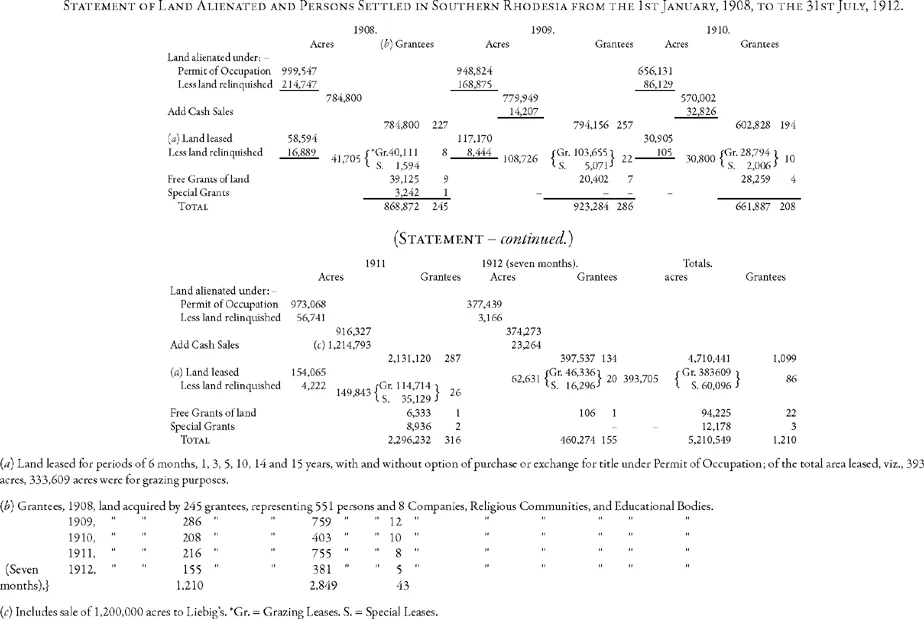
It would not, however, be fair to take this figure as representative of the Company’s recent work in connection with settlement. The greater portion of the large area now held by Companies was alienated in the early days of Rhodesia, and the Company has had since no say in its development. The results of recent policy are to be found in the following figures, which are concerned solely with the last 4½ years.
It will be seen from these figures that 2,849 persons have been settled during the last 4½ years upon 5,210,549 acres. Taking a round figure of 3,000 persons so as to cover individuals settled upon the land alienated to Companies, we arrive at a density of population upon land recently settled of 1 person per 1,736 acres.
Density of settlement during the last 4½ years.
I deal in Chapter III. with the direct and indirect financial results to the Company of its past policy in regard to the alienation of land. /
Financial results.
Tables showing results of settlement for the last 4½ years
(3). Characteristics of Land in Southern Rhodesia.
I print, for convenience of reference, in Appendix I.,3 a number of general reports by eminent authorities who have been employed by the Company at different times to report upon various aspects of its land holdings. Further information of the same nature may be found in the Reports of the Agricultural Department of Southern Rhodesia and in the Agricultural Journal issued by that Department. I also refer to Chapter I, of my Memorandum, “Problems of Development and Policy,” dated 15th January, 1910.
While the capacities of the land, nature of the soil, rainfall, altitude, &c., vary from district to district, it is, nevertheless, possible to state some broad conclusions upon the authority of the experts who have from time to time expressed their views.
(1). CATTLE-RAISING.
All authorities agree that Rhodesia is pre-eminently a stock-raising country, as the following quotations show: –
Rhodesia preeminently a stock country VIEWS OF EXPERTS: Lieut.-Col. Owen Thomas
Lieut.-Col. Owen Thomas, in a Report dated 15th March, 1904,* states: –
“The inference which I drew, after 3½ years in South Africa (where I had unusual opportunities of examining conditions of agriculture and pasturage, qualities of soils and herbage, values of land, etc.), was that Rhodesia is pre-eminently suitable for stock-farming. Indeed, I have stated as clearly as possible my firm conviction that as regards the pastoral aspect of husbandry, Rhodesia possesses qualifications which are unrivalled in South Africa. And I fearlessly re-assert this opinion; for I cannot be oblivious to the many presently insuperable obstacles which impede the progress of agriculture, although I personally sympathise most heartily with those who (for excellent reasons) would choose rather to engage in and to foster the latter branch of husbandry. At the same time I foresee that (with the augmentation of industrial activity) there will be a tendency toward the advancement of agricultural activity; but at this date its practicability as a leading national industry of Rhodesia cannot be demonstrated to the satisfaction of the serious agriculturist. I frankly admit my failure to solve the problem of success in agriculture in Rhodesia, except as a minor adjunct of stock-farming; but I unreservedly recognise the immense suitability of that country for the pastoral branch of husbandry.”
Mr. W. B. Gordon, C.I.E.
Mr. W. B. Gordon, C.I.E., speaking of the granite formation near Marandellas, which is typical of vast areas of country, says, in a Report dated 13th January, 1907†: –
“On the other hand, the lands appear to be eminently suited for stock. As is usual in granite formations, they are watered by a multitude of small streams, many of which run throughout the year; and although these during the dry months are too small in volume to provide water for irrigation on an extensive scale, they will be invaluable for domestic purposes and for the watering of cattle.”
Prof. Robert Wallace
Professor Robert Wallace reported on the 21st October, 1908,* as follows: –
“Southern Rhodesia is essentially a live stock country, and for the present by far its greatest possibilities lie in the bovine branch of the industry. I formed a very high opinion of its possibilities for the breeding...
Table of contents
- Cover
- Half Title
- Title Page
- Copyright Page
- Table of Contents
- Rural and Urban Land
- Report of the Land Committee, East Africa Protectorate (1905)
- Settling Farmers in the Matopo Valley, Southern Rhodesia (1904)
- Henry Wilson Fox, The British South Africa Company Memorandum: Containing Notes and Information Concerning Land Policy (1912)
- W. J. Simpson, Report on Plague in the Gold Coast in 1908 (1908)
- Nairobi Sanitary Commission, Report, Evidence, &c. (1913)
- Papers relating to the Southern Rhodesia Native Reserve Commission (1917)
- Correspondence on the Subject of Grants of Land in the East African Protectorate to Men who have Taken Part in the War (1917)
- J. W. Barth, Report of the Land Settlement Commission (1919)
- W. H. McLean, ‘Town Planning in the Tropics. With Special Reference to the Khartoum City Development Plan’ (1913)
- Prof. W. J. Simpson, ‘Segregation and Town-Planning in Northern and Southern Nigeria’ (1920)
- Norman Leys, ‘Memorandum on the Land Question in Tropical Africa’ (1922)
- Report of the Commission of Inquiry into the Affairs of the Freetown Municipality, May–July, 1926 (1926)
- ‘Interview Granted by the Secretary of State for Dominion Affairs to Tshekedi Khama’ (1930)
- ‘The Mine Townships Ordinance, 1932’ (1934)
- Editorial Notes
Frequently asked questions
Yes, you can cancel anytime from the Subscription tab in your account settings on the Perlego website. Your subscription will stay active until the end of your current billing period. Learn how to cancel your subscription
No, books cannot be downloaded as external files, such as PDFs, for use outside of Perlego. However, you can download books within the Perlego app for offline reading on mobile or tablet. Learn how to download books offline
Perlego offers two plans: Essential and Complete
- Essential is ideal for learners and professionals who enjoy exploring a wide range of subjects. Access the Essential Library with 800,000+ trusted titles and best-sellers across business, personal growth, and the humanities. Includes unlimited reading time and Standard Read Aloud voice.
- Complete: Perfect for advanced learners and researchers needing full, unrestricted access. Unlock 1.5M+ books across hundreds of subjects, including academic and specialized titles. The Complete Plan also includes advanced features like Premium Read Aloud and Research Assistant.
We are an online textbook subscription service, where you can get access to an entire online library for less than the price of a single book per month. With over 1.5 million books across 990+ topics, we’ve got you covered! Learn about our mission
Look out for the read-aloud symbol on your next book to see if you can listen to it. The read-aloud tool reads text aloud for you, highlighting the text as it is being read. You can pause it, speed it up and slow it down. Learn more about Read Aloud
Yes! You can use the Perlego app on both iOS and Android devices to read anytime, anywhere — even offline. Perfect for commutes or when you’re on the go.
Please note we cannot support devices running on iOS 13 and Android 7 or earlier. Learn more about using the app
Please note we cannot support devices running on iOS 13 and Android 7 or earlier. Learn more about using the app
Yes, you can access The Government and Administration of Africa, 1880-1939 Vol 4 by Casper Anderson,Andrew Cohen in PDF and/or ePUB format, as well as other popular books in History & World History. We have over 1.5 million books available in our catalogue for you to explore.