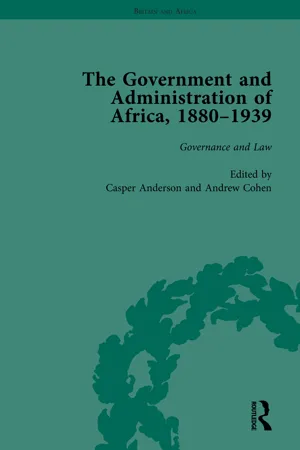
eBook - ePub
The Government and Administration of Africa, 1880-1939 Vol 2
- 2,080 pages
- English
- ePUB (mobile friendly)
- Available on iOS & Android
eBook - ePub
The Government and Administration of Africa, 1880-1939 Vol 2
About this book
This collection makes available rare sources on the aims, functions and effects of British administration in Africa. Topics examined include: land and urban administration, law and jurisprudence, taxation and administration of natural resources.
Trusted by 375,005 students
Access to over 1.5 million titles for a fair monthly price.
Study more efficiently using our study tools.
Information
Subtopic
World HistoryIndex
HistoryJ. L. Maffey, Minutes from the Governor-General of Sudan, ‘Devolution in Native Administration’ (1 January 1927). Sudan Archive, Durham University, 695/8/3.
MINUTE HIS EXCELLENCY THE GOVERNOR GENERAL,1 DATED 1:1:27.
Before going off on tour I take the opportunity of putting down somewhat hastily my first and necessarily immature reflections on what appears to me to be an urgent and vital matter for the Sudan, namely our present attitude towards the principle of general administrative policy as enunciated in the 1924 Memorandum.
1. The pivotal idea is contained in the following extract from the Milner Report:–2
“Having regard to its vast extent and the varied character of its inhabitants, the administration of its different parts should be left, as far as possible, in the hands of the native authorities, wherever they exist, under British supervision. Decentralisation, and the employment, wherever possible, of native agencies for the simple administrative needs of the country, in its present stage of development, would make both for economy and efficiency.”
The Memorandum elaborates the view that there are two agencies for the realisation of this aim:
“The first and most important consists of the tribal chiefs and sheikhs as such, that is as administering their own tribes. The second are executive officials selected for the public service from the ranks of the native population.”
These two agencies appear to me to work along divergent tracks and be in a sense antagonistic.* The appointment of natives to the public service is merely a convenience to the alien bureaucracy of which it is a part.
2. The grant of powers to native magistrates and sheikhs is more in keeping with the prime principle, but here again unless such machinery stands on a true native and traditional basis it is off the main drive. Advisory Councils cropped up as a possible means to our end but the proposal was not well received and I think there were good grounds for hesitation. Later on in certain intelligentsia areas, when we have made the Sudan safe for autocracy, such Councils may be innocuous or even desirable. Also Advisory Councils to Chiefs would be in keeping with the broad principle. Otherwise Advisory Councils contain the seeds of grave danger and eventually present a free platform for capture by a pushful [sic] intelligentsia.
3. If the encouragement of native authority in the true sense of the Milner formula is our accepted policy, before old traditions die we ought to get on with extension and expansion in every direction, thereby sterilising and localising the political germs which must spread from the lower Nile into Khartoum.
Under the impulse of new ideas and with the rise of a new generation, old traditions may pass away with astonishing rapidity. It is advisable to fortify them while the memories of Mahdism and Omdurman are still vivid and while tribal sanctions are still a living force. The death of two or three veterans in a tribe may constitute a serious break with the past.
Such anxiety on my part may seem far-fetched to those who know the outlying parts of the Sudan. Perhaps it is, for I realise the wide range of differing conditions. But I have watched an old generation give place to a new in India and I have seen how easily vague political unrest swept over even backward peoples simply because we had allowed the old forms to crumble away. Yet the native states in India remain safe and secure in the hands of hereditary rulers, loyal to the King Emperor, showing what we might have done if we had followed a different course. We failed to put up a shield between the agitator and the bureaucracy.
4. Political conditions are still easy in the Sudan. But nothing stands still and in Khartoum we are already in touch with the outposts of new political forces. For a long time the British Administrative Officer in the Sudan has functioned as “Father of the People”. In many places he will for a long time so continue. But this cannot last. The bureaucracy must yield either to an autocratic / or to a democratic movement and the dice are loaded in favour of the latter. If we desire the former, the British Officer must realise that it is his duty to lay down the role of Father of the People. He must entrust it to the natural leaders of the people whom he must support and influence as occasion requires.
In this manner the country will be parcelled out into nicely balanced compartments, protective glands against the septic germs which will inevitably be passed on from the Khartoum of the future.
Failing this armour we shall be involved in a losing fight throughout the length and breadth of the land. The possibility may be remote but the course of events in other parts of the world show that it is never too early to put one’s house in order.
5. Speaking constructively, and subject to the advice of others who know these problems through close personal contact with them, I feel that we ought to:–
(a)Experiment boldly with schemes of transferred administrative control, making no fetish of efficiency, remembering that in the long run the temper of his own people will do more to keep a native ruler straight than alien interference, and not forgetting that our efficiency is often more apparent than real and lacks those picturesque and “amour propre” qualities of native rule which compensate for its apparent crudities;
(b)be prepared to grant a worthy scale of remuneration to the Chiefships we foster, great and small in order to give them dignity and status, in the confident hope that we shall thereby be saved in the long run from costly elaborations of our own administrative machinery.
(SGD) J. L. MAFFEY
KHARTOUM.
1st January, 1927.
M.R.
Note
*In this connection on please see S.C. Circular 1.H. 1 of 20:10:24 “Sudanese Sub-Mamur System and Decentralisation.” which has His Excellency’s approval in principle. /
Petition Against the Appointment and Deposition of Chiefs Bill, 1930, to the Right Honourable Lord Passfield,1 P.C., His Majesty’s Principal Secretary of State for the Colonies. Adopted by the Lagos Section of the National Congress of British West Africa at an Extra-Ordinary Meeting held at the Glover Memorial Hall, Lagos, on Monday 10 March 1930 (London: Colonial Office, 1930).
The Right Honourable
LORD PASSFIELD, P.C.,
Principal Secretary of State for the Colonies,
Colonial Office, Downing Street,
LONDON, S.W., ENGLAND.
My Lord,
The Petition of the undersigned members of the Lagos Section of The National Congress of British West Africa2 humbly and respectfully sheweth:–
1. That your Petitioners are representatives of the National Congress of British West Africa. Lagos Section, the members whereof are drawn from the Colony and Protectorate of Nigeria, and are loyal subjects of His Most Gracious Majesty King George the Fifth.
2. That in a Session of The Legislative Council of the Colony of Nigeria commenced in the town of Lagos in the Colony aforesaid on the 30th day of January 1930 and ended on the 5th day of February 1930, The Legislature passed a Bill entitled “An Ordinance to provide for the Appointment and Deposition of Chiefs in the Colony and Head Chiefs in the Protectorate” the widespread dissatisfaction and protest of the community, and the votes of all the elected Members and those of the majority of the nominated Unofficial Members against the Bill, notwithstanding.
3. That at a meeting of Congress held on the 14th day of February 1930 at the Glover Memorial Hall in the town of Lagos in the Colony aforesaid, the subject matter of the aforementioned Bill, falling as it does within the scope of Congress policy, engaged the careful deliberation of members who then unanimously passed the Resolution hereto annexed and marked “Appendix X”.
4. That your Petitioners having secured the entire and unflinching support of The National Congress of British West Africa, on the West Coast of Africa, in accordance with the terms of Clause 4 of their Resolution as mentioned in paragraph 3 hereof, again assembled on the 10th day of March 1930 at an extraordinary Meeting held at the Glover Memorial Hall aforesaid, to protest against the Bill aforementioned, when it was unanimously resolved, that a petition be submitted to Your Lordship, as per exhibit also attached and marked “Appendix Y”; and that, in the interim, a cablegram be addressed to The Secretary of State, on the ground of urgency, praying him to withhold his assent from the aforesaid Bill.
5. That this document, to which your Petitioners have respectfully set their signatures and marks, is the Petition referred to in the Resolution of Congress set out in paragraph 4 hereof, which was also adopted and passed by the said meeting.
6. That your Petitioners, as Loyal Subjects of His Most Gracious Majesty the King Emperor, humbly and respectfully beg to record their protest against the Bill, on the various grounds set forth hereunder:
(i)That in so far as its objects are concerned, the Bill seeks, quite unjustifiably, to encroach on and to displace an ancestral right and a privilege of certain sections of His Majesty’s Subjects throughout the Colony and Protectorate of Nigeria, to elect their own Chiefs, which right and privilege are founded upon good conscience and immemorial User.
(ii)That the Bill seeks to invest the Governor with full power to operate with impunity on the liberty of Native Chiefs and Native Officials, since, when read along with an Ordinance already in force in the Colony and Protectorate of Nigeria, to wit: “The Deposed Chiefs Removal Ordinance, “it constitutes the Governor “The Sole, highest and only judge of Native law and custom, concerning the deposition, appointment and deportation of Native Chiefs and Native Officials within the said Colony and Protectorate. /
(iii)That in so far as the Bill creates disabilities on persons not of European birth or descent in the Colony and Protectorate of Nigeria, it not only deprives the people of their sole or exclusive right to elect and depose their own Chiefs, but it also makes a wide incision into the right of the people to elect persons – and persons only – who by Native law and custom are entitled to be made Chiefs, inasmuch as “The Governor may himself appoint such person as he may deem fit and proper to carry out such duties incidental to the Chieftaincy as it may be necessary to perform”. It also empowers the Governor to make appointment in contra distinction to the exclusive and inherent right of the people to elect their own Chiefs or Rulers.
(iv)That accustomed as the people have been, from time immemorial, to elect their own Rulers, Chiefs and Native Officials from the common stock whence they themselves originate, and to remove such Rulers, Chiefs or Native Officials in times of necessity, by means only of the popular vote, it argues a reasonable conviction that their constitution has all along and hitherto been based on the principles of democracy, and therefore your Petitioners view with great disfavour any attempt to wrench asunder the Status Quo in substitutions of a policy which appears to be tainted with autocracy and despotism.
(v)That if passed into law, the Bill would lead to a complete disruption of the best, highest and purest Native Institution in the Colony and Protectorate of Nigeria, and would also militate against the common and immemorial interest of the people, which interest is solemnly regarded by them as one of their most sacred constitutional privileges.
(vi)That your Petitioners view with grave apprehension the fact that the Bill does not only seek to destroy an inherent jurisdiction of His Majesty’s Supreme Court of Nigeria to determine all matters touching and affecting the appointment, deposition and deportation of Native Chiefs within the Colony and Protectorate, but it also seeks to deprive His Majesty of His ancient Prerogative of hearing petitions from a section of His Subjects, inasmuch as the Governor is to be constituted “The Sole judge” of Native law and custom, and therefore an appeal is not intended to lie as of right from his judgment.
(vii)That the Bill seeks to place the Governor in that most extraordinary position where, in exercising his power over Native Chiefs and Native Officials, he may depose, appoint and deport them with impunity, the Governor being answerable only to God and his own conscience, and therefore your Petitioners humbly submit that the Bill is repugnant to natural justice, equity and good conscience.
(viii)That your Petitioners respectfully beg to urge that the Bill is also a direct negation of one of those ancient and plain Rules of the British Constitution to wit: Nemo Debet Esse Judex in Propria Sua Causa,3 and for that reason, it is in every respect antipodal to good Government, since it seeks to place the Governor in a position wherein he may become an aggressor and a “Sole Judge” of his own aggression, he being apparently screened by a stratagem which no defendant in any English Court of Justice could enjoy.
(ix)That one of the objects of the Bill, in so far as the Legislature has attempted to constitute the Governor a judge appears to your Petitioners to resolve itself into a direct contravention of Letters Patent under the Great Seal of the United Kingdom, constituting the Office of Governor and Commander-in-Chief of the Colony of Nigeria, and providing for the Government thereof.
(x)That conceding, in the alternative, that the Legislature acted intra vires its powers in passing the Bill in Council, it appears to your Petitioners very dissonant and indeed very unnatural to make the / Governor a “Sole judge”, and yet to constitute no Courts wherein he may dispense Native law and custom to His Majesty’s subjects, in accordance with the dictates of English Jurisprudence.
(xi)That in so far a...
Table of contents
- Cover
- Half Title
- Title Page
- Copyright Page
- Table of Contents
- Governance and Law
- Royal Niger Company (1899)
- Royal Niger Company, Regulations (1886)
- Imperial British East Africa Company, The Settlement of Uganda and British East Africa Company (1894)
- ‘Memorandum on the Constitution of the Native Government of the Buganda Kingdom’ (n.d.)
- Harry Johnston, Uganda Protectorate, Ordinance No. 8 of 1902, ‘King’s African Rifles’ (1902)
- British Mandates for the Cameroons, Togoland and East Africa (1923)
- ‘Agreement between Her Britannic Majesty’s Government and the Government of Her Highness the Khedive of Egypt, relative to the Future Administration of the Soudan’ (1899)
- D. Gwyther Moore, ‘Notes on the Legislation of the Anglo-Egyptian Sudan’ (1924)
- Frederick D. Lugard, ‘Correspondence relating to the Amalgamation of Northern and Southern Nigeria’ (1913)
- ‘Series “A” Minutes. Conference of Governors of the East African Dependences Possibility of Further Co-ordination of Policy in the East African Dependencies’ (1926)
- Devonshire Declaration, Indians in Kenya (1923)
- Letter from the Kabaka of Buganda to Sir G. Archer (27 September 1926)
- Letter from Sir G. Archer to Sir S. Wilson (5 January 1927)
- Native Courts Regulations, East Africa (1903)
- Tanganyika Territory. Native Administration Memoranda No II. Native Courts (1930)
- J. L. Maffey, Minutes from the Governor-General of Sudan, ‘Devolution in Native Administration’ (1 January 1927)
- Petition Against the Appointment and Deposition of Chiefs Bill (1930)
- Uganda Secretary of Native Parliament: Dismissal of Yusufu Bamuta, Dispatches and Correspondence (1929)
- Sir Donald Cameron, Address by His Excellency the Governor (6 March 1933)
- Instructions Passed to the Governor and Commander-in-chapterief of the Uganda Protectorate (1920)
- Report of the Commission of Inquiry into the Administration of Justice in Kenya, Uganda, and the Tanganyika Territory in Criminal Matters (1934)
- East Africa Protectorate. Correspondence relating to the Flogging of Natives by Certain Europeans at Nairobi (1907)
- Colony of Natal. Report of an Official Enquiry into the Prison System of the Colony (1907)
- Despatch from the Governor of Sierra Leone Reporting on the Measures Adopted to Deal with Unlawful Societies in the Protectorate (1913)
- Letter from Herbert J. Taylor to Chief Native Commissioner’s Office, Bulawayo (4 November 1904)
- Letter from Sir W. H. Milton to H. Fox-Wilson (22 July 1904)
- ‘Police. Ordinance No. 6 of 1894. An Ordinance relating to the Civil Police of the Gold Coast Colony’ (1894)
- Lord Hailey, ‘Law and Justice in Africa’ (1937)
- Editorial Notes
Frequently asked questions
Yes, you can cancel anytime from the Subscription tab in your account settings on the Perlego website. Your subscription will stay active until the end of your current billing period. Learn how to cancel your subscription
No, books cannot be downloaded as external files, such as PDFs, for use outside of Perlego. However, you can download books within the Perlego app for offline reading on mobile or tablet. Learn how to download books offline
Perlego offers two plans: Essential and Complete
- Essential is ideal for learners and professionals who enjoy exploring a wide range of subjects. Access the Essential Library with 800,000+ trusted titles and best-sellers across business, personal growth, and the humanities. Includes unlimited reading time and Standard Read Aloud voice.
- Complete: Perfect for advanced learners and researchers needing full, unrestricted access. Unlock 1.5M+ books across hundreds of subjects, including academic and specialized titles. The Complete Plan also includes advanced features like Premium Read Aloud and Research Assistant.
We are an online textbook subscription service, where you can get access to an entire online library for less than the price of a single book per month. With over 1.5 million books across 990+ topics, we’ve got you covered! Learn about our mission
Look out for the read-aloud symbol on your next book to see if you can listen to it. The read-aloud tool reads text aloud for you, highlighting the text as it is being read. You can pause it, speed it up and slow it down. Learn more about Read Aloud
Yes! You can use the Perlego app on both iOS and Android devices to read anytime, anywhere — even offline. Perfect for commutes or when you’re on the go.
Please note we cannot support devices running on iOS 13 and Android 7 or earlier. Learn more about using the app
Please note we cannot support devices running on iOS 13 and Android 7 or earlier. Learn more about using the app
Yes, you can access The Government and Administration of Africa, 1880-1939 Vol 2 by Casper Anderson,Andrew Cohen in PDF and/or ePUB format, as well as other popular books in History & World History. We have over 1.5 million books available in our catalogue for you to explore.