- 210 pages
- English
- ePUB (mobile friendly)
- Available on iOS & Android
eBook - ePub
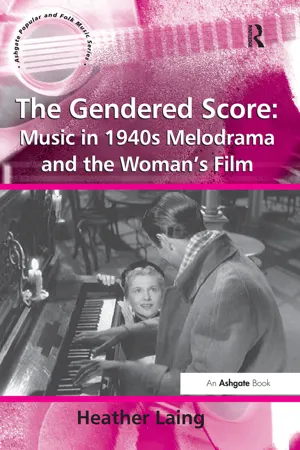
The Gendered Score: Music in 1940s Melodrama and the Woman's Film
About this book
Heather Laing examines, for the first time, the issues of gender and emotion that underpin the classical style of film scoring, but that have until now remained unquestioned and untheorized, thus providing a benchmark for thinking on more recent and alternative styles of scoring. Many theorists have discussed this type of music in film as a signifier of emotion and 'the feminine', a capacity in which it is frequently associated with female characters. The full effect of such an association on either female or male characterization, however, has not been examined. This book considers the effects of this association by progress through three stages: cultural-historical precedents, the generic parameters of melodrama and the woman's film, and the narrativization of music in film through diegetic performance and the presence of musicians as characters. Case studies of specific films provide textual and musical analyses, and the genres of melodrama and the woman's film have been chosen as representative not only of the epitome of the Hollywood scoring style, but also of the narrative association of women, emotion and music. Laing leads to the conclusion that music functions as more than merely a signifier of emotion. Rather, it takes a crucial role in both indicating and determining how emotion is actually understood as part of the construction of gender and its representation in film.
Trusted by 375,005 students
Access to over 1.5 million titles for a fair monthly price.
Study more efficiently using our study tools.
Information
Subtopic
MusicChapter 1
The Siren and the Muse: Ideas of gender, emotion and subjectivity in music and film
[M]usical performance provides an excellent context for observing and understanding any society’s gender structure because similar notions of power and control often lie at the heart of both gender and musical/social dynamics.1
The association of music and emotion—and by extension gender—was by no means an invention of sound cinema. On the contrary, it is an association that extends back through the history of Western society and its dramatic self-representations as far as the earliest records of musical activity. The use of music in 1940s film to evoke emotion, particularly in relation to gendered characterization, cannot therefore be considered in isolation, and must be seen as part of a continuing history in its own right. The dominant style through which such musical–emotional meaning was evoked in film at this time was the nineteenth-century Romantic style of composition, which indeed became little short of ubiquitous as a scoring style. It is perhaps, however, the very acceptance of this musical style as standard that has prevented important questions from being asked about the specificity of its potential inheritance of meaning. The nineteenth-century style has effectively become an ‘ahistorical’ signifier of emotion in film. Whereas different historical periods can be evoked through the use of appropriate musical styles, the nineteenth-century style has achieved a unique historical neutrality, and can thus be used to represent emotion in narratives set in any time period before or after its own actual historical development. Such an assumption of neutrality threatens to mask, however, the cultural–historical specificity of this music. The cultural thought on emotion that underpinned it in its own time was, in fact, highly problematic in its perceived signification in relation to gender—or rather, more specifically, in relation to women. It follows, therefore, that as it was adopted into film scoring, it brought an inheritance of cultural meaning that was of obvious potential significance to gendered characterization. By examining films through the filter of nineteenth-century musical conventions and conceptions, it is possible to see the extent to which romantic ideas of gender and emotion continued to inform the representation of both femaleness and maleness well into the twentieth century.
In order to explore and reveal this inheritance, this chapter begins by surveying the historical relationship of music, gender and emotion, particularly as it relates to women. While this necessarily centres on the cultural concepts and musical– dramatic conventions of the nineteenth century, this is itself framed—however briefly—in just enough of a broader historical context to demonstrate its own corresponding inheritance from earlier models of representation. In the light of this survey, I then consider the generic position of women in film melodrama and their emotional representation through music. As a result, I argue that the film scoring style of the 1940s in fact burdens female characters with a Romantic relationship to music that carries with it both psychological and physical implications. The prevalence and frequent diegetic foregrounding of music in those genres centred on the emotional and psychological trajectories of women suggest a degree of conflation of Romantic ideas of the ‘feminine’ and the ‘female’, and the apparent adoption of this gendered musical inheritance results in a frustratingly restrictive position for female characters. The musical representation of their emotions suggests the transcendent nature of women’s interiority. At the same time, however, it also demonstrates the inevitable frustration or destructive power of this interiority in the context of contemporaneous—or historical—social mores and/or nineteenth-century ideas of the female constitution.
Historical Concepts of Female Creativity and Performance in Music
The relationship of women and music has always proved problematic to patriarchal society. Charles Segal traces this difficulty back to ancient Greek mythology, where female characters are divided according to archetypal polarities of physicality, sexuality, the voice, music, social positioning and agency within such a society.2 His suggestion that this division is informed by a fear of female sexuality, or perhaps the male fear of his own sexuality and a resultant desire to exercise control over women, is crystallized in the female musical archetypes that he invokes—and that have indeed rung down through the ages in this capacity—of the Siren and the Muse. Each of these certainly bears out Segal’s theory. The terrifyingly strong and irresistible sexuality and musicality of the Siren exist solely for the purpose of seducing and destroying men. The physically subdued but nevertheless ethereally beautiful Muse dedicates her voice and music to the glory and inspiration of men. It is not difficult, however restricted these models of characterization are and however clear their ideological purpose may be, to see how they continue to inform representations of female behaviour to the present day. Indeed, the terms ‘siren’ and ‘muse’ have passed into common parlance as a means of describing the sexual demeanour and social significance of women even without any musical reference. The specificity of their mythological origins, however, emphasizes their construction according to the idea of the indivisibility of vocality and musicality from such behaviour, which distinguishes them in both the style and purpose of their self-expression from such comparable non-musical figures as the ‘virgin’ and the ‘whore’. Considering the quotation with which I opened this chapter, the question therefore arises of whether musical forms and narratives have the potential to perpetuate the otherness of women in patriarchal society through the circulation of such female types.
During the Renaissance, for example, women’s social and sexual conception in relation to music was clearly dependent upon their use of that music in accordance with prevailing patriarchal codes. According to Linda Phyllis Austern, the socially acceptable and desirable woman should not threaten the apparently vulnerable self-control of masculinity. She was therefore required to exercise a demure and ‘proper’ use of music. The most pertinent edict in this respect was that her musicality should be physically hidden from men. While performing music before men could be seen in a positive light—as a means of becoming more attractive to potential husbands— the female musician’s embodiment of the most powerful sensual partnership of femaleness and music may also be too physically exciting, seducing the man into corrupt thoughts and conduct. Tellingly, of course, the choice between these options lay firmly with the women, so that any effect on men was considered entirely the result of conscious female intent.3 Such apparently mythical musical–sexual power, however, was not only controlled by the socially drawn boundaries of decency. On the contrary, physiological theory was also mobilized to prove that women were both mentally and physically incompatible with the processes of higher artistic creativity. As Christine Battersby points out, women at this time were condemned by a conception of the female constitution that precluded the possibility of intellectual superiority, dependent as this was upon the allegedly exclusively male possession of rational ‘ingenium’. Women were conceived as subject to the biologically dictated ‘hysteria’ rather than the more masculine and potentially inspirational ‘melancholy’.4 As a result of this, Battersby concludes that:
In our terms, women were thought of as too creative, too original, with much too much subjectivity. In Renaissance terms, none of these were artistic virtues, and women lacked the fires of male physiology that could burn out an image of the truth. They were trapped in the cloud of unknowing [emphasis in original].5
With Romanticism, however, came a reconceptualization of creativity that revalued these very qualities, making paramount the artist’s subjective, emotional and therefore ‘feminine’ experience of the world. While this should have deified women as natural artists, the male prerogative of cultural superiority actually dictated otherwise. As a result of significant reconceptualizations of gender construction, the place of the female was ‘re-denigrated’ in terms of musical and artistic understanding and creativity.
The elevation of a feminine sensibility arose from Romanticism’s concern with encapsulating the verbally indescribable inner ‘essence’ of things, rather than merely their external appearance. Music was perceived as able to appeal directly and immediately to the senses, and so to bypass more concrete and denotative forms of representation. Instrumental music in particular was seen to epitomize this in the ‘absolute’ music which, ‘“dissolved” from verbal and functional constraints “sublimates” or “exhalts” itself above the boundedness of the finite to an intimation of the infinite’.6 Since a feminine sensibility rendered the artist almost ‘at one’ with the most basic and powerful forces of nature, however, nothing short of the most masculine strength and virility could allow the individual to withstand its dramatic impact. There is, of course, nothing inherent in such an androgynous model to preclude women from creativity, but cultural and physiological constructions of femininity and femaleness conspired once again to promote a male monopoly of the arts. The elevation of intuition, emotion and imagination may have feminized the artist’s soul, but his body—providing his essential supporting strength—remained necessarily male.7 Masculine strength allowed the male artist to experience the most extreme perceptions of a feminine soul. He was therefore seen to transcend and sublimate the denigrated biology that still bound women inextricably to ‘procreative and domestic duties which would take up all their (limited) energy’.8 The female body, still being conceptualized according to long-outdated medical ideas of the debilitating effect of ‘the vapours’, was considered too physically fragile to withstand the rigours of sublime contemplation. As Battersby states, women who aspired to the higher reaches of creativity at this time,
All found themselves confronted by fathers and doctors—and even by mothers and sisters—anxious for their welfare: eager to tell them that Nature had provided women with a physique that would punish them with madness and disease if they attempted to rival the males.9
The male artist’s perceived originality allowed him to write music ‘for an imaginary public, for the future, and if possible for “eternity”’,10 with the apotheosis of such creativity lying in the mysterious deity that was the virtuoso, personified in the mythical physical and sexual potency of figures such as Paganini and Liszt.11 Perhaps unsurprisingly, however, given the nature of these examples, such powerful personal imagery and charisma was not available as a model to aspiring female artists. Apart from any perceived physical constraints, their relationship to creativity remained mediated, as in the renaissance, by contemporaneous ideas of female propriety. The continuing social perception of the danger and aberration of active female sexuality meant that ‘[f]or women, the loss of identity involved in a passionate experience of the sublime threatened the boundaries of the proper femininity essential for their reputation.’12 It was, in other words, too dangerous an activity for a respectable and ‘feminine’ woman. Even just to perform—particularly, as Sarah Webster Goodwin suggests, as a singer—could draw an unseemly amount of attention to the body, and this was naturally interpreted in an entirely different way to the overtly physical display of the male virtuoso.13 Instead, wom...
Table of contents
- Cover
- Half Title
- Dedication
- Title
- Copyright
- Contents
- List of figures
- List of music examples
- General editor's preface
- Acknowledgements
- Introduction
- 1 The Siren and the Muse: Ideas of gender, emotion and subjectivity in music and film
- 2 Music and the voice in the woman's film
- 3 The female listener
- 4 The female musician
- 5 The male musician
- Bibliography
- Filmography
- Index
Frequently asked questions
Yes, you can cancel anytime from the Subscription tab in your account settings on the Perlego website. Your subscription will stay active until the end of your current billing period. Learn how to cancel your subscription
No, books cannot be downloaded as external files, such as PDFs, for use outside of Perlego. However, you can download books within the Perlego app for offline reading on mobile or tablet. Learn how to download books offline
Perlego offers two plans: Essential and Complete
- Essential is ideal for learners and professionals who enjoy exploring a wide range of subjects. Access the Essential Library with 800,000+ trusted titles and best-sellers across business, personal growth, and the humanities. Includes unlimited reading time and Standard Read Aloud voice.
- Complete: Perfect for advanced learners and researchers needing full, unrestricted access. Unlock 1.5M+ books across hundreds of subjects, including academic and specialized titles. The Complete Plan also includes advanced features like Premium Read Aloud and Research Assistant.
We are an online textbook subscription service, where you can get access to an entire online library for less than the price of a single book per month. With over 1.5 million books across 990+ topics, we’ve got you covered! Learn about our mission
Look out for the read-aloud symbol on your next book to see if you can listen to it. The read-aloud tool reads text aloud for you, highlighting the text as it is being read. You can pause it, speed it up and slow it down. Learn more about Read Aloud
Yes! You can use the Perlego app on both iOS and Android devices to read anytime, anywhere — even offline. Perfect for commutes or when you’re on the go.
Please note we cannot support devices running on iOS 13 and Android 7 or earlier. Learn more about using the app
Please note we cannot support devices running on iOS 13 and Android 7 or earlier. Learn more about using the app
Yes, you can access The Gendered Score: Music in 1940s Melodrama and the Woman's Film by Heather Laing in PDF and/or ePUB format, as well as other popular books in Media & Performing Arts & Music. We have over 1.5 million books available in our catalogue for you to explore.