- 214 pages
- English
- ePUB (mobile friendly)
- Available on iOS & Android
eBook - ePub
About this book
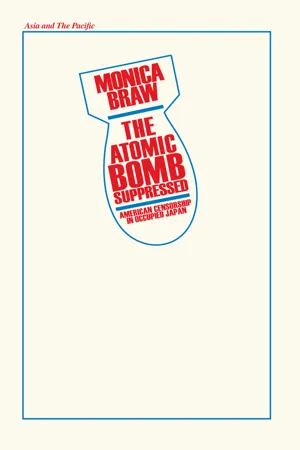
Swedish journalist and author Braw draws on declassified documents and interviews in Japan and the US to reveal how the US occupation authorities established elaborate systems of censorship and disinformation among the Japanese press, scientists, and even novelists and poets, about the bombing of Hi
Trusted by 375,005 students
Access to over 1.5 million titles for a fair monthly price.
Study more efficiently using our study tools.
Information
1
Introduction
FORTY-FIVE years after the atomic bombs that destroyed Hiroshima and Nagasaki in August 1945, the world abounds with material about the consequences of nuclear weapons. We are not only familiar with the fact that nuclear weapons are directed at major cities all over the world and that new "devices" are continually installed, but we also realize the indescribable results if these weapons were ever used. We have heard about "nuclear winter," which would leave no environment suitable for human life, and about the neutron bomb, which would leave buildings but no life.
In comparison, the atomic bombs of Hiroshima and Nagasaki were ridiculously small. They affected less than half a million people. Today, the cities destroyed are sprawling centers where one has to search for signs of catastrophe. Every visitor who comes to Hiroshima and Nagasaki for the first time is surprised, and perhaps also, for at least a moment, inclined to doubt the horrors that were so real forty-five years ago. But those horrors still haunt the survivors as nightmares about the past and as fear for the future and the health of unborn generations.
The survivors of Hiroshima and Nagasaki are still the only human beings who can tell what it means to survive nuclear war. In spite of that, the world has only occasionally listened to them. In fact, only periodically has the world concerned itself with the effects of nuclear weapons at all. Today, we live in times when this concern is widespread, but this was not so in 1969. Then it was possible for a young Swedish woman like myself to arrive in Hiroshima and be shocked that I had realized so little of what the atomic bombing of Hiroshima means. I was shaken by my own lack of realization and by the sorrow of the survivors at not being heard.
I thought at that time that it was solely out of disinterest and inertia that Hiroshima and Nagasaki were not on the minds of people in general. I could find no explanation as to why the atomic bombings received mere passing mention in the history books of my native Sweden. But being a writer, I wanted to remedy this lack of knowledge as best as I could by interviewing survivors and publishing their stories.
I soon became aware, however, that it had not always been possible to conduct such interviews, much less to publish them. Many of the hibakusha (atomic bomb survivors) I met told me that material about the atomic bomb, its effects, and the conditions of hibakusha in Hiroshima and Nagasaki had been censored. One of them was Issei Nishimori, a medical doctor who specialized in pathology, particularly white corpuscle count in the blood. He was a medical student at the time of the atomic bombing of Nagasaki. After the war he decided to concentrate on research concerning the effects of the atomic bomb on human beings. But he soon discovered that this was very difficult:
Partly this was because we could not afford research. We had to make a living. But partly it was because if we had conducted research we would not have been able to make the results public. Research during this period soon after the actual bombings would have been important. The Americans did not order us to stop, but they imposed so many restrictions, for example, that everything had to be translated into English, that in practice we were prohibited from publishing.
Also, they took all the autopsy material that we had collected and sent it to America. Had even half of it been left, we pathologists could have done research on the effects of the atomic bomb on human beings. As it was, there was no autopsy material about the important period of the bombing and its immediate aftermath. The material was not returned to us for thirty years, and then only after we repeatedly asked for it At that time, of course, it was already history.
Neither were we told anything about the results of the research undertaken at the Atomic Bomb Casualty Commission (ABCC), started in Hiroshima in 1947. All results were sent to America. There was no possibility of having them published in Japan. In addition, the ABCC only did research. It did not try to cure. It kept many secrets. This made hibakusha feel that they were experimental animals. As a doctor I think it is common sense that when one finds something new during research one should publish it for the benefit of all human beings. But the ABCC did not share its research. Had the Americans, with their higher knowledge in medical science, done that, many patients would have been saved.1
Another person who told me about limits to the spread of information about the atomic bombings was Sueo Inoue, a cameraman for Nippon Eiga-sha (Nippon Film Co.) In September 1945 he had been sent to Hiroshima and Nagasaki to film the destruction:
Our plan was to appeal against the inhumanity of the atomic bomb to the Red Cross in Geneva. Our team also belonged to an academic investigation group doing research about the effects of the bomb. We were thirty-two or thirty-three persons. On September 16 we started filming in Nagasaki. We continued until October 24, when we were arrested by American military police. Then all work was stopped. All the film was confiscated. I was told to return to Tokyo.
My company protested against the confiscation, but we were told that it was on orders from the American Navy. When the Americans watched our films, they found them useful. So they changed our orders and gave us permission to take more film. We had finished in Hiroshima but returned to Nagasaki. By December we had completed our work. Then we were ordered to edit the films. The films were taken to America—everything we had shot and edited, even the small cuts. All in all it was 30,000 feet of film. The Japanese government had to pay the cost of the raw film.
But secretly we copied some film before giving it to the Americans. Only four people knew about this film. If the Occupation authorities had known, they would probably have sent us to Okinawa for hard labor. The reason we made the copy was that we wanted to show proof of the inhumanity of the atomic bomb. We wanted to send the film to the Red Cross in Geneva. But under the Occupation we did not dare to. We thought maybe we would be able to show it when the Occupation had come to an end.2
Even people who had nothing to do with information, newspapers, or film-making knew about restrictions. Tsukasa Uchida was a Nagasaki schoolboy in 1945:
The Americans brought bulldozers to clear up the Urakami area which had been hit by the atomic bomb. There were still many dead under the rubbish. Despite that the Americans drove their bulldozers very fast, treating the bones of the dead just the same as sand or soil. They carried the soil to lower places and used it to broaden roads there. A person who tried to take a picture of what they were doing was approached by the military police. The MP pointed his gun and threatened to confiscate any picture taken.
Because of the Press Code there was no possibility for us to write about such incidents. Newspapermen did not tell about them and they did not appear even in the readers' columns.
But Dr. Takashi Nagai was allowed to publish what he wrote. He was a Catholic. He called the atomic bomb a kind of baptism. In spite of the horrendous conditions after the bombing in Nagasaki he said that God must have had a special meaning, letting the atomic bomb be dropped on the Urakami area, where many Catholics lived.3
Hideo Matsuno, who was a journalist at the Domei News Agency, told me: "Because of the Press Code, we could not write freely. I kept my reports about Nagasaki in the hope that someday I would be able to publish them."4
In Hiroshima I was told similar things by the poet Sadako Kurihara. During our interview she suddenly said: "We could never have written about our experiences of the atomic bomb during the Occupation. It would have been impossible because of the censorship."5
Like most other people, I never thought of censorship in connection with the American Occupation of Japan. I had read many histories about this period and never heard about censorship. I associated censorship with dictatorship. The Occupation, on the other hand, I thought of as the democratization of defeated, militaristic Japan. "We were not allowed to write about the atomic bomb during the Occupation. We were not even allowed to say that we were not allowed to write about the atomic bomb," Ms. Kurihara explained.
Why? From those days in the 1970s when I first heard about Occupation censorship, I wanted to find the answer. But when I looked through available literature about the Occupation, I rarely found censorship mentioned, and then most often in passing. Regarding censorship of the atomic bomb, there were only brief reminiscences by people like Sadako Kurihara, who had themselves experienced it.
In 1977 the United States declassified the archives on the Occupation of Japan. The complete Records of the Supreme Commander for the Allied Forces, with a few exceptions, became available to the public. This enormous collection of material, although extremely poorly organized, opened up completely new possibilities for research into one of the most extensive attempts at social engineering ever—the remaking of Japan in the image of American democracy.
For the first time it also became possible extensively to research censorship during the American Occupation. No comprehensive studies on this subject had been written before that. The transformation of the minds and hearts of the Japanese people through the activities of the Civil Information and Education Section of the Occupation authorities have been studied—for example, the reformation of the education system. The censorship operations, on the other hand, were left largely unresearched, although they certainly played an important part in influencing Japanese knowledge and opinions. Because of this, when I started studying censorship of the atomic bomb I first had to find out about censorship in general.
My first question was: Why did the American Occupation impose censorship at all? Why and how was it decided to introduce censorship? Wasn't censorship totally inimical to the concept of democracy? Introducing democracy to Japan was the stated aim of the Allies. I could understand that censorship might be necessary when troops are occupying enemy territory in war. But Japan was not exclusively regarded as a defeated enemy after the surrender; it was a nation earmarked to become "better." The Japanese were to discard the military beliefs that led to war, in favor of democracy, which would assure peace. That, in short, was the American agenda. With that starting point, was the censorship envisaged as a military operation? Or did it in practice become something other than planned? How did the United States and the other Allies reason?
When I started studying the censorship plans I soon understood that the censorship operations were very broad. Generally speaking, Japan was an unknown country for Americans, even if Japan specialists in different departments prepared wide-ranging reports.6 For the ordinary participant in the Occupation, it was not only Japan's culture that was unknown. Even more important, from the viewpoint of censorship, was that few Americans understood the Japanese language, and it was extremely difficult to learn. How could censorship be feasible under such circumstances? Who were the censors? How did they work?
The practical aspects aside, what did the censors censor? The first thing that comes to mind is that censors delete criticism of themselves and the rulers they represent. Was this the case in Japan, in spite of the basic premises of democracy, which allow free political discussion? How was it possible under such circumstances to draw lines for what to allow and what to ban? Without clear-cut restrictions, could censorship be effective?
Not until these questions were answered would it be possible to take up the case of censorship of atomic bomb material. Dr. Nishimori, Mr. Inoue, Mr. Uchida, Mr. Matsuno, and Ms. Kurihara had stated that they had not been allowed to write freely about the atomic bomb. In spite of that, a look at bibliographies of books published during the Occupation showed that some works had been published on that subject. How was that possible? I had to ask: Were the Japanese I interviewed wrong?
The rules of American censorship, the Press Code, made no mention of the atomic bomb. In fact, the rules were rather vague. But when I found reports of censorship written by censors themselves it became clear that much material about the atomic bomb had, indeed, been censored. What was allowed and what was prohibited? With what motivations? And, above all, where were those decisions made? Was censorship policy in Japan concerning the atomic bomb set locally or in Washington? What were the reasons for censoring such material? It was, after all, already known throughout the world that on August 6, 1945, Hiroshima was obliterated by such a bomb. Hiroshima and Nagasaki could hardly be said to be a secret. As a whole, I wanted to know the result of the censorship of the atomic bomb in Japan during the first four years after the atomic bombings of Hiroshima and Nagasaki.
These are questions that this study tries to answer. I have had to limit myself mainly to newspaper censorship, but I believe that this topic is representative of censorship in general. Further detailed studies are needed. I have searched the American archives of the Occupation to try to explain how the occupiers themselves reasoned and worked and to find the result of their actions. In doing so, it may seem that I have forgotten the hibakusha and their own evidence of what it was like to live under the Occupation and to write under censorship. But they are not forgotten. Had it not been for them, this study would never have been made. By making it I hope to contribute to an understanding of nuclear weapons, of their horror and their importance, both to those who possess them and to their victims.
2
The Atomic Bomb Presented to the World
ON AUGUST 6, 1945, an atomic bomb was detonated above the Japanese city of Hiroshima. That day in Washington President Harry Truman made an announcement:
Sixteen hours ago an American airplane dropped one bomb on Hiroshima, an important Japanese army base. This bomb had more power than 20,000 tons of TNT. With this bomb we have now added a new and revolutionary increase in destruction to supplement the growing power of our armed forces. It is an atom bomb. It is a harnessing of the basic power of the universe. We are now prepared to obliterate more rapidly and completely every production enterprise the Japanese have above ground in any city. We shall destroy their docks, their factories and their communications. Let there be no mistake; we shall completely destroy Japan's power to make war. It was to spare the Japanese people from utter destruction that the ultimatum of July 26 was issued at Potsdam.1
The same day, still August 6 in the United States, the top news story was self-evident. The Washington Daily News, for instance, filled its first page with the headlines ''ATOM BOMB HITS JAPAN Nip Base Gets First 'Tiny' Sample Equaling 20,000 Tons of TNT and WORSE ONES are ON the way.'' The Daily Mirror of New York covered its first page with the headline ''ATOMIC BOMB ROCKS JAP CITY.'' In graphics the tremendous power of the hitherto completely unknown weapon was explained: '' 1 atom bomb equals 100 B-29's carrying 10 tons each of TNT." In a dispatch from Guam in the Pacific, United Press reported " 'My God' says crew as flash wipes out 60 Pet. of Hiroshima." In another dispatch from Washington, D.C., the same news agency reported that the Allies were considering a new ultimatum calling on Japan to surrender or be annihilated by ...
Table of contents
- Cover
- Half Title
- Title
- Copyright
- Contents
- Figures
- Preface
- Abbreviations
- Acknowledgments to the Second Edition
- Acknowledgments
- 1. Introduction
- 2. The Atomic Bomb Presented to the World
- 3. Ideals and Goals of U.S. Occupation Planning and Censorship
- 4. SCAP Takes Charge of the Japanese Press
- 5. The Allies and the Occupation
- 6. Censorship in Practice
- 7. Punishment for Violations
- 8. Censorship of the Atomic Bomb
- 9. Reasons for Censoring the Atomic Bomb
- 10. Results of U.S. Censorship Operations in Japan
- Notes
- Bibliography
- Index
Frequently asked questions
Yes, you can cancel anytime from the Subscription tab in your account settings on the Perlego website. Your subscription will stay active until the end of your current billing period. Learn how to cancel your subscription
No, books cannot be downloaded as external files, such as PDFs, for use outside of Perlego. However, you can download books within the Perlego app for offline reading on mobile or tablet. Learn how to download books offline
Perlego offers two plans: Essential and Complete
- Essential is ideal for learners and professionals who enjoy exploring a wide range of subjects. Access the Essential Library with 800,000+ trusted titles and best-sellers across business, personal growth, and the humanities. Includes unlimited reading time and Standard Read Aloud voice.
- Complete: Perfect for advanced learners and researchers needing full, unrestricted access. Unlock 1.5M+ books across hundreds of subjects, including academic and specialized titles. The Complete Plan also includes advanced features like Premium Read Aloud and Research Assistant.
We are an online textbook subscription service, where you can get access to an entire online library for less than the price of a single book per month. With over 1.5 million books across 990+ topics, we’ve got you covered! Learn about our mission
Look out for the read-aloud symbol on your next book to see if you can listen to it. The read-aloud tool reads text aloud for you, highlighting the text as it is being read. You can pause it, speed it up and slow it down. Learn more about Read Aloud
Yes! You can use the Perlego app on both iOS and Android devices to read anytime, anywhere — even offline. Perfect for commutes or when you’re on the go.
Please note we cannot support devices running on iOS 13 and Android 7 or earlier. Learn more about using the app
Please note we cannot support devices running on iOS 13 and Android 7 or earlier. Learn more about using the app
Yes, you can access The Atomic Bomb Suppressed by Monica Brau in PDF and/or ePUB format, as well as other popular books in Politics & International Relations & Politics. We have over 1.5 million books available in our catalogue for you to explore.