- 240 pages
- English
- ePUB (mobile friendly)
- Available on iOS & Android
eBook - ePub
Synopsis of Vocal Musick by A.B. Philo-Mus.
About this book
Synopsis of Vocal Musick, by the unidentified A.B., was published in London in 1680 and appears to have only ever had one edition. Its relatively short shelf-life belies its importance to the history of early British music theory. Unlike other English theoretical writings of the period, the Synopsis derives many of its aspects from the continental theoretical tradition, including the first references in English theory to the modern fractional time signatures that had been invented in Italy in the mid-seventeenth century, the first references in English to compound time and the first explanations of tempo terms such as Adagio and Presto. In these respects the treatise forms an important link between English and continental theoretical traditions and may have encouraged the adoption of Italian principles which became a common feature of English writings by the early eighteenth century. The treatise is essentially in two parts. The first section of the book comprises rudimentary instruction on understanding notation and intervals, descriptions of common vocal ornaments and instruction in the process of learning to sing. The second part consists of a selection of psalms, songs and catches which are provided as exercises for the singer, though several of them require a reasonably advanced degree of skill. These pieces provide valuable insight into the way both sacred and secular music might have been performed by amateur musicians in the Restoration period. They include 14 rare English madrigal settings by the Italian composer Gastoldi - further evidence of the Italian influence which pervades the text. This is the first modern edition of the Synopsis, and indeed the first edition to appear since its original publication.
Trusted by 375,005 students
Access to over 1.5 million titles for a fair monthly price.
Study more efficiently using our study tools.
Information
Subtopic
Music[p. 1]
CHAP. I.
Of Vocal Musick in general
Vocal Musick is an Art of expressing rightly things by Voice, for the sweet moving of the affections and the mind.
It is an Art, because it is busied about an object, which can be made, and is meet only for every Art. For the formal object of it is Singing, wherein it directeth the understanding.
Its form is a right expression of things by voice, either monodically in a simple melodie, or Symphonially in a compounded.1
[p. 2] The end and effect of it is, a sweet moving of the affections and the mind. For exhilarating the animal spirits, it moderateth gratefully the affections, and thus penetrateth the interiours of the mind, which it most pleasantly doth affect.2
The means by which it is acquired are a frequent exercising of the voice, as well according to certain signs by which vocal melodies are represented, as according to the direction, either of a well tuned Instrument, or rather of an experienced Master.3
The signs whereby vocal melodies are represented, are either of the melodies themselves, or of the Ornaments of them.4
Signs of melodies themselves are either of sounds, or of things.
The signs of Sounds are either of the length, or of the thickness, or of the breadth of a sound.5
Signs of the length of sounds do note their duration. And are either of the length of sounds it self, or of the touch,6 by which the length of sounds is measured.7
The signs of the length of sounds it self, are either of the length of positive or present sounds, or of the length of privative or absent sounds.8
Signs of the length of positive or present Sounds, are either primary or Secondary.
[p. 3]
CHAP. II.
Of the Notes
THE Primary signs of the length of positive or present sounds are the Notes.9
Notes are signs which do note the duration of sounds; and are either whole or broken.10
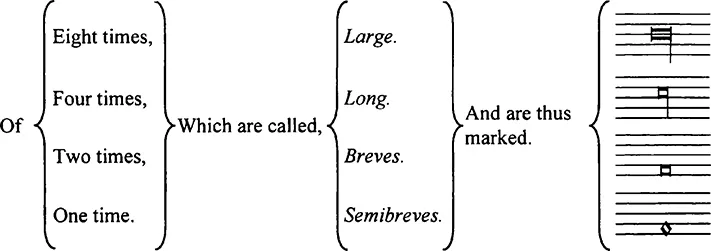
Whole Notes do note the duration of whole times. And art either11
[Original notation]
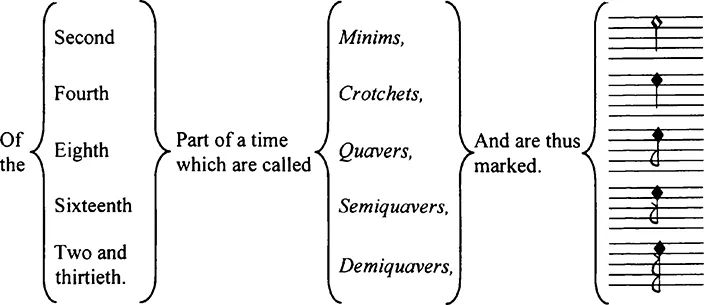
[p. 4] Broken Notes do note the duration of sounds of parts of a time. And are either
[Original notation]
[p. 5]
CHAP. III.
Of the Pricks
The Secundary Signs of the length of positive or present sounds are the Pricks.12
Pricks are Signs which do augment by the half part every Note after which they are placed. Therefore
[Original notation]13
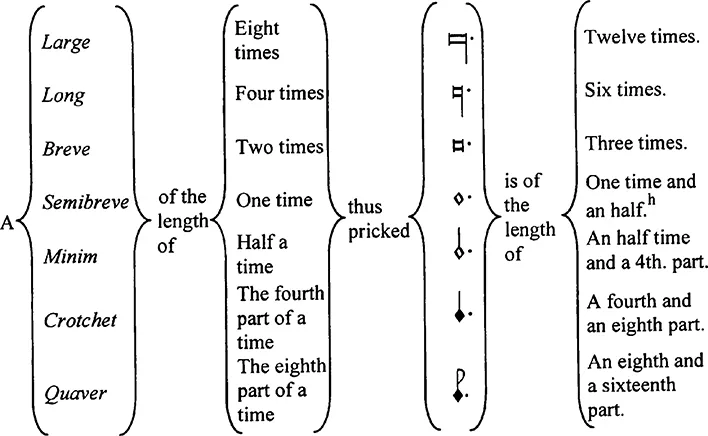
h The dotted semibreve is blackened in the copy in US-Wcm.
[p. 6]
CHAP. IV.
Of the Pauses
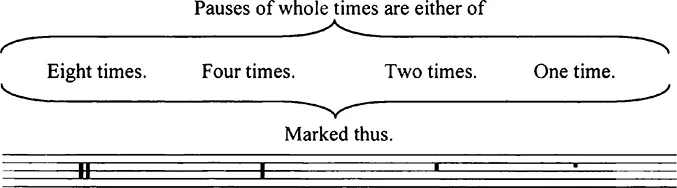
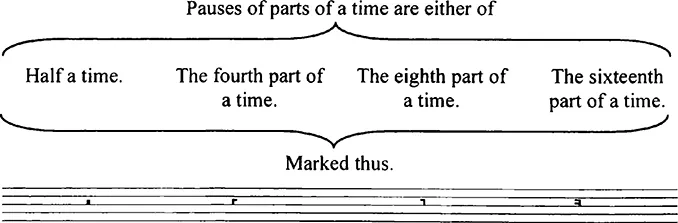
Signs of the length of privative or absent sounds are the pauses or rests.14 Pauses are signs which do note the duration of silences;15 and are either of whole times, or of parts of a time.16
[Original notation]
[p. 7]
[Original notation]
CHAP. V.
Of the Signs of the Common Time
Signs of the tact, touch or time, are by which the length of all Sounds, Notes and Pauses are measured and are either primary or secondary.
The primary Signs of the Time are diverse, according to the diversity of the Time.
[p. 8] Time is a successive motion, depression and elevation, fall and rise of the hand,17 by which the length of all Sounds, Notes and Pauses is measured: and is either dupla usually called common, or tripla, or sesquia[l]tera.18
The Common Time is whose parts, depression and elevation are equ...
Table of contents
- Cover Page
- Title Page
- Copyright Page
- Contents
- List of Figures
- List of Tables
- List of Musical Examples
- Series Editor’s Preface
- Preface
- Introduction
- Synopsis of Vocal Musick:
- TO ALL Ingenious Lovers of MUSICK
- [Epistola Dedicatoria]
- Chapter I: Of Vocal Musick in general
- Chapter II: Of the Notes
- Chapter III: Of the Pricks
- Chapter IV: Of the Pauses
- Chapter V: Of the Signs of the Common Time
- Chapter VI: Of the slower Triple
- Chapter VII: Of the Swifter Triple
- Chapter VIII: Of the Swiftest Triple
- Chapter IX: Of the slower Sesquialtre
- Chapter X: Of the Swifter Sesquialtre
- Chapter XI: Of the Swiftest Sesquialtre
- Chapter XII: Of the Systems
- Chapter XIII: Of the Bars, and Repeats
- Chapter XIV: Of the Cliffs
- Chapter XV: Of the Use of Cliffs in respect of Voices
- Chapter XVI: Of the Use of Cliffs in respect of Notes
- Chapter XVII: Of the Syllables
- Chapter XVIII: Of the Scale of Musick
- Chapter XIX:Of the Order of the Generation of the Degrees
- Chapter XX:Of the Intervals of the Degrees
- Chapter XXI:Of the agreeableness of the Cliffs and Syllables with the Degrees of the Scale of Musick
- Chapter XXII:Of the generation of an Eighth in b flat
- Chapter XXIII:Of the lesser principal and secondary contained signs
- Chapter XXIV:Of the signs of the breadth of sounds, and of things
- Chapter XXV:Of the signs of the Ornaments of Songs
- Chapter XXVI:Of the second Mean to attain the Art of Musick
- Twelve Most Usual TUNES OF PSALMS: IN THREE PARTS. TREBLE, MEAN, and BASS
- Twelve Selected ENGLISH TUNES IN THREE PARTS. Two TREBLES and a BASS
- Twelve Selected ENGLISH CATCHES A. 3. Voc. Composed by sundry AUTHORS
- FOURTEEN ITALIAN SONGS COMPOSED BY GIOVANNI GIACOMO CASTOLDI DA CARRAVAGGIO
- Notes
- Critical Commentary
- Appendix Original Settings of Three Gastoldi Songs
- Bibliography
- Index
Frequently asked questions
Yes, you can cancel anytime from the Subscription tab in your account settings on the Perlego website. Your subscription will stay active until the end of your current billing period. Learn how to cancel your subscription
No, books cannot be downloaded as external files, such as PDFs, for use outside of Perlego. However, you can download books within the Perlego app for offline reading on mobile or tablet. Learn how to download books offline
Perlego offers two plans: Essential and Complete
- Essential is ideal for learners and professionals who enjoy exploring a wide range of subjects. Access the Essential Library with 800,000+ trusted titles and best-sellers across business, personal growth, and the humanities. Includes unlimited reading time and Standard Read Aloud voice.
- Complete: Perfect for advanced learners and researchers needing full, unrestricted access. Unlock 1.5M+ books across hundreds of subjects, including academic and specialized titles. The Complete Plan also includes advanced features like Premium Read Aloud and Research Assistant.
We are an online textbook subscription service, where you can get access to an entire online library for less than the price of a single book per month. With over 1.5 million books across 990+ topics, we’ve got you covered! Learn about our mission
Look out for the read-aloud symbol on your next book to see if you can listen to it. The read-aloud tool reads text aloud for you, highlighting the text as it is being read. You can pause it, speed it up and slow it down. Learn more about Read Aloud
Yes! You can use the Perlego app on both iOS and Android devices to read anytime, anywhere — even offline. Perfect for commutes or when you’re on the go.
Please note we cannot support devices running on iOS 13 and Android 7 or earlier. Learn more about using the app
Please note we cannot support devices running on iOS 13 and Android 7 or earlier. Learn more about using the app
Yes, you can access Synopsis of Vocal Musick by A.B. Philo-Mus. by Rebecca Herissone in PDF and/or ePUB format, as well as other popular books in Media & Performing Arts & Music. We have over 1.5 million books available in our catalogue for you to explore.