- 528 pages
- English
- ePUB (mobile friendly)
- Available on iOS & Android
eBook - ePub
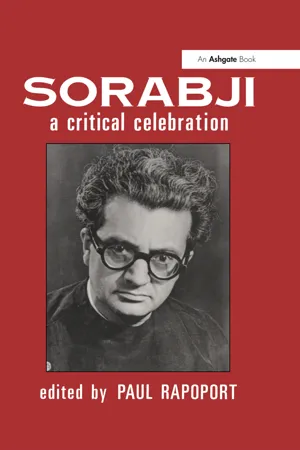
Sorabji: A Critical Celebration
About this book
Kaikhosru Shapurji Sorabji (1892-1988) was an unusual legend in his own lifetime: a Parsi composer and critic living in England whose compositions are of such length and difficulty that he felt compelled to ban public performances of them. This book, the first devoted to Sorabji, explores his life and character, his music, his articles and letters. It both presents the legend accurately and dispels its exaggerated aspects. The portrait which emerges is not of a crank or eccentric but of a highly original and accomplished musical thinker whom recent performances and recordings confirm as unique and important. Most of the contributors knew Sorabji personally. They have all written about or performed his music, gaining international recognition for their work. Generous quotation of Sorabji's published and unpublished music and prose assists in bringing him and his work strikingly to life. The book also contains the most complete and accurate register of his work ever published.
Trusted by 375,005 students
Access to over 1.5 million titles for a fair monthly price.
Study more efficiently using our study tools.
Information
Subtopic
MusicPart I
Discovery
1
Why Sorabji?
Paul Rapoport (b. 1948, Toronto) received a Bachelor’s degree in linguistics and music from the University of Michigan and Master’s and Doctoral degrees in musicology from the University of Illinois. He has written books on Vagn Holmboe and Havergal Brian, as well as one dealing with six composers living in Northern Europe, including Sorabji. He has also written many articles on 20th-century music, including reviews in Fanfare since 1977. As a composer he has a particular interest in microtonality. Currently he is on the faculty of McMaster University in Hamilton, Ontario.
He began studying Sorabji’s music and prose in 1971, first corresponded with him in 1974, and visited him four times from 1976 to 1980.
In the following, I.P. stands for Interested Person, one experienced in listening to and reading about music. Ed. is the editor of this book.
I.P.: Who is Sorabji?
Ed.: There’s a simple answer: a composer of the 20th century who wrote a lot of fascinating and unusual music, especially piano music, which few people are aware of.
I.P.: What nationality is he? His name sounds Indian.
Ed.: It’s a Parsi name. Many Parsis settled in India after they fled from Persia over a thousand years ago. But in order to find out why Sorabji did not consider himself an Indian, indeed became enraged at being called one, I’ll ask you to read Chapter 2 of this book. He was born and lived in England, by the way, but he refused equally to be labelled English.
I.P.: That sounds rather strange. But what I really want to know is whether I’d like his music. I haven’t heard any of it.
Ed.: I don’t know whether you’d like it, as I don’t know your attitudes towards music and listening to it, or other aspects of your experiences. Even then, predicting likes and dislikes is nearly impossible. Understanding is perhaps a more worthy objective. I think that nearly anyone who has a positive curiosity about music of this century may understand Sorabji’s music. But he also has his roots in many composers of earlier times, including some who were only slightly older. Do you have any interest in Skryabin, Debussy, Reger, Busoni, Liszt, Bach, early Schoenberg?
I.P.: Yes … I like some of them. Are those Sorabji’s influences? Does he sound at all like them? I can’t imagine putting all those together.
Ed.: Neither can I, but Sorabji certainly was attracted to some of their music and attitudes. For example, Liszt’s virtuosity, Debussy’s love of sound colour, Skryabin’s mystical extremism, Bach’s counterpoint …
I.P.: I get the idea, but the generalities help only a little. Supposing one were curious, what would be the best place to start? There must be several recordings, to which any newcomer would appreciate some guidance.
Ed.: There have been eight recordings, excluding reissues, plus one that was noncommercial. They’re listed in Appendix 2 — and are certainly worth hearing, although some are recommendable only in part. However: a mere dozen years ago there were no recordings at all. The first was issued when Sorabji was nearly 90.
I.P.: Why so little, especially during his lifetime? How can this composer be of any significance if almost no one records his music?
Ed.: A partial answer to your first question lies in the music’s extreme difficulty. More explanations are found in Chapters 2 and 3 of this book. As for the second, why are recordings, or performances for that matter, necessary for significance of a composer’s music?
I.P.: Surely you’re not serious. It’s obviously the best music which enters the Western tradition, and it can’t do that without being heard, and heard by a lot of people. If a composer’s music is good, it will get around. If it isn’t heard, in a sense it doesn’t even exist. It certainly can’t be significant. And these days any compose...
Table of contents
- Cover
- Half Title
- Title
- Copyright
- Dedication
- Contents
- List of Illustrations
- Acknowledgements
- Part I Discovery
- Part II The Prose
- Part III The Music
- Perigraph To Remember Sorabji’s Music: A Short-Form Conclusion
- Appendix 1 The Texts of Sorabji’s Vocal Music
- Appendix 2 The Recordings of Sorabji’s Music
- Appendix 3 The Sorabji Music Archive
- Bibliography
- Index of Sorabji’s Compositions
- General Index
Frequently asked questions
Yes, you can cancel anytime from the Subscription tab in your account settings on the Perlego website. Your subscription will stay active until the end of your current billing period. Learn how to cancel your subscription
No, books cannot be downloaded as external files, such as PDFs, for use outside of Perlego. However, you can download books within the Perlego app for offline reading on mobile or tablet. Learn how to download books offline
Perlego offers two plans: Essential and Complete
- Essential is ideal for learners and professionals who enjoy exploring a wide range of subjects. Access the Essential Library with 800,000+ trusted titles and best-sellers across business, personal growth, and the humanities. Includes unlimited reading time and Standard Read Aloud voice.
- Complete: Perfect for advanced learners and researchers needing full, unrestricted access. Unlock 1.5M+ books across hundreds of subjects, including academic and specialized titles. The Complete Plan also includes advanced features like Premium Read Aloud and Research Assistant.
We are an online textbook subscription service, where you can get access to an entire online library for less than the price of a single book per month. With over 1.5 million books across 990+ topics, we’ve got you covered! Learn about our mission
Look out for the read-aloud symbol on your next book to see if you can listen to it. The read-aloud tool reads text aloud for you, highlighting the text as it is being read. You can pause it, speed it up and slow it down. Learn more about Read Aloud
Yes! You can use the Perlego app on both iOS and Android devices to read anytime, anywhere — even offline. Perfect for commutes or when you’re on the go.
Please note we cannot support devices running on iOS 13 and Android 7 or earlier. Learn more about using the app
Please note we cannot support devices running on iOS 13 and Android 7 or earlier. Learn more about using the app
Yes, you can access Sorabji: A Critical Celebration by Paul Rapoport in PDF and/or ePUB format, as well as other popular books in Media & Performing Arts & Music. We have over 1.5 million books available in our catalogue for you to explore.