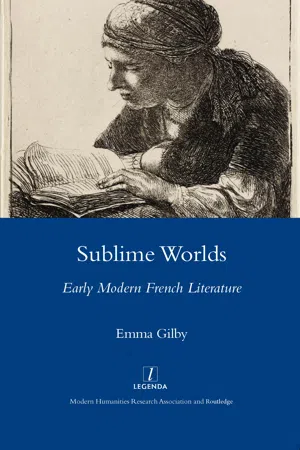
- 160 pages
- English
- ePUB (mobile friendly)
- Available on iOS & Android
eBook - ePub
About this book
Some of the language we come across, in reading other peoples' works or listening to others speak, moves us profoundly. It requires a response from us; it occupies and involves us. Writers, always readers and listeners as well, are fascinated by this phenomenon, which became the subject of the classical treatise On the Sublime , traditionally attributed to Longinus. Emma Gilby looks at this compelling and complex text in relation to the work of three major seventeenth-century authors: Pierre Corneille, Blaise Pascal and Nicolas Boileau. She offers, in each case, intimate critical readings which spin out into broad interrogations about knowledge and experience in early modern French literature.
Trusted by 375,005 students
Access to over 1.5 million titles for a fair monthly price.
Study more efficiently using our study tools.
Information
Subtopic
LanguagesChapter 1 Longinus
The methodically minded have sought to rebuild an argument from the fragmentary remains of Peri hypsous. Elder Olson writes that ‘a careful consideration of the direction and method of argument and of the assumptions involved in the critical judgments affords excellent ground for some restoration of the lacunae, at least to the extent of reconstructing the argument’.1 But Longinus’s extant sentences are wayward and his hypotheses flexible. So in spite of certain tactical reconstructions, it remains, in Neil Hertz’s words, ‘remarkably easy to lose one’s way’ in Peri hypsous.2 Longinus’s choice of examples, as Hertz suggests, seems particularly unruly: ‘One quotation will suggest another but not necessarily because each illustrates the rhetorical topic at issue: both might, but the effective links between them seem at once flimsier and subtler than that’ (p. 581). ‘Longinus skates’, writes Anne Carson, ‘from Homer to Demosthenes to Moses to Sappho on blades of pure bravado.’3 Peri hypsous is a text in which critical models are pervaded by variable inflations and perceptions. Let us consider, though, the most basic premise of Peri hypsous: the fact that language moves. This, like all basic premises, at once simplifies and intimates complexity, and I shall explore it in this chapter. One aim here will be to show that analyses of Peri hypsous which bring the text back to a single stylistic feature or moral aim fail. Another will be to look at how Longinus’s hypsos, though ineffable, has a continuing relationship with the ways in which we make sense of the world and the people in it.
Hypsos
Longinus writes about language which touches us so successfully that we feel ‘as if we had ourselves produced what we had heard’.4 He calls this experience of identification ‘hypsos’. ‘Hypsos’, we are told, ‘shatters everything like a bolt of lightning and reveals the full power of the speaker at a single stroke’ (1.4). Liddell and Scott’s primary definition of the term is ‘height’; they also have, citing Longinus, ‘sublimity, grandeur’.5 Etymologically, the term ‘hypsos’ and its relations
ne sont que le sémitique ‘ouf’, voler, s’élever, et tous probablement qu’une belle onomatopée tirée du soufflement, ronflement ou sifflement que fait entendre l’air froissé, foulé, battu par l’aile ou tout autre corps. Ou du cri, du son up, hup, houp, que fait entendre toute bouche humaine lorsqu’il s’agit de lever, de soulever un fardeau de bas en haut, en comprimant subitement avec les lèvres une forte expiration de l’haleine.6
The English term ‘sublimity’ derives from the Latin ‘sub-limen’, or ‘aloft, raised high’, with the prefix denoting movement upwards and ‘limen’ meaning literally a doorstep, but indicating any form of metaphorical threshold.7 Given the longstanding historical association of Longinus and the term ‘sublime’, the problem of finding a satisfactory English translation of ‘hypsos’ is not posed as often as it might be. As Grube notes: ‘The English translators and editors seem to be agreed that “sublime” is an unsatisfactory translation of ὕψoς, but they continue to use it; few of them give any clear idea of what Longinus is writing about.’8 He questions the validity even of the metaphor of elevation:
Longinus is trying to answer the question, what makes great writing, or, if we want to preserve the metaphor, how do writers reach those sudden heights which we all recognise as great? But we cannot keep the metaphor, for words such as ‘elevation’, which do, are the kind of technical term he avoided, and are in any case unsuitable. (p. 360)
In his own translation, Grube opts for the title On Great Writing, with On the Sublime in brackets.
One frequent confusion, as my introduction has already indicated, is between Longinian ‘hypsos’ and the ‘genus grande’ or ‘genus sublime’ by which rhetorical theory in the tradition of Cicero and Quintilian designates elevated diction (this is what Grube means by ‘the kind of technical term [Longinus] avoided’).9 If Cicero’s discourse is as powerful, in Peri hypsous, as ‘a widespread conflagration, rolling around and devouring all around it’, sublime words such as those of Demosthenes may by contrast be ‘compared to a flash of lightning or a thunderbolt’ (12.4). The language of both writers is obdurately and unstoppably strong; but sublimity is characterized by the suddenness, and so often also the simplicity, with which it enmeshes the listener or reader in its arousal of emotion.10
This distinction is fundamental. Boileau expresses it well at the beginning of the preface to his translation:
Il faut donc sçavoir que par Sublime, Longin n’entend pas ce que les Orateurs appellent le stile sublime: mais cet extraordinaire et ce merveilleux qui frape dans le discours, et qui fait qu’un ouvrage enleve, ravit, transporte. Le stile sublime veut toujours de grands mots; mais le Sublime se peut trouver dans une seule pensée, dans une seule figure, dans un seul tour de paroles.11
But, as Boileau notes, sublimity of language and simplicity of language are not the same phenomenon: ‘le Sublime se peut trouver dans une seule pensée’ (my emphasis), but is not always found thus. Indeed, one chapter of Peri hypsous is devoted to sublime instances of periphrasis: ‘that periphrasis can contribute to the sublime, no one, I fancy, would question’ (28.1). Clearly, though, some of the instances of sublimity cited by Longinus are in the ‘plain style’. One important example he gives is a version of the passage near the beginning of Genesis generally known as the Fiat lux: ‘God said — what? “let there be light”, and there was light, “let there be earth”, and there was earth’ (9.9). This passage, so Longinus’s theory goes, gives the reader an absolute and immediate understanding of the qualities of the divine being portrayed by the author. Thus the utterance is not just great, noble, or elevated (although it may be seen to be all of these things too). It is sublime: characterized by ‘hypsos’ because of its author’s successful communication. The fact that God’s power is communicated (or that the communicator is inspired by God) is secondary here. The analogy in Peri hypsous is with Homer’s depiction of Poseidon (9.8).
If Longinus differentiates himself from such rhetors as Cicero in his definition of the sublime, he also nominates a move away from Caecilius of Caleacte, of whose ‘little treatise on the Sublime’ we are told that ‘it appeared to us to fall below the level of the subject’ (1.1). What kind of adequacy, then, does Longinus claim for himself? Caecilius ‘endeavoured by a thousand instances to demonstrate the nature of the sublime’, but stopped short of covering those key points that would permit us as readers to ‘reach the goal ourselves’ (1.1; Grube translates this latter phrase as ‘make it ours’, p. 3). Longinus seeks to facilitate a circuitry of participation and possession. In Longinus, the reader becomes the guarantor of the text’s quality. If we cannot ‘make it ours’, it has failed. Longinus confuses any hierarchical relation between the writer and the receiver of text, creating a phenomenology of reading which fuses the features of the text and the reader’s reaction to them, stresses the action brought about in response to language.
It follows that several critics have noted, with Richard Macksey, that ‘Longinus variously associates [the sublime] with the inspired author, the “excited” text itself, and the impact transmitted to the audience’.12 Olson, for example, writes similarly that, in distinguishing his own work from that of the canonical Greek rhetors, Longinus ‘introduces the triad of terms — author, work and audience — which constitutes the fundamental framework of his argument’.13 Sublimity cannot be attributed to any single one of these poles. As Olson continues, Longinus uses ‘a reaction of the audience to define a fault or virtue of a work, a quality of the work to illustrate a faculty of the author’, with the result that, in the sublime moment, ‘we know ourselves to be moved to ecstasy by a literary work produced by a human agent’ (p. 238). Longinus gives us to understand that ‘hypsos’ is best defined as a movement, and not merely a movement upwards (as one might expect from a term often translated as ‘height’), but also horizontally, towards others. Sublime elevation is, importantly, only elevation inasmuch as it is elevation towards another human being.
But what kind of intermittent fault would cause the sublime to short-circuit? Authorial defects which would preclude the sublime include the spectre of plenitude that is bombast or tumidity: ‘Tumours’, we are told, ‘are bad things whether in books or bodies’ (3.3). They include puerility: ‘the exact opposite of grandeur’, ‘an idea born in the classroom, whose overelaboration ends in frigid failure’ (3.4). And they include false sentiment (‘what Theodorus used to call the pseudo-bacchanalian’): ‘emotion misplaced and pointless where none is needed’, or ‘unrestrained where restraint is required’ (3.5). The refrain that Longinus modulates with these examples points to sublimity as the experience of encounter: as a trans-actional moment. The sublime cannot survive indifference catalysed by boredom or confusion.
To write sublimely about heroic adventure, then, an author must seem to participate fully in the dangers portrayed in his or her text. Euripides joins Phaethon in his chariot (‘Would you not say that the writer’s soul is aboard the car, and takes wing to share the horses’ peril?’, 15.4), and in the Iliad Homer enters into the fray at Troy: ‘The battle is blown along by the force of Homer’s writing, and he himself “stormily raves, as the spear-wielding War-god, or Fire, the destroyer” ’ (9.11).14 In a further example taken from the Iliad in 10.6, Homer ‘has tortured his language into conformity with the impending disaster, magnificently figured the disaster by the compression of his language, and almost stamped on the diction the precise form of the danger’. It is clear that, as Suzanne Guerlac states, sublimity ‘can only be presented in action, through and as an act of enunciation’.15 And logically, sublimity is a function of ‘the place, the manner, the circumstances, the motive’ of the utterance: when Demosthenes swears an oath upon his ancestors, it is his particular statement, rather than ‘the swearing of an oath’, which is sublime (16.3).
Lawrence Kerslake has condensed the triangle of identification that is the sublime into two points of contact: ‘Although [Longinus] deals, in the treatise, with the relationship between author and work, and with the relationship between audience and work, the most important aspect of the triad is the communication between author and audience.’16 This, however, is to negate the care that Longinus takes to specify the intermediary role of discourse. It is vital that the means to the sublime should be discourse; it is worth noting that our anonymous seventeenth-century translator’s version is entitled ‘De la sublimité du discours’, and Boileau is accurate in defining the sublime in his preface as an encounter with ‘l’excellence et la souveraine perfection du discours’.17
Music, for instance, has undoubted emotive power. We read at 39.1 that ‘men find in melody not only a natural instrument of persuasion and pleasure, but also a marvellous instrument of grandeur and emotion’. But Longinus deals with this emotive power in a way that intimates suspicion of it. A ‘variety of sounds’ or ‘harmonious blending’ is ‘only a bastard counterfeit of persuasion’ (39.3). The sublime is more forceful than persuasion (‘our persuasions are usually under our own control, while these things exercise an irresistible power and mastery, and get the better of every listener’, 1.4), but instrumental music is persuasion’s illegitimate offspring, a ‘bastard counterfeit’. Music is like persuasion, but is not quite as well founded, just as persuasion is like sublimity, but is not quite there. As George B. Walsh states when glossing this passage, ‘Although illegitimate children certainly resemble their fathers, nothing comes from such resemblance — no wealth or power or prestige; it may be real but it does not count.’18 The pathos of music is a poor relation, destined to insignificance. Only words ‘reach not only [man’s] ears but his very soul’ (39.3). Similarly, nature can present us with powerfully affecting phenomena. In Chapter 35, Longinus contrasts ‘small streams, clear and useful as they are’ with ‘the Nile, the Danube, the Rhine and above all the Ocean’, and ‘the little fire we kindle for ourselves’ with ‘the craters of Etna in eruption’ (35.4). But his point here concerns the force of the unusual: ‘On all such matters I would say only this, that what is useful or necessary is easily obtained by man; it is always the unusual which wins our wonder’ (35.4, my emphases).19 Music and powerful natural phenomena are analogies for, rather than examples of, the sublime, which pertains to discourse, is a ‘specifically human product’20 — one that can none the less, of course, make forceful use of metaphors and analogies sourced from the natural world.
Longinus repeatedly finds ways to rehearse and re-stress the cognition that accompanies emotion in the sublime. There is a cognitive dimension in the production of the sublime (obtaining ‘a clear knowledge and appreciation of wha...
Table of contents
- Cover Page
- Half Title
- Title Page
- Copyright
- LEGENDA
- Editorial Board
- Contents
- Acknowledgements
- Introduction
- Chapter 1 Longinus
- Chapter 2 The Sublime and the Tragic
- Chapter 3 Theatrical Controversy
- Chapter 4 Corneille’s Movements
- Chapter 5 Pascalian ‘Connaissance’
- Chapter 6 Knowledge, Experience, and the Uses of ‘Expérience’ for Pascal
- Chapter 7 Embodiments of Experience: Montaigne and Augustine
- Chapter 8 Translations and Reflections
- Chapter 9 The Querelle des Anciens et des Modernes and the Sublime
- Conclusion
- Bibliography
- Index
Frequently asked questions
Yes, you can cancel anytime from the Subscription tab in your account settings on the Perlego website. Your subscription will stay active until the end of your current billing period. Learn how to cancel your subscription
No, books cannot be downloaded as external files, such as PDFs, for use outside of Perlego. However, you can download books within the Perlego app for offline reading on mobile or tablet. Learn how to download books offline
Perlego offers two plans: Essential and Complete
- Essential is ideal for learners and professionals who enjoy exploring a wide range of subjects. Access the Essential Library with 800,000+ trusted titles and best-sellers across business, personal growth, and the humanities. Includes unlimited reading time and Standard Read Aloud voice.
- Complete: Perfect for advanced learners and researchers needing full, unrestricted access. Unlock 1.5M+ books across hundreds of subjects, including academic and specialized titles. The Complete Plan also includes advanced features like Premium Read Aloud and Research Assistant.
We are an online textbook subscription service, where you can get access to an entire online library for less than the price of a single book per month. With over 1.5 million books across 990+ topics, we’ve got you covered! Learn about our mission
Look out for the read-aloud symbol on your next book to see if you can listen to it. The read-aloud tool reads text aloud for you, highlighting the text as it is being read. You can pause it, speed it up and slow it down. Learn more about Read Aloud
Yes! You can use the Perlego app on both iOS and Android devices to read anytime, anywhere — even offline. Perfect for commutes or when you’re on the go.
Please note we cannot support devices running on iOS 13 and Android 7 or earlier. Learn more about using the app
Please note we cannot support devices running on iOS 13 and Android 7 or earlier. Learn more about using the app
Yes, you can access Sublime Worlds by Emma Gilby in PDF and/or ePUB format, as well as other popular books in Languages & Linguistics & Languages. We have over 1.5 million books available in our catalogue for you to explore.