- 232 pages
- English
- ePUB (mobile friendly)
- Available on iOS & Android
eBook - ePub
Studies in Gangs and Cartels
About this book
Concerns over the changing nature of gangs and cartels and their relationships to states in the late 20th and early 21st centuries has resulted in the emergence of a scholarly body of work focused on their national security threat potentials. This body of work, utilizing the third generation gangs and third phase cartel typologies, represents an alternative to traditional gang and organized crime research and one that is increasingly influencing the US defense community. Rather than being viewed only as misguided youth and opportunistic criminals or, in their mature forms, as criminal organizations with no broader social or political agendas, more evolved gangs and cartels, are instead seen as developing political, mercenary, and state-challenging capacities. This evolutionary process has emerged due to the growing illicit economy and other unintended consequences of globalization.This important anthology of writings by Robert J. Bunker and John P. Sullivan draws upon a collection of their works from the mid-1990s to the present with the addition of new essays written specifically for this publication. The work will be of great interest to academics and students in the fields of political science and criminal justice and to military, law enforcement, and governmental professionals and policy makers.This book is a collection of new and previously published works from a variety of publications, a full list of which is on the Citation Information page.
Trusted by 375,005 students
Access to over 1.5 million titles for a fair monthly price.
Study more efficiently using our study tools.
Information
Subtopic
Military & Maritime HistoryIndex
HistoryIntroduction: Third Generation Gangs and Third Phase Cartels
Gangs and organized crime exist throughout the world and throughout history. At various times and places, they have a differential impact on communities, society, and the state. Usually, they constitute criminal, public security threats that challenge local communities. During different eras they have greater political impact and challenge the state. This book is about the broader challenges gangs and organized crime can present to states. Specifically, it looks at gangs and organized crime as occupying “one corner of the intersection between crime and war.”1
Gang and Cartel Evolution
The chapters contained in Studies in Gangs and Cartels are based upon participant observation and research. That is, they are derived from a unique blend of operational experience and academic inquiry. Essentially, the following chapters collect many of the works produced individually and collectively by Robert J. Bunker and myself, starting in the mid-1990s. We have explored the emerging gangs and organized crime nexus and the impact of this nexus. Many conversations and quite a few panel discussions, workshops, conference papers, and field interviews have challenged our perceptions and contributed to this emerging body of theory.
The story starts with the surge of gang violence in Los Angeles County in the 1980s–1990s. Los Angeles was experiencing an epidemic of gang violence and murders, exemplified by the now notorious ‘drive-by shooting.’ In my co-authored paper with Martin E. Silverstein, MD, I looked at the impact of gang violence in Los Angeles, describing the seemingly never-ending tempo of gang confrontations and homicides. Our conclusion was that gang victimology and epidemiology were understudied and constituted a chronic, endemic form of conflict disaster.2 Shortly after, I was approached by senior gang and tactical officers within the Los Angeles law enforcement community and asked if gangs could evolve to constitute potential terrorist threats. The short answer was that I didn’t know, but that it was worth looking into. Certainly gang violence had a ‘quasi-terrorist’ component, but the motivations for their actions seemed to exclude a political dimension—at least at first glance.
About that same time, Robert J. Bunker was exploring ‘criminal soldiers’ and epochal change impacting social and political evolution (as seen in Chapters 3 and 4 of this book). Robert and I met around this time at a briefing he provided to senior operations and intelligence officers of the 1st Marine Expeditionary Force (I MEF) and then later discussed these potentials. The result was the active development of a framework for understanding emerging gang potentials. The early outcome was the initial articulation of ‘third generation gang’ theory in two papers exploring ‘third generation street gangs.’3 From the outset, we recognized that gangs and cartels were social networks and that changes in societal organization fueled by changes in technology and globalization were factors influencing adaptation and evolution of criminal organizations. This was described in my follow-on paper, “Urban Gangs Evolving as Criminal Netwar Actors.”4 Indeed, the pioneering works by John Arquilla and David Ronfeldt on ‘netwar’ were to profoundly shape our understanding, as seen in my later chapter in their book Networks and Netwars, “Gangs, Hooligans, and Anarchists—The Vanguard of Netwar in the Streets.”5
Third Generation Gangs
Third generation (3 GEN) gangs are gangs with political potential. They can either act as mercenaries or proxies for more sophisticated organized crime groups (as seen in the Mexican Drug War) or they can gain their own political agenda. Most observers concentrate on street (or corner) gangs as localized, turf-oriented groups and most gangs stay in this formulation throughout their lifecycle. Others have focused on the more complicated gangs involved in drug sales (market gangs) with a broader reach. Few have looked at the continuum of gang evolution or alternative forms. Third generation gang theory fills this void.
Our analysis shows that gangs can exist in three ‘generational’ alternatives (with a notional pre-generation of ad hoc groupings) and potentially evolve into organized crime or cartel configurations beyond (indeed, the third generation gang can be viewed as a transitional bridge to organized crime). Some criminal enterprises evolve through all generations. Some start at the second or third generation and devolve. The framework is not deterministic. Evolution is not guaranteed. Some gangs die out before making the transition; others splinter with some components staying at one level or another. In all cases, gangs are adaptive. Adaptation and evolution to more complex generations is often the result of interaction with more sophisticated actors.
Three factors influence the position of a gang within the respective generations. These factors are: politicization, internationalization, and sophistication. The first factor (politicization) is measured from limited to evolved; the second (internationalization) from local to global reach; and the third (sophistication) from less sophisticated to more sophisticated (see Table 1). The generations can be described as follows:
• Turf: first generation gangs are traditional street (or corner) gangs with a turf orientation. They operate at the lower end of extreme societal violence. These gangs have loose leadership and focus their attention on turf protection and gang loyalty within their immediate reach (often a few blocks or a neighborhood). When they engage in criminal enterprise, it is largely opportunistic and local in scope. Turf gangs are limited in political scope and sophistication.
• Market: second generation gangs are engaged in business. They are entrepreneurial and drug-centered. Their goal is market protection and they use violence to control their competition. They have a broader, market-focused, sometimes overtly political, agenda (to co-opt and corrupt police and government officials) and they operate throughout a broader spatial or geographic area. Their operations sometimes involve regional, multistate and even international areas. Their tendency for centralized leadership and sophisticated operations for market protection places them in the center of the range of politicization, internationalization, and sophistication.
Table 1 Characteristics of Street Gang Generations
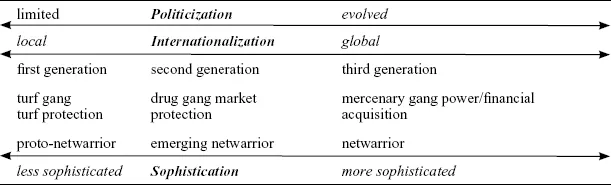
Source: John P. Sullivan, “Third Generation Street Gangs: Turf, Cartels, and NetWarriors,” Transnational Organized Crime, Vol. 3, No. 3, Autumn 1997.
• Mercenary/Political: third generation gangs have evolved political aims. They operate—or seek to operate—at the global end of the spectrum, using their sophistication to gain and secure power, drive financial acquisition, and engage in mercenary-type activities. To date, most 3 GEN gangs have been primarily mercenary in orientation; yet, in some cases, they have sought to further their own political and social objectives.
Gangs in all three generations benefit from insecurity and weak social control structures. Their areas of operations range from ‘failed communities or neighborhoods’ though weak and contested states. In addition, gangs at all three generations interact with each other with more sophisticated organized crime groups providing potential drivers for adaptation and evolution.
Transnational Gangs
Some second and third generation gangs have become cross-border or transnational actors. Transnational gangs are a concern throughout the Western Hemisphere. Criminal street (and hybrid prison-street) gangs have evolved to pose significant security and public safety threats in individual neighborhoods, metropolitan areas, nations, and across borders. Such gangs—widely known as maras—are no longer just street gangs. They have morphed through interactions with other gangs and transnational organized crime groups (e.g., narcotics cartels/drug trafficking organizations) into complex networked threats.6
Transnational maras have evolved into a transnational security concern throughout the Americas (especially Central America). As a consequence of globalization, the influence of information and communications technology, and travel/migration patterns (including forced deportation), gangs formerly confined to local neighborhoods have spread their reach across neighborhoods, cities, and countries. In some cases, this reach is increasingly cross-border and transnational. Transnational gang activity is a concern in several Central American States and Mexico (where they inter-operate with cartels).7 One example is Barrio Azteca/Los Aztecas, an El Paso based prison-street gang that operates in Texas and New Mexico, as well as in Ciudad Juárez. The Aztecas played a major role in the battle for the Juárez Plaza (drug trafficking node).
Transnational gangs can be defined as having one or more of the following characteristics: 1) criminally active and operational in more than one country; 2) criminal operations committed by gangsters in one country are planned, directed, and controlled by leadership in another country; 3) they are mobile and adapt to new areas of operations; and 4) their activities are sophisticated and transcend borders.8 The gangs most frequently mentioned in this context are Mara Salvatrucha (MS-13) and Eighteenth Street (M-18 or Calle 18), both originating in the barrios of Los Angeles. Further, MS-13 has been mentioned as an ally of both Los Zetas and the Sinaloa cartel.9
Transnational, third generation gangs are networked actors. They link with allies, feudal lieges (prison gangs like Eme—the Mexican Mafia) and transnational criminal organizations (cartels) in intricate ways. Some analysts have argued that they lack sophistication because they lack a defined hierarchy. That is wrong since their sophistication lies in the network connectivity. Other analysts have argued that the third generation gangs can be viewed in a disarticulated fashion—essentially a group like MS-13 can be a third generation entity in one space (e.g., El Salvador) but is less of a threat in the U.S. This misreads both network theory and third generation gang theory. As Castells st...
Table of contents
- Cover
- Half Title
- Title Page
- Copyright Page
- Table of Contents
- Citation Information
- Note from the Publisher
- Note about the cover image
- Preface: Criminology and National Security Perspectives in Gang and Cartel Analysis
- 1. Introduction: Third Generation Gangs and Third Phase Cartels
- SECTION I Source documents
- SECTION II Maturing perspectives
- Appendix 1: Insurgency and Crime
- Appendix 2: Gang and Cartel Maps (I)
- Appendix 3: Gang and Cartel Maps (II), can be found on http://scholarship.claremont.edu/cgu_facbooks/13/ Chronological Listing of Selected Gang and Cartel Studies References
- Index
Frequently asked questions
Yes, you can cancel anytime from the Subscription tab in your account settings on the Perlego website. Your subscription will stay active until the end of your current billing period. Learn how to cancel your subscription
No, books cannot be downloaded as external files, such as PDFs, for use outside of Perlego. However, you can download books within the Perlego app for offline reading on mobile or tablet. Learn how to download books offline
Perlego offers two plans: Essential and Complete
- Essential is ideal for learners and professionals who enjoy exploring a wide range of subjects. Access the Essential Library with 800,000+ trusted titles and best-sellers across business, personal growth, and the humanities. Includes unlimited reading time and Standard Read Aloud voice.
- Complete: Perfect for advanced learners and researchers needing full, unrestricted access. Unlock 1.5M+ books across hundreds of subjects, including academic and specialized titles. The Complete Plan also includes advanced features like Premium Read Aloud and Research Assistant.
We are an online textbook subscription service, where you can get access to an entire online library for less than the price of a single book per month. With over 1.5 million books across 990+ topics, we’ve got you covered! Learn about our mission
Look out for the read-aloud symbol on your next book to see if you can listen to it. The read-aloud tool reads text aloud for you, highlighting the text as it is being read. You can pause it, speed it up and slow it down. Learn more about Read Aloud
Yes! You can use the Perlego app on both iOS and Android devices to read anytime, anywhere — even offline. Perfect for commutes or when you’re on the go.
Please note we cannot support devices running on iOS 13 and Android 7 or earlier. Learn more about using the app
Please note we cannot support devices running on iOS 13 and Android 7 or earlier. Learn more about using the app
Yes, you can access Studies in Gangs and Cartels by Robert J. Bunker,John P. Sullivan,RobertJ. Bunker in PDF and/or ePUB format, as well as other popular books in History & Military & Maritime History. We have over 1.5 million books available in our catalogue for you to explore.