- 200 pages
- English
- ePUB (mobile friendly)
- Available on iOS & Android
eBook - ePub
About this book
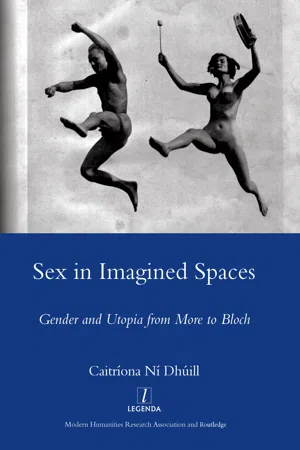
From Thomas More onwards, writers of utopias have constructed alternative models of society as a way of commenting critically on existing social orders. In the utopian alternative, the sex-gender system of the contemporary society may be either reproduced or radically re-organised. Reading utopian writing as a dialogue between reality and possibility, this study examines the relationship between historical sex-gender systems and those envisioned by utopian texts. Surveying a broad range of utopian writing from the nineteenth and twentieth centuries, including Huxley, Zamyatin, Wedekind, Hauptmann, and Charlotte Perkins Gilman, this book reveals the variety and complexity of approaches to re-arranging gender, and locates these 're-arrangements' within contemporary debates on sex and reproduction, masculinity and femininity, desire, taboo and family structure. These issues occupy a position of central importance in the dialogue between utopian imagination and anti-utopian thought which culminates in the great dystopias of the twentieth century and the postmodern re-invention of utopia.
Trusted by 375,005 students
Access to over 1.5 million titles for a fair monthly price.
Study more efficiently using our study tools.
Information
CHAPTER 1
No Place Like Here: Utopian Imagination as a Critical Space
Utopia – anti-utopia – dystopia: mapping the terrain
Reports of the death of utopia have been greatly exaggerated.1 For many, the demise of state communism in Central and Eastern Europe vitiated the case for utopia: attempts to create the perfect society here on earth, to eliminate poverty, suffering and social injustice and to establish the necessary conditions for human flourishing were tried in large parts of the world in the twentieth century, and have failed spectacularly. The utopian desire to make a better world, so the argument goes (and it is often compelling), is hubristic and breeds violence, and we are better off without it. In the immediate aftermath of communism’s collapse, liberal Western-style democracy on the economic foundation of free-market capitalism was frequently touted as the only workable solution to the problems communism had attempted to eradicate. The spectres of global financial meltdown, international terrorism and ecological crisis have combined since then to render even this anti-utopian utopia untenable. Nevertheless, the rush to declare utopia moribund is premature. Profound instability, rapid change, the bankruptcy of established systems and ideologies — these are, in fact, precisely the conditions under which utopia has flourished in the past. However we may define it, utopia remains a tenacious and diverse category of the human imagination. The ‘death of utopia’ is thus, if anything, a conceptual pawn in the broader game of redefining the political and intellectual traditions of left and right in a post-communist world.
This study aims to disengage the concept of utopia from this polemical setting, to historicize utopian thinking, to relocate the utopian within literary and imaginative practice, and to relate some of its more problematic and thought-provoking aspects to other discourses and debates. Writers and thinkers who have touted the death of utopia in recent years are read here as contributors to an ongoing conversation about the meaning and function of utopia; by proclaiming the demise of utopia, they in fact posit a particular kind of relationship between reality and imagination which needs to be critically examined in turn.
Critical literature on the utopian tradition has tended to focus on the social systems or orders, or on the principles abstractable from utopian societies, whether fictional or actual. A common theme, especially in the examination of fictional dystopias — themselves a special kind of utopia, as we shall see — is the troubling relationship between the system and the individual trapped within it: the shortcomings of the system are demonstrated with reference to the life of the individual, who is somehow limited or frustrated by the social constraints the utopian order demands. This opposition of individual and system is fleshed out in the plots of much utopian and dystopian fiction — the protagonists of Yevgeny Zamyatin’s We and George Orwell’s Nineteen Eighty-Four spring to mind — but it obscures as much as it reveals. The figures in utopian fiction are constructs of the societies they inhabit, or, put another way, the values of the utopian order are materialized through the bodies of its inhabitants.
Throughout this book, I will be concerned with the ways in which these bodies, even in the most radically alternative arrangements, continue to be gendered bodies that have to reproduce themselves in order for their society to perpetuate its existence. What happens to gender arrangements, to sexual identities and sexual and reproductive practices, when they are imagined anew within the fictional space of a utopian order? The citizens of utopia may live in conditions that are strikingly and deliberately alien, but their status as gendered bodies and subjects refers them back to the practices of gender in the social and historical contexts from within which they are imagined. Where the imaginary world of utopia dispenses with the gender arrangements and sexual norms in force in reality, the utopian alternatives are a form of commentary on these arrangements and norms. The depiction of a fantasy matriarchy is a way of commenting critically on patriarchy; the abolition of the conventional family, a common expedient of many utopias, is a device for reflecting on the cultural power and social function of family relationships.
Most utopian and dystopian texts refer in some way to questions of sex and gender, if only tangentially, but in some texts these themes occupy a centrally important position. Three such texts will receive special attention in chapters 4, 5, and 6 of this book: Charlotte Perkins Gilman’s novel Herland (1915), Gerhart Hauptmann’s novel The Island of the Great Mother (1924), and Frank Wedekind’s incomplete, unpublished utopia The Great Love, the first three chapters of which were published as the novella Mine-Haha (1903). These texts are less well known than the dystopias by Huxley, Orwell, and Zamyatin discussed in other chapters, yet they deserve attention for the innovative ways in which they employ features of the traditional utopia to create a framework for exploring questions of sex, gender, and reproduction.
The sample of fiction discussed in this book aims to provide the reader with a representative picture of modern utopian imagination in its negotiations with questions of sex and gender. The focus on the decades around 1900, as well as the prominence of German texts, are two aspects of the selection that deserve elucidation. The anti-utopian claim that utopia is inherently totalitarian and ultimately murderous has often drawn compelling and dramatic evidence from the history of National Socialism and of the persecution and genocide carried out under Hitler’s regime. The ‘Volksgemeinschaft’ or racial community idealised in Nazi propaganda was itself a highly selective Aryan utopia of sorts, and incorporated many elements of fin de siècle utopian reform discourse. The fact that the murderous totalitarian regimes of the mid-twentieth century enshrined utopian elements in their self-justifying ideology should prompt us to look closely and critically at the ways in which utopia — as concept, as dream, as topos — was understood, imagined and used in the preceding period. This is not to posit a teleology; venturing any kind of explanation of the origin of National Socialism is a notoriously difficult and problematic task, and is not attempted in this study. The point is rather to establish the diversity of uses to which utopian motifs were put, the variety of forms utopian imagination could take, but also the congruences and connections between the various utopian models advanced at a given period in history and in a particular cultural milieu. The German texts examined here are notable for the ways in which they combine utopian motifs with elements of fin de siècle reform discourse. A careful reading of these texts against the backdrop of the utopian tradition will, it is hoped, shed light on the complex relationships between reform movements, cultural criticism and utopian imagination in the early twentieth century — a set of relationships not easily explained in the binaristic terms of left and right, progressive and regressive, modern and anti-modern, or socialist and proto-fascist.
The utopia of ‘life reform’
The term Lebensreform — literally ‘life reform’ or ‘reform of life’ — is used to refer collectively to the many loosely related reform movements that arose around 1900, all concerned in different ways with questions of health and the body. The diverse causes of Lebensreform ranged from progressive education to naturism, from eugenics to hill-walking, from sexual liberation to vegetarianism to modern dance. (The sheer range of groups, interests, and movements is well captured in the two-volume, extensively annotated catalogue of a major exhibition on Lebensreform which took place in Darmstadt in 2001.) Various political movements, such as feminism and socialism, were receptive to Lebensreform ideas. For example, it is striking how many early twentieth-century feminists saw eugenics as an integral part of feminism; this perhaps unexpected congruence is discussed in more detail in later chapters. Many elements of Lebensreform discourse would later be incorporated into fascist and National Socialist ideology, particularly eugenics and the idealization of the healthy, athletic body, rendered collective in the ultimately genocidal vision of a ‘fit race’. As with most strands of Lebensreform, however, in the case of eugenics there were protagonists and interest groups active on both the left and the right of the political spectrum in the early twentieth century.
Clearly, these movements and trends were not restricted to the German context. When I come to discuss the congruence of socialism and eugenics, or feminism and eugenics, I refer to material from British and American activists, writers, and reformers. The same goes for the literary expression and representation of these movements: from the eurhythmics of D. H. Lawrence’s Women in Love to the maternalist feminism of Charlotte Perkins Gilman’s Herland, we find experimental and reformist ideas incorporated into the literature of the period, in English as well as in German. But it was in Germany that the cultural impact of the Lebensreform movements was most clearly accentuated. There were a number of reasons for this, but the most important is probably Germany’s belated and accelerated industrialization in the decades prior to 1900, which led to modernization and urbanization of unprecedented, and unparalleled, rapidity. Lebensreform is, among other things, a reaction to modernization, and where the modernization process is intense and rapid, the cultural reaction is correspondingly marked.
In its diversity and political range, Lebensreform was both less and more than a movement; it is perhaps best described as a sensibility which combined both modern and anti-modern elements to form a broad utopian agenda. Anti-modern, in that its criticism and rejection of many aspects of late capitalist industrial society, from the mechanization and rationalization of production to the living conditions of the urban proletariat often entailed an idealization of pre-modern conditions; modern, in that reformers were optimistic about humankind’s ability to progress beyond its current condition, and to solve the problems that the modernization process had created. In fact, Lebensreform in many of its manifestations is a variation on the theme of progress, even if the specific form of progress it advocates often takes the form of ‘back to nature’.
This seemingly paradoxical combination of the modern and the anti-modern is clearly demonstrated in the German texts which I discuss in chapters 4, 5, and 6. These chapters focus on the utopian prose experiments of two major German dramatists, Wedekind and Hauptmann — the former a forerunner of Expressionism whose principal theme was sex, the latter best known as a key figure in realism whose later writings increasingly tended to engage with mystical and esoteric subjects. Hauptmann’s The Island of the Great Mother and Wedekind’s The Great Love are not numbered among their authors’ best-known productions. While Hauptmann’s novel sold fairly well initially, it was not one of the works on which his reputation was built. Wedekind’s The Great Love remained incomplete and unpublished during his lifetime, and the drafts still await publication almost a century after his death. The significance of these texts lies less in their impact on the reading public of the time, then, than in their explicit and distinctive relationship to the utopian tradition. Both writers use utopian motifs in ways that demonstrate the considerable strain to which the concept of utopia was subject at this period in history. Their fantasy worlds did not follow the tr...
Table of contents
- Cover Page
- Title Page
- Copyright Page
- Contents
- Acknowledgments
- 1 No Place Like Here: Utopian Imagination as a Critical Space
- 2 From Utopian Crisis to Dystopian Response
- 3 Re-Arranging Gender: Utopian Constructions of Sexual Difference
- 4 Matriarchy and Maternalism: Nurture and Nature as Social Critique
- 5 Utopias of the Dionysian
- 6 From Pedagogical Province to Primitivist Utopia
- 7 Beyond the Blueprint: Utopias of Postmodernity
- Bibliography
- Index
Frequently asked questions
Yes, you can cancel anytime from the Subscription tab in your account settings on the Perlego website. Your subscription will stay active until the end of your current billing period. Learn how to cancel your subscription
No, books cannot be downloaded as external files, such as PDFs, for use outside of Perlego. However, you can download books within the Perlego app for offline reading on mobile or tablet. Learn how to download books offline
Perlego offers two plans: Essential and Complete
- Essential is ideal for learners and professionals who enjoy exploring a wide range of subjects. Access the Essential Library with 800,000+ trusted titles and best-sellers across business, personal growth, and the humanities. Includes unlimited reading time and Standard Read Aloud voice.
- Complete: Perfect for advanced learners and researchers needing full, unrestricted access. Unlock 1.5M+ books across hundreds of subjects, including academic and specialized titles. The Complete Plan also includes advanced features like Premium Read Aloud and Research Assistant.
We are an online textbook subscription service, where you can get access to an entire online library for less than the price of a single book per month. With over 1.5 million books across 990+ topics, we’ve got you covered! Learn about our mission
Look out for the read-aloud symbol on your next book to see if you can listen to it. The read-aloud tool reads text aloud for you, highlighting the text as it is being read. You can pause it, speed it up and slow it down. Learn more about Read Aloud
Yes! You can use the Perlego app on both iOS and Android devices to read anytime, anywhere — even offline. Perfect for commutes or when you’re on the go.
Please note we cannot support devices running on iOS 13 and Android 7 or earlier. Learn more about using the app
Please note we cannot support devices running on iOS 13 and Android 7 or earlier. Learn more about using the app
Yes, you can access Sex in Imagined Spaces by Caitriona Dhuill in PDF and/or ePUB format, as well as other popular books in Languages & Linguistics & Languages. We have over 1.5 million books available in our catalogue for you to explore.