- 268 pages
- English
- ePUB (mobile friendly)
- Available on iOS & Android
eBook - ePub
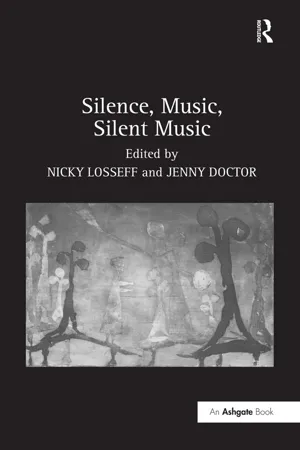
Silence, Music, Silent Music
About this book
The contributions in this volume focus on the ways in which silence and music relate, contemplate each other and provide new avenues for addressing and gaining understanding of various realms of human endeavour. The book maps out this little-explored aspect of the sonic arena with the intention of defining the breadth of scope and to introduce interdisciplinary paths of exploration as a way forward for future discourse. Topics addressed include the idea of 'silent music' in the work of English philosopher Peter Sterry and Spanish Jesuit St John of the Cross; the apparently paradoxical contemplation of silence through the medium of music by Messiaen and the relationship between silence and faith; the aesthetics of Susan Sontag applied to Cage's idea of silence; silence as a different means of understanding musical texture; ways of thinking about silences in music produced during therapy sessions as a form of communication; music and silence in film, including the idea that music can function as silence; and the function of silence in early chant. Perhaps the most all-pervasive theme of the book is that of silence and nothingness, music and spirituality: a theme that has appeared in writings on John Cage but not, in a broader sense, in scholarly writing. The book reveals that unexpected concepts and ways of thinking emerge from looking at sound in relation to its antithesis, encompassing not just Western art traditions, but the relationship between music, silence, the human psyche and sociological trends - ultimately, providing deeper understanding of the elemental places both music and silence hold within world philosophies and fundamental states of being. Silence, Music, Silent Music will appeal to those working in the fields of musicology, psychology of religion, gender studies, aesthetics and philosophy.
Information
Chapter 1
The Texture of Silence
Jenny Doctor
The voices blend and fuse in clouded silence: silence that is the infinite of space: and swiftly, silently the soul is wafted over regions of cycles of cycles of generations that have lived.James Joyce, Ulysses1
In the revised New Grove Dictionary of Music, published in 2001, there is no article on ‘Silence’. There is an article called ‘Music’ this time.2 There wasn’t one in the 1980 edition, the reasoning being that since the entire dictionary embodied music, it was superfluous to have an article to explain it. But there was much criticism that a twenty-volume dictionary devoted to music did not specifically define and assess the term. So it became a point of honour and purpose that Music would be acknowledged in a concrete way in the revised edition. In fact, Music was the first article to arrive, well before the rest of the dictionary was even commissioned - and I might well add that it was the first article to be lost. In his excitement, Stanley Sadie placed the typescript somewhere, and there were many searches over the next six months as we tried to find it, tried to find ways to avoid admitting to the author that, now that it finally existed, this rather significant piece of work had almost immediately vanished off the face of the Grove map.
I found this scenario of Music’s arrival and loss amusingly symbolic, even at the time – but thinking back on it from today’s vantage point, it is not nearly as symbolic as the omission of Silence. You see, amidst all the many noisy discussions about the content of the revised dictionary, I don’t remember there ever being a suggestion that we include an article on Silence. There was comprehensive lack of recognition of this term, this concept, this entity as a music-relevant subject, the lack of recognition itself symbolic of the role Silence plays generally in music-related discourse. And thinking about it now, after considering, contemplating and confronting various relationships between Music and Silence over the past few years - and feeling that I’m not yet scratching the surface - I have to wonder: if an attempt were made to capture the concept in a dictionary of music, would silence be defined as music’s opposing force or as its consummate, transcendent form?
It is this dichotomy that lies at the basis of my thoughts about music and silence in this essay. I have chosen to explore these musically through the medium of the string quartet, because it encompasses a multi-dimensionality of sound and timbre, as well as an intimacy that encourages textures in which ‘the voices [may] blend and fuse in clouded silence: silence that is the infinite of space’.
§
A way a lone a last a loved a long the — riverrun, past Eve and Adam’s, from swerve of shore to bend of bay, brings us by a commodius vicus of recirculation back to Howth Castle and Environs.3
This celebrated, oft-quoted circular ending-beginning to Finnegan ‘s Wake by James Joyce (1882–1941) inspired my initial thoughts in exploring the aspect of music and silence that particularly interests me: the relationship between silence and musical texture. To a large extent, this involves noticing, focusing on and thinking about musical events that are commonplace, so obvious that they often go unnoticed; it requires the acknowledgement of aural spaces that are usually ignored as insignificant.
The monosyllabic sounds of Joyce’s concluding text provide a starting point: ‘A way a lone a last a loved a long the.’ To state the obvious: as an entity in itself, this string of words does not make grammatical sense. Yet space between each pairs of words allows us to glimpse a meaning: ‘Away Alone a last a loved a long the riverrun.’ ‘Space between words’ meaning: silence. Thus silence plays a functional role here to articulate both a sense of meaning and a rhythm in an otherwise meaningless string of syllables - a single-layer texture of uttered sounds in an undistinguished continuum.
On a larger scale, consider a passage from later in Finnegan’s Wake, the part in Chapter 8 where two washerwomen gossip about Anna Livia Plurabelle, wife of Humphrey Chimpden Earwicker, whose story has already been told and retold. The text on the page represents another sound continuum, undulating vividly between words and phrases that immediately make sense and those that don’t.
Well, you know or don’t you kennet or haven’t I told you every telling has a taling and that’s the he and the she of it. Look, look, the dusk is growing! My branches lofty are taking root. And my cold cher’s gone ashley. Fieluhr? Filou! What age is at? It saon is late. ‘Tis endless now senne eye or erewone last saw Waterhouse’s clogh. They took it asunder, I hurd thum sigh. When will they reassemble it? O, my back, my back, my bach! I’d want to go to Aches-les-Pains. Pingpong! There’s the Belle for Sexaloitez! And Concepta de Send-us-pray! Pang! Wring out the clothes! Wring in the dew! Godavari, vert the showers! And grant thaya grace! Aman. Will we spread them here now? Ay, we will. Flip! Spread on your bank and I’ll spread mine on mine. Flep! It’s what I’m doing. Spread! It’s churning chill. Der went is rising. I’ll lay a few stones on the hostel sheets. A man and his bride embraced between them. Else I’dhave sprinkled and folded them only. And I’ll tie my butcher’s apron here. It’s suety yet. The strollers will pass it by. Six shifts, ten kerchiefs, nine to hold to the fire and this for the code, the convent napkins, twelve, one baby’s shawl. ...4
This is the text that begins a reading that Joyce gave in August 1929 at a studio in the Orthological Institute in London; and, famously, it was recorded.5 The words and phrases have meanings as words and phrases, of course; Joyce apparently spent hundreds of hours writing this chapter, filled with symbolism, multiple-entendres, water references and river names; diligent fans have devoted much time ever since to ferreting out even the most obscure textual references.6 To state another obvious point: this extraordinary recording of Joyce reading with his particular accent and pronunciation immediately clarifies some meanings that may have been obscured on the page.
But listening to the sonority, the music of it, one can derive an entirely different level of understanding. Yet again stating the obvious: through obfuscating usual modes of text communication, Joyce raised the receiver’s imagination or consciousness to a new level; this form of communication forces the reader/recipient to find his or her own path of meanings through the passage continuum. In Joyce’s own reading, the tone qualities, the counterpoint between his vocal colours and the intermittent spaces, and the diminuendos reducing sounds to silences all contribute toward shaping the sound-syllables into something each recipient comes to understand - even without necessarily comprehending the words. This mental process is analogous to hearing musical settings of texts in languages unknown to the listener and nevertheless deriving meaning from the experience. Through the act of performing this passage, Joyce sculpted the text so that it functioned as texture. When listening to his reading, silence and space play a primary, essential role in permitting the mind to perceive meaning, dividing the landscape into gestures rather than sounds, and using the gestures to discover a way through sonic ambiguity. Silence thus gives meaning here to texted texture.
§
The silent images of things in the soul bring their silence to the words that are the life of the mind. They work silence into the texture of language; they keep it supplied with silence, with the original power of silence.7
In The World of Silence (1948), the Swiss theologian, Max Picard (1888–1965), found a way to weigh this relationship between silence and sound texture; as this quotation reveals, in his spiritual quest, Picard gave primary billing to silence. In the realm of Western art music, silence is generally perceived not as ‘the original power’ at the centre of the texture, but at the ...
Table of contents
- Cover
- Half Title
- Title Page
- Copyright Page
- Table of Contents
- List of Illustrations and Music Examples
- Notes on Contributors
- Acknowledgements
- Introduction
- 1 TheTexture of Silence
- 2 Faith, Silence and Darkness Entwined in Messiaen’s ‘Regard du silence’
- 3 Sounding Silence, Moving Stillness: Olivier Messiaen’s Le banquet céleste
- 4 Going Gently: Contemplating Silences and Cinematic Death
- 5 Film Sound, Music and the Art of Silence
- 6 Pragmatics of Silence
- 7 Some Noisy Ruminations on Susan Sontag’s ‘Aesthetics of Silence’
- 8 Preliminary Thoughts About Silence in Early Western Chant
- 9 The Communicative Rest
- 10 The Air Between Two Hands: Silence, Music and Communication
- 11 ‘Meditation is the Musick of Souls’: the Silent Music of Peter Sterry (1613-1672)
- 12 Silent Music and the Eternal Silence
- Selected Bibliography
- Index
Trusted by 375,005 students
Access to over 1.5 million titles for a fair monthly price.
Study more efficiently using our study tools.
Frequently asked questions
Yes, you can cancel anytime from the Subscription tab in your account settings on the Perlego website. Your subscription will stay active until the end of your current billing period. Learn how to cancel your subscription
No, books cannot be downloaded as external files, such as PDFs, for use outside of Perlego. However, you can download books within the Perlego app for offline reading on mobile or tablet. Learn how to download books offline
We are an online textbook subscription service, where you can get access to an entire online library for less than the price of a single book per month. With over 1.5 million books across 990+ topics, we’ve got you covered! Learn about our mission
Look out for the read-aloud symbol on your next book to see if you can listen to it. The read-aloud tool reads text aloud for you, highlighting the text as it is being read. You can pause it, speed it up and slow it down. Learn more about Read Aloud
Yes! You can use the Perlego app on both iOS and Android devices to read anytime, anywhere — even offline. Perfect for commutes or when you’re on the go.
Please note we cannot support devices running on iOS 13 and Android 7 or earlier. Learn more about using the app
Please note we cannot support devices running on iOS 13 and Android 7 or earlier. Learn more about using the app
Yes, you can access Silence, Music, Silent Music by Jenny Doctor, Nicky Losseff in PDF and/or ePUB format, as well as other popular books in Media & Performing Arts & Music. We have over 1.5 million books available in our catalogue for you to explore.