- 204 pages
- English
- ePUB (mobile friendly)
- Available on iOS & Android
eBook - ePub
About this book
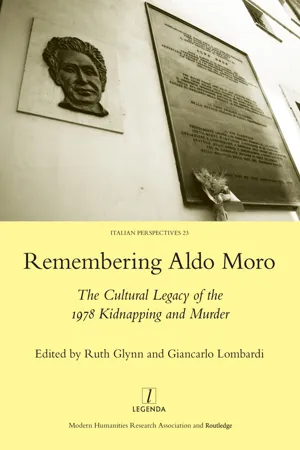
The 1978 kidnapping and murder of Christian Democrat politician, Aldo Moro, marked the watershed of Italy's experience of political violence in the period known as the 'years of lead' (1969-c.1983). This uniquely interdisciplinary volume explores the evolving legacy of Moro's death in the Italian cultural imaginary, from the late 1970s to the present. Bringing a wide range of critical perspectives to bear, interventions by experts in the fields of political science, social anthropology, philosophy, and cultural critique elicit new understandings of the events of 1978 and explain their significance and relevance to present-day Italian culture and society.
Information
PART I
❖
Modes of Emplotment
CHAPTER 1
❖
Aldo Moro and the Tragic Afterlife of a Melodrama
Revisiting the book, The Moro Morality Play: Terrorism as Social Drama, nearly twenty years after its publication, this essay connects the kidnapping and assassination of Aldo Moro to other contemporary historical traumas that ramify across different levels of society.1 The essay attempts to craft a language of interpretation that simultaneously accommodates the vision of individuals, families, civil society, and the state. It does this by focusing on varieties of individual and collective mourning and commemoration, and the ways these varieties intervene to re-imagine the world left wounded by the historical trauma. It develops further the original distinction drawn between melodrama and tragedy as modalities by which to understand such traumas and through which societies live them. The essay concludes by exploring what the recuperation of Aldo Moro’s own voice might contribute to the projects of collective mourning and historical comprehension.
The process of returning, many years after publishing my book, The Moro Morality Play: Terrorism as Social Drama, to reflect upon Aldo Moro and the tragic events of his kidnapping and assassination has been sobering. This is partly a function of the analytic stance generally. An honest scholar must experience the sobriety of standing in front of history with a paradoxical combination of dispositions — hubris and humility. Humanists and social scientists often feel the pull of social and political crises — the felt need to pay close attention, to interpret, and analyse, the traumas that resonate upwards, from individuals through families and communities, to the larger social and political collectivity. Hegel linked history itself to the state: ‘It is the State [he wrote] which first presents a subject-matter that is not only adapted to the prose of History, but involves the production of such History in the very progress of its own being.’2 The state thus views itself as the central character of history, with an agency and a political body of its own, capable of being wounded. The lives of individuals, whether caught up as soldiers in war, or as workers in a transforming economy, or as victims of terrorist attacks, find themselves and their individual points of view eclipsed by that of the state itself. And this is true regardless of how central to the state’s very progress these individuals are.
Different genres have evolved to differentiate the visions, exhortations, and remonstrances of these different social agents. In his brilliant analysis of The Gettysburg Address, Gary Wills writes of Abraham Lincoln’s adaptation of the ancient Greek epitaphios (‘funeral oration’) to the task of dedicating a military cemetery on the site of the former American Civil War battlefield at Gettysburg. Of this classical template, Wills writes that it provided a ‘prose form of the Greek orations that was meant to be bracing after the sung lament (threnos) of the burial rite […]. The prose form is itself a return to political life, a transition from family mourning to the larger community’s sense of purpose’.3 From sung lamentation to prosodic oratory, the state re-claims its transcendent purview. The state thus has its genres and keen representatives of the state — or better, the nation — like Lincoln, can, at moments like Gettysburg, deploy them effectively. But we need to assess other historical moments of crisis in which the line between the purview and prerogatives of the state and those of individuals and families is not so clear cut, when the ‘right’ genre for representing historical events does not so easily present itself, and when the confusion is largely a function of discord over the meaning of an event in real time and which continues to take shape long afterwards, even as the interpreters of history cast their retrospective vision on it.
This is where the hubris of interpretation needs to connect with the humility of the interpreter looking squarely into the face of trauma. The task then becomes doubly difficult — to fashion a language of interpretation that moves to that collective level of history but that also takes seriously the work of threnos (‘lamentation’). Greek tragedy found that middle way, largely because the families whose actions were performed were literally the families heading the state. And tragedies like Sophocles’ Antigone were especially tuned to this combination of focus on the conflicting demands of family and state. In more contemporary historical traumas, like that of the Aldo Moro tragedy and that of ii September 2001, the vision of the family is not easily superseded by that of the state nor should these visions (that of the state and that of the family) be simply counter-posed. Ultimately, the task of the analyst is to craft a language that gives access to the very process by which these different angles of vision onto history interact with each other, with all of the fatal consequences of such interaction put into high relief. This is the task I set for myself when I wrote The Moro Morality Play in the mid 1980s, and it is the task I set for myself now in revisiting this event.
We acknowledge events as historical if and when they appear to cause or mark a break from the ongoing temporal flow. And our acknowledgement depends on our comprehension of forms. We hear speeches, we read news articles, we see flags waving en masse, we view photographs and paintings. We hear our fellow citizens narrate events in the form of stories. In other words, in apprehending these breaking historical events, forms matter. They matter not just because they are the media by which events come to be known, but because they also have consequences for the way events are ultimately directed — forms influence the very course of events. But discussion of forms, to reprise the initial preoccupations of my essay, can take a dispassionate, removed tone, distant from the events themselves, events that directly affect the lives of those who literally live through them. What does it mean to be an observer? What is the correct or the most fruitful angle of vision — how near, how far, how sensitive to emotions and sentiments, how clinical? Recent works by Luc Boltanski (Distant Suffering, 1999) and Carlo Ginzburg (Wooden Eyes, 2002) have raised the important question of identifying genres, or forms, adequate to the task of communicating history and suffering at a distance.4 They have also raised the question of identifying the optimal distance for the most revelatory examination of cultural objects. But distance is only one of the dilemmas of interpretation. More specifically, I want to ask questions about what forms or genres are up to the task of representing acts of violence. For some theorists, for example, Shoshana Felman (following Walter Benjamin), history itself ‘consists in chains of traumatic interruptions rather than in sequences of rational causalities’.5 Traumatic interruptions, acts of violence, generate a relay race of forms as historical events aim toward coherence, taking provisional shape as societies try and understand what is happening or make sense out of rupture. Alternatively, one might ask what it might mean to catch this process on its way toward coherence, to cast analytical light on its very incoherence with all of the consciousness of what is (or was) at stake in the outcome?
The Moro Morality Play focused on discerning the social and political mechanisms by which specific interpretations of events during the period of Aldo Moro’s kidnapping were either accepted or rejected as reasonable, valuable, truthful, and useful. These attempts at sense-making were existential, political, orientational, and strategic. What remains shocking is the degree to which Aldo Moro’s own interpretations and mediations were systematically discredited by other interpreters. The person most affected, most involved, most proximate to the site of rupture was systematically disregarded. My book was largely about how this discrediting was accomplished; it was only marginally focused on considerations of why this occurred, considerations other scholars have debated in their focus on geo-politics. My research methodology involved combing through the documents and the images that reached the public during those fifty-five days — the speeches, letters, newspaper articles, photographs, communiqués, and radio show transcripts — to get a handle on the arguments and images that drove the crisis forward. All of this with an ear and an eye tuned to the linguistic and semiotic choices made by those in positions to communicate. My assumption was that each communicative act involved a series of choices (however unconscious) about how to categorize and conceptualize what was happening. My most important claim was that these choices had material consequences, first and foremost, for the fate of Aldo Moro as well as for the self-understanding and coherence of the Italian nation-state.
Given the claim that forms matter in both the practice and the analysis of history, what kind of concepts give us the best purchase on those forms? I argued that the anthropological and sociological perspectives were particularly revelatory. From Victor Turner’s analysis of the social drama, to Mary Douglas’s frameworks for understanding the relationship between purity, morality, and sacredness (particularly in processes of policing social boundaries), to Harold Garfinkle’s focus on degradation rituals, to Durkheimian assessments of collective representations, sociological, and anthropological models of society provided angles of vision into a complex, turbulent event. As well, sociologists studying large-scale modern societies pay close attention to institutions of government, mass media, the economy, religion, and law when tracking the course of these events. Each institution has its own characteristic language and characteristic forms for adjudicating what is right and wrong, possible or impossible, moral or immoral, legitimate or illegitimate. In the months of Aldo Moro’s captivity, all of these characteristic forms were activated — juridical trials (both legitimate and illegitimate ones), special editions of media organs, demonstrations and strikes, political speeches, prayer, and laws. All active agents in social and political conflicts, regardless of their institutional bases, process events in an ongoing manner with certain key referents guiding their ideas — the party, the nation, the family, the state, the leader, the enemy. The task then was to connect all of these frameworks and processes to reveal the material stakes in the project of making trauma cohere.
The overarching framework for The Moro Morality Play was that of Victor Turner’s ‘social drama’, with its four phases of Breach, Crisis, Redress, and Reconciliation or Schism.6 The dramaturgical perspective views social life as theatrical not only nor primarily in the sense that social life is full of drama, but rather that ideas about roles and plots and endings that derive originally from theater are salient in social and political events, particularly as these events are mediated through multiple channels of communication. These frameworks get set semi-automatically, with the active protagonists thinking with theatrical idioms as they make their choices and make them known. Some of these choices are obvious — avoid gestures and speech acts that might be construed as farcical, engage those that draw on affective states of seriousness and concern. Further, the claim is that there are vastly different repercussions to adopting different theatrical idioms. I will return to those repercussions later when outlining the difference between melodrama and tragedy.
Turner’s social drama framework was originally developed to explain phenomena in small-scale societies, phenomena where a crisis threatens to break the society apart and the society enlists ritual and symbolic mechanisms to preempt such a rupture from occurring. He wrote:
At its simplest, the drama consists of a four stage model, proceeding from breach of some relationship regarded as crucial in the relevant social group, which provides not only its setting but many of its goals, through a phase of rapidly mounting crisis in the direction of the group’s major dichotomous cleavage, to the application of legal or ritual means of redress or reconciliation between the conflicting parties which compose the action set. The final stage is either the public and symbolic expression of reconciliation or else of irremediable schism.7
My application of the framework to a large-scale society like Italy could not, obviously, be automatic. Large-scale societies are interactionally and constitutionally different from small-scale societies. Also, I sought to understand the way that long-term problems and acute crises were intercalibrated in social dramas. In this way, long term crises of governmental legitimacy and acute crises of terrorist attacks and kidnappings were both expressed and worked out in the medium of the social drama.
The social drama model presses the analyst to locate what Turner called the ‘crucial relationships’. In the events surrounding Aldo Moro’s kidnapping were they the relationships among the major political parties (the Christian Democrats and Communists first and foremost) and the sectors of the public they represented? Were they relationships between one generation and another? Were they actually the relationships among the individuals empowered to take action (or not to take action) to resolve the crisis and obtain Aldo Moro’s release? In some sense, they were all of these. The social drama model also focuses attention on the forms of expression and communication of the crisis — trials, letters, communiqués, speeches, and newspaper editorials — which all vied for prominence and legitimacy. Positions and claims and interpretations of what was happening were all taken and made within the forms of expression that were already generically codified. With each new communication, a veritable army of interpreters leaped into the breach to declare that this statement was true, that one false, this line of reasoning legitimate, that one illegitimate, this argument lucid and worthy, that one confused and ignorable, this image of Italy or of Aldo Moro himself magnificent or degraded. Trying to make sense, myself, of the ways in which these evaluations were made so swiftly — peremptorily, in fact — and how the life of Aldo Moro hinged on precisely such judgments, I came to understand the totality of such judgments as taking either the shape of a melodrama or that of a tragedy, this being the main contrast established by the book.
As I begin, now, to reprise my discussion of this opposition between melodrama and tragedy, I want to make one point very clear. At the time of the book’s writing, and again now, I have always viewed Aldo Moro himself as the central person of this social drama. This might sound obvious, but it is worth stating. This is not, I would argue, an arbitrary aesthetic or sociological decision about point of view. This is a normative and political statement about individual agency. Further, I would argue that the active campaign on the parts of many of the on-the-ground actor/interpreters of the crisis in those heavy spring months of 1978 to reposition Aldo Moro in the margins of this event was both po...
Table of contents
- Cover
- Half Title
- Title Page
- Copyright Page
- Table of Contents
- Acknowledgements
- Notes on the Contributors
- Introduction: Remembering Aldo Moro
- Prelude: ‘A Long Preparation for Dying’? The Life of Aldo Moro, 1916–1978
- Part I: Modes of Emplotment
- Part II: Tropes, Language, and Trauma
- Part III: The Body of Moro
- Part IV: Mediating Moro
- Index
Trusted by 375,005 students
Access to over 1.5 million titles for a fair monthly price.
Study more efficiently using our study tools.
Frequently asked questions
Yes, you can cancel anytime from the Subscription tab in your account settings on the Perlego website. Your subscription will stay active until the end of your current billing period. Learn how to cancel your subscription
No, books cannot be downloaded as external files, such as PDFs, for use outside of Perlego. However, you can download books within the Perlego app for offline reading on mobile or tablet. Learn how to download books offline
Perlego offers two plans: Essential and Complete
- Essential is ideal for learners and professionals who enjoy exploring a wide range of subjects. Access the Essential Library with 800,000+ trusted titles and best-sellers across business, personal growth, and the humanities. Includes unlimited reading time and Standard Read Aloud voice.
- Complete: Perfect for advanced learners and researchers needing full, unrestricted access. Unlock 1.5M+ books across hundreds of subjects, including academic and specialized titles. The Complete Plan also includes advanced features like Premium Read Aloud and Research Assistant.
We are an online textbook subscription service, where you can get access to an entire online library for less than the price of a single book per month. With over 1.5 million books across 990+ topics, we’ve got you covered! Learn about our mission
Look out for the read-aloud symbol on your next book to see if you can listen to it. The read-aloud tool reads text aloud for you, highlighting the text as it is being read. You can pause it, speed it up and slow it down. Learn more about Read Aloud
Yes! You can use the Perlego app on both iOS and Android devices to read anytime, anywhere — even offline. Perfect for commutes or when you’re on the go.
Please note we cannot support devices running on iOS 13 and Android 7 or earlier. Learn more about using the app
Please note we cannot support devices running on iOS 13 and Android 7 or earlier. Learn more about using the app
Yes, you can access Remembering Aldo Moro by Ruth Glynn in PDF and/or ePUB format, as well as other popular books in Languages & Linguistics & Languages. We have over 1.5 million books available in our catalogue for you to explore.