eBook - ePub
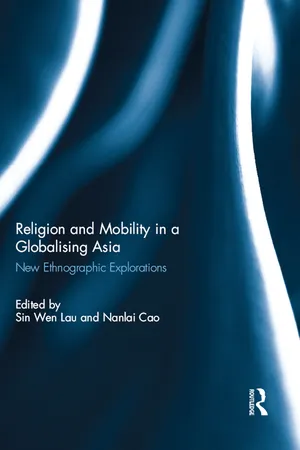
Religion and Mobility in a Globalising Asia
New Ethnographic Explorations
- 150 pages
- English
- ePUB (mobile friendly)
- Available on iOS & Android
eBook - ePub
Religion and Mobility in a Globalising Asia
New Ethnographic Explorations
About this book
This volume examines the dynamic, mutually constitutive, relationship between religion and mobility in the contemporary era of Asian globalisation in which an increasing number of people have been displaced, forcefully or voluntarily, by an expanding global market economy and lasting regional political strife. Seven case studies provide up-to-date ethnographic perspectives on the translocal/transnational dimension of religion and the religious/spiritual aspect of movement. The chapters draw on research into Buddhism, Islam, Chinese qigong, Christianity and communal ritual as these religious beliefs and practices move in and across Singapore, Taiwan, China, Malaysia, Hong Kong, the upper Mekong region, the Thai-Burma border, the Middle East and France. With these diverse and rich ethnographic cases on translocal/transnational Asian religious practices and subjectivities, the book transcends the conventional nation-state centered framework to look into how mobile religious agents are redefining boundaries of local, regional, national identities and recreating translocal, transnational and interregional connectivity. In so doing, it illustrates the importance of promoting a dynamic understanding of Asia not just as a geopolitical entity but as an ongoing social and religious formation in late modernity. This book was published as a special issue of the Asia Pacific Journal of Anthropology.
Information
Religion and Mobility in a Globalising Asia: An Introduction
This volume examines the dynamic, mutually constitutive relationship between religion and mobility in the contemporary era of Asian globalization in which an increasing number of people have been displaced, forcefully or voluntarily, by an expanding global market economy and lasting regional political strife. Seven case studies provide up-to-date ethnographic perspectives on the translocal/transnational dimension of religion and the religious/spiritual aspect of movement, invoking religion’s relationship to processes of modernity as well as issues of territoriality, connectivity and materiality. Technological innovations and improvements in mass communications and air travel have promoted Asian religions to go global. International media headlines in the five years preceding 2012 are littered with incidents marked in one way or the other with religious overtones. In 2007, Buddhist monks in Burma led civil protests against the military junta in what became popularly known as the ‘Saffron Revolution’, a move that fuelled the hopes of Burmese in the country and around the world for an improvement to everyday lives in Burma. A year later, monasteries in the country played a critical role in distributing international humanitarian aid in the aftermath of Cyclone Nargis. The incarceration of Venerable Ming Yi, a Buddhist monk who had abbotship of temples in Malaysia, Singapore and Hong Kong, for the misuse of donations and forgery in 2009, as well as ongoing investigations of alleged misappropriations of church tithes to finance the international singing career of his wife by Pastor Kong Hee, charismatic founder of the regionally active City Harvest Church, raised moral outcries against deteriorating values in millennium Singapore. Periodic eruptions of sectarian violence between the Buddhist majority and Rohingya Muslims in Burma, the burning of churches in Muslim majority Indonesia and clashes between Muslim settlers and tribal groups in Assam, India, underscore the salience of religion in the region. Beijing Shouwang Church, the largest unregistered house church in China’s capital city attended by mostly university-educated intellectuals and academics, aroused much media and government concern in the Western world by staging high profile outdoor worship services in open defiance of the Chinese state’s regulation of religious venues. Entangled with the cultural histories and socio-political realities of Asia, religion is hardly a peripheral activity performed in the private sphere but a vital force shaping state politics and everyday public life in the region (Clammer 2009; Dubois 2010).
Implicit in this contemporary penetration of religion into the mundane is a sense of movement. Globalization and transnational Asian capitalism have prompted Asian religious actors and ideas to cross boundaries of nation-states and create new spaces of connectedness and mutuality. The unprecedented flow of peoples across territories has brought different groups into close contact with each other. Asian religiosities have become geographically unbounded. Indeed, the sectarian clashes in Burma and India give voice to the tensions inherent in everyday struggles between the settled and newcomers in particular localities. The transnational reach of religious specialists in Singapore underscores the spread of religiosities across the region, even as it articulates moral critiques against the expansion of mega-religions in a spiraling world of market capitalism. Asserting the affinity between global entrepreneurship and spiritual revivalism, Neo-Pentecostal and charismatic missionaries in the Chinese diaspora of East and Southeast Asia are utilizing entrepreneurial skills, logic and resources to expand religious structures across Asia in creative, yet controversial ways. Attending to this movement of peoples are flows of goods and money. The role played by Burmese monasteries as dissemination nodes for basic necessities after Cyclone Nargis, distinctive expressions of Pentecostal energy in the Chinese merchant diaspora, as with allegations of illegally channeling religious funds around the world by religious specialists in Singapore, exemplifies the materiality of regional and global religious connections in and out of Asia. The flow of ideas also attends to the movement of peoples across the region. Images of maroon-robed monks taking to the streets of Rangoon invoked a nostalgic yearning for home in the Burmese diaspora. These flows of people, goods and ideas bind Asia into a web of interconnectivity that cuts across local, regional and global scales. As the tempo of life speeds up in this globalized milieu, familiar points of reference become unmoored and the making of life choices increasingly complex (Appadurai 1996). This complexity leads to an intensification of religiosities as the peoples of Asia make their way through this maelstrom and search for certainty and community. Indeed, forms of Asian religiosities are increasingly implicated with ongoing histories of movement in the global context.
Despite this intersection between religion and mobility, much of the scholarship on religiosities in Asia approach religion as locality-based practice (for notable exceptions, please see Taylor 2004; van der Veer 2007; Waghorne 2004; Yang 2004)1. We suspect that two impulses may have undergirded this literature. The first, following the Asian area studies tradition, sets out to document the cosmos of a particular group of people with an aim to understand how an indigenous way of life is constituted through religious beliefs and practices (Ahern 1973; Geertz 1960; Tambiah 1970). These finegrained ethnographies are referenced as baseline studies from which to understand the distinctiveness and transformation of Asian religious beliefs and practices in the new global era as new ideas, social relations and influences enter the region with much greater intensity. Building on this work, the second direction pursued in this set of scholarship demonstrates the ways through which religion is profoundly implicated with ideas of ethnicity (Gladney 1991), nationalism (van der Veer 1994), gender (Chong 2008; Jaschok & Shui 2011; Robinson 2009), kinship (Kuah-Pearce 2011), and modernity (Gillette 2000; Keane 2007). Exploring how indigenous ways of life are transformed through cultural encounters and reproduction, these studies conceive of religion as enabling the accommodation of new ideas and values as people draw on their religious beliefs to make sense of socio-political shifts. These studies have done much to advance our understandings of how religious experience is embedded and mediated within specific socio-political contexts, the implications of which refract the complexities of Asian societies in the twenty-first century.
However, focused on religion as a locality-based practice, this scholarship runs the risk of producing a teleological understanding of Asia as a territorially bounded community. Religious beliefs and practices are set up as pristine traditions evocative of an indigenous way of life or pure local agency, and narrated as hybridized through encounters with Western-dominated or Western-derived influences. In this understanding, primordial religious traditions constitute Asia as distinct, rooted and essentialised. Change is limited by these cultural bases and where it occurs, aspires towards a Western modernity. Silent on the flows of religiosities in and out of particular localities, this teleological understanding pays insufficient attention to the creativity through which the peoples of Asia are putting their religious beliefs and practices to work mediating the movements undergirding their everyday lives. It also tends to eschew the extension of translocal religious networks as Asian religiosities circulate in the region and are exported into the world. Having tied religion to emplaced communities, too little is known about the contours, mediations and implications of religiosities on the move in Asia for meaningful comparative engagements with the wider literature on migrants and their translocal religious life (e.g. Ebaugh & Chafetz 2002; Levitt 2007; Warner & Wittner 1998; Werbner 2003), as well as with ongoing scholarly debates on the movement, transformation and impact of religion in a globalizing world (e.g. Coleman 2000; Csordas 2009; Vasquez & Marquardt 2003). It is our hope that systematic empirical studies that focus on the interrelationship between religion and mobility in the Asian context builds on existing discussions and further open up the possibility of thinking about how the flow of Asian religiosities across territories (re)produces or challenges conceptions of Western modernity, play a part in shaping what it means to be modern in the context of a globalizing Asia, and articulate a discursive category of Asia in diasporic conditions.
This volume aims to achieve this by offering ethnographic explorations into the ways religion is lived and reconfigured in motion. Our contributors take religion to be a social fact (Mauss 1990[1925]) and pay attention to the ways religious ideas, social formations, institutions, political identities, practices and beliefs coexist, and are embodied and meaningful for a large number of people in Asia. Taking mobility as an analytical trope seriously, this volume asks how mobility is made sense of by people on the move through their religious faiths and how religion is reconstituted by processes and experiences of mobility such as migration and displacement. Our discussion draws on research into Buddhism, Chinese qigong, Islam, Christianity, and communal ritual as these religious beliefs and practices move in and across Singapore, Taiwan, China, Malaysia, Hong Kong, the upper Mekong region, the Thai-Burma border, Iran and France. Taken collectively, these ethnographic explorations investigate how religiosities in motion engender universal subjectivities, assert boundaries of particularized identities, and enable multiple belongings through reconstitutions of locality, gender, religious knowledge, circulations of ritual economy and interpenetrations of the rural / traditional / Asian into the urban / modern / Western.
The first two chapters, by Prasert Rangkla and Wasan Panyagaew respectively, deal with Buddhism with a conceptual focus on religious mobility, change and growth in the inter-Asian context of borderland politics. Prasert Rangkla discusses the placemaking practices of Buddhist Karens in the town of Mae Sot on the Thai-Burma border. The Karens he discusses belong to the Mon-Burmese Buddhist order and are refugees who have settled in Thailand after fleeing civil war in Burma. Instead of presenting the Karens as helpless victims displaced by powerful nation-states, Rangkla portrays them as innovative agents who actively draw on a familiar religious tradition in order to engender a sense of belonging in forced mobility. His ethnography centers on a Burmese monastery and explores the ways the Buddhist Karens transform the border town into a place of hope by adroitly maneuvering around Thai state authority in order to build the religious structure, constructing a magical pagoda that casts an aura of peace and protection onto the conflict-ridden landscape, and re-interpretations of Buddhist rituals and festivals that constitute a sense of a Karen community in exile. These religious practices, argue Rangkla, are a means through which displaced Karens have been able to be ‘in and of their new place’.
Wasan Panyagaew provides a case of religious revivalism as he takes us on the wanderings of Khruba Khuen, a charismatic Lue monk through the frontiers of northern Thailand, eastern Burma and southwest China, an area traditionally the homeland of the Lue people. This historically rich and sensitive ethnography investigates the ways religion, mobility and social memory intersect as countries in the area push towards regional integration and the world for economic development. Ethnographically, Panyagaew illuminates the flows of Buddhist art and architecture, ideas and skills, disciples and followers, as well as donations that attend to the restoration of religious sites like monasteries, pagodas, monk huts and images of the Buddha as Khruba Khuen journeys across these borderlands. The installation of these religious structures reminds people of Theravada Buddhism as they conduct their religious activities at these sites. It is, as Panyagaew eloquently puts it, through these religious acts of ‘remembering with respect’ that members of the Lue diaspora reconnect with one another and create a sense of place and belonging in the upper Mekong region.
The next two chapters turn our attention to the effects of mobility on popular religion. Shu-Ling Yeh examines the impact of rural-urban migration on traditional religious practices through an exploration of communal ritual life amongst the increasingly mobile Austronesian-speaking Amis of Taiwan. Focusing on the Miingay ritual and the circulation of pig sacrifices and money surrounding it, Yeh asks how this ritualization of mobility sustains and reproduces a translocal Amis community in the context of Taiwanese state driven capitalism and Amis conversion to Catholicism. Yeh’s argument is intricate. On one hand, her ethnography demonstrates the revitalization of kinship sets in Amis villages through the consumption of sacrificial pigs during the Miingay ritual, a feasting that symbolically marks communion with Amis ancestors. On the other, she notes that the exchanges of money between the village she studied and the urban areas where Amis men have moved to as waged labour build enduring translocal connections and express Amis consciousness of their embeddedness within a wider world. Underscoring the reciprocity of these translocal ties, Yeh argues for the engendering of a synthesized cultural order that incorporates Amis on the move with their kin and home villages.
Chee-Han Lim explores the transnational dimension of Falungong by studying a group of mainland Chinese Falungong practitioners who employed a spiritual narrative of their migration from China to Singapore. The ethnography shows how these Falungong practitioners consider their transnational migration a spiritual journey, and specifically, how they resort to Falungong exercises in resolving life crises associated with transplantation and seeking a new authentic spiritual experience that was unavailable to them back in China. Lim pays special attention to the unique spiritual yearnings of these immigrants who reject a scientistic, materialist interpretation of qigong and reclaim their Chinese spiritual legacy by searching for the true Buddhist Pure Land on earth in the new society.
The three remaining chapters explore the social and economic implications of religious knowledge, beliefs and practices as they are put into motion in regional and global configurations. Tiffany Cone offers a case study into the religious aspirations of Sufi students to travel between a Sufi shrine in China and the sacred city of Qum in Iran in a quest for knowledge. She demonstrates how a sense of connection to a transnational Islamic community is given meaning through history, embodied in the everyday practice of Islam and narrated as spiritual journeys of self-cultivation and community building. In doing so, Cone explores the ways religious knowledge is embodied and moves across nation-states as well as how such journeys of knowledge matter in the context of young people’s search for religious authenticity and empowerment.
Sin Wen Lau asks what it takes to be Christian in mobility for a Singaporean expatriate housewife. This woman has lived in a state of chronic mobility for close to two decades, circulating once every two to three years between Singapore, Hong Kong, Kuala Lumpur, Taipei and Shanghai as her husband is posted around the region by the multinational corporations he works for. Focusing on the private deliberations and contemplations of this woman as she searches for church, Lau demonstrates how religious belonging for hyper-mobile elites in the region is fractured by concerns of class, language and nationality and suggests that this feminized form of overseas Chinese religiosity is shaped by a desire to be differentiated as a privileged woman on the move in Asia. This compact study underscores the unevenness of global Christianity and offers a case study into the challenges of sustaining faith in movement.
Nanlai Cao’s contribution pushes the discussion beyond the region by tracing the export of an Asian religiosity into the West. His topic is the Christianity practiced by a group of entrepreneurial Wenzhou Chinese who have migrated to Paris, France. Vibrant in Paris, this Christianity was indigenized in Wenzhou through intergenerational transmission and was deeply intertwined with a regional culture of commercialism in coastal southeast China. Wenzhou migrants in Paris draw on this homegrown Christianity as a form of conservative patriarchal morality to reconstruct a distinctive Wenzhou mercantile identity, family and way of life in diaspora. They also employ Christianity as a moral framework to narrate and legitimize their histories of illegal migration and morally ambivalent business practices. Cao’s ethnography suggests that this global Christianity as a universalist moral discourse is embedded in a transnational space and embodies connectedness to native-place and informal communal networks.
With these diverse and rich ethnographic cases on translocal/transnational Asian religious practices and subjectivities, the editors and contributors make a concerted effort to transcend the conventional nation-state centered framework to look into how mobile religious agents are redefining boundaries of local, regional, national identities and recreating translocal, transnational and interregional connectivity. In so doing, we hope to ill...
Table of contents
- Cover
- Half Title
- Title Page
- Copyright Page
- Dedication
- Table of Contents
- Citation Information
- Notes on Contributors
- Acknowledgements
- 1. Religion and Mobility in a Globalising Asia: An Introduction
- 2. Refuge and Emplacement through Buddhism: Karen Refugees and Religious Practices in a Northwestern Border Town of Thailand
- 3. Remembering with Respect: History, Social Memory and the Cross-Border Journeys of a Charismatic Lue Monk
- 4. Pig Sacrifices, Mobility and the Ritual Recreation of Community Among the Amis of Taiwan
- 5. Migration as a Spiritual Pathway: Narratives of Chinese Falungong Practitioners in Singapore
- 6. Journeys of Knowledge: the Role of a Chinese Sufi gongbei in Generating Mobility between China and Iran
- 7. Mobility, Christianity and Belonging: Reflections of an Overseas Chinese Expatriate Wife in Shanghai
- 8. Renegotiating Locality and Morality in a Chinese Religious Diaspora: Wenzhou Christian Merchants in Paris, France
- 9. Epilogue: Religion and Mobility in a Globalising Asia
- Index
Trusted by 375,005 students
Access to over 1.5 million titles for a fair monthly price.
Study more efficiently using our study tools.
Frequently asked questions
Yes, you can cancel anytime from the Subscription tab in your account settings on the Perlego website. Your subscription will stay active until the end of your current billing period. Learn how to cancel your subscription
No, books cannot be downloaded as external files, such as PDFs, for use outside of Perlego. However, you can download books within the Perlego app for offline reading on mobile or tablet. Learn how to download books offline
Perlego offers two plans: Essential and Complete
- Essential is ideal for learners and professionals who enjoy exploring a wide range of subjects. Access the Essential Library with 800,000+ trusted titles and best-sellers across business, personal growth, and the humanities. Includes unlimited reading time and Standard Read Aloud voice.
- Complete: Perfect for advanced learners and researchers needing full, unrestricted access. Unlock 1.5M+ books across hundreds of subjects, including academic and specialized titles. The Complete Plan also includes advanced features like Premium Read Aloud and Research Assistant.
We are an online textbook subscription service, where you can get access to an entire online library for less than the price of a single book per month. With over 1.5 million books across 990+ topics, we’ve got you covered! Learn about our mission
Look out for the read-aloud symbol on your next book to see if you can listen to it. The read-aloud tool reads text aloud for you, highlighting the text as it is being read. You can pause it, speed it up and slow it down. Learn more about Read Aloud
Yes! You can use the Perlego app on both iOS and Android devices to read anytime, anywhere — even offline. Perfect for commutes or when you’re on the go.
Please note we cannot support devices running on iOS 13 and Android 7 or earlier. Learn more about using the app
Please note we cannot support devices running on iOS 13 and Android 7 or earlier. Learn more about using the app
Yes, you can access Religion and Mobility in a Globalising Asia by Sin Wen Lau,Nanlai Cao,SinWen Lau in PDF and/or ePUB format, as well as other popular books in Social Sciences & Ethnic Studies. We have over 1.5 million books available in our catalogue for you to explore.