- 336 pages
- English
- ePUB (mobile friendly)
- Available on iOS & Android
eBook - ePub
About this book
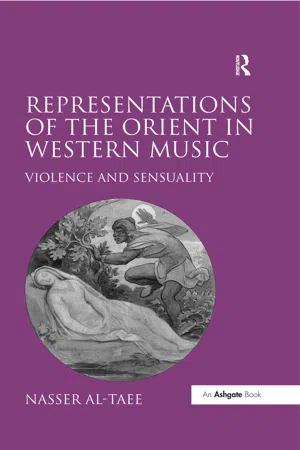
This book focuses on the cultural, political and religious representations of the Orient in Western music. Dr Nasser Al-Taee traces several threads in a vast repertoire of musical representations, concentrating primarily on the images of violence and sensuality. Al-Taee argues that these prevailing traits are not only the residual manifestation of the Ottoman threat to Western Europe, but also the continuation of a long and complex history of fear and fascination towards the Orient and its Islamic religion. In addition to analyses of musical works, Al-Taee draws on travel accounts, paintings, biographies, and political events to engage with important issues such as gender, race, and religious differences that may have contributed to the variously complex images of the Orient in Western music. The study extends the range of Orientalism to cover eighteenth-century Austria, nineteenth-century Russia, and twentieth-century America. The book challenges those scholars who do not see Orientalism as problematic and tend to ignore the role of musical representations in shaping the image of the Other within a wider interdisciplinary study of knowledge and power.
Information
Part I
Introduction
Chapter 1
Between Violence and Sensuality: Orientalism in Musicology
Themes of violence and sensuality have been at the center of Western stereotypes, representation, appropriation, and fascination with Islamic culture. In eighteenth-century music, these notions found fertile ground in Western musical infatuation with the Turkish seraglio and the alla turca style. The seraglio was the locus of European gaze, obsession, and distortion. It was the place where power and sensuality collided, providing Europeans with infinite subjects of tyrannical sultans, bloodthirsty guards, deformed slaves, and imprisoned concubines in a challengingly corrupt institution. Led by a misguided religion that "licenses" abhorrent practices of polygamy and slavery, the palace was viewed as both a prison and a place of delight, where the political and religious leader of the Turkish Empire lay hostage to his sensual desires. The harem, the "most prevalent symbol in Western myths constructed around the theme of Muslim sensuality", was the ultimate metaphor for this decay and corruption.1 In Medieval accounts of the Prophet of Islam, the result is nothing short of a twisted and distorted image of Muhammad's life and message. A host of narratives concerning his violent upbringing were complemented by incestuous and adulterous affairs that stripped him of his spiritual and humanistic message. Similarly, the alla turca style was an invented style by European composers meant to signify or allude to the Orient in a cartoonish and bombastic fashion. These misrepresentations, codified in the Middle Ages, continue well into our modern time, combining to produce a theatrical display for defamation, mockery, and exploitation of the Orient.
In most European representations of the Orient, the Middle East and Asia are viewed with prejudice to further help the formation of European image of superiority. An invented field. Orientalism, therefore, is a discipline of thoughts created by Europeans for European audiences about a fantastic Orient rather than a realistic one. In nineteenth-century French art, the delineation of the Orient in paintings of Islamic culture often included themes of a sexual and violent Orient as a place of desire, fantasy, and lax morals, but also of irrational, menacing, and dishonest people.
In his works on race, difference, and sexuality, Sander Gilman argues that the creation of images and stereotypes emanate from fear and glorification of the Other.2 Indeed, the duality of violence and sensuality fit that model as Europe came to terms with the rise and demise of a long-time foe in the Ottoman Empire. At its apex during the reign of Sultan Suleiman the Magnificent (1520–1566), the Empire was known for its military expansion eastwards and westwards. Its Janissary army, led by the music of the mehter, sent their version of shock and awe into the hearts of their enemies. Their military might, combined with their religious devotion and fearlessness, made them a daunting force, and. understandably, they were treated harshly and unfavorably by many European travelers. As they advanced in the battlefield, they would shout to scare their enemy, accompanied by a sizeable military band of loud winds and percussion instruments. Christian commanders noted that the Janissaries would advance into an "inferno of fire, climbing over piles of their dead, and would instantly exploit any flaw or weakness in the defense."3 Though there is truth to some of these documents, they are not free from exaggerated descriptions aimed at showing the barbarity and aggressiveness of the Ottoman forces. Even after the Empire's weakening and gradual decline in the eighteenth century, the Austrian Marshal Ernst Laudon wrote admiringly of the Janissaries' bravery in defending a fortress against his attack in the campaign of 1788:
It is beyond all human powers of comprehension to grasp how strongly these places are built and just how obstinately the Turks defend them. As soon as one fortification is demolished, they merely dig themselves another one. It is easier to deal with any conventional fortress and with any other army than with the Turks when they are defending a stronghold.4
The eighteenth-century British naval officer Adolphus Slade describes the Janissaries as the "Lords of the day." who ruled with uncontested authority in Constantinople. Like his predecessors, he focuses on their alien appearance and qualities, condemning their "excess of libertism; their foul language; their gross behavior; their enormous turbans; their open vests; their bulky sashes filled with arms; their weighty sticks; rendering them objects of fear and disgust."5 Lady Mary Wortley Montagu's accounts of the Janissaries, however, avoid such disparaging language. Though she acknowledges their ability to be violent, she emphasizes their high discipline, zeal, and loyalty to the person they were dedicated to protecting.6 While gender difference and Montagu's detached political stance may have contributed to her relatively sympathetic descriptions of the Turks, her contrary views on the state of the Empire, both culturally and politically, are of great importance to historians seeking alternative views on the Orient and its culture in the eighteenth century.
With the gradual decline of the Empire following its second failed siege of Vienna in 1683, corruption spread through all levels of the Janissary army. Once invincible and powerful, the Ottoman army now failed to measure up to European armies' modernized firepower. While the image of the violent Turk was still prominent, sensuality and feminine attributes began to emerge as common traits attached to the people of the weakening Empire. The Empire was hostage to its own failed power, its sensuality, ignorance, and lack of advancement. Such a collapse brought not only a sense of relief to the Western consciousness but also joy and happiness. Elizabeth Craven hailed the pitiful state of the Empire as a blessing that served European interests. Writing in 1789. Craven states that it is "lucky for Europe that the Turks are idle and ignorant," for they would have posed greater challenges to Europe otherwise. She breathed a sigh of relief knowing that the Empire at last served only as a "dead wall to intercept the commerce and battles which other powers might create."7
Long after the Ottoman threat on Vienna, Viennese librettists concocted Singspiels that capitalized on the themes of the violent and sensual Turk. In this context, we see an amazing mixture of reality and fantasy designed to mock the former enemy, ridicule its belief system, and cast Turks as lascivious villains. Indeed, some of these theatrical works pretended to be "biographical," set in real geographical cities (Smyrna, Tunis, Cairo, and Baghdad, to name a few) ruled by real Turkish and Arabic sultans and pashas (Selim, Mustafa, Süleyman, and the Abbasid Caliph of Baghdad from the ninth century, Haroun al-Rashid). Now weak and defanged, the great Empire is reduced on Western stage and in European thought to the impotent figure of a watchdog inflamed with rage and sensuality.8
Throughout and beyond the eighteenth century, images that remained ambivalent between benevolence and violence gave way to a more unified, more detailed, and more coherent stereotype of the Orient that proved extraordinarily stable and durable. As the result of increased European penetration of Oriental territories, the image of the Orient became more and more feminine, and Orientalism, as a masculine domain of the West, sought to fulfill its own sensual and sexual fantasies. The Orient, then, began to be depicted as a place for delight and bizarre activities, as a fixed free-zone for European voyeurs and explorers. Rana Kabbani summarizes the shift:
The more fully the Orient fell under the sway of the European powers, the deeper it came to be sublimated in the imagination, in literature, painting, music, and fashion. The Arabian Nights appeared in Europe at a time that coincided with Turkish defeat. "Turkish Rondos" were incorporated into European music when the Ottomans had ceased being a real threat to Europe's stability. And after Napoleon's conquest of Egypt, turbans were all the rage in the West. A shift in attitude had become strikingly visible by the nineteenth century; an ignorant awe had become a familiar contempt.9
In the nineteenth century, Western colonialist expansion served only to reinforce the negative images of the Orient, and Western exploration and its alleged study of Oriental cultures were motivated in part by colonialist attitudes of superiority. Beginning with the Description de L'Égypte, the Napoleonic adventure in Egypt and Syria (1798–1801) signaled a new era of Western colonialism, during which the Orient and Oriental culture were put under Western microscopes for the sake of exploitation and control. Under such circumstances, Orientalism flourished and expanded. Once the Orient had been studied and properly put into its place with clearly identified margins, it was easier to force it into submission and control.
The masculine image of the Orient continued to be replaced by a feminine one in the form of an odalisque or a seductive dancer in the nineteenth century. coinciding with the rise of Western colonialism and its desire to penetrate the East. Absent from most of the eighteenth-century operatic representations, the Oriental woman would assume center stage with fatalistic tendencies. Operas such as Weber's Oberon (1826) in England; Cornelius' Der Barbier von Bagdad (1858) in Germany; Rossini's L 'Italiana in Algeri (1813), Verdi's Atda (1871) and Otello (1887) in Italy; and Meyerbeer's L'Africaine (1865), Bizet's Carmen (1875), Saint-Saëns' Samson et Dalila (1877), and Delibes's Lakmé (1883) in France are examples of Orientalist operas reflecting the shift from masculine representation to the feminine.
Said’s Orientalism
Edward Said's Orientalism (1978) initiated a scholarly debate concerning representation and appropriation of the Orient in Western culture. Said argues that the term was linked to Western power, colonialism, and hegemony over the Orient. As the territory adjacent to Europe, it is also the place of Europe's greatest richest, and oldest colonies, the source of its civilizations and languages, its cultural contestant, and one of its deepest and most recurring images of the Other. In addition, the Orient has helped define Europe (or the West) as its contrasting image, idea, personality, and experience. Thus, the Orient is an integral part of European material civilization and culture, and Orientalism expresses and represents it culturally, and even ideologically, as a mode of discourse with supporting institutions, vocabulary, scholarship, imagery, doctrines, and even colonial bureaucracies and styles. According to Said, the West has created a dichotomy between the reality of the East and the romantic notion of the Orient. The Middle East was shown as a primitive place, so lacking control of its own destiny that it had to be mapped out by the West.10 European imperialism of the nineteenth and twentieth century was the realization of such knowledge of the Orient.
Said argues that Orientalism, far from being an objective field, is a system of representations framed by political forces that brought the Orient into Western learning. Western consciousness, and Western empire. To Said, the Orient exists for the West and is constructed by and in relation to the West. It is, therefore, a mirror image of what is inferior, bizarre, and alien, a theme representative in musical through Europeans' invention of the alla turca topic that represented the Orient and served as a contrast to the lofty European model. Connected to this theme is Said's second major claim that Orientalism helped define Europe's self-image through the establishment of an inferior Other. The construction of identity in every age and every society, Said maintains, involves establishing opposites and "Others" because the West exists only in relationship to the Orient, thus making it necessary for the West. In doing so, Said uses Michel Foucault's notion of relating knowledge to ...
Table of contents
- Cover
- Half Title
- Dedication
- Title
- Copyright
- Contents
- List of Plates
- List of Tables and Music Examples
- Preface
- Acknowledgments
- PART I INTRODUCTION
- PART II PROPHETS AND CONCUBINES: MODELS OF VIOLENCE AND SENSUALITY
- 2 The Character of Muhammad: A Model of Violence and Sensuality in the European Image of the Orient
- PART III THE EIGHTEENTH AND NINETEENTH CENTURIES: THE CONTEXTUALIZATIQN OF KNOWLEDGE
- PART IV THE ARABIAN NIGHTS IN MUSIC AND FILM
- Select Bibliography
- Index
Trusted by 375,005 students
Access to over 1.5 million titles for a fair monthly price.
Study more efficiently using our study tools.
Frequently asked questions
Yes, you can cancel anytime from the Subscription tab in your account settings on the Perlego website. Your subscription will stay active until the end of your current billing period. Learn how to cancel your subscription
No, books cannot be downloaded as external files, such as PDFs, for use outside of Perlego. However, you can download books within the Perlego app for offline reading on mobile or tablet. Learn how to download books offline
Perlego offers two plans: Essential and Complete
- Essential is ideal for learners and professionals who enjoy exploring a wide range of subjects. Access the Essential Library with 800,000+ trusted titles and best-sellers across business, personal growth, and the humanities. Includes unlimited reading time and Standard Read Aloud voice.
- Complete: Perfect for advanced learners and researchers needing full, unrestricted access. Unlock 1.5M+ books across hundreds of subjects, including academic and specialized titles. The Complete Plan also includes advanced features like Premium Read Aloud and Research Assistant.
We are an online textbook subscription service, where you can get access to an entire online library for less than the price of a single book per month. With over 1.5 million books across 990+ topics, we’ve got you covered! Learn about our mission
Look out for the read-aloud symbol on your next book to see if you can listen to it. The read-aloud tool reads text aloud for you, highlighting the text as it is being read. You can pause it, speed it up and slow it down. Learn more about Read Aloud
Yes! You can use the Perlego app on both iOS and Android devices to read anytime, anywhere — even offline. Perfect for commutes or when you’re on the go.
Please note we cannot support devices running on iOS 13 and Android 7 or earlier. Learn more about using the app
Please note we cannot support devices running on iOS 13 and Android 7 or earlier. Learn more about using the app
Yes, you can access Representations of the Orient in Western Music by Nasser Al-Taee in PDF and/or ePUB format, as well as other popular books in Media & Performing Arts & Ethnomusicology. We have over 1.5 million books available in our catalogue for you to explore.