eBook - ePub
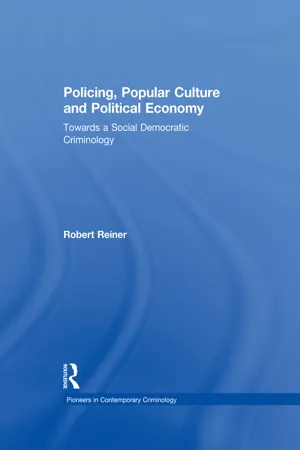
Policing, Popular Culture and Political Economy
Towards a Social Democratic Criminology
- 478 pages
- English
- ePUB (mobile friendly)
- Available on iOS & Android
eBook - ePub
Policing, Popular Culture and Political Economy
Towards a Social Democratic Criminology
About this book
Robert Reiner has been one of the pioneers in the development of research on policing since the 1970s as well as a prolific writer on mass media and popular culture representations of crime and criminal justice. His work includes the renowned books The Politics of the Police and Law and Order: An Honest Citizen's Guide to Crime and Control, an analysis of the neo-liberal transformation of crime and criminal justice in recent decades. This volume brings together many of Reiner's most important essays on the police written over the last four decades as well as selected essays on mass media and on the neo-liberal transformation of crime and criminal justice. All the work included in this important volume is underpinned by a framework of analysis in terms of political economy and a commitment to the ethics and politics of social democracy
Information
Part I
Policing
[1]
The Police, Class and Politics
(I) Introduction: The Need for a Socialist Analysis of the Police
At last year's Tory party conference, Mr. William Whitelaw claimed that it was "part of left-wing mythology" that "there was something despicable, almost immoral, in discussing the prevention of crime at all".1 "Our Socialist rulers", he said, "never even discussed the whole problem of crime at their conference". He criticised their allegedly "haphazard and fickle" attitude to "freedom under the law".2
Public Concern about Crime
We may be excused for failing to notice that the solid figures of James Callaghan and his Cabinet constitute "our Socialist rulers". It would be less excusable to assume that socialists have nothing to learn from Mr. Whitelaw's words, for, as he rightly said, ordinary people are concerned about questions of crime, and look to governments to ensure their protection.3 If socialists are seen as either indifferent or hostile to these concerns this is undoubtedly a serious political liability, and deservedly so, for it is unforgivably elitist to minimise such acutely felt anxieties experienced by people. This is not to say, however, that fears about the maintenance of "law and order" must be accepted at face value. Popular definitions and analyses of the "crime problem" may be misguided in many ways, and socialists can have an educative role to play. But they must not fail to be sensitive to people's own priorities, or allow so important an issue to be seen as a Tory one.
The Requirements of a Socialist Analysis
What is required is an analysis of the police which recognises the need which will be faced by people in any society short of a communist millenium for protection of person, personal property and the conditions Of a secure, ordered and productive existence. This does not mean that the criminal justice system of a socialist society would simply mirror the existing one. But it does mean that thought must be given to the structures that should be developed. More specifically, it is vital that the personnel of the criminal justice system are brought into alliance with other progressive forces. Effective reform of the police and other criminal justice institutions cannot be envisaged without wider changes in society which alter the conditions generating crime, but at the same time consideration must be given to the structures needed in a socialist society and the ways of moving towards these. To date there has been little serious discussion of the police from a socialist perspective, but they must be seen as central to political strategy.
The Centrality of the Police to Political Strategy
The police are crucial to the prospects for socialism in Britain and other developed capitalist countries. This is despite the common realisation amongst communists that an insurrectionary strategy is not likely to succeed given the balance of social forces and the means of coercion available, in such societies. The police are important in three ways. First, the danger would confront any socialist government, even if it had majority support, that the police and army might be used in a counter-revolutionary coup. As Carrillo puts it, largely drawing on the experience of the Chilcan tragedy:
"without the transformation of the State apparatus, every socialist transformation is precarious and reversible, not by an electoral result which it would be logical and natural to accept, but by an armed coup carried out by the very people theoretically responsible for defending legality".4
Winning the support of at least the rank-and-file of the repressive state apparatuses is necessary to forestall this.
Second, the police play a part in preventing the building of majority support for socialism. As documented in Tony Bunyan's recent book The Political Police in Britain, sections of the police, together with the army and intelligence services, are continuously engaged in surveillance and harassment of political activists and trade-unionists. In recent years these institutions have become increasingly involved in active preparation against the possibility of insurrection, and there has been a significant development of police-military co-operation in exercises and planning, justified by the growth of IRA and other terrorist activity.5 Under the guise of impartial law-enforcement and order-maintenance the police also prevent specific struggles from succeeding. Recently, for example, they have been deployed against the Grunwick pickets, and on October 9th, 1977, 6,000 police officers were fielded in a massive operation costing £0.25m. to protect the "democratic right" of National Front organiser Martin Webster to march in Hyde, Manchester.
Third, the police are the enforcement arm of the legal system which legitimises capitalist social relations. They contribute to the acceptance of a rhetoric of "law and order" as the cement of civilised existence, which abstracts from the class character of the content and application of legal rules in a capitalist society.6
Democratisation of the Police
A vital element of socialist strategy and the building of a socialist society is the democratisation of the police force, to work towards making the rhetoric of law as representing the communal interest the reality which it cannot be in a class society. This democratisation has two formal aspects: changing the internal relations in the police so as to allow police officers the same democratic rights as other workers; and bringing the police force firmly under the control of popular democratic institutions. However, neither aspect is only a question of formal institutional change in the machinery of policing. Without wider changes towards equalisation of economic and political power any reforms within the police apparatus will remain merely formal, or even prove counter-productive. Furthermore, institutional changes must be linked to debate involving both the police and public about the police role in a democratic society, a consideration of the social implications of policing activities and the meaning of "law and order". Such debates have begun among the French police as the influence of socialist ideas has spread with the growing political success of the Left.7
Police Forces Not Monolithic
The basis of such developments is the fact that police forces are not the monolithic, mechanical entities suggested by such terms as "state machine" or "apparatus". Police officers are employees who share some common interests with other workers, as shown by the development of police unions in all democratic societies. In recent years these organisations have become increasingly important politically in Britain, the US and Europe. The implications of this will be considered in the next section of this article, and the prospects for proper unionisation of the British police assessed. The third section of the article will broaden the discussion to consider the police role in society. The place of the police in class relations will be analysed to try and specify the possibilities and limits of alliance between the police and labour movement. Finally, the police conception of their role as law-enforcement agents will be considered, and the contradictions within it discussed. This will lead to suggestions about the role of the police in a society undergoing democratic transition to Socialism.
(II) Police Unionisation: Problems and Prospects
Police Unions: Reactionary or Progressive?
A necessary first step towards democratisation of the police force would be the winning of the same rights of trade union representation for the rank-and-file as exist for all other occupations apart from the army. However, trade unionism is, of course, not necessarily associated with progressive or socialist ideas and practices, and this is especially so in the case of police unions.
Reactionary Political Interventions by the Police
American police associations have in the last decade and a half become increasingly militant in terms of industrial action but when their targets have gone beyond a bread-and-butter kind they have exerted their political muscle for reactionary ends.8 In several cities police unions, for example, have been successful in defeating civilian review boards, the most famous instance being the New York Patrolmen's Benevolent Association's victory in a 1966 referendum, when it mounted a highly effective campaign combining appeals to white racism and fear of crime.
In Britain, the Police Federation in 1975 launched a "law and order" campaign which sought to influence political and public opinion to reverse what they perceived as a liberalising trend in criminal justice policy. Apart from this campaign, the Federation has emerged as a vocal and effective pressure-group putting forward the rank-and-file view on policies which are felt to impinge on their interests, for example abolition of capital punishment.
Progressive Police Organisations
But while police representative organisations in Britain and America have tended to put forward right-wing demands when their concerns have transcended economism. European police unions have often supported liberal policies and tried to resist being used by the state to repress dissent and the workers' movement. For example, the secretary of the main French police union dissociated it from the violence against students in May 1968 and blamed the government. He declared that the police ought never be used against a justifiable demonstration."
In Britain, too, during the only period in which there existed independent police unionism, 1913–19, the illegal Police and Prison Officers' Union gradually forged links with the labour movement, and its leaders called for the democratisation of the force. Although most rank-and-file support for the Union and the 1918–19 strikes was instrumentally motivated, the association with organised labour underlay the government and conservative press's apocalyptic analysis of the situation, and its determination to smash the Union. The Union was defeated by the granting of a substantial pay rise combined with the establishment of the Police Federation as a tame substitute.
The Need for Police Unionisation
The political character of police unionism is clearly historically variable. Although in the recent past British and American police associations have acted as right-wing pressure-groups, in the period after the First World War they showed tendencies of radicalisation in line with the general direction of the labour movements in all capitalist societies at that time. Similarly, in recent years police unions in several Continental countries, notably France, have begun to align themselves with the Left as it has grown in strength. The political character of police unionism must be seen as a reflection of the general balance of class and political forces in society, and is not necessarily a monolithic conservatism. While the immediate consequence of greater rank-and-file power today in Britain or America might be support for reactionary policies, in the longer term the police would be able to associate more freely with the labour movement, and might even seek affiliation. The result of such association could be a reduction in the present virulently anti-union views of many police officers, and a lessening of their enthusiasm for controlling pickets.10
While the achievement of trade union rights by the police is only a part of the aim of democratisation of the force and could initially take a right-wing character, it would nonetheless be a step forward. The reliability of the force as an automatic instrument of government would be reduced, it would be exposed to different views and possibly attract types of recruits presently inhibited from joining, and signify a change in the anti-union sentiments of the police.
The Prospects of Police Unionisation
Since 1976 there has been a much publicised growth of militancy in the British police arising mainly out of grievances over pay. It is expressed in demands tor the right to strike and rejection of existing negotiating machinery. This contrasts sharply with previous...
Table of contents
- Cover
- Half Title
- Title
- Copyright
- Contents
- Acknowledgements
- Introduction
- Part I Policing
- Part II Popular Culture and Crime
- Part III Political Economy of Crime and Control
- List of Publications
- Name Index
Trusted by 375,005 students
Access to over 1.5 million titles for a fair monthly price.
Study more efficiently using our study tools.
Frequently asked questions
Yes, you can cancel anytime from the Subscription tab in your account settings on the Perlego website. Your subscription will stay active until the end of your current billing period. Learn how to cancel your subscription
No, books cannot be downloaded as external files, such as PDFs, for use outside of Perlego. However, you can download books within the Perlego app for offline reading on mobile or tablet. Learn how to download books offline
Perlego offers two plans: Essential and Complete
- Essential is ideal for learners and professionals who enjoy exploring a wide range of subjects. Access the Essential Library with 800,000+ trusted titles and best-sellers across business, personal growth, and the humanities. Includes unlimited reading time and Standard Read Aloud voice.
- Complete: Perfect for advanced learners and researchers needing full, unrestricted access. Unlock 1.5M+ books across hundreds of subjects, including academic and specialized titles. The Complete Plan also includes advanced features like Premium Read Aloud and Research Assistant.
We are an online textbook subscription service, where you can get access to an entire online library for less than the price of a single book per month. With over 1.5 million books across 990+ topics, we’ve got you covered! Learn about our mission
Look out for the read-aloud symbol on your next book to see if you can listen to it. The read-aloud tool reads text aloud for you, highlighting the text as it is being read. You can pause it, speed it up and slow it down. Learn more about Read Aloud
Yes! You can use the Perlego app on both iOS and Android devices to read anytime, anywhere — even offline. Perfect for commutes or when you’re on the go.
Please note we cannot support devices running on iOS 13 and Android 7 or earlier. Learn more about using the app
Please note we cannot support devices running on iOS 13 and Android 7 or earlier. Learn more about using the app
Yes, you can access Policing, Popular Culture and Political Economy by Robert Reiner in PDF and/or ePUB format, as well as other popular books in Social Sciences & World History. We have over 1.5 million books available in our catalogue for you to explore.