eBook - ePub
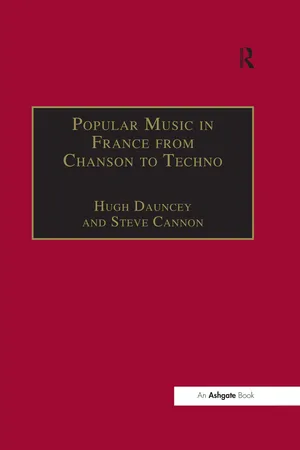
Popular Music in France from Chanson to Techno
Culture, Identity and Society
- 294 pages
- English
- ePUB (mobile friendly)
- Available on iOS & Android
eBook - ePub
Popular Music in France from Chanson to Techno
Culture, Identity and Society
About this book
In France during the 1960s and 1970s, popular music became a key component of socio-cultural modernisation as the music/record industry became increasingly important in both economic and cultural terms in response to demographic changes and the rise of the modern media. As France began questioning traditional ways of understanding politics and culture before and after May 1968, music as popular culture became an integral part of burgeoning media activity. Press, radio and television developed free from de Gaulle's state domination of information, and political activism shifted its concerns to the use of regional languages and regional cultures, including the safeguard of traditional popular music against the centralising tendencies of the Republican state. The cultural and political significance of French music was again revealed in the 1990s, as French-language music became a highly visible example of France's quest to maintain her cultural 'exceptionalism' in the face of the perceived globalising hegemony of English and US business and cultural imperialism. Laws were passed instituting minimum quotas of French-language music. The 1980s and 1990s witnessed developing issues raised by new technologies, as compact discs, the minitel telematics system, the internet and other innovations in radio and television broadcasting posed new challenges to musicians and the music industry. These trends and developments are the subject of this volume of essays by leading scholars across a range of disciplines including French studies, musicology, cultural and media studies and film studies. It constitutes the first attempt to provide a complete and up-to-date overview of the place of popular music in modern France and the reception of French popular music abroad.
Information
Chapter 1
The study of popular music between sociology and aesthetics: a survey of current research in France
Philippe Le Guern
Placed within the general framework of the sociology of art, the sociology of music, and in particular the sociology of the most ‘contemporary’ forms of musical production, appears in France to have been relatively neglected.1 The neglect for this field of research can for example be measured by the number of articles devoted to it in academic journals: although Actes de la Recherche en Sciences Sociales was quick to show an interest in the production of symbolic forms, a survey of articles published in the journal between 1975 and 1997 (119 numbers) reveals that only six articles were devoted to music (five dealing with classical music and one with country music) and that, in comparison, the literary field and that of art were much better covered. In the Revue Française de Sociologie the treatment of different artistic disciplines is statistically less biased against music, but the subject was nevertheless covered only twice between 1981 and 2000 in a total of more than 500 articles (one article on jazz and one on contemporary music). The perusal of bibliographies of French work in sociology allows similar conclusions to be drawn; for example, in the dozen or so pages of a recent bibliography claiming an exhaustive coverage of studies on music, only three references are to be found to French articles and books specifically dealing with rock or with musiques actuelles, in stark contrast with the much greater number of studies produced by Anglo-Saxon researchers on the same subjects.2 Such a situation has lead Patrick Mignon, for example, to emphasize that ‘research interest in rock is new in France, but the pioneering nature of French work on the subject should not lead anyone to imagine that we are are doing anything more than discovering an America already comprehensively explored’.3 Danièle Pistone uses another source to arrive at a similar conclusion, since in consulting the CD-Rom Doc-Thèses covering PhDs awarded in France between 1972 and 1999 he finds merely three theses dealing with music out of a total of 341 devoted to sociology overall.4
How can this apparent lack of interest in musiques actuelles be explained? Several reasons can doubtless be suggested: on the one hand, in contrast with classical music, the least legitimated forms of music do not predispose musiques actuelles to become acceptable objects of study – as Erik Neveu has pointed out (not without humour), ‘why waste serious academic work on minor topics while Hobbes and the sociology of voting behaviour still have so much to tell us? What does an interest in rock reveal apart from a questionable desire to distinguish oneself?’ On the other hand, the criticisms that have accompanied the growth of rock music and the dangers of anomie predicted by some intellectual commentators (such as Alain Finkielkraut and Alan Bloom)5 has helped contribute to the undervaluing of rock music as a worthy object of study. Moreover, whereas important studies of the role of government policies in general and cultural policy in particular in the encouragement of musical scenes and the record industry do exist, for example, rare are the ethnographic works which analyse record companies themselves or musicians. This may suggest that practical difficulties (which are not, of course, the monopoly of the study of music) are to blame, and do not allow the establishment of a cumulative body of knowledge, enabling us to produce a subtle understanding of the musical artist and to reflect the full complexity of the world of musical art. Another difficulty is that the meaning of the categories most usually used to describe musical styles (musiques vivantes, amplifiées, actuelles) vary according to whether they are coined and used by institutions as disparate as musical criticism, specialist magazines, record companies, or public policy emanating from central or local government. To fully understand the nuances of these terms it would doubtless be necessary to study the visions these categories obey and the divisions which held them apart. A further difficulty relates to the problem whether and how sociologists should take into account the supposedly special nature of the musical act itself, and, for example, the value of collaboration between sociology and musicology.6
The analysis of musiques actuelles as a social and cultural phenomenon is criss-crossed by a series of questions which are properly sociological: the legitimacy of cultural goods; music as a vector of the construction of identity; methodological choices between paradigms of the sociology of domination (Bourdieu) and the sociology of ‘worlds of art’ (Becker); or, further, attempts to go beyond the determinist sociology which relates the structure of tastes and socioeconomic position through a sociology of ‘love of music’ or ‘ceremonies of pleasure’;7 the pertinence of the distinction between ‘savant’ and ‘populaire’, in other words between music which is ‘serious’ and music which is ‘not serious’. Additionally, we should not forget the peculiar position which those who come to study this kind of subject find themselves occupying, since the struggle to study rock is similar to that required to study female, proletarian, or black perspectives on history.8
Without aspiring to an exhaustive survey, and by concentrating on a number of major academic journals, this chapter proposes a summary of the current state of French research on the sociology of musiques actuelles (distinct from classical music or contemporary music) in France. This summary will cover work on the conditions of music production itself (the socio-political context and the workings of the systems of production), and the conditions of music’s reception (systems of mediation such as radio, concerts, accompanying discourses such as the ‘Rock press’) studies of the music-consuming public and of the uses to which music is put. From such a summary, it will transpire that a study of rock’ needs to address at least three significant series of questions: firstly, how can one measure the impact of musiques actuelles, particularly amongst young audiences and those driven by the tenets of counter-culture – how far is rock a music which is indissociably linked to a certain phase of life? Secondly, how can one analyse the origin and development of rock music in France other than as a spontaneous phenomenon – what is the role played by ‘the Art world’ (the recording industry and the media etc.) in the social production of this kind of music? And how can one take account of musical genres or musical practices left in the shadows such as amateur musicians or musicians in the Métro? Finally, what are the typologies which obtain within the musical field (musiques actuelles, vivantes, amplifiées) and according to what principles do they operate?
Typologies and terminology: ‘musiques actuelles’, ‘musiques vivantes’, ‘musiques amplifiées’
The issue of typologies and of how to label the different styles of music is one of the major preoccupations of the sociology of music. We can, for example, point out the variability of genres and styles of music covered by the common-denominator term of ‘rock’. Today, the label ‘rock’ is widely attributed. Thus one can find within the same musical landscape of ‘rock’ both rap and ‘new age’ music diametrically opposed to each other. Catherine Dutheil remarks – in a survey of bands in Nantes – that the profusion of musical styles to which rock bands lay claim reflects a logic of belonging in which it is important to assert one’s identity and originality as a band, a process which can go so far as to invent new styles or new descriptions of musical style, such as ‘hard-blues’.9 More generally, it is the category ‘rock’ which is problematic: does it represent a pure, original style of music and how can distinctions be made between different genres of music where there are so many similar styles?
The opposition drawn between ‘serious music’ and ‘non-serious music’ is similarly problematic: the important contribution to this debate made by Pierre-Michel Menger’s study of musicians raises the question of the divide which seems to exist between ‘legitimate’ musics and those which are less legitimate or not legitimate at all. Menger’s analysis, which combines economics and sociology, deals with work in music and artistic careers and deals precisely with composers of so-called ‘serious’ music since 1945. Menger’s analysis notably leads him to define ‘la musique populaire’ negatively as a music of mass consumption, in contradistinction to music of restricted consumption. He reveals that in the musical field, the question of defining artistic domains and their boundaries is above all an issue of money, ‘since a "serious" repertoire, by a more or less complex machinery of revalorisation is advantaged in the drawing up of rights in order to marginally rectify the socio-economic imbalance between the two opposing markets’.10 In contrast to ‘rock’ but also to classical or ‘serious’ music, it is jazz that is considered by Béatrice Madiot as a musical genre which is intermediate between what can be legitimated and what is legitimate, an intermediate object in the social hierarchy of musical value between ‘serious music’ and musique populaire.11 A survey carried out by Madiot of 95 jazz musicians provides a possibility of apprehending – negatively – the social representation of rock’ since although ‘rock’ appears hard to define, its musical characteristic which is the most often cited is its sound, and sound is followed by rhythm and then by its choice of instruments, of which the guitar is the unchallenged symbol. But in addition to these considerations of style, Madiot finds that rock has particular features as a genre, such as energy and a technical simplicity.12 Thus an initial criterion in the definition of ‘rock’ could seem to be the value attached to instantaneousness and the present, this value being found notably in the primacy given to the desire to technically master an instrument and the excessive importance attached to representations such as authenticity, energy, instinct and impulse.13
It is also possible to define ‘rock’ within the framework of a teleological approach: Seca, for example, concludes that the purpose of rock music is to engender a ‘state of trance’, in other words to uncover emotions by exaggerating them in a type of aesthetic rapport with music which is relatively novel.14 Another purpose of rock music may also be to create markers of recognition and affinity – in other words new identities for social groups. Rock music can also serve various other purposes, for example at the level of local government policy: economic at Belfort with the Eurockéennes festival, or, as Mignon has stressed, linked to issues of identity at Givors, with politics and publicity at Rennes, Belfort and Agen – with the Florida festival – cultural at Rennes, Poitiers, Lille and Montpellier, or social, like the first political measures taken in favour of rock. Yet another purpose of rock music can be to enable the re-creation of ‘local memory’ as in the case of the Musée de la musique populaire at Montluçon.15
In the final analysis, it is probably the constructivist viewpoint which offers the richest resources for understanding the category of ‘rock’ music. In looking at the social invention of the notion of ‘rock’ music, Mignon demonstrates that ‘rock’ is not a closely defined isolated object but is rather the result of collective activities, thus: ‘Rock can be defined as the network of all those individuals who are necessary to the production of what is called "rock" – the musician, the fan, the record-buyer, the music critic, the concert organiser, the instrument salesman and repairer, the record producer, the sound engineer, the academic who analyses trends in society and the chargé de mission for rock at the Ministry of Culture.’16 In this perspective, rock and its history can be analysed as a succession of different systems of collective actions and compromises on what one agrees to define as rock, or again as the juxtaposition of specific interests (of musicians, the media, music industry employees, the market, critics and commentators) which propose a series of definitions and representations of which rock is the subject (for example – rock is more ‘authentic’ than varieties, more ’representative’ of mouvements sociaux). More specifically, this framework of analysis close to constructivist sociology enables Mignon to draw up an inventory of factors which allow the existence of a rock music à la française tied, for example, to ‘the sedimentation of old musical practices, the invention of local worlds of rock music and to its ability to involve local politics and cultural, social and educational institutions’.17 Similarly, Philippe Teillet also opposes an essentialist definition of rock music, explaining that as a generic expression covering often contradictory terms, ‘rock’ exists only through the discourses (historical, critical, media) of which it is the object and which create it.18 It is thus possible to identify elements in the discourses about rock which construct the identity of rock music and which permit the exclusion of artistic suggestions which go too far.19 This is an identity which is defined negatively (neither a component of mass culture, nor a component of elite culture) or positively (authentic music, heterogeneous music, music of multiple borrowings). Tracing the birth of the terminologies used to describe rock and its multiple forms also means taking into consideration the social construction of its referents expressed in cultural policies at various levels, from the Ministry of Culture down to the regional or local level, as Mignon,20 Teillet21 and E. Brandl22 have indicated, but also those contained within activities of commentary, particularly in the rock press.23 In this respect, Teillet demonstrates how and why the French regional decentralized authorities favour the term ‘musiques amplifiées’ whereas the Ministry of Culture prefers ‘musiques actuelles’, these choices reflecting the positions occupied by these musics and the power relationships at different levels of cultural policy. Concerning the apparatus of commentary (particularly the specialized press), Teillet also shows how references and norms such as ‘immediacy’ and ‘ephemerality’ have been instituted with the aim of characterizing rock music. He also shows how it is the interiorization...
Table of contents
- Cover Page
- Half title
- Title page
- Copyright
- Contents
- List of Contributors
- General Editor’s Preface
- Abbreviations
- Introduction: Music, modernization and popular identity
- 1 The study of popular music between sociology and aesthetics: a survey of current research in France
- 2 In from the margins: chanson, pop and cultural legitimacy
- 3 The French music industry: structures, challenges and responses
- 4 Popular music on French radio and television
- 5 The popular music press
- 6 The disintegration of community: popular music in French cinema 1945-present
- 7 Le Demy-monde: the bewitched, betwixt and between French musical
- 8 Chanson engagée and political activism in the 1950s and 1960s: Léo Ferré and Georges Brassens
- 9 Divided loyalties: singing in the Occupation
- 10 Rock and culture in France: ways, processes and conditions of integration
- 11 Globalization, Americanization and hip hop in France
- 12 Flaubert’s sparrow, or the Bovary of Belleville: Edith Piaf as cultural icon
- 13 French electronic music: the invention of a tradition
- Conclusion: French popular music, cultural exception and globalization
- Bibliography
- Index
Trusted by 375,005 students
Access to over 1.5 million titles for a fair monthly price.
Study more efficiently using our study tools.
Frequently asked questions
Yes, you can cancel anytime from the Subscription tab in your account settings on the Perlego website. Your subscription will stay active until the end of your current billing period. Learn how to cancel your subscription
No, books cannot be downloaded as external files, such as PDFs, for use outside of Perlego. However, you can download books within the Perlego app for offline reading on mobile or tablet. Learn how to download books offline
Perlego offers two plans: Essential and Complete
- Essential is ideal for learners and professionals who enjoy exploring a wide range of subjects. Access the Essential Library with 800,000+ trusted titles and best-sellers across business, personal growth, and the humanities. Includes unlimited reading time and Standard Read Aloud voice.
- Complete: Perfect for advanced learners and researchers needing full, unrestricted access. Unlock 1.5M+ books across hundreds of subjects, including academic and specialized titles. The Complete Plan also includes advanced features like Premium Read Aloud and Research Assistant.
We are an online textbook subscription service, where you can get access to an entire online library for less than the price of a single book per month. With over 1.5 million books across 990+ topics, we’ve got you covered! Learn about our mission
Look out for the read-aloud symbol on your next book to see if you can listen to it. The read-aloud tool reads text aloud for you, highlighting the text as it is being read. You can pause it, speed it up and slow it down. Learn more about Read Aloud
Yes! You can use the Perlego app on both iOS and Android devices to read anytime, anywhere — even offline. Perfect for commutes or when you’re on the go.
Please note we cannot support devices running on iOS 13 and Android 7 or earlier. Learn more about using the app
Please note we cannot support devices running on iOS 13 and Android 7 or earlier. Learn more about using the app
Yes, you can access Popular Music in France from Chanson to Techno by Steve Cannon, Hugh Dauncey in PDF and/or ePUB format, as well as other popular books in Media & Performing Arts & Music. We have over 1.5 million books available in our catalogue for you to explore.