- 416 pages
- English
- ePUB (mobile friendly)
- Available on iOS & Android
eBook - ePub
About this book
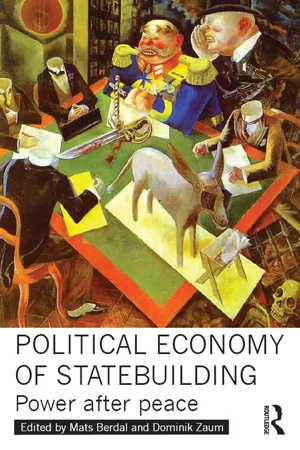
This volume examines and evaluates the impact of international statebuilding interventions on the political economy of post-conflict countries over the past 20 years. While statebuilding today is typically discussed in the context ofpeacebuilding and 'stabilisation operations, the current phase of interest in external interventions to (re)build and strengthen governmental institutions can be traced back to thegood governance policies of the International Financial Institutions (IFIs) in the early 1990s. These sought political changes and improvements in the quality of governance in countries that were subject to, or were seeking support under, IFI-designed structural adjustment programmes.The focus of this book is specifically on state-building efforts in conflict-affected countries: countries that are emerging, or have recently emerged, from periods of war and violent conflict. The interventions covered in the present volume fall into three broad and overlapping categories:International administrations and transformative occupations (East Timor, Iraq, and Kosovo); Complex peace operations (Afghanistan, Burundi, Haiti, and Sudan); Governance and state-building programmes conducted in the context of economic assistance (Georgia and Macedonia).This book will be of much interest to students of statebuilding, humanitarian intervention, post-conflict reconstruction, political economy, international organisations and IR/Security Studies in general.
1 | Power after peace |
The post-Cold War era has witnessed a remarkable growth in international efforts to assist in the rebuilding of states and societies affected by war and violent conflict. Many of these interventions have involved what has become known as statebuilding: “actions undertaken by international and national actors to establish, reform, or strengthen the institutions of the state and their relation to society” (Call 2008a: 5).1 In a rich variety of settings and circumstances, international organisations and donor states have found themselves involved, to an unprecedented degree, in the creation and reform of representative political institutions, the strengthening of governmental capacity, the promotion of judicial reform and the liberalisation of economies. This book is concerned with one aspect of that experience in particular: the impact of state-building interventions on the political economy of war-torn societies. Our understanding of the “political economy of statebuilding” is discussed more fully below, suffice it to say here that an underlying concern throughout is with the impact of outside intervention on the complex relationship, in terms of power and influence, between formal and informal political and economic actors, groups and networks within war-torn and conflict-affected societies.
While statebuilding today is typically discussed in the context of “peace-building” and “stabilisation” operations, the current phase of interest in external interventions to (re)build and strengthen governmental institutions can be traced back to the “good governance” policies of the International Financial Institutions (IFIs) in the early 1990s. These sought political changes and improvements in the quality of governance in countries that were subject to, or were seeking support under, IFI-designed structural adjustment programmes (see Susan Woodward’s chapter in this volume). The focus of this book is specifically on statebuilding efforts in conflict-affected countries: countries that are emerging, or have recently emerged, from periods of war and violent conflict. Even this limitation, however, leaves a wide range of relevant experiences and statebuilding activities to investigate. The interventions covered in the present volume fall into three broad and overlapping categories: international administrations and transformative occupations (East Timor, Iraq and Kosovo); complex peace operations (Afghanistan, Burundi, Haiti and Sudan); and governance and statebuilding programmes conducted in the context of economic assistance (Georgia and Macedonia). This very range hints at one of the conclusions that emerge in detail from the individual case studies: the experience of the past 20 years is one of great diversity of statebuilding approaches, a reflection in part of the variety of motivations held by external actors engaged in the exercise. We are not, in other words, looking at a coherent or consistent approach to statebuilding by donors and international organisations in the post-Cold War era. This of course should not come as any great surprise. States and international organisations have different national and institutional interests that they pursue when they engage in post-conflict statebuilding. Crucially, they often also have different perspectives on the origins and character of the conflicts that prompted intervention in the first place. These realities all necessarily shape and skew the priorities and approaches of actors to statebuilding.
The growing interest and involvement of external actors in war-torn states through statebuilding is reflected in two developments.
The first of these is the growing number of peace operations in war-torn countries that have, as part of their mandate, engaged in or supported state-building activities. Out of a total of 49 UN-led peacekeeping operations established between 1989 and 2011, 29 had some form of statebuilding mandate. The scope and transformative ambition of these operations make them qualitatively different from earlier activities, be it UN peacekeeping operations during the Cold War, or League of Nations activities in the 1920s and 1930s. In some cases, the resources devoted by external actors to a statebuilding project have exceeded the country’s GDP, in some cases (i.e. Liberia and Afghanistan) by multiples. While there are major differences between operations – differences in terms of the extent and nature of outside involvement, the resources committed by donors and the political context within which statebuilding is undertaken – they have all typically been characterised, and justified, in terms of their ambition to promote and undertake institutional and societal transformations aimed at eradicating the underlying or “structural” sources of violence.
The second development alluded to above is the identification of “state failure” – rightly or wrongly – as a major threat to both human and national security by many Western countries. A consequence of this has been for state-building to be viewed as a policy response to a growing number of international social ills. It has been presented as the “solution” to a very diverse set of threats and challenges:
• strengthening state capacity is considered central to the economic development of poor and conflict-affected countries (World Bank 1997; UN Millennium Project 2005; OECD 2011: 15);
• democratisation, the promotion of justice and economic liberalisation in weak, post-conflict states can reignite violence without strengthened state institutions to support these objectives (Paris 2004);
• weak and fragile states are seen as posing threats to wider regional and international security, and have been associated with international terrorism (White House 2002), drugs trafficking, organised crime and the proliferation of weapons of mass destruction (Fearon and Laitin 2004).2
Statebuilding has therefore become one of the central policy tools deployed both by multilateral institutions and by major donor countries to address the diverse challenges faced by developing and, in particular, conflict-affected countries.
Central themes and questions posed
Although international statebuilding efforts can play, and on occasion have played, an important role in helping societies to move out of conflict (i.e. in Burundi or Macedonia, see Uvin and Bayer’s, and Bender’s chapters in this volume), the overall impact in terms of ensuring stability, promoting development and mitigating violence remains decidedly mixed. Indeed, according to Ken Menkhaus, “few international aid programmes have met with such consistent frustration as state-building” (2010: 173), a conclusion broadly supported by the present volume. By focusing on the political economy of statebuilding in war-torn societies, the present book highlights a number of recurring themes that help explain why international statebuilding interventions have tended to fall short of the visions of interveners and local populations alike. These include, perhaps most notably, evidence of important continuities between wartime and “post-conflict” economies and authority structures, which are often consolidated as a consequence of international involvement; tensions arising from what are often the competing interests and values held by different interveners and local actors; and, finally, the continuing salience of economic and political violence in statebuilding processes and war-to-peace transitions.
These themes, that statebuilding outcomes have differed from expectations, and that security and development gains might not only be more fragile, but also of a different character and quality than statebuilders might have expected and desired, is a starting point for the analysis in this book, rather than a conclusion, as they raise a range of important questions that are addressed in the different parts in this book. What are the aims of external statebuilders, and how do they differ between actors and over time? How have these agendas interacted with the interests and agendas of local actors, and with what consequences? How are statebuilding practices mediated through local actors and institutions? What is the character of the states that have been (re)built? Have statebuilding efforts, despite their mixed record, contributed to political stability, justice and economic development in the affected societies? What have been the factors that help us to understand the reasons for the shortcomings of international statebuilding practices? These are the kinds of questions posed by the authors – from the perspective of different practices, countries and organisations – brought together in this volume.
While not a comprehensive account of international statebuilding practices since the end of the Cold War, the book seeks to provide both an accurate overview and evaluation of these efforts, and of how they shape the character of post-conflict states. Before that, though, it is important to revisit and explain some of the assumptions, definitions and concepts that underpin the book, most obviously the concepts of political economy and statebuilding.
A political economy perspective on statebuilding: restating the central research question
The term “political economy” has been employed broadly and with a range of different meanings across time and subjects. Since the mid-twentieth century, it has been used to describe both the close relationship between economics and politics, and the application of the methodology of economics to the inquiry into questions of politics (Weingast and Wittman 2006: 3–4). Robert Gilpin’s understanding of the political economy, as a set of questions that are “generated by the interaction of the state and the market as the embodiment of politics and economics in the modern world” (1987: 9), fits into this tradition and provides a useful starting point for conceptualising the political economy of statebuilding. To further develop our understanding of a political economy of statebuilding, however, three additional observations are merited.
First, many statebuilding policies aim to restructure the relationship between the state, society and the market, and affect the capacity of the state to regulate and intervene into the economy. The emphasis on market liberalisation and on the privatisation of state-owned enterprises that have been at the core of the economic development policies of many post-conflict statebuilding operations (i.e. in accordance with the strictures of the so-called the “Washington Consensus”), aim to limit the role of the state in the market (del Castillo 2008; Woods 2006). The World Bank’s 1997 World Development Report: The State in a Changing World, for example, argued that states’ roles should match their capabilities, and that “[w]eak states must tailor their ambitions to their capability” (1997: 41). The key functions on which weak states, including post-conflict states, should focus are those core functions necessary to support free markets (ibid.; see also Susan Woodward’s chapter in this volume). Statebuilding efforts therefore have important consequences for the relationship between state and market in post-conflict countries.
Second, to finance the institutions of the state and the public goods that they are expected to provide, a state needs to develop an economic base and the capacity to extract resources – in particular through taxation – to finance its activities. The success of any statebuilding effort is therefore intricately tied up with wider questions about the political economy of post-conflict countries.
Finally, war, and in particular civil war, transforms the relationship between state and market, and creates its own political economy. It gives rise to new structures of political power and authority, new actors controlling economic resources, and new forms of interaction between the political and economic life. While traditionally civil war has been considered as a breakdown of order and “development in reverse” (in particular Collier et al. 2003, but also World Bank 2010), scholars such as Christopher Cramer (2006) and David Keen (1998) have convincingly argued that civil war is not simply the collapse of a “normal” peacetime order but also involves the emergence of different, alternative kinds of order, governed by their own political and economic logic. Importantly, such war economies persist into peacetime, and are likely to shape the character of the post-war political economy. Transforming these very political wartime economies is a central challenge for statebuilding operations. As Michael Pugh and his co-authors have observed, “At best, an inability to transform war economies perpetuates corruption, flawed governance, and tensions created by competing patrimonies and ethnic groups … At worst, it can store up long-term problems that can lead to the recurrence of conflict” (2004: 3–4).
These observations suggest that the political economy of post-conflict statebuilding has to go beyond Gilpin’s focus on formal rules and institutions, and the interaction of state and markets, but also needs to be concerned with informal political and economic structures, in particular (but not exclusively) those arising from conflict. Thus, for the purpose of this book we understand the political economy of statebuilding to encompass the relationships between formal and informal economic and political structures in post-conflict environments. Our concern is both with formal political and economic structures and with the “alternative systems of power, profit and protection” (Berdal and Keen 1997: 797) rooted in war and conflict but certain to have mutated, adapted and survived into the “post-conflict” phase. Such a perspective brings out not only the fact that those on the receiving end of statebuilding exercises are neither passive nor inert (MacGinty 2011), but also that the international presence itself forms an important part of the political economy of post-conflict statebuilding (and that, by extension, the policies and actions of outsiders feed back into and do themselves play a critical role in shaping the character and dynamics of conflict-ridden societies).
Thus, to sum up, the political economy of post-conflict statebuilding being investigated has three dimensions:
• the institutions and structures of the formal state, which are reformed and supported by external statebuilding actors;
• the informal structures and actors which precede and/or emerge during the conflict (such as tribal and clan structures, war lords, and criminal and smuggling networks), and which are often central to the organisation and exercise of power in conflict-affected states, and which both complement and compete with formal institutions;
• the international presence, with its peacekeepers, aid agencies, donors and consultants, who often exercise state functions (such as the provision of security), and who (whether intentionally or not) are participants in the politics and conflicts of post-conflict countries.
With this in mind, we can restate in a slightly different form the major aim of the book: to explore whether statebuilding efforts have succeeded in transforming, and in what ways they have done so, the political economy and power structures that have fuelled conflict and violence in the first place. In particular, it aims to examine how international statebuilding policies have affected the domestic actors who, at the end of the conflict, exercise political power, dominate state institutions, and control and exploit economic assets.
Shortcomings of the existing statebuilding literature
Such a political economy perspective challenges two important strands of the literature on post-conflict statebuilding. First, it challenges what has aptly been described as a “mechanical metaphor” of state failure that has informed both the writings on and the practice of Western-led statebuilding. This is the tendency to treat failed states much “like broken machines, [which] can be repaired by good mechanics” (Ellis 2005: 6). It is a conception of state failure that naturally lends itself to technocratic approaches and solutions. Second, it challenges the literature on “liberal statebuilding” and “liberal peacebuilding”, which has been highly critical of these efforts predominantly (but not exclusively) on normative grounds, and which has made some rather brave assumptions about the coherence of the “liberal state-building project” (Richmond 2005), and the extent to which the failures of statebuilding can be attributed to the imputed underlying liberal ideology.
Technocratic approaches to statebuilding
Much of the writing on statebuilding has been technocratic and template driven in nature, proceeding from the assumption that state failure is fundamentally a “function of low capacity”. Ken Menkhaus (2010: 176) neatly summarises the policy prescriptions that flow from this view:
By reducing state failure to a matter of low capacity, this view lends itself to technical solutions … More funding, better trained civil servants, a more professionalised and equipped police force, and a healthy dose of democratisation (where not politically inconvenient) have been the main elements of state-building strategies.
As a consequence, the focus of this literature has mainly been on “inputs” such as time, financial aid, and troops and police on the ground (Dobbins et al. 2005a, 2005b), and on the promotion of particular institutional templates – especially democracy (i.e. Rotberg 2004) – rather than actual processes of statebuilding, the dynamics between external and local actors, and their impact on the political economy of societies. Approached in this way, it is hardly surprising that statebuilding practice and much of the writings on it (including key donor documents from the World Bank and OECD/DAC) have tended to focus on (a) how to strengthen state capacity by building formal institutions and/or (b) problems specifically relating to “delivery”, including, inter alia, lack of donor coordination, bureaucratic turf battles among agencies, poor sequencing and inadequate implementation of otherwise sound plans. These are not unimportant issues, but focusing only on them runs the risk of conceptualising and treating societies subject to state-building interventions as passive and static.
A political economy perspective on statebuilding points to two problems with this literature in particular. First, a technocratic approach to state-building fails to account for the fundamentally political character of such interventions. It tends to view the statebuilding policies promoted or imposed by external actors as largely unproblematic technical fixes to capacity and collective action p...
Table of contents
- Cover
- Title Page
- Copyright Page
- Table of Contents
- List of illustrations
- Notes on contributors
- Foreword
- Acknowledgements
- Abbreviations
- 1 Power after peace
- PART I
- PART II
- PART III
- Bibliography
- Index
Trusted by 375,005 students
Access to over 1.5 million titles for a fair monthly price.
Study more efficiently using our study tools.
Frequently asked questions
Yes, you can cancel anytime from the Subscription tab in your account settings on the Perlego website. Your subscription will stay active until the end of your current billing period. Learn how to cancel your subscription
No, books cannot be downloaded as external files, such as PDFs, for use outside of Perlego. However, you can download books within the Perlego app for offline reading on mobile or tablet. Learn how to download books offline
Perlego offers two plans: Essential and Complete
- Essential is ideal for learners and professionals who enjoy exploring a wide range of subjects. Access the Essential Library with 800,000+ trusted titles and best-sellers across business, personal growth, and the humanities. Includes unlimited reading time and Standard Read Aloud voice.
- Complete: Perfect for advanced learners and researchers needing full, unrestricted access. Unlock 1.5M+ books across hundreds of subjects, including academic and specialized titles. The Complete Plan also includes advanced features like Premium Read Aloud and Research Assistant.
We are an online textbook subscription service, where you can get access to an entire online library for less than the price of a single book per month. With over 1.5 million books across 990+ topics, we’ve got you covered! Learn about our mission
Look out for the read-aloud symbol on your next book to see if you can listen to it. The read-aloud tool reads text aloud for you, highlighting the text as it is being read. You can pause it, speed it up and slow it down. Learn more about Read Aloud
Yes! You can use the Perlego app on both iOS and Android devices to read anytime, anywhere — even offline. Perfect for commutes or when you’re on the go.
Please note we cannot support devices running on iOS 13 and Android 7 or earlier. Learn more about using the app
Please note we cannot support devices running on iOS 13 and Android 7 or earlier. Learn more about using the app
Yes, you can access Political Economy of Statebuilding by Mats Berdal in PDF and/or ePUB format, as well as other popular books in History & Military & Maritime History. We have over 1.5 million books available in our catalogue for you to explore.