eBook - ePub
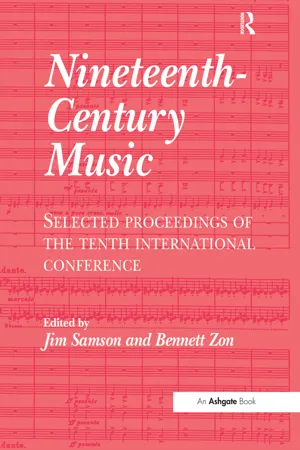
Nineteenth-Century Music
Selected Proceedings of the Tenth International Conference
- 400 pages
- English
- ePUB (mobile friendly)
- Available on iOS & Android
eBook - ePub
Nineteenth-Century Music
Selected Proceedings of the Tenth International Conference
About this book
This selection of essays represents a wide cross-section of the papers given at the Tenth International Conference on Nineteenth-Century Music held at the University of Bristol in 1998. Sections include thematic groupings of work on musical meaning, Wagner, Liszt, musical culture in France, music and nation, and women and music.
Information
Part I
Philosophy of Music
Chapter 1
Musical Meaning?
Andrew Bowie
At the end of his essay ‘Aesthetic Value, Objectivity, and the Fabric of the World’ John McDowell asks ‘how can a mere feeling constitute an experience in which the world reveals itself to us?’ (McDowell, 1998, p. 130), and suggests that any philosophical approach which would prevent this question being asked may for that reason be regarded as at least questionable. McDowell puts into question a view which has tended, directly or indirectly, to inform many of the dominant ways of discussing the philosophy of music in the English-speaking world. In this view philosophy’s concern is to establish the Archimedean point from which the essential truth about reality can be established: once this point is established one would have ‘a framework within which any philosophical reflection on the remainder of our view of reality must take place’ (ibid., p. 129). This framework is, of course, the framework of the natural sciences which aim, in Bernard Williams’ phrase, for an ‘absolute conception’ of reality, a conception in which feeling is pretty unlikely to play a decisive role. The sciences are seen in terms of their articulating the truth about the world in propositions and it is philosophy’s job to clarify and articulate the nature of the languages in which these propositions are couched. In their extreme forms such approaches to language have incoherently attempted to exclude most forms of actual language-use as ‘meaningless’ because what they convey is not amenable to the kind of verification procedures required for scientific inquiry. As such, the result of quite a lot of philosophical reflection in this tradition has been to restrict more or less severely what can count as ‘meaning’, excluding much of what most people find – using the word in a deliberately rather indeterminate sense – ‘meaningful’.
A characteristic offshoot of this proposition-based approach begins considering the question of musical meaning by looking for ways in which music seems to relate to language, then adopts some existing philosophical theory of the nature of language, and, on this basis, either confirms or denies – usually the latter – that music is ‘like a language’. This may seem the evident thing to do, but two things should give pause for thought here. The first is that the results of this procedure are often startlingly arid. This can already be suggested by the relative lack of interest in these results on the part of many musicians and listeners who are otherwise intellectually fascinated by music, and by the fact that both the cast-list of philosophers of music in this tradition, and their agenda of questions, have been remarkably small, though there are signs of this now changing, one of which is Roger Scruton’s recent book (Scruton, 1997). In the main, though, serious historical questions are, as we shall see, largely ignored in this tradition, being dealt with only to the extent to which they may offer resources for questions about music of a non-historical kind. The second, related point is that the initial assumption of this approach already precludes much of what is significant about the question of philosophy and music, because its grounding idea is that philosophy is going to tell us what music is and is not, and what music can and cannot do. What, though, and it is this which interests me most here, of the idea that music may be able to ‘tell’ philosophy a thing or two, for instance concerning how to approach what cannot be said but which yet demands articulation?
The obvious objection to this is that what music tells us about philosophy will have in the end to be stated propositionally. However, this may be begging the question, because it will presumably only be those aspects of music which are amenable to propositional articulation that can be definitively dealt with in this manner. Given the fact that in the modern period music has often been regarded as significant precisely because of what it says or does that verbal language does not, the objection begins to look at least debatable. It looks even more debatable when the link between music and poetry is made in the manner which began with Romanticism. There is, for example, widespread agreement that cashing out the meaning of a poem in propositional terms fails to articulate what is so significant about ‘these words in these positions’ (Wittgenstein). Gadamer makes the essential point as follows: ‘The word of everyday and as well of scientific and philosophical discourse points to something and disappears itself as something temporary behind what it shows. The poetic word on the other hand itself appears in its showing and, as it were, stands still’ (Gadamer, 1993, p. 19). Stephen Davies who is part of the Anglo-American analytical tradition referred to above, does not even have the terms ‘poetry’ or ‘literature’ in the index of his book Musical Meaning and Expression, and he thereby exemplifies a key deficit in the analytical approach suggested by Gadamer’s remark. One can also question the assumption that the adoption of conceptions from the analytical philosophy of language is the appropriate initial move in the philosophy of music on the grounds that this aspect of the Anglo-American tradition of philosophy has anyway increasingly attenuated its earlier claims to be able give a theory of meaning. It has done so to the point where the distinguished American semanticist Donald Davidson has famously asserted that ‘there is no such thing as a language ... if a language is anything like what many philosophers and linguists have supposed’ (in [ed.] Lepore, 1986, p. 446) – namely an identifiable entity the discovery of whose rules will give us the method for explaining the meanings of utterances.
If we adopt Davidson’s claim it clearly becomes rather hard to argue about whether music is ‘like a language’ because both terms of the comparison cease to be strictly definable. One way of suggesting the difficulty here is that in actual language use much of the working of language has to do precisely with elements which many analytical philosophers of language never even mention. Schleiermacher, who was himself in many ways an analytical philosopher of language avant la lettre, was fully apprised of these elements which his successors ignore, as the following remarks from 1809–10 suggest: ‘language as a totality of tones is a musical system. The musical element also has an effect in every utterance, and as this effectiveness has a different basis from that of the significant, they can come into conflict with each other’ (Schleiermacher, 1998, p. 238). Elsewhere he asserts that ‘Language also has, along with the logical value of the word, a musical value, this is the rhythmic and the euphonic. If something is added in a period because of the rhythm then this does not, of course, have the same logical value as something else which is necessary in the context of thoughts: logically it comes closer to redundancy’ (ibid., p. 83). The vital point is that language must be seen in terms of both the ‘musical’ and the ‘logical’, so that what is redundant in a purely scientific piece of language may be the source of the significance of a literary utterance, a significance which has something to do with its ‘musicality’. Gadamer suggests the point of the hermeneutic attention to these dimensions of language as follows: ‘The word which one says or which is said to one is not the grammatical element of a linguistic analysis, which can be shown in concrete phenomena of language acquisition to be secondary in relation, say, to the linguistic melody of a sentence’ (Gadamer, 1986, p. 196). The essential question here can be summed up by the hermeneutic contention that if understanding is ontologically prior to explanation one cannot then use explanation to explain understanding. Unless we have some prior ways of understanding the world we would never even be able to learn rules for understanding an utterance because we would not understand what it is to learn a rule at all. I do not, incidentally, mean to suggest by this that we consciously learn rules, just that a regress is entailed by the attempt to ground understanding in the learning of rules: what rule does one use to learn a rule in the first place? These ways of understanding were what led Kant to the notion of ‘schematism’, the non-rule-bound ability to form and grasp concepts at all, in order to avoid a regress of rules for rules that would render all understanding impossible. Schematism is, then, the ability to apprehend identity in difference, to apprehend something as something, which, as we will see, is vital for an account of musical meaning.
There are, then, two crude but useful ways of thinking about the object of investigation in both the philosophy of music and the philosophy of language. One is to assume that there is a ‘fact of the matter’ which is ‘out there’, in the way there may be in the case of the physical sciences – how, though, could we establish in a non-circular manner that there is? – so that one’s account will ‘represent’ or ‘correspond to’ what is already present. Such a world, as Peter Strawson has rather cruelly put it, would have to consist of ‘sentence-shaped items’ that can correspond to what Richard Rorty terms ‘Nature’s Own Language’. The other is to assume that the relationship between the subjective and the objective cannot be described in such terms because there is no definitive way of stepping outside our involvement with the object in question in order to separate what we, in Kant’s sense, ‘spontaneously’ contribute to the object, and what we receive from the object. On the basis of this assumption one gives up the idea that the ultimate means of access to truth is the correspondence of sentences to what is already the case and accepts that all kinds of articulation may give access to what matters in the world, because the world consists of more than ‘sentence-shaped items’. As such, the world therefore also involves aspects which the first view would regard as merely subjective, such as feelings or, remembering Heidegger, moods. This is echoed in the fact that language itself involves ‘the musical’, not just as an optional extra, but as something which can affect both how something is understood and what effect it has on its recipient.
Mapped onto questions often asked in the philosophy of music this difference is echoed in the difference between two kinds of theories. The first kind asks whether music is able to re-present the world in the same kind of ways as language supposedly does. The second suggests that the model of language as representation of what is already there itself renders much of our understanding of the world incomprehensible, because it is impossible, as Schleiermacher already showed in the 1810s, definitively to separate out what the world contributes and what we contribute to truth and meaning. Consequently the representation model cannot be used to explain music’s possession or lack of meaning either. Peter Kivy offers a characteristic example of the kind of assumptions involved in the first position when he says of Beethoven’s Eroica Symphony that ‘it has no content to reveal, no message to decode’, and that in the teaching of the work ‘few instructors, trained in the modern analytical and musicological traditions as they are, will be tempted to attribute any meaning to it’ (Kivy, 1993, p. 29), it being, ‘in a sense’, ‘pure contentless abstract form’ (ibid., p. 30). The sort of meaning it has mistakenly been supposed to have Kivy talks about as being expressed in terms involving representation of ‘God and goodness’ (ibid.) or, in another essay, in terms of the emotions either of the composer or the listener.
Clearly this kind of attribution of meaning cannot be an adequate response to the question of what the Eroica might mean, but one has to say that Kivy hardly alights on the most likely candidates for its meaning. Even if the Eroica makes no assertions about the end of feudalism and the concomitant liberation of human possibilities of combining order and free invention it would be an impoverished conception of how we might understand the world that denied that this music could function as a metaphor of these aspects of early modernity which cannot simply be replaced by the kind of historical cliche ´s I have just employed. In this latter view the Eroica can indeed articulate dimensions of the experience of modernity via which McDowell’s ‘mere feeling’ may well ‘constitute an experience in which the world reveals itself to us’, in this case by articulating the dynamism which results from the realization of the possibilities inherent in new forms of combination of musical material that are unfettered by existing conventions governing the scale and complexity of musical composition. It seems a good idea, therefore, to leave open more space than Kivy does for what musical meaning might be, given the resources of metaphor which we employ nearly all the time – not just in relation to music – to get in touch with what cannot be simply cashed out into literal assertions. The same point was suggested earlier in relation to poetry. While allowing a significantly greater leeway and offering many important suggestions for the ways in which metaphor is necessarily involved in reflection on the meaning of music, Roger Scruton still makes the analytical claim that ‘Language is essentially an information carrying medium, intelligible in principle for every rational being, and governed by rules which organise a finite vocabulary into a potential infinity of sentences. It is not obvious that any of those things is true of music’ (Scruton, 1997, p. 172). It is, though, also not obvious that the primary function of language is the carrying of information, rather than, as the hermeneutic and pragmatist traditions would have it, the enabling of orientation in the world or the enabling of human coexistence; the latter, for example, does not rely solely on the informational, but rather on the performative aspects of language, aspects that can often depend on the tone, rhythm and degree of emphasis of utterances, all of which belong to the ‘musical’ rather than the ‘logical’ aspect of language. Rather a lot turns here, of course, on what one takes ‘meaning’ to be.
Heidegger famously suggests in Being and Time that ‘words accrue to meanings’, because what we understand when we understand is the world we inhabit, not sentences about states of affairs, or whatever. If we therefore take ‘meaning’ to be what we understand when we understand, it becomes unclear how this understanding could emerge solely via rules, not least because that would explain neither language acquisition nor how new forms of understanding emerge in relation to new aspects of the world, which can be relatively unproblematically accounted for when we think in terms of the need for new forms of interaction with the world. The limits of what is implied by the representational, rule-based view are easy to make apparent. Any new metaphor clearly cannot be understood in terms of the existing rules of a language, even though it will usually obey syntactic rules, because it would then simply be an old metaphor or a piece of literal usage for the linguistic community in question. In the view I want to suggest we therefore need a much more open-textured sense of the relationship between language and the world, that does not ignore those kinds of understanding which question the idea that meaning can be reduced to what we know when we know the conditions under which sentences are true. Such an approach might then begin to answer McDowell’s question of how a feeling can ‘constitute an experience in which the world reveals itself to us’.
The meaninglessness of the Eroica in Kivy’s terms results from the fact that it has no ‘content’. Content here means semantic content, which is what we understand when we understand a proposition. If it were the case that we could give a convincing account of such understanding we could, as Kivy wishes to, keep straightforward divisions between semantic and non-semantic forms of articulation, and music would be meaningless – although, as he says elsewhere, it may still have ‘expressive properties’. Matters are, though, not that straightforward, even in relation to semantics. Scruton claims in a discussion of the difference of metaphor from literal meaning that ‘In understanding a literal sentence, I acquire a grasp of its truth-conditions’ (ibid., p. 85). However, the problem with this is that the truth conditions of a literal sentence must be stated in further sentences, leading to a regress of statements of truth conditions for the truth conditions of the truth conditions, and so on. Now it is either the case that, as hermeneutics and Davidson’s ‘principle of charity’ suggest, we do understand the world and what is said about it in languages we have acquired most of the time, or it is the case that we therefore never really understand because of the regress of truth conditions. Given the implausibility of the latter assumption it must be the case that meaning in the sense just suggested is not constituted solely by grasping truth conditions, so that understanding is indeed not reducible to explanation. Furthermore, the strict distinction Scruton wishes to draw between metaphor and literal meaning is also put into question by the suspicion that the line between literal meaning and metaphor is not a stable one, because we cannot exhaustively specify what any utterance can mean – what its truth conditions are – if it is used in a new context. History tells us that metaphors literalize themselves and literal meanings become metaphorical: how do we decide which comes first and where the line is to be drawn, if we accept that meanings change as the world does? What, for example, is the literal meaning of the term ‘music’?
Davidson, who admittedly insists that the only ‘meaning’ a word can have is its literal meaning – because he thinks meaning in this restrictive sense is given in terms of truth conditions – claims that ‘the endless character of what we call the paraphrase of a metaphor springs from the fact that it attempts to spell out what the metaphor makes us notice, and to this there is no clear end. I would say the same for any use of language’ (Davidson, 1984, p. 263). If one can notice more than states of affairs that can be represented in propositions it would seem to be the case that music can make one notice aspects of moods, feelings, temporality, landscape or even, in some cases, states of affairs – for instance via the effects of film music on what one understands in a film – that may not even be expressible in propositions. Indeed, music may first enable certain ways of being to become accessible at all, as suggested in Heidegger’s pupil Heinrich Besseler’s remark that ‘m...
Table of contents
- Cover
- Half Title
- Title
- Copyright
- Contents
- List of Music Examples
- List of Figures
- List of Tables
- Notes on Contributors
- Editors' Preface
- PART I PHILOSOPHY OF MUSIC
- PART II WAGNER
- PART III LISZT
- PART IV MEDIATING MUSIC: CREATING, COLLECTING AND PUBLISHING IN NINETEENTH-CENTURY FRANCE
- PART V MUSIC AND NATION
- PART VI WOMEN AND MUSIC
- Index
Trusted by 375,005 students
Access to over 1.5 million titles for a fair monthly price.
Study more efficiently using our study tools.
Frequently asked questions
Yes, you can cancel anytime from the Subscription tab in your account settings on the Perlego website. Your subscription will stay active until the end of your current billing period. Learn how to cancel your subscription
No, books cannot be downloaded as external files, such as PDFs, for use outside of Perlego. However, you can download books within the Perlego app for offline reading on mobile or tablet. Learn how to download books offline
Perlego offers two plans: Essential and Complete
- Essential is ideal for learners and professionals who enjoy exploring a wide range of subjects. Access the Essential Library with 800,000+ trusted titles and best-sellers across business, personal growth, and the humanities. Includes unlimited reading time and Standard Read Aloud voice.
- Complete: Perfect for advanced learners and researchers needing full, unrestricted access. Unlock 1.5M+ books across hundreds of subjects, including academic and specialized titles. The Complete Plan also includes advanced features like Premium Read Aloud and Research Assistant.
We are an online textbook subscription service, where you can get access to an entire online library for less than the price of a single book per month. With over 1.5 million books across 990+ topics, we’ve got you covered! Learn about our mission
Look out for the read-aloud symbol on your next book to see if you can listen to it. The read-aloud tool reads text aloud for you, highlighting the text as it is being read. You can pause it, speed it up and slow it down. Learn more about Read Aloud
Yes! You can use the Perlego app on both iOS and Android devices to read anytime, anywhere — even offline. Perfect for commutes or when you’re on the go.
Please note we cannot support devices running on iOS 13 and Android 7 or earlier. Learn more about using the app
Please note we cannot support devices running on iOS 13 and Android 7 or earlier. Learn more about using the app
Yes, you can access Nineteenth-Century Music by Bennett Zon, Jim Samson in PDF and/or ePUB format, as well as other popular books in Media & Performing Arts & Music. We have over 1.5 million books available in our catalogue for you to explore.