- 552 pages
- English
- ePUB (mobile friendly)
- Available on iOS & Android
eBook - ePub
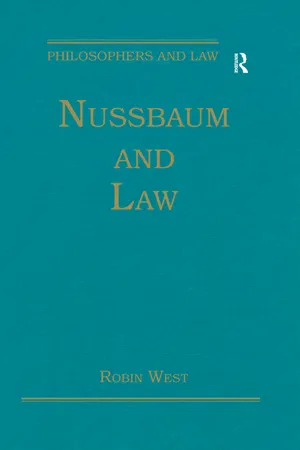
Nussbaum and Law
About this book
The essays collected in this volume reflect the profound impact of Martha Nussbaum's philosophical writings on law and legal scholarship. The capabilities approach that she has largely authored has influenced the approach scholars take to the law of disabilities, both in the United States and in Canada, as well as to international human rights and to domestic private law's protections of vulnerable populations. Her analyses of the relationship between our emotions and our thought and action has triggered a re-assessment of the legal regulation and recognition of emotion in a range of fields, most particularly in the field of criminal law; and her writing on the nature of dignity has informed an understanding of the emerging civil rights of gay and lesbian citizens worldwide. Our appreciation of the role of narrative in legal thought and discourse and the contributions of literature to law and legal culture, have also been broadened and deepened by her contributions. Taken together, and including the introduction by the editor, the essays collected in this volume demonstrate the far-reaching impact of Nussbaum's philosophical oeuvre.
Information
Part I
The Capabilities Approach
[1]
Disability Human Rights
Michael Ashley Stein†
Responding to the absence of cm international treaty expressly protecting people with disabilities, the United Nations General Assembly will soon adopt a disability-based human rights convention. This Article examines the theoretical implications of adding disability to the existing canon of human rights, both for individuals with disabilities and for other under-protected people. It develops a "disability human rights paradigm" by combining components of the social model of disability, the human right to development, and Martha Nussbaum's version of the capabilities approach, but filters them through a disability rights perspective to preserve that which provides for individual flourishing and modifying that which does not. This Article maintains that Nnssbaum's capabilities approach provides an especially fertile space within which to understand the content of human rights. However, because her scheme excludes some intellectually disabled individuals and conditions the inclusion of others, it falls short of a comprehensive framework. Amending Nussbaum's capabilities approach to develop the talents of all individuals results in a disability human rights paradigm that recognizes the dignity and worth of every person. This Article also argues that a disability rights paradigm is capable of fortifying human rights in two ways: first, it can reinforce protections afforded to groups already protected, such as women; and second, it can extend protections to people currently not protected, such as sexual minorities and the poor. Ultimately, the disability rights paradigm indicates that human rights protection can progress from a group to an individual basis. Repositioning disability as an inclusive concept embraces disability as a universal human variation rather than an aberration.
Introduction
More than six hundred million people, or about 10% of the world's population, have some type of disability.1 Around 80% of disabled persons live in developing countries, where they experience material deprivation and social exclusion.2 For example, only 2% of disabled children in such countries receive any schooling.3 Nevertheless, no existing United Nations human rights treaty expressly protects people with disabilities. To claim protection under a United Nations convention, disabled individuals must either invoke a universal provision or embody a separately protected characteristic. For instance, a woman with a disability may not claim protection based on her disability status alone, but may claim protection from torture or from sex discrimination.
As a result of these limitations, only a handful of disability-based human rights claims have been asserted under these "hard laws." By contrast, a series of General Assembly resolutions, declarations, and protocols explicitly reference disability. Yet these "soft laws" are not legally enforceable. Consequently, no existing international human rights instrument is both applicable to and enforceable by individuals on the basis of disability. In response to this void, the United Nations commissioned an Ad Hoc Committee to consider an international convention specifically protecting the human rights of disabled persons. As of this writing, that committee has drafted articles for consideration by the General Assembly.
This Article examines the theoretical implications of adding disability protections to the existing canon of human rights, both for individuals with disabilities and for other under-protected people.4 To do so, it develops a "disability human rights paradigm" that combines components of the social model of disability, the human right to development, and philosopher Martha Nussbaum's version of the "capabilities approach,"5 but filters these frameworks through a disability rights perspective to preserve that which provides for individual flourishing and modify that which does not.
Nussbaum's capabilities approach generally values the dignity, autonomy, and potential of all individuals, and views each as his or her own end. In doing so, her framework provides an elegant normative theory of human rights as a means of ensuring human flourishing. However, Nussbaum's scheme does not sufficiently account for the development of individual talent. This is because it requires that individuals be capable of attaining each of ten functional abilities as a prerequisite to being "truly human" and thus wholly entitled to resource distribution. Consequently, her framework excludes some individuals with intellectual disabilities, and only indirectly assists others.6
A more inclusive approach is the disability human rights paradigm, which maintains as a moral imperative that every person is entitled to the means necessary to develop and express his or her own individual talent. This paradigm compels societies to acknowledge the value of all persons based on inherent human worth, rather than basing value on an individual's measured functional ability to contribute to society. Accordingly the framework assesses ability from the bottom up, embracing all individuals—including those excluded by Nussbaum's capabilities approach—and accounting for their functional variations. By putting potential talent above function, the paradigm I offer embraces disability as a universal variation rather than as an aberration. This approach is necessary if human rights are to apply to all humans.
This Article also argues that disability-based human rights necessarily invoke both civil and political ("first-generation") rights, as well as economic, social, and cultural ("second-generation") rights to a greater degree than previous human rights paradigms. Broadly stated, first-generation rights largely occupy the focus of human rights practitioners and advocates. These rights are understood as promoting equal treatment among individuals, and include prohibitions against State interference. Sometimes these rights are thought of as "negative rights."7 Examples of first-generation rights are the rights to life, movement, thought, expression, association, religion, and political participation.8 Second-generation rights are traditionally the province of development agencies. These rights are understood as providing equal opportunity, and are often thought of as "positive rights."9 Second-generation rights generally focus on standards of living, including issues such as the availability of housing and education.10
Tying first-and second-generation rights together illustrates how the disability human rights paradigm can be applied to other people. The social attitudes underlying disability-related exclusion manifest more overtly than those causing isolation of other groups. Applying a disability paradigm highlights the effect of social exclusion, and points out the need of ensuring that the human rights of all socially marginalized groups are protected. As a result, the disability human rights paradigm reaffirms that established human rights protections, like those extending to women, require indivisible application of first-and second-generation rights as envisioned by the third-generation human right to development. The disability framework also maintains that human rights protections should be applied to other marginalized people, such as sexual minorities and the poor. Ultimately, the disability rights paradigm indicates that human rights protection can progress from a group to an individual basis. Thus, in addition to advocating for disability-specific protection paralleling that of established human rights instruments—itself a rare exercise in legal literature11—I proffer an argument for extending disability-based human rights concepts to other socially excluded individuals.12 The paradigm therefore stakes out a distinct perspective on human rights law, one I hope will encourage further discussion.
Parts I and II set forth the existing canon of disability-based human rights protections. Part I considers current United Nations instruments pertaining to disability, and briefly recounts the efforts underway to pass a convention on behalf of disabled persons. Part II describes the social model of disability in contrast to the medical model, and discusses its growing influence on the formation of international instruments as well as its limitations in overall human rights discourse. Parts III and IV consider the implications of applying a disability human rights paradigm both to persons with disabilities and other groups. Part III develops the paradigm by integrating Martha Nussbaum's version of the capabilities approach with the social model of disability and the human right to development.Part IV argues that the clearly indivisible nature of disability-based rights presents a strong exemplar, indicating the ability to understand established human rights as similarly undividable, and creates the possibility for extending human rights protection to other vulnerable populations. This Article concludes with a few thoughts on the potential consequences of viewing disability as universal to rather than abnormal from the human condition.
1 The Scope of Disability Human Rights
Each of the seven core United Nations treaties theoretically applies to disabled persons in varying degrees, but are rarely applied in practice. Compounding this problem. Genera...
Table of contents
- Cover
- Half Title
- Title
- Copyright
- Contents
- Acknowledgements
- Series Preface
- Introduction: Towards Humanistic Jurisprudence
- PART I THE CAPABILITIES APPROACH
- PART II LAW AND EMOTIONS
- PART III SEXUALITY, GENDER, FEMINISM AND LAW
- PART IV LAW AND LITERATURE
- Name Index
Trusted by 375,005 students
Access to over 1.5 million titles for a fair monthly price.
Study more efficiently using our study tools.
Frequently asked questions
Yes, you can cancel anytime from the Subscription tab in your account settings on the Perlego website. Your subscription will stay active until the end of your current billing period. Learn how to cancel your subscription
No, books cannot be downloaded as external files, such as PDFs, for use outside of Perlego. However, you can download books within the Perlego app for offline reading on mobile or tablet. Learn how to download books offline
Perlego offers two plans: Essential and Complete
- Essential is ideal for learners and professionals who enjoy exploring a wide range of subjects. Access the Essential Library with 800,000+ trusted titles and best-sellers across business, personal growth, and the humanities. Includes unlimited reading time and Standard Read Aloud voice.
- Complete: Perfect for advanced learners and researchers needing full, unrestricted access. Unlock 1.5M+ books across hundreds of subjects, including academic and specialized titles. The Complete Plan also includes advanced features like Premium Read Aloud and Research Assistant.
We are an online textbook subscription service, where you can get access to an entire online library for less than the price of a single book per month. With over 1.5 million books across 990+ topics, we’ve got you covered! Learn about our mission
Look out for the read-aloud symbol on your next book to see if you can listen to it. The read-aloud tool reads text aloud for you, highlighting the text as it is being read. You can pause it, speed it up and slow it down. Learn more about Read Aloud
Yes! You can use the Perlego app on both iOS and Android devices to read anytime, anywhere — even offline. Perfect for commutes or when you’re on the go.
Please note we cannot support devices running on iOS 13 and Android 7 or earlier. Learn more about using the app
Please note we cannot support devices running on iOS 13 and Android 7 or earlier. Learn more about using the app
Yes, you can access Nussbaum and Law by Robin West in PDF and/or ePUB format, as well as other popular books in Droit & Histoire du monde. We have over 1.5 million books available in our catalogue for you to explore.