- 196 pages
- English
- ePUB (mobile friendly)
- Available on iOS & Android
eBook - ePub
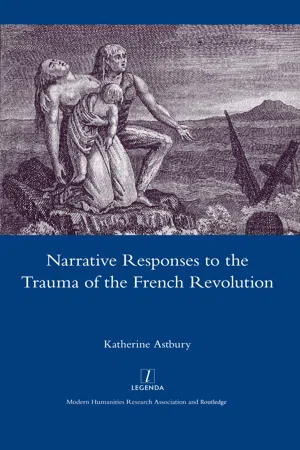
Narrative Responses to the Trauma of the French Revolution
About this book
During the French Revolution, traditional literary forms such as the sentimental novel and the moral tale dominate literary production. At first glance, it might seem that these texts are unaffected by the upheavals in France; in fact they reveal not only a surprising engagement with politics but also an internalised emotional response to the turbulence of the period. In this innovative and wide-ranging study, Katherine Astbury uses trauma theory as a way of exploring the apparent contradiction between the proliferation of non-political literary texts and the events of the Revolution. Through the narratives of established bestselling literary figures of the Ancien Regime (primarily Marmontel, Madame de Genlis and Florian), and the early works of first generation Romantics Madame de Stael and Chateaubriand, she traces how the Revolution shapes their writing, providing an intriguing new angle on cultural production of the 1790s.Katherine Astbury is Senior Lecturer in French Studies at the University of Warwick.
Information
CHAPTER 1

The Revival of the Pastoral
Having set out my reasons for re-examining the apparently non-political literary production of the Revolution, I want to turn now to the revival of the pastoral, a pan-European literary vogue during the second half of the eighteenth century. We should not forget the political satires that mushroomed in the first couple of years of the Revolution;1 however, the pastoral dominates literary production in 1790 and 1791, ahead of novels labelled as ‘adventures’ (largely either Robinsonades or travel narratives).2 Utopia links these predominant forms, for they are intimately concerned with alternative societies, a golden age and the re-evaluation of the individual as a result of new experiences. It is well known that periods of rapid change and instability generate utopian literature,3 and the link between utopia and the pastoral is a close one.
This chapter will explore three key notions. First, it sets out to demonstrate that there is a change in the way in which the pastoral genre is used after 1789. Its prevalence as a literary form during the Revolutionary decade allows us to use it as an illustration of how the seemingly familiar is in fact reworked as a result of the Revolution. It can therefore serve as a rebuttal of the view that literary forms of the decade are merely a continuation of those of the Ancien Régime. Second, the chapter will show that even the apparently non-political can in fact be an engagement with the Revolution. The pastoral as a form lends itself surprisingly well to political engagement. As Alain Niderst has pointed out, ‘le référent de la pastorale est rarement la vie des campagnes. Le genre est vite récupéré et devient un truchement idéologique’ [the pastoral’s referent is rarely country life. The genre is quickly appropriated and becomes a means to transmit ideology].4 Third, the chapter will show that the pastoral is used by writers across the political spectrum; it is not a form limited to one particular political standpoint. Overall, it will become clear that the pastoral is used for a variety of purposes which can only be understood fully in the context of the impact of the Revolution.
Ancien Régime pastorals
The pastoral enjoyed a revival in France in the middle of the eighteenth century. Françoise Lavocat believes that although a similar movement can be identified in Spain and Italy, it is above all in France that the trend establishes itself most firmly.5 But what do we mean by ‘the pastoral’ in the context of mid eighteenth-century France? There are various strands which constitute the French pastoral. First there is the classical model which would have been familiar to the educated elite right across Europe. The Greeks Theocritus, with his Idylls, and Longus, with his pastoral novel Daphnis and Chloe, provided the inspiration for countless imitations: these used a timeless classical setting populated by shepherds, and were concerned above all with love and song. To such sources can be added the Virgilian Latin model of the Eclogues, where the bucolic acts as a vehicle for comment on contemporary society. For contemporaneous critics like Marmontel and Winckelmann, the pastoral represented innocence and simplicity but also elegance and quiet grandeur: a stylized vision of life as a shepherd.6 In addition, the revival of the pastoral in the second half of the eighteenth century in France is inspired by Swiss and English writers who extended the notion of the pastoral beyond the life of shepherds to a representation of country living.
Thomson’s Seasons were widely read in France,7 both in the original and in translation, especially in the derivative Les Saisons [The Seasons] by Saint-Lambert; but it is the Swiss writer Salomon Gessner who exercised the most significant influence on the French pastoral. His Daphnis appeared in France in prose translation in 1756, followed by La Mort d’Abel in 1760 and Idylles in 1762. Over 150 works have been identified as directly imitating Gessner, which makes him the most imitated of all foreign writers of the second half of the eighteenth century in France.8 His position in the development of European taste is well established,9 and he was very much seen as the first writer ‘qui ait donné au genre pastoral toute l’étendue dont il est susceptible et qui ait peint ses bergers comme des hommes’ [who gave the pastoral its full range and who painted his shepherds as men] (Huber, translator of the Idylles, 1762).10 Gessner’s work clearly touched a chord during the 1760s in particular, feeding into the vogue for sensibility and into the ‘return to nature’ movement; but there is a surprising revival of interest for his work during the Revolutionary decade.
During the 1770s and 1780s, the classical model of the pastoral with its shepherds and a setting in Ancient Greece falls from favour, to be replaced by a more general use of the notion of the pastoral which comes to refer to any idyllic countryside setting. Malcolm Cook has provided a useful working definition of the pastoral as ‘a picture of an idyllic world in a real framework’.11 The focus of these new French pastorals was on country life, but the protagonists were not always shepherds and the settings were not always a mythical past but also sometimes a recognizably contemporary France. Florian’s Essai sur la pastorale [Essay on the Pastoral], published in 1787, assesses the genre’s stagnation in 1780s France: ‘dès que l’on annonce un ouvrage dont les héros sont des bergers, il semble que ce nom seul donne envie de dormir’ [as soon as a work is announced with shepherds as heroes, the word alone makes you want to fall asleep].12 While careful to praise Classical writers, he rejects the eclogue as a form where characters ‘parlent tous de la même chose, dont les idées roulent sur le même fond’ [all talk of the same thing and whose ideas cover the same ground] (p. 5). Edouard Guitton has gone so far as to suggest that by 1780, the pastoral as a genre in France was ‘virtuellement condamnée’ [virtually doomed].13 Florian’s suggestions for the renewal of the genre include the use of poetic prose and characters who are not shepherds, but it is clear that the classical pastoral model was not especially in favour. The more general acceptance of ‘pastoral’ to mean the representation of country life in an idyllic landscape, on the other hand, most certainly was, and manifests itself in various artistic forms as well as in Marie-Antoinette’s hamlet at Versailles with its perfumed sheep and be-ribboned shepherdesses. The contrast, implicit or otherwise, between idyllic countryside and the corruption of town life, a recurrent theme in the long wake of La Nouvelle Héloïse, finds particular expression in this enlarged concept of the pastoral. For Lavocat, this French manifestation of the pastoral is the representation of an ‘Arcadie familiale, monarchiste et bourgeoise’ [familial, monarchist and bourgeois Arcadia],14 a point worth bearing in mind when we come to consider the revival of the pastoral during the Revolutionary decade.
From Virgil onwards, the pastoral had always been a form that allowed intellectuals ‘to denote their ideological stance as writers in relation to their sociopolitical environment’.15 It is perhaps unsurprising that as 1789 draws near, the idyllic is increasingly used as a form of social criticism. The pastoral, in its new, enlarged sense, becomes a means to criticize the prevailing cultural, social and political practices of the day, with the protagonists often positioned as belonging to ‘une classe intermédiaire entre les paysans et la noblesse’ [an intermediary class between the peasants and the nobility].16 The 1780s in particular see some important pastoral works in Bernardin’s Paul et Virginie and Florian’s Estelle, both of which aim to renew the form by giving it ‘un degré d’intérêt, peut-être même d’utilité’ [a degree of interest perhaps even usefulness].17 Bernardin especially makes much of the contrast between the artificiality of society and the naturalness of the island home of his two eponymous protagonists. For Raymond Trousson, Paul et Virginie is ‘une expression du “genre arcadien” qui, sous le patronage des idylles de Gessner, fleurit à l’époque Louis XVI et traduit les besoins d’une sentimentalité frustrée’ [an expression of the ‘Arcadian genre’ which, under the patronage of Gessner’s idylls, flourished during the reign of Louis XVI and expressed the needs of a frustrated sentimentality].18 Bernardin in the foreword situates the text, however, in the tradition of Theocritus and Virgil rather than Gessner.19 The island setting on Mauritius in the first instance serves as a space to flee from society for the two mothers, thus representing a ‘Flucht aus der Zeitwirklichkeit, ein “besseres” “Drinnen” als Gegenbereich zum “schlechteren” “Draußen” ’ [flight out of the reality of the present day, a ‘better’ ‘inside’ in opposition to somewhere ‘worse’ ‘outside’], to use Horst Brunner’s terminology.20 In this account, ‘Zeitwirklichkeit’ is ‘present in absence’. As a result, the idyllic surroundings of the island are detailed primarily to criticize French contemporary society, though in true pastoral tradition ‘the pastoral setting is simultaneously a place both safe and vulnerable’.21 The text’s stated aim is to ‘réunir à la beauté de la nature entre les tropiques la beauté morale d’une petite société’ [unite the beauty of nature in the tropics and the moral beauty of a small society] as well as ‘d’y mettre en évidence plusieurs grandes vérités’ [to reveal several great truths], thus aligning it firmly with the pastoral tradition, although the pastoral here throws light on its absent ‘other’.22
Bernardin is even more explicit in L’Arcadie, of which the first part appeared in 1788; here he makes it clear that his use of the pastoral is partly escapism, partly criticism of the current state of France. In the preamble to L’Arcadie, Bernardin explains that he has chosen ‘une évasion passéiste et poétique’ [a backward-looking and poetic evasion] (p. 5) since his soul is ‘mécontente des siècles présens’ [dissatisfied with the present century] (p. 15). Only by setting his poem in the distant past could he get away with writing about a ‘république dirigée suivant les lois de la nature’ [republic governed following the laws of nature] (p. 13). The first book includes a picture of a people where ‘druids’ control education and the nobility have the right of life and death over their vassals. The parallels with Ancien Régime France are thinly disguised:
Ces deux classes de citoyens, dont l’une emploie la ruse et l’autre la force, pour se faire craindre, se balancent entre elles; mais elles se réunissent pour tyranniser le peuple qu’elles traitent avec un souverain mépris. (pp. 88–89)
[These two classes of citizens, one of which uses ruse and the other force to make themselves feared, balance each other out; but they come together to tyrannize the people whom they treat with sovereign disdain.]
It comes as no surprise that Bernardin embraced the Revolution enthusiastically a little over a year after writing this. The Arcadian setting, just as in Paul et Virginie, serves merely as a cover for social and political criticism of the status quo.
Even when writers in the 1780s take refuge more deeply in an earlier pastoral age, present-day society is still criticized by implication. Jean-André Perreau’s Scènes champêtres [Rural Scenes] (1782) for instance are Gessner-influenced idylls set in a non-specific location, though one that is clearly not France. He makes it clear that his refuge is to guard against ‘les maux qu’enfante l’asservissement de l’homme né libre’ [the ills caused by the subjugation of man who is born free].23 He offers up the following prayer:
s’il est une contrée de ce globe infortuné pure encore, où l’homme n’ait point versé le sang de l’homme, ciel bienfaisant! rends-la inaccessible à jamais aux fureurs du fanatisme et de la tyrannie! (p. 83)
[if there is a country of this unfortunate globe which is still pure, where man has not spilled the blood of man, then, beneficent heavens, make it forever inaccessible to the furies of fanaticism and tyranny!]
Both Bernardin and Perreau thus lend to their concept of the pastoral ‘une légère teinte de philosophie’ [a hint of philosophy] as recommended by Florian in his Essai sur la pastorale (p. 25). They fit comfortably into an enlightened tradition of using the pastoral to create progressive works advocating social reform (though often without concrete suggestions for an alternative social order). These pastorals are often idyllic in nature, which is perhaps unsurprising when we consider that ‘les Lumières ont trouvé dans l’utopie un mode d’expression idéal’ [the Enlightenment found in utopia an ideal medium of expression] as it allowed writers to explore the search for...
Table of contents
- Cover Page
- Title Page
- Copyright Page
- Acknowledgments
- Quotations and Translations
- List of Illustrations
- Introduction
- 1 The Revival of the Pastoral
- 2 The Regeneration of the Nation:The Bestsellers of Florian and Marmontel, 1790–92
- 3 The English Novel and the Literary Press in France during the Revolutionary Decade
- 4 Reconnection: 1794–98
- 5 Bearing Witness: The Émigré Novel
- Conclusion
- Bibliography
- Index
Trusted by 375,005 students
Access to over 1.5 million titles for a fair monthly price.
Study more efficiently using our study tools.
Frequently asked questions
Yes, you can cancel anytime from the Subscription tab in your account settings on the Perlego website. Your subscription will stay active until the end of your current billing period. Learn how to cancel your subscription
No, books cannot be downloaded as external files, such as PDFs, for use outside of Perlego. However, you can download books within the Perlego app for offline reading on mobile or tablet. Learn how to download books offline
Perlego offers two plans: Essential and Complete
- Essential is ideal for learners and professionals who enjoy exploring a wide range of subjects. Access the Essential Library with 800,000+ trusted titles and best-sellers across business, personal growth, and the humanities. Includes unlimited reading time and Standard Read Aloud voice.
- Complete: Perfect for advanced learners and researchers needing full, unrestricted access. Unlock 1.5M+ books across hundreds of subjects, including academic and specialized titles. The Complete Plan also includes advanced features like Premium Read Aloud and Research Assistant.
We are an online textbook subscription service, where you can get access to an entire online library for less than the price of a single book per month. With over 1.5 million books across 990+ topics, we’ve got you covered! Learn about our mission
Look out for the read-aloud symbol on your next book to see if you can listen to it. The read-aloud tool reads text aloud for you, highlighting the text as it is being read. You can pause it, speed it up and slow it down. Learn more about Read Aloud
Yes! You can use the Perlego app on both iOS and Android devices to read anytime, anywhere — even offline. Perfect for commutes or when you’re on the go.
Please note we cannot support devices running on iOS 13 and Android 7 or earlier. Learn more about using the app
Please note we cannot support devices running on iOS 13 and Android 7 or earlier. Learn more about using the app
Yes, you can access Narrative Responses to the Trauma of the French Revolution by Katherine Astbury in PDF and/or ePUB format, as well as other popular books in Languages & Linguistics & Languages. We have over 1.5 million books available in our catalogue for you to explore.