eBook - ePub
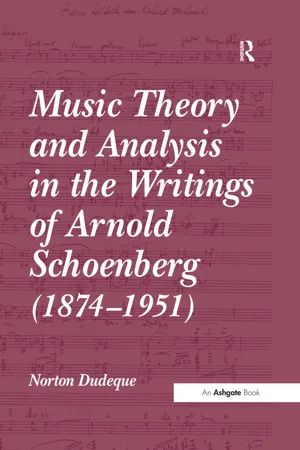
Music Theory and Analysis in the Writings of Arnold Schoenberg (1874-1951)
- 296 pages
- English
- ePUB (mobile friendly)
- Available on iOS & Android
eBook - ePub
Music Theory and Analysis in the Writings of Arnold Schoenberg (1874-1951)
About this book
Arnold Schoenberg's theory of music has been much discussed but his approach to music theory needs a new historical and theoretical assessment in order to provide a clearer understanding of his contributions to music theory and analysis. Norton Dudeque's achievement in this book involves the synthesis of Schoenberg's theoretical ideas from the whole of the composer's working life, including material only published well after his death. The book discusses Schoenberg's rejection of his German music theory heritage and past approaches to music-theory pedagogy, the need for looking at musical structures differently and to avoid aesthetic and stylistic issues. Dudeque provides a unique understanding of the systematization of Schoenberg's tonal-harmonic theory, thematic/motivic-development theory and the links with contemporary and past music theories. The book is complemented by a special section that explores the practical application of the theoretical material already discussed. The focus of this section is on Schoenberg's analytical practice, and the author's response to it. Norton Dudeque therefore provides a comprehensive understanding of Schoenberg's thinking on tonal harmony, motive and form that has hitherto not been attempted.
Information
Chapter 1
Some Aspects of Schoenberg’s Inheritance of Nineteenth-Century Music Theory
Introduction
Schoenberg belongs to a generation of musicians, of composers and theorists, who aspired to perpetuate the tradition of German and classical Viennese music. He laid claim to his position in the 1931 article 'National Music', in which he declared that his music 'produced on German soil, without foreign influences, is a living example of an art...derived through and through from the traditions of German music'. Later in the same text, he substantiated his rightful inheritance to the Austro-Germanic tradition by asserting that his teachers where 'primarily Bach and Mozart, and secondarily Beethoven, Brahms, and Wagner' (Schoenberg, 1975, p. 173).1 Schoenberg's declaration pertains to his compositional practice. Among his observations of what he claimed to have learnt from 'his teachers' are the techniques of phrase construction and phrase rhythm in the music of Mozart and Brahms, aspects not covered by the nineteenth-century theorists addressed here. For Schoenberg, the continuation of the tradition of tonal music provided a justification both for his own music and his wider evaluation of music. He believed that the mastery of the tonal language, ranging from Bach to Brahms and to his own compositions, could provide the necessary tools for the understanding of musical structure, and that this acquired knowledge would suffice for the individual expression in composition, and for the critical evaluation of music. As expected, music theory played a part in this picture because the understanding of the tonal repertoire depended on the knowledge of music theory. Similarly, Schoenberg's inheritance of nineteenth-century music theory granted a reaffirmation of his link to tradition. Schoenberg understood that this tradition endowed him with the necessary authority to assume a leading position in the teaching and in the aesthetic judgement of music. Thus, the aim of this chapter is to overview some aspects of Schoenberg's inherited music theory.
Music theory and analysis in the nineteenth century was characterized by the development of notions drawn from the previous century. One of the most fundamental conceptions was the identification of motive as the generator of larger formal structures. The predominant view expounded by eighteenth-century theorists, that the connection of phrases represented a structuring principle capable of producing larger formal structures (Baker, 1983, pp. 1-59; Bent, 1987, pp. 12-24; Lester, 1992, pp. 258-99), was substituted for a more detailed examination of musical structures. This way of looking at the musical surface resulted in the view that 'segmented "phrases" (Sätze) became "motifs" (Motive), [and] the fragmentation process came to be reinterpreted in organic terms' (Bent, 1994a, p. 23). A consequence of such motivic thinking was the increasing tendency to systematize musical form. The resulting theoretical-analytical approach has been related to an organicist view of the musical structure, a view which had already become popular among theorists at the beginning of the nineteenth century. Lichtenthal, for example, expressed this notion in his Dizionario of 1826, in which he wrote about unity in music:
Unity is the foremost of the two great principles upon which harmony depends, not only in music but in all the arts.
Without unity there is neither sound, concord, cadence, phrase, period nor any kind of music. Given unity and variety, all is well with the arts and with each of their respective parts. The man of genius must constantly keep these two in balance.
The rule that prescribes that there shall be one plot and that interest shall constantly focus upon one object is perfectly applicable to musical compositions. One musical theme can suffice to make an entire symphony...Amongst the works of the great masters may be found innumerable pieces that are built upon a single motif. What marvellous unity there is in the structure of these compositions! Everything relates to the subject: nothing extraneous or inappropriate is there. Not a single link could be detached from the chain without destroying the whole. Only the man of genius, only the learned composer can accomplish such a task, one that is as admirable as it is difficult...(Lichtenthal, 1826, pp. 276-7).2
This perception of structural unity may be observed in Schoenberg's analytical theories. By the turn of the century, Gestalt psychology became prominent and emphasized that 'wholes' and structures could not be broken down into smaller elements and that the perception of these wholes is based on similarity and contrast. In Schoenberg's case, the influence of the Gestaltists is most perceptible in the Gedanke manuscript of the 1930s, in which he often speaks of the whole idea of a composition. However, this whole structure may be partitioned into smaller elements which together produce sense of form. To achieve this impression, Schoenberg laid down several 'Laws of Comprehensibility' for a general principle: 'remembering is based on recognition and rerecognition' and 'recognition is thus based on experience and on comparison' (Schoenberg, 1995, p. 131; and p. 145).3 Finally, as regards Schoenberg's theoretical writings, two most prominent inherited influences will be briefly discussed. These are focused on the theories of A. B. Marx and Simon Sechter.
Schoenberg and Marx—Form
Schoenberg's projected Formenlehre, unfortunately never completed, involves more than the descriptive approach outlined in Fundamentals of Musical Composition. The incomplete Gedanke manuscript, along with the 1917 Zusammenhang, Kontrapunkt, Instrumentation, Formenlehre text, attempt to elucidate the musical logic behind the idea of the presentation of form. Schoenberg's assessment of this presentation is expressed in terms of the goal of instruction in form, which is 'to offer, in integrated presentation, an optimally large number of proven principles of application and diagrams of form, based on the most general possible principles, suitable for use in creating forms of the smallest to the largest size' (Schoenberg, 1994, p. 103). However, the distinction between a pedagogical presentation and the means to achieve comprehensibility and coherence in musical form is an important argument for Schoenberg.
The tradition of Formenlehre, established by the middle of the nineteenth century, produced a series of treatises which are concerned mainly with the instruction of form in the teaching of musical composition.4 Despite this main concern, tonality was not discarded and many examples included in these treatises approached the harmonic language of the Viennese classical composers. By the late nineteenth and early twentieth century, a change in the approach devoted to form was introduced in the works of Prout and Leichtentritt. They approached form from an analytical perspective, differing from the previous prescriptive practice-manuals for students of composition. Schoenberg's Fundamentals of Musical Composition is a treatise that follows both trends. On one hand, it is concerned with instruction for students of composition, and on the other, it is concerned with music analysis.
A central figure in the teaching of form during the nineteenth century was A. B. Marx.5 Fundamental to Marx's notion of form is an idea, related to the perception of the dynamics of form, which is expressed in the general notion of rest–motion–rest. For Marx, this idea is already present in the diatonic scale. He explains that the tonic is 'the starting-sound and final resting of the tonal motion'. After its first appearance, and if the tonic is followed by a succession of other sounds, it will represent motion. 'And thus our first and most simple succession represents the intervals of
Rest—Motion—Rest,
which constitute the basis of all musical forms' (Marx, 1852, p. 19). This general idea is the fundamental tenet upon which Marx's treatise is grounded; musical elements such as the motive and the Satz depend upon the intervals of 'Rest—Motion—Rest'. Marx identifies two fundamental forms in music: Satz, and the Gang. From these structures, or from their combination, emerges form in music. The Satz represents a closed thought, a complete structure, which expresses the initial and closing tonic (Marx illustrates this with the diatonic scale in C major: c1–d1–s1–f1–g1–a1–b1–c2). Fischer observes that the Satz possesses a dynamic quality for Marx; it calls forth a second Satz to follow it, implying a continuation (Fischer, 1991, pp. 40-3). For instance, if the Satz is combined with a contrasting or opposing unit, the Gegensatz, both form the period, which is subsequently classified as an antecedent [Vordersatz], ending with a half-cadence, and a consequent [Nachsatz], ending in a full-cadence. The period is therefore characterized by closure. Conversely, the Gang does not have formal definition; it neither represents a complete idea nor does it end on the tonic (Marx, 1997, pp. 42-5 ['Die Form in der Musik', 1856]).
The next element in Marx's presentation is the motive. He explains that 'such a group of two, three, or more sounds, serving as the type or model for more extended tonal successions, forms the nucleus or germ from which the latter develop themselves, and is termed a motivo, or motive' (Marx, 1852, p. 27). The motive is subordinate to the formal categories of Satz and Gang; it is nonetheless also considered to be a primal element. Marx works out motivic elaboration in order to give shape to the Satz, period, etc. He starts with the ascending second, c1–d1, which can be transposed, retrograded, and rhythmically diminished or augmented (ibid: p. 28). From these definitions of the small elements of form, Marx introduces harmony and begins to build up larger structures, from the eight-bar to sixteen-bar periods, and from these to binary and ternary Liedform. According to Burnham, the climax of this process of building forms is achieved in the sonata form (Burnham, 1989, pp. 258-9). For Marx, the great advance of sonata form is the developmental second section, which allows the thematic material to be developed from the preceding Sätze. He states that 'the sonata form constructs its second part out of events from the first part, from the main Satz, the subsidiary Satz, or the closing Satz, or from the two of the above, or from all of them' (Marx, 1997, pp. 82-3). The sonata form therefore represents the apex of an organic approach to musical form.6
The overall idea for Marx was that form is generated from the small elements. Marx may have been the first to explicitly adopt this notion in an analogy to Goethe's Morphologie ([1807] 1817) and Metamorphose der Pflanzen (1790). On the whole, the idea considers that innumerable life-forms are metamorphoses of a limited number of archetypes; in this case, each archetype generates a group of animals or plants. This holistic view of the evolution of life-forms influenced Marx, who understood the initial musical thought to be the motive. For him, 'the motive is the primal configuration [Urgestalt] of everything musical, just as the germinal vesicle, that membranous sac filled with some fluid element (or perhaps with solid bodies), is the primal configuration of everything organic – the true primal plant or primal animal' (Marx, 1997, p. 66 ['Die Form in der Musik', 1856]). Such notions of organic growth may also suggest an approximation to Schoenberg's notions of form and to the function of Grundgestalt. Schoenberg's equivalent notion which claims that a 'basic motive is often considered the 'germ' of the idea' (Schoenberg, 1967, p. 8) is similarly organic in its approach to musical form.7 In fact, Marx's influence on Schoenberg is reflected not only in such general notions as the growth of form from a motive, but also in the systematic presentation of a theory of form.
Schoenberg adopts two normative archetypes for small musical structures, namely the sentence and the period. These provide a framework for the presentation of a musical idea. They have a clearly defined construction and are left open enough in their conception to accommodate a great range of 'exceptions to the rule'; that is, the many possible variations in their 'practice forms' or ideal forms. Such structures indicate that Schoenberg aimed at a general principle, in which paradigmatic forms act in the presentation of musical ideas. Schoenberg influenced his disciples. For instance, Webern addresses the issue in a similar way in The Path to the New Music. In this work, he illustrates the structures in a broad range of examples from Gregorian Chant to Schoenberg's music. Webern points out that 'these two forms are the basic el...
Table of contents
- Cover
- Half Title
- Dedication
- Title
- Copyright
- Contents
- List of Examples
- List of Figures and Table
- Preface
- Acknowledgements
- Note
- Introduction
- 1 Some Aspects of Schoenberg's Inheritance of Nineteenth-Century Music Theory
- 2 Speculative and Polemical Contents in Schoenberg's Tonal Theory
- 3 A Contribution towards a Systematic Presentation of Tonal Harmony
- 4 A Contribution towards a Systematic Presentation of the Technique of Thematic Development
- 5 Analyses
- 6 Concluding Remarks
- Glossary of Terms
- Bibliography
- Index
Trusted by 375,005 students
Access to over 1.5 million titles for a fair monthly price.
Study more efficiently using our study tools.
Frequently asked questions
Yes, you can cancel anytime from the Subscription tab in your account settings on the Perlego website. Your subscription will stay active until the end of your current billing period. Learn how to cancel your subscription
No, books cannot be downloaded as external files, such as PDFs, for use outside of Perlego. However, you can download books within the Perlego app for offline reading on mobile or tablet. Learn how to download books offline
Perlego offers two plans: Essential and Complete
- Essential is ideal for learners and professionals who enjoy exploring a wide range of subjects. Access the Essential Library with 800,000+ trusted titles and best-sellers across business, personal growth, and the humanities. Includes unlimited reading time and Standard Read Aloud voice.
- Complete: Perfect for advanced learners and researchers needing full, unrestricted access. Unlock 1.5M+ books across hundreds of subjects, including academic and specialized titles. The Complete Plan also includes advanced features like Premium Read Aloud and Research Assistant.
We are an online textbook subscription service, where you can get access to an entire online library for less than the price of a single book per month. With over 1.5 million books across 990+ topics, we’ve got you covered! Learn about our mission
Look out for the read-aloud symbol on your next book to see if you can listen to it. The read-aloud tool reads text aloud for you, highlighting the text as it is being read. You can pause it, speed it up and slow it down. Learn more about Read Aloud
Yes! You can use the Perlego app on both iOS and Android devices to read anytime, anywhere — even offline. Perfect for commutes or when you’re on the go.
Please note we cannot support devices running on iOS 13 and Android 7 or earlier. Learn more about using the app
Please note we cannot support devices running on iOS 13 and Android 7 or earlier. Learn more about using the app
Yes, you can access Music Theory and Analysis in the Writings of Arnold Schoenberg (1874-1951) by Norton Dudeque in PDF and/or ePUB format, as well as other popular books in Media & Performing Arts & Music. We have over 1.5 million books available in our catalogue for you to explore.