eBook - ePub
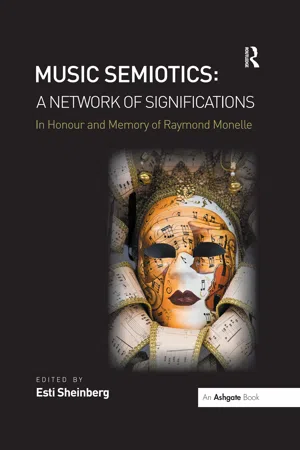
Music Semiotics: A Network of Significations
In Honour and Memory of Raymond Monelle
- 366 pages
- English
- ePUB (mobile friendly)
- Available on iOS & Android
eBook - ePub
About this book
United in their indebtedness to the scholarship of Raymond Monelle, an international group of contributors, including leading authorities on music and culture, come together in this state of the art volume to investigate different ways in which music signifies. Music semiotics asks what music signifies as well as how the signification process takes place. Looking at the nature of musical texts and music's narrativity, a number of the essays in this collection delve into the relationship between music and philosophy, literature, poetry, folk traditions and the theatre, with opera a genre that particularly lends itself to this mode of investigation. Other contributions look at theories of musical markedness, metaphor and irony, using examples and specific musical texts to serve as case studies to validate their theoretical approaches. Musical works discussed include those by Haydn, Mozart, Beethoven, Schumann, Wagner, Stravinsky, Bart Xenakis, Kutavicius and John Adams, offering stimulating discussions of music that attest to its beauty as much as to its intellectual challenge. Taking Monelle's writing as a model, the contributions adhere to a method of logical argumentation presented in a civilized and respectful way, even - and particularly - when controversial issues are at stake, keeping in mind that contemplating the significance of music is a way to contemplate life itself.
Information
Chapter 1
Introduction
Esti Sheinberg
Viktor Frankl’s groundbreaking research into the Self is published in English under the title Man’s Search for Meaning.1 Its original title,…trotzdem Ja zum Leben sagen is, nevertheless, more telling about this painfully meticulous portrayal of a persistent quest. This description of a psychological struggle with suffering, its transcendence and final transfiguration into a renewed and courageous existential stance, produced a new term: Logotherapy – healing by meaning.
We live in a universe of meanings that we create and according to which we live. Paraphrasing Frankl, our life depends on our constantly challenging these meanings with questions, interpretations and analyses, all surrounded by infinite doubts. Certainties divide humankind; questions unite us. The constant search for signification, the very process of inquiry, makes our existence intentional – and therefore meaningful.
The Universe of Musical Meaning
The area of meaning that the writers of this collection address is music, and the most important element that unites them all is their indebtedness, in one way or another, to the scholarship of Raymond Monelle. Were it not for the risk of being deemed banal (and lacking in keywords for search engines), this book could be titled The Posthumous Papers of the Dr Strabismus of Utrecht (whom God preserve) Club. Such title would honour Raymond Monelle’s literary persona,2 his love for Charles Dickens and his rare gift of combining earnest (and razor-sharp unforgiving) analyses with a self-ironizing Doppelgänger’s gaze at his own work. Indirectly, it would also allude to his diverse taste and overwhelming knowledge of literature, philosophy, history, art and music; in other words, of his being, first and foremost, a truly open-minded scholar.
In an academic world divided by findings, Raymond Monelle cherished search. His relentless study, scholarly integrity and unfashionable insistence on a civilized, respectful discourse inspired a generation of scholars. His courage to contemplate music as a signifying system reminded us of the true meaning of our own work, and his admirable determination to calmly stare into the abyss of music’s ‘absent meaning’3 became thus a lesson in confronting Life.
Monelle’s articles often started with a faint spotlight – a teaser, maybe – directed at some obscure corner of a musical work, a ‘something’ that no one had noticed before, mainly because it was, well, obvious. However, the narrow beam implied, this particular little detail did not quite fit in, was not quite right. Once defamiliarized, the specific element, née Obvious, became Fascinating, a starting point for a new Thinking-Adventure. Reading his work meant engaging in an exciting game in which he was the Magister Ludi, the one who juggled the ever-moving, ever-changing spaces that weave the endless glass-beads of human thought. Never underestimating his readers, he built his story, developing a characteristically transparent narrative of the inquiry, and inviting us to a mental dialogue that offered no intellectual concession. This volume presents some phases of this dialogue.
Texts
The original subtitle of this collection was Texts on Music Semiotics. Borrowed from one of Monelle’s most intricate essays, it highlighted a main keyword of his scholarship.4 To understand the nature of a musical text, he argued, one must first define what is a text. Puzzled by this ostensibly simple concept and inspired by French-thinking inquisitive minds such as Rousseau, Derrida and Tintin5 – Monelle investigated the nature of texts in literature, poetry and music, and of music texts set to literature and poetry. His early thesis was written precisely on this relationship,6 and many of his later projects display this interest. Even his earliest paper, on Bartók’s purely instrumental Fourth String Quartet, focused on the meaningfulness of its musical structure.7
What is a text? ‘A text is a semiosis, something understood’.8 A score can become a musical text ‘not as performed, but as understood, its dialectics [between the signifier and signified – ES] resolved into intelligibility’.9 A text is not a thing; it is an interpretant, a part of a process. It exists only when interpreted. The book you hold is not a text; it becomes one only when it is read and understood.
Furthermore: a text is never a text. While its existence requires the meeting of two minds – the originator of a message and its reader (or, as all of us well know, the two minds of one originator) – any one message can become an infinite number of texts, interpretants produced by semiotic processes, tied by an infinite number of threads to an infinite number of other texts and other minds. A message is a promise for an ever-expanding web of possible significations: of perpetual, eternal semiosis, connecting between periods, places and people. Texts are communications between human minds, ad infinitum renewed and renewable.
Theory
The theory of semiotics stipulates the principles of signification. Monelle positions it at one pole of two different oppositions: in the first, it opposes all particular manifestations of readings, performances, or texts. Semiotics is a theory, and therefore it does not necessarily prescribe any particular method of communication or of sign reading. Unlike hermeneutics or any other type of interpretation, semiotics does not look at what is signified as much as it looks at how the signification process takes place.
The second opposition differentiates semiotics from any set of principles that carry value judgments. ‘Semiotics is innocent’: its queries and statements follow no ideology, no agenda. Therefore, ‘semiotics threatens no one’.10 As a theory, argues Monelle, semiotics is based on speculative and deductive thought rather than on inductive processes that characterize, for example, psychology, history or sociology. Examples and particular texts serve as case studies to validate and corroborate (or refute) its stipulations, which must remain clear of any a-priori values.
Being a series of principles that offer explanations for the phenomenon of signification, the semiotics of music explains how music signifies. While the phenomenon of music signification is intuitively familiar to each one of us, the theoretical basis on which its principles, ideas and postulates, as well as the criteria for their formation into sets or schemes, is still unfinalized, forming the subject of our quest for accurate definitions and lucid descriptions.
While our conviction that music signifies is indeed primarily based on intuition and observation, theoretical thought must be verified through critical processes, making sure that the principles of accuracy, impartiality and transparency are respected and followed at each step. Each point must – and should – be debatable. While acknowledging that no eye – and no mind – is innocent, the fact that no Grail of Innocence awaits us at the end of this road does not invalidate what this quest stands for. Insisting on scholarly rigour keeps us from falling into the deepest (and most cynically abused) pit of postmodern theory: the false claim that ‘anything goes since everything is just an interpretation’. Our research is geared precisely against entering that tempting comfort-zone; our strategy is based on the ethos of rationality.
Reading and writing semiotics is a merciless enterprise, particularly when the writers are, first and foremost, musicians. Focusing on facts and ideas, we are called to set aside our opinions, feelings, natural prejudices, and any immediate ‘gut reactions’ we were trained to trust in our musical encounters. Being open to discussion and to criticism is, therefore, a main postulate of this collection. The only way in which we can hone our analyses and improve our research is by exposing our thoughts and deliberations to comments and constructive criticism. In a field that is murky with overlapping and confusing terminologies, our aim is clarity of expression and thought.
Networks
Meaning is intermodal. The simplest pairing of a signifier and signified, inherent in the very idea of a sign, implies a web of inter-systemic correlations. As systems complicate, inter-systematic correlations become interdisciplinary networks. Being aural sign-systems that develop in time, musical works are by their very nature interconnected with other systems: dramatic, political and social narratives, historical contexts and rhetorical devices. Ignoring that music semiotics is based on intermodality necessarily misleads music interpretation. If a text is ‘something that is understood’, then all the chapters in this volume are not only intermodal but also intertextual. Musicians writing about music need to be acquainted not only with literature, mythology, poetry, art and history, which so often are an inseparable part of a musical work, but also with a quite expansive array of philosophical, theological, psychological, linguistic and sociological studies. Monelle wrote on works by Bach, Barthes, Bartók, Baudelaire, Debussy, Derrida, Greimas, Jakobson, Mahler, Maxwell-Davies, Metastasio, Molino, Nattiez, Peirce, Schumann, Tchaikovsky, Wagner and Žižek – to mention only a few. We write about music and poetry and learn about the connection between music and movement while wondering about the relationship between music and facial expressions. We engage in the study of opera, literature, mathematics, history, zoology, computers, film and what not, looking for ways in which these systems of signification might relate to ours. Led by the nature of music no less than by our – slightly arrogant, let’s admit – curiosity, we tend to roam through various fields of inquiry. More often than not, we are lucky and grateful to encounter sympathetic minds, our own Virgils and Beatrices.
The interrelationship between music and literature was among the first to be explored in studies of music signification. Its centuries-old roots lie in poetic verse theories, but the evolution of these studies ‘from so simple a beginning’ (as Darwin might have said), is staggering. Monelle’s interest in the dramatic power of music expanded to its relation to lyrical poetry; his later writings are often related to music’s own semantic meaning, but never neglect the manifold interconnections of music with the literary arts.11 Meanwhile, Grabócz and Tarasti developed studies of music’s narrativity, based on literary theories of Greimas and Propp.12 Other studies, like those by Hatten, Spitzer and myself, focused on specific areas of the intermodal semantic universe: theories of mus...
Table of contents
- Cover
- Half Title
- Title Page
- Copyright Page
- Table of Contents
- List of Figures
- List of Tables
- List of Music Examples
- Notes on Contributors
- Foreword by Eero Tarasti
- Preface
- Chapter 1. Introduction
- Part I. The Universe of Musical Meaning
- Part II. Texts: Narrativities and Intermodalities
- Part III. Networks: Who Signals What (And How?)
- Part IV. The Musical Topic: Beyond Conventions
- Tributes
- Bibliography
- Index of Concepts
- Index of Names
Trusted by 375,005 students
Access to over 1.5 million titles for a fair monthly price.
Study more efficiently using our study tools.
Frequently asked questions
Yes, you can cancel anytime from the Subscription tab in your account settings on the Perlego website. Your subscription will stay active until the end of your current billing period. Learn how to cancel your subscription
No, books cannot be downloaded as external files, such as PDFs, for use outside of Perlego. However, you can download books within the Perlego app for offline reading on mobile or tablet. Learn how to download books offline
Perlego offers two plans: Essential and Complete
- Essential is ideal for learners and professionals who enjoy exploring a wide range of subjects. Access the Essential Library with 800,000+ trusted titles and best-sellers across business, personal growth, and the humanities. Includes unlimited reading time and Standard Read Aloud voice.
- Complete: Perfect for advanced learners and researchers needing full, unrestricted access. Unlock 1.5M+ books across hundreds of subjects, including academic and specialized titles. The Complete Plan also includes advanced features like Premium Read Aloud and Research Assistant.
We are an online textbook subscription service, where you can get access to an entire online library for less than the price of a single book per month. With over 1.5 million books across 990+ topics, we’ve got you covered! Learn about our mission
Look out for the read-aloud symbol on your next book to see if you can listen to it. The read-aloud tool reads text aloud for you, highlighting the text as it is being read. You can pause it, speed it up and slow it down. Learn more about Read Aloud
Yes! You can use the Perlego app on both iOS and Android devices to read anytime, anywhere — even offline. Perfect for commutes or when you’re on the go.
Please note we cannot support devices running on iOS 13 and Android 7 or earlier. Learn more about using the app
Please note we cannot support devices running on iOS 13 and Android 7 or earlier. Learn more about using the app
Yes, you can access Music Semiotics: A Network of Significations by Esti Sheinberg in PDF and/or ePUB format, as well as other popular books in Media & Performing Arts & Ethnomusicology. We have over 1.5 million books available in our catalogue for you to explore.