eBook - ePub
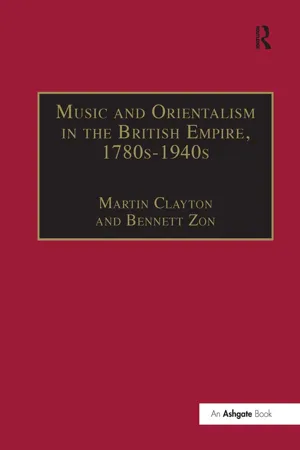
Music and Orientalism in the British Empire, 1780s–1940s
Portrayal of the East
- 368 pages
- English
- ePUB (mobile friendly)
- Available on iOS & Android
eBook - ePub
Music and Orientalism in the British Empire, 1780s–1940s
Portrayal of the East
About this book
Filling a significant gap in current scholarship, the fourteen original essays that make up this volume individually and collectively reflect on the relationship between music and Orientalism in the British Empire over the course of the long nineteenth century. The book is in four themed sections. 'Portrayal of the East' traces the routes from encounter to representation and restores the Orient to its rightful place in histories of Orientalism. 'Interpreting Concert Music' looks at one of the principal forms in which Orientalism could be brought to an eager and largely receptive - yet sometimes resistant - mass market. 'Words and Music' investigates the confluence of musical and Orientalist themes in different genres of writing, including criticism, fiction and travel writing. Finally, 'The Orientalist Stage' discusses crucial sites of Orientalist representation - music theatre and opera - as well as tracing similar phenomena in twentieth-century Hindi cinema. These final chapters examine the rendering of the East as 'unachievable and unrecognizable' for the consuming gaze of the western spectator.
Information
PART I
Portrayal of the East
Chapter 1
Encountering the Other,
Redefining the Self: Hindostannie Airs,
Haydn’s Folksong Settings and the
‘Common Practice’ Style
Nicholas Cook
I
The work of Gerry Farrell and Ian Woodfield has put the ‘Hindostannie air’ (to adopt one of its many spellings) firmly on the musicological map, so my outline of it can be brief. It had its origins in the special political circumstances of the kingdom of Oudh, on the borders of Nepal and now part of Uttar Pradesh, which favoured cultural and social interaction between British and Indians: in the words of Warren Hastings, the first Governor-General of India, ‘every accumulation of knowledge, and especially such as is obtained by social communication with people over whom we exercise a dominion founded on the right of conquest, is useful to the state’.1 In the case of music such interaction focused round Indian dancing groups which were invited into Anglo-Indian (one should really say British-Indian) homes, and which included such charismatic singers as Khanam, in Captain Thomas Williamson’s words ‘a haughty, ugly, filthy black woman [who] could solely by the grace of her motions, and the novelty of some Casmerian airs, hold in complete subjection, and render absolutely tributary, many scores of fine young British officers!’2
But what specifically gave rise to the Hindostannie air was a desire on the part of some — largely female — colonials to transcribe these songs for Western instruments. Special transcription sessions took place in Anglo-Indian homes, with the use of a harpsichord or pianoforte as transcription aid; Margaret Fowke, the daughter of the diamond merchant and amateur violinist Joseph Fowke,3 made her own transcriptions, but usually a professional musician was employed for the purpose. (Margaret Fowkes’s friend Sophia Plowden employed a musician called John Braganza.4) Once transcribed, the music was developed into a performable form through the addition of an accompaniment, and such performances became a feature of Anglo-Indian society. Hastings himself sang them, but the best known performer was Plowden, who had her manuscript collection of Hindostannie airs handsomely bound, together with illustrations of Indian instruments by local artists, in which form they became a souvenir of the colonial experience.5 Plowden’s collection was never published, but others were, the most important being William Hamilton Bird’s Oriental Miscellany (published in Calcutta in 1789),6 on which subsequent collections — mainly published in London — largely drew.
My focus in this chapter is on the nature of the cross-cultural encounter of which the Hindostannie air is the trace, and its relationship to the ‘common practice style’ (hereafter CPS) of European music at the turn of the nineteenth century. Farrell describes the Hindostannie air as ‘an illustration of the way in which music functioned as a bridge between cultures’, yet his emphasis is on what he calls the ‘one-way process’ through which any distinctively Indian features were ‘drawn into, and finally submerged by’, the CPS. Not only does Western notation ‘discipline’ Indian music, he says, but in the transmission of the airs through successive publications ‘melodic identity is sacrificed to harmonic sophistication’, with the Indian element becoming no more than a series of ‘surface features’.7 This formulation highlights the organicism inherent in the conception of the CPS: one might say that the process traced by Farrell is one in which the foreign element migrates upwards within the musical fabric, leaving the underlying, structural identity of the CPS unaffected. It makes sense then to see the set of ‘surface features’ that, by the end of the nineteenth century, had congealed into a musical lexicon of alterity (modality, pentatonic/gapped scales, parallel fourths/fifths, augmented seconds, and so on) as perfectly adapted to add decorative colour without impacting on the thoroughly Western structure beneath. Understood this way, non-Western musical styles are not so much translated into as appropriated by the CPS: the Hindostannie air becomes an early exercise in orientalist representation.
The classic statement of the idea of musical representation is in Mozart’s letter to his father about Osmin’s first aria in Die Entführung aus dem Serail (’music, even in the most horrifying situation, must never offend the ear, but must actually please, and consequently remain music’).8 But its application to the Hindostannie air of course reflects the model of cross-cultural encounter adumbrated by Edward Said, according to which the representation of the other must be understood in terms of the logic of the self: ‘Orientalism’, Said says, ‘deals not with a correspondence between Orientalism and the Orient, but with the internal consistency of Orientalism’, and again, it is ‘a closed system, in which objects are what they are because they are what they are, for once, for all time, for ontological reasons that no empirical material can either dislodge or alter’.9 As is well known, Said’s Orientalism initiated a major debate among writers on postcolonialism, many of whom criticized his model for its rigidity and insensitivity to historical change,10 but in musicology the Saidian model has more often than not been accepted without demur, and widely read texts such as Derek Scott’s From the Erotic to the Demonic have presented it more or less as an orthodoxy.11 The result has been a deflection of emphasis from the empirical dimension of cross-cultural encounters: ‘attempts to relate musical Orientalism to techniques of non-Western music’, Matthew Head writes, ‘are a relatively minor, and potentially misleading and obfuscating, line of enquiry within the broader context of studies of Orientalism’.12
The suspicion of cross-cultural understanding that characterizes what I shall term the received Saidian model (RSM) emerges with particular clarity from Said’s later book Musical Elaborations, in which he writes that music is just one of the means by which the West fortified itself ‘against change and a supposed contamination brought forward threateningly by the very existence of the Other. In addition, such defensiveness permits a comforting retreat into an essentialized, basically unchanging Self’.13 (It is no wonder A.L. Macfie comments that by ‘essentializing the West, as a hermetically sealed and stereotypical culture, [Said] makes the promotion of cross-cultural awareness … theoretically impossible’.14) Such suspicion reflects more general doubts about the relationship between self and other. Within the broad Hegelian tradition where the terminology of ‘self’ and ‘other’ originates, HansGeorg Gadamer claims of both interpersonal and cross-cultural relationships that ‘hermeneutics bridges the distance between minds and reveals the foreignness of the other mind’, and reciprocally that ‘Self-understanding always occurs through understanding something other than the self’; as Jeff Warren puts it, ‘understanding the Other is understanding the self’. But Gadamer is opposed by Emmanuel Levinas, for whom hermeneutics ‘allows the approach of the Other but then appropriates the Other to the same’: for Levinas, then, Gadamer’s ‘fusion of horizons’ cannot but be an imposition of the self in disguise, corresponding to Saidian appropriation.15 If then one starting point for this chapter is the wish to put forward an alternative to the pessimistic view of cross-cultural encounters embodied in the RSM, another arises from the interpretation of such encounters in terms of the lexicon of alterity to which I referred. It is fundamental to the RSM that ‘Orientalist styles have related to previous Orientalist styles rather than to Eastern ethnic practices’, but of course this begs the question of where such styles came from: as Scott goes on to say, the purpose of orientalist music ‘is not to imitate but to represent’,16 yet it would surely be perverse to maintain that the lexicon of alterity had no source in imitation. In this way the RSM stands in need of supplementation by a model of the encounter between cultures that has the empirical grounding which the RSM undercuts.
There is of course a chronological issue here. Said explicitly defines orientalism as having begun in the late eighteenth century — or at any rate he sometimes does so17 — but as many critics (in particular John MacKenzie) have observed, the RSM is often applied without historical discrimination. An admittedly early study by Richard Leppert of Anglo-Indian domestic life begins historically enough by citing the appointment in 1786 of Cornwallis, in succession to Hastings, and his exclusion of Indians from all senior governmental posts, which — in Leppert’s words — ‘struck a fatal blow … to racial understanding and cooperation’.18 But then Leppert seems to forget about his chronology. His principal exhibit is a painting by the then Lucknow-based painter Zoffany (who also painted Khanam19) of an Anglo-Indian family grouped round that prime symbol of Western domestic culture at the end of the eighteenth century, a harpsichord: as Leppert observes, there is nothing in the painting to disclose the Indian location. Leppert’s argument leads to far-reaching conclusions regarding music’s complicity in the colonial ideology that grounded orientalism: ‘music’s role’, he writes, ‘is limited to that o...
Table of contents
- Cover
- Half Title
- Title Page
- Copyright Page
- Table of Contents
- List of Figures and Tables
- List of Music Examples
- Notes on Contributors
- General Editor’s Series Preface
- Introduction
- I PORTRAYAL OF THE EAST
- II INTERPRETING CONCERT MUSIC
- III WORDS AND MUSIC
- IV THE ORIENTALIST STAGE
- Index
Trusted by 375,005 students
Access to over 1.5 million titles for a fair monthly price.
Study more efficiently using our study tools.
Frequently asked questions
Yes, you can cancel anytime from the Subscription tab in your account settings on the Perlego website. Your subscription will stay active until the end of your current billing period. Learn how to cancel your subscription
No, books cannot be downloaded as external files, such as PDFs, for use outside of Perlego. However, you can download books within the Perlego app for offline reading on mobile or tablet. Learn how to download books offline
We are an online textbook subscription service, where you can get access to an entire online library for less than the price of a single book per month. With over 1.5 million books across 990+ topics, we’ve got you covered! Learn about our mission
Look out for the read-aloud symbol on your next book to see if you can listen to it. The read-aloud tool reads text aloud for you, highlighting the text as it is being read. You can pause it, speed it up and slow it down. Learn more about Read Aloud
Yes! You can use the Perlego app on both iOS and Android devices to read anytime, anywhere — even offline. Perfect for commutes or when you’re on the go.
Please note we cannot support devices running on iOS 13 and Android 7 or earlier. Learn more about using the app
Please note we cannot support devices running on iOS 13 and Android 7 or earlier. Learn more about using the app
Yes, you can access Music and Orientalism in the British Empire, 1780s–1940s by Bennett Zon, Martin Clayton in PDF and/or ePUB format, as well as other popular books in Media & Performing Arts & Classical Music. We have over 1.5 million books available in our catalogue for you to explore.