- 376 pages
- English
- ePUB (mobile friendly)
- Available on iOS & Android
eBook - ePub
About this book
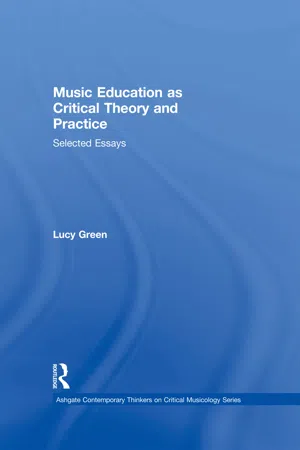
This collection of previously published articles, chapters and keynotes traces both the theoretical contribution of Lucy Green to the emergent field of the sociology of music education, and her radicalhands-on practical work in classrooms and instrumental studios. The selection contains a mixture of material, from essays that have appeared in major journals and books, to some harder-to-find publications. It spans issues from musical meaning, ideology, identity and gender in relation to music education, to changes and challenges in music curricula and pedagogy, and includes Green's highly influential work on bringing informal learning into formal music education settings. A newly-written introduction considers the relationship between theory and practice, and situates each essay in relation to some of the major influences, within and beyond the field of music education, which affected Green's own intellectual journey from the 1970s to the present day.
Information
Part One
Music Education as a
Reproductive Force – Ideology,
Musical Meaning, Social Groups
and Identity
CHAPTER 1
To construe and to construct... what do we mean by ‘the sociology of music education’, and what’s the point of it anyway?
Introduction
This chapter was originally delivered as a keynote address to the Sixth International Symposium on the Sociology of Music Education (SoME) at the University of Limerick, Eire in 2009. The biannual meeting of SoME reflects an increasing interest in sociological analyses of music education, an interest which has spread over the last few decades, from the early visionary work of Small (1977), Vulliamy (1977a and b), Vulliamy and Shepherd (1984), Shepherd & Vulliamy (1994), to that of more recent scholars such as Froelich (2007) and Wright (2010), to name only a few. Today, sociological investigations of music education are adding new dimensions to the already-existing, and much greater amount of music-education research which has traditionally taken a philosophical, and in the last hundred years, a psychological lens to the subject. Whilst the discipline of sociology itself has antecedents in the 18th century, the sociology of education in the 19th century, and the sociology of music rather more so in the 20th century, the sub-discipline of the sociology of music education is newer still – newer even than the sociology of rock, a field that was galvanised in 1978 by the publication of Simon Frith’s first book, which carried that title. In fact the actual phrase ‘the sociology of music education’, quite common now amongst those interested in the field, barely existed only 20 years ago.
In this chapter I would like to address the question of what is meant by ‘the sociology of music education’, and what, I believe, ought to be meant. As a part of this I will briefly consider what the group of people who attended SoME may collectively mean, or have meant, by the term, according to the topics in the 80 or so abstracts that were submitted, in the English language from many countries across the world. A crucial issue to which I will turn at the end is: what is the point of doing research in the sociology of music education?
What is meant by ‘the sociology of music education’?
In considering what is meant by a term, we necessarily come across the question of how it differs from other similar or cognate terms. So, how does the sociology of music education differ from, say, the psychology and social psychology of music education; ethnomusicology; the philosophy of music education; and the history of music education? Which also brings in the question – what does our field have in common with those fields? And then again, we need to ask – how is our sub-discipline related to its parent discipline of sociology itself; and within that, on one hand, to the sociology of music, and on the other hand, to the sociology of education. It is helpful to start by stripping away both the concept of ‘music’ and the concept of ‘education’, so as to consider the main features of ‘sociology’, at an abstract, general level.
Sociology
Perhaps we could agree in broad terms that sociology is the study of:
- Relationships between people. This can be anything from large-scale macro-level relationships between classes or other social groups; to small-scale interpersonal relationships between members of a family or between say, teachers and learners in a classroom or instrumental studio, or members of a band in a rehearsal space.
- How those relationships become normal and institutionalised. By ‘normal’ I do not mean ‘natural’, but how they come to seem natural, and to be taken-for-granted. By ‘institutionalised’ I do not mean how they turn into bricks-and-mortar buildings such as schools, universities, hospitals and so on, although that is often an important part of the process of institutionalisation; but I am also referring to abstract institutions, which may or may not be associated with particular types of buildings, such as marriage.
- How those relationships and institutions help to reproduce the society along the same lines. That is, how they keep the society going, and how they help to ensure the continuation of the same relationships and institutions, and the same practices and values, from generation to generation. This can occur through taken-for-granted traditions, or through governmental policies specially designed to uphold old values and practices; and through the exercise of power by groups in whose interests it is to keep things the same.
- How those relationships and institutions help to revolutionise, or initiate change in the society. This can happen through bloody revolution or military coup; more peacefully through democratic processes leading to changes in governmental policy; or through technological, demographic and cultural changes of many different kinds.
Social Groups
As a major part of the above areas of enquiry, sociologists have considered the nature of social groups. Some of the most familiar and well-researched ones are of course, class, ethnicity and gender; but there are many more including age, religion, race, sub-culture, the family, and so on. Groups are bound to overlap each other – for example, within the middle class there are several different ethnic groups, and within each ethnic group there are likely to be many classes. At the level of the individual person, each person is bound to be a member of several different social groups. Some of these might conflict with each other – for example a person could live in a middle-class family home but be doing a working-class job; and some of them might change over time – for example a person may change their religion, move from one class to another, or even have a sex-change. The crucial thing is that it is impossible for any person to avoid belonging to a range of social groups. Even a person who is explicitly committed to a position of extreme individualism has acquired his or her individualist perspective through social interaction and membership of a variety of social groups, and will belong to some social groups whether they like it or not.
Social Groups and Music
So, how do the concepts of sociology and of social groups, so far, relate to music? One issue is that people in different social groups are liable to engage in different musical practices in relation to different kinds of music, or what I will call musical styles. For example in certain countries of the world, the majority of people who listen to Western classical music, are white, middle class and over the age of 35; most (but not all) rap artists and DJs are black, male and under 35; most (but not all) famous classical composers are, to use a cliché white, male and dead.
Even in these brief examples, I have referred to four social groups (race, social class, age and gender); and, as it happens, three musical practices (listening, performing and composing), and two styles of music (classical and hip-hop). Therefore I would now like to think about how social groups relate to musical practices.
The Social Organisation of Musical Practice
It can be helpful to break down the question of how social groups relate to musical practices, into three main areas. The first is musical production, that is, composition, performance, sound engineering and so on – including, incidentally, these practices when they take place in classrooms or other teaching-and-leaming contexts. Secondly we have distribution mechanisms and practices, such as retail of sound-recordings, TV, radio, music on the internet, live concerts, busking, sessions, religious ceremonies, or teaching. Thirdly there is consumption, or what is often referred to in the cultural field as reception. This includes how people use music, for example, by listening to recorded music in their homes, at work, in the car, on their iPods, radio or whatever medium; watching music programmes on TV; going to concerts, dancing to music; just hearing music played around and about; and also by teaching and learning.
At this point it may be helpful to distinguish between large-scale social groups and small-scale socio-musical groups, with respect to the practices of musical production, distribution and reception. As just one example, focussing on production: different social groups – for example classes, ethnic groups, gender groups, age groups, religious groups and so on – are characteristically involved in producing different types of music in different ways, depending of course on the historical era, geographical location and other contexts. At the same time, therefore, musical production throws up new socio-musical groups, such as performers, composers, recording engineers; as well as subgroups within each of these such as orchestral composers, songwriters, rock bands, orchestras; and within those, trumpeters, singers, sound engineers, or kids recording in their bedrooms. Of course these groups will characteristically be involved in different musical styles, and will often have quite specialised involvements in quite a limited number of styles. Although some musical producers, such as session musicians, might cut across several styles, few musicians are likely to be able to play across a really diverse range: say, Indian classical music and Western classical music and African and Gamelan music too.
That offers just one example, concerning only the category of production, of how large-scale social groups can interrelate with small-scale socio-musical groups, regarding a range of musical styles. Of course there are many other examples within the category of production; and then many more within the categories of distribution and reception too.
Musical Beliefs and Values
As I have already suggested, sociology not only considers social groups in relation to their practices, but it also considers the complex, sometimes contradictory, changeable and overlapping beliefs and values that the people in those complex, sometimes contradictory, changeable and overlapping social groups hold. Along with that area come questions about how people come to agree and disagree about their beliefs and values; and how they reproduce old beliefs and values, and produce new ones.
Any discussion of how something is valued tends to lead to distinctions between that which is valued, and that which is not valued. In a sense we could say that valuing actually produces distinctions, which is of course why the great French sociologist Bourdieu named one of his most important books by that title (1984). In music, most of the broad distinctions concern what we can generally term ‘musical style’, which is categorised by the music industry, education and several other social groups or institutions, into the main, broad categories of classical, popular, jazz, folk and traditional musics of the world, or ‘world music’. As with social groups, there are of course blurred boundaries, changes, and many overlaps and contradictions between these. Nonetheless, generally when considering what people believe about music and how they value music, the concept of musical style comes to the fore. This is because when we consider our beliefs and values about music we necessarily already start to make distinctions; and the distinctions we make are liable to include, somewhere in them, stylistic distinctions. This is the case whether we are distinguishing between large-scale styles, finer gradations within a style, or differences within the output of one band, performer, composer or whatever.
Not only is the concept of musical style brought into play, but when discussing issue...
Table of contents
- Cover Page
- Title Page
- Copyright Page
- Contents
- Music Education as Critical Theory and Practice
- Ashgate Contemporary Thinkers on Critical Musicology
- Acknowledgements
- Introduction
- List of Publications
- Acknowledgements
- Introduction
- List of Publications
- PART ONE MUSIC EDUCATION AS A REPRODUCTIVE FORCE – IDEOLOGY, MUSICAL MEANING, SOCIAL GROUPS AND IDENTITY
- 1. To construe and to construct... what do we mean by ‘the sociology of music education’, and what’s the point of it anyway? (2009)
- 2. Why ‘Ideology’ is Still Relevant for Critical Thinking in Music Education (2003)
- 3. Music Education, Cultural Capital, and Social Group Identity (2003/2011)
- 4. Musical Meaning and Social Reproduction: A Case for Retrieving Autonomy (2005)
- 5. Musical Identities, Learning and Education: Some Cross-cultural Issues (2012)
- PART TWO GENDER AND MUSIC EDUCATION
- 6. Music, Gender and Education: A Report on Some Exploratory Research (1993)
- 7. Gender Identity, Musical Experience and Schooling (2002)
- 8. The Emergence of Gender as an Issue in Music Education (1996)
- PART THREE ASSESSMENT AND CURRICULUM CONTENT IN MUSIC EDUCATION
- 9. The Assessment of Composition: Style and Experience (1990)
- 10. Music as a Media Art: Evaluation and Assessment in the Contemporary Classroom (2000)
- 11. From the Western classics to the world: secondary music teachers’ changing attitudes in England, 1982 and 1998 (2002)
- PART FOUR INFORMAL LEARNING AND THE MUSIC CLASSROOM
- 12. What Can Music Educators Learn from Popular Musicians? (2004)
- 13. Informal Learning in the Music Classroom: A Seven-Stage Program (2010)
- 14. Popular music education in and for itself, and for ‘other’music: current research in the classroom (2006)
- 15. Group cooperation, inclusion and disaffected pupils: some responses to informal learning in the music classroom (2008)
- 16. Teenagers, Musical Identity and Classical Music: The Classroom as a Catalyst
- PART FIVE AURAL LEARNING, INFORMAL LEARNING AND THE INSTRUMENTAL TEACHING STUDIO
- 17. Musical “learning styles” and “learning strategies” in the instrumental lesson: Some emergent findings from a pilot study (2012)
- 18. Informal Learning and Aural Learning in the Instrumental Music Lesson: A Research-And-Development Pilot Project (20 12)
- Name Index
Trusted by 375,005 students
Access to over 1.5 million titles for a fair monthly price.
Study more efficiently using our study tools.
Frequently asked questions
Yes, you can cancel anytime from the Subscription tab in your account settings on the Perlego website. Your subscription will stay active until the end of your current billing period. Learn how to cancel your subscription
No, books cannot be downloaded as external files, such as PDFs, for use outside of Perlego. However, you can download books within the Perlego app for offline reading on mobile or tablet. Learn how to download books offline
Perlego offers two plans: Essential and Complete
- Essential is ideal for learners and professionals who enjoy exploring a wide range of subjects. Access the Essential Library with 800,000+ trusted titles and best-sellers across business, personal growth, and the humanities. Includes unlimited reading time and Standard Read Aloud voice.
- Complete: Perfect for advanced learners and researchers needing full, unrestricted access. Unlock 1.5M+ books across hundreds of subjects, including academic and specialized titles. The Complete Plan also includes advanced features like Premium Read Aloud and Research Assistant.
We are an online textbook subscription service, where you can get access to an entire online library for less than the price of a single book per month. With over 1.5 million books across 990+ topics, we’ve got you covered! Learn about our mission
Look out for the read-aloud symbol on your next book to see if you can listen to it. The read-aloud tool reads text aloud for you, highlighting the text as it is being read. You can pause it, speed it up and slow it down. Learn more about Read Aloud
Yes! You can use the Perlego app on both iOS and Android devices to read anytime, anywhere — even offline. Perfect for commutes or when you’re on the go.
Please note we cannot support devices running on iOS 13 and Android 7 or earlier. Learn more about using the app
Please note we cannot support devices running on iOS 13 and Android 7 or earlier. Learn more about using the app
Yes, you can access Music Education as Critical Theory and Practice by Lucy Green in PDF and/or ePUB format, as well as other popular books in Media & Performing Arts & Education Theory & Practice. We have over 1.5 million books available in our catalogue for you to explore.