- 472 pages
- English
- ePUB (mobile friendly)
- Available on iOS & Android
eBook - ePub
About this book
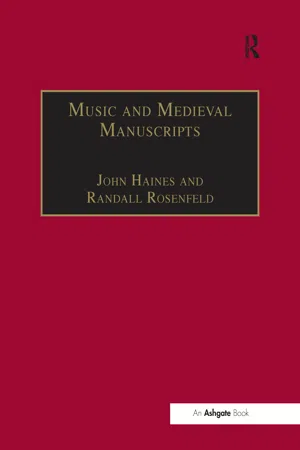
The interdisciplinary approach of Music and Medieval Manuscripts is modeled on the work of the scholar to whom the book is dedicated. Professor Andrew Hughes is recognized internationally for his work on medieval manuscripts, combining the areas of paleography, performance, liturgy and music. All these areas of research are represented in this collection with an emphasis on the continuity between the physical characteristics of medieval manuscripts and their different uses. Albert Derolez provides a landmark and controversial essay on the origins of pre-humanistic script, while Margaret Bent proposes a new interpretation of a famous passage from a fifteenth-century poem by Martin Le Franc. Timothy McGee contributes an innovative essay on late-medieval music, text and rhetoric. David Hiley discusses musical changes and variation in the offices of a major saint's feast, and Craig Wright presents an original study of Guillaume Dufay. Jan Ziolkowski treats the topic of neumed classics, an under-explored aspect of the history of medieval pedagogy and the transmission of texts. The essays that comprise this volume offer a unique focus on medieval manuscripts from a wide range of perspectives, and will appeal to musicologists and medievalists alike.
Information
PART I
PALEOGRAPHY
Chapter 1
The Script Reform of Petrarch:
An Illusion?
(To the Memory of Albinia C. de la Mare)
In the history of Western handwriting, Humanistic script has an importance that surpasses that of all other types of handwriting, because it is the direct ancestor of the printed Roman type now in use in the whole Western world and may be considered one of the great creations of the human mind.1 As everybody knows, the credit for having introduced this clear, simple and harmonious alphabet owes not so much to the Italian Humanists of the early fifteenth century themselves, as to Carolingian monks six centuries earlier. Carolingian script as it had developed in the late eleventh century was imitated by the Humanists and afterwards was assured a world-wide divulgation by the printing-press. Hence the names for both scripts now preferred by many paleographers: littera antiqua (i.e., Carolingian script) and littera antiqua renovata (i.e., Humanistic script). The rapid success of this antiquated type of handwriting, first in Quattrocento Italy, then all over Europe, and its triumph over its rival the littera moderna or Gothic script, is a kind of miracle which has no parallel in other periods in the history of Western handwriting. Decades of intensive research by such scholars as Berthold Louis Ullman and Albinia C. de la Mare (to name only the two most prominent specialists) have resulted in quite a precise knowledge of when and where Humanistic script came into being and who were the persons involved in its creation and earliest development. The new script was born about 1400 in a small circle of Florentine Humanists, and its initiators appear to have been Salutati, Niccoli and Poggio.
As Humanistic script is directly linked to a movement of literary and artistic renovation that was under way for at least one century, it is quite natural that research has focused on the handwriting of Humanistic circles in the period preceding the ‘invention’ of Humanistic script, in order to find possible antecedents of the new style of handwriting. In Italy as in the rest of Europe, the handwriting used in the thirteenth and fourteenth centuries was Gothic, even if the Italian types such as Rotunda are forms less typical of Gothic script than Northern Textualis: less angular and spiky, more rounded, and with a series of different morphologies.
The prominent Italian Humanist and poet Francesco Petrarca (1304-1374) is one of the extremely rare authors of the Middle Ages to have made statements on the handwriting of his time. This has been all the more a reason for various paleographers to direct their attention to his handwriting. It will not be necessary to quote once again in their full extent Petrarch’s critical observations on the typical handwriting of the fourteenth century and the utterings of his admiration for earlier, i.e., Carolingian, and especially late Carolingian book script.
His criticism was especially directed at Gothic Textualis, and probably more in its Northern version than in the form of Italian Rotunda. Armando Petrucci, the author of the only existing monograph devoted to Petrarch’s handwriting, believed that he had especially the litterae scholasticae in view, the university variants of Textualis such as Littera Parisiensis and Littera Bononiensis, but admitted that also the solemn littera de forma was the target of his criticism.2 The letters in these scripts are written, according to Petrarch, by means of artificial strokes (’artificiosis litterarum tractibus’).3 Above all, the Humanist denounces the ‘diffuse ("vaga") and exuberant ("luxurians") letter written by the scribes (or better, the painters) of our time, charming the eye from a distance, but nearby disturbing and fatiguing it, as if it were devised for something other than to be read’.4
There is consequently no doubt that Petrarch was highly critical of the scripts in use at his time. According to Petrucci, the great Humanist even carried on "an uninterrupted implacable polemic against the scribes of his time and their scripts’. It appears, however, that his criticism was especially directed at the current production system of manuscript books, in which ignorant artisans were entrusted with the various tasks involved in such an elevated work as the making of books: the preparation of parchment, the copying, the correction, the illumination, etc., and few authors deigned to take any interest in this process. This resulted, according to Petrarch, in sloppy manuscripts full of errors, in which *an author would not even recognize his own work.5
Even if the latter criticism had more to do with correctness of texts and orthography than with the handwriting itself, Petrarch’s statements betray a general negative feeling towards the handwriting used in his time. For him, a good handwriting should have three qualities: it should be simple (’castigata’), clear (’clara’) and orthographically correct. He possessed many manuscripts from the twelfth century in late Carolingian script, and there is little doubt that he considered these to present the ideal form of handwriting. He praised their ‘maiestas’, ‘decor’ and ‘sobrius ornatus’, i.e., their majesty, their decorum and their sober ornamentation.6
The question for us now is whether or not this admiration for the ‘vetustas’ of his early books had incited Petrarch to change his own handwriting under the influence of the models he handled with so much pleasure and considered with so much veneration. Seeing that some of his contemporaries praised the beauty of his own handwriting, one is inclined to answer in the affirmative. His friend Francesco Nelli left us a flowery testimony to this admiration: ‘Tell me, please, with what hammers or anvils you strike all your words, and even the forms of your letters, so that their fragrance, although filling most of the world, rightly deserves to reach all of it?7 Many modern scholars are convinced that by purifying his handwriting under the influence of Carolingian models Petrarch is at the origin of what would be Humanistic script, and this opinion has become a commonplace in paleographical handbooks.
In 1892 the great Petrarch scholar Pierre de Nolhac, in addition to affirming that ‘cette ecriture est bien celle d’un poete; elle en a la grace et aussi les caprices’, already considered Petrarch’s handwriting as a precursor of Humanistic script.8 In 1912 Ehrle and Liebaert were the first both to include a specimen of Petrarch’s script in their paleographical atlas and to call it ‘fere humanistica’.9 In 1928 the German paleographer Joachim Kirchner, co-author of the first book on Gothic handwriting, used for Petrarch’s script the somewhat less appropriate name of ‘gotico-antiqua’ proposed earlier by Alfred Hessel, meaning that it is halfway between Gothic Textualis and the not yet existing Humanistic script. It would be the result of a conscious clarification of the Gothic canon and display a tendency towards ‘das humanistische Schriftideal’.10 In 1933 Alfred Hessel published his epoch-making article on the origin of Humanistic script and concluded that Petrarch’s handwriting constituted ‘das erste Stadium des Strebens nach dem vermeintlichen antiken Ideal’.11 This opinion was gradually accepted by paleographers and we find it in the handbooks of Battelli, Cencetti, Bischoff (with some caution) and Gasparri;12 the latter happily suggests the term prehumanistique’ for Petrarch’s handwriting. We find it also in the studies on Humanistic script by Wardrop and Ullman, although the latter author is not very outspoken about the supposed script reform of Petrarch.13
Two authors have more than others contributed to the fame of Petrarch as a reformer of handwriting. First is Giorgio Cencetti, who devoted no less than eight pages of his voluminous handbook to the subject and used the name ‘semigotica’ for the book script of Petrarch and other specimens of handwriting of the same type (we will return to this term in the following pages).14
The second is Armando Petrucci, whose monograph on Petrarch’s handwriting, published in 1967, has remained a classic, and from whom much of the information contained in the preceding pages has been taken. In this early work of the great Italian paleographer, the ‘estetica grafica del Petrarca’ and the ‘riforma grafica petrarchesca’ are the leading motives. Even if Petrucci conceded that Carolingian script was for Petrarch never a model to be imitated and that he remained faithful to Gothic script and the use of a broad-nibbed pen,15 he was fully convinced of the importance of the Humanist’s graphic reform. He characterized the script by its precision of tracing (’precisione del tracciato’), separation of letters (’distacco fra le lettere’) and clarity (’chiarezza’).16 We will discuss in a moment a few more objective criteria formulated by Petrucci.
In a recent contribution, Paola Supino Martini resumes the idea of Petrarch as a reformer of script and offers a close study of the ‘semigotiche di ambiente petrarchesco’, which she thinks derive neither from the littera moderna (i.e., Textualis), nor from the extremely calligraphic Cancelleresca (or Italian cursive script), but from a simplified version of the latter, which ‘recuperava la matrice Carolina’ of Cancelleresca.17
On the other hand some paleographers have denied‒or have passed over in silence‒the revolutionary or innovative character of Petrarch’s handwriting. The old handbook of Edward Maunde Thompson (first published 1912) does not mention Petrarch; neither do the well-known atlases of Franz Steffens (first published 1909) and S. Harrison Thomson (1969). A scholar of the stature of Paul Lehmann wrote in 1918: ‘Es ist unverkennbar, dass Petrarca im Grunde noch ganzlich gotisch schreibt’.18 Above all, Emanuele Casamassima in one of his last contributions has vigorously (as was his usual way of expressing himself) denied Petrarch’s supposed renewal of Latin script. ‘The greatness of the poet’, he wrote, ‘the strong personality of the man and artist seem unduly to have radiated upon the scribe, who is no more than a dilettante, albeit a gifted one, entirely rooted in the norms and style of his time’. And he added: ‘Placing (as has been done for a long time) Petrarch’s ...
Table of contents
- Cover Page
- Title Page
- Copyright Page
- Contents
- List of Figures, Examples and Tables
- Acknowledgements
- Introduction
- Andrew Hughes in Focus
- Notes on Contributors
- PART I: PALEOGRAPHY
- PART II: MUSIC
- PART III: DRAMA
- PART IV: LITURGY
- Publications of Andrew Hughes
- Index
Trusted by 375,005 students
Access to over 1.5 million titles for a fair monthly price.
Study more efficiently using our study tools.
Frequently asked questions
Yes, you can cancel anytime from the Subscription tab in your account settings on the Perlego website. Your subscription will stay active until the end of your current billing period. Learn how to cancel your subscription
No, books cannot be downloaded as external files, such as PDFs, for use outside of Perlego. However, you can download books within the Perlego app for offline reading on mobile or tablet. Learn how to download books offline
Perlego offers two plans: Essential and Complete
- Essential is ideal for learners and professionals who enjoy exploring a wide range of subjects. Access the Essential Library with 800,000+ trusted titles and best-sellers across business, personal growth, and the humanities. Includes unlimited reading time and Standard Read Aloud voice.
- Complete: Perfect for advanced learners and researchers needing full, unrestricted access. Unlock 1.5M+ books across hundreds of subjects, including academic and specialized titles. The Complete Plan also includes advanced features like Premium Read Aloud and Research Assistant.
We are an online textbook subscription service, where you can get access to an entire online library for less than the price of a single book per month. With over 1.5 million books across 990+ topics, we’ve got you covered! Learn about our mission
Look out for the read-aloud symbol on your next book to see if you can listen to it. The read-aloud tool reads text aloud for you, highlighting the text as it is being read. You can pause it, speed it up and slow it down. Learn more about Read Aloud
Yes! You can use the Perlego app on both iOS and Android devices to read anytime, anywhere — even offline. Perfect for commutes or when you’re on the go.
Please note we cannot support devices running on iOS 13 and Android 7 or earlier. Learn more about using the app
Please note we cannot support devices running on iOS 13 and Android 7 or earlier. Learn more about using the app
Yes, you can access Music and Medieval Manuscripts by Randall Rosenfeld, John Haines in PDF and/or ePUB format, as well as other popular books in Media & Performing Arts & Music. We have over 1.5 million books available in our catalogue for you to explore.