- 614 pages
- English
- ePUB (mobile friendly)
- Available on iOS & Android
eBook - ePub
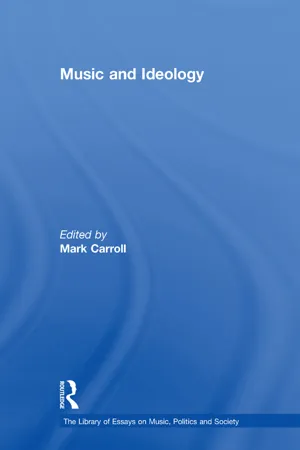
Music and Ideology
About this book
This volume gathers together a cross-section of essays and book chapters dealing with the ways in which musicians and their music have been pressed into the service of political, nationalist and racial ideologies. Arranged chronologically according to their subject matter, the selections cover Western and non-Western musics, as well as art and popular musics, from the eighteenth century to the present day. The introduction features detailed commentaries on sources beyond those included in the volume, and as such provides an invaluable and comprehensive reading list for researchers and educators alike. The volume brings together for the first time seminal articles written by leading scholars, and presents them in such a way as to contribute significantly to our understanding of the use and abuse of music for ideological ends.
Information
[1]
MUSIC AND IDEOLOGY: RAMEAU, ROUSSEAU, AND 1789
Forty-four years ago Julien Benda drew up a devastating indictment of some of the best known intellectuals of his time. He charged Mommsen, Treitschke, Ostwald, Brunetière, Barrès, Lemaître, Péguy, Maurras, d’Annunzio, Kipling, and their like with having forfeited their devotion to the discovery of eternal truths. Nearly every page of their writings, so went the indictment, betrayed an impatience with pure thought, a scorn for reason, an obsession with idées fixes, a fear of abstraction, a thirst for sensation, a need for certitude, a hatred of opposition, and an inclination toward violence, vituperation, and relentless vindictiveness.1 In their passionate loathing for dispassionate pursuits, these writers had forsaken their intellectual commitment for partisan or national causes. Hence we can hardly be surprised, Benda continued, if we discover political tracts where we had expected to find poetry, fiction, criticism, metaphysics, or history.2
Partisan history, it goes without saying, is not the specialty of nationalists, royalists, and conservatives. All historians are subjects of Francis Bacon’s Idols of the Tribe, of the inescapable human frailties of bias, passion, and misjudgment. And possibly nowhere is the historians’ capacity to adjust their judgments to their biases more conspicuous than in the writings on the French Revolution of 1789. It is a commonplace among historians that “opinions on such questions as the interrelationship of the state, the individual, religion, society, and classes, and … corresponding evaluations of nationalism, tradition, and the Church” are inseparably linked to interpretations of the Revolution of 1789.3 It is also a well-known fact that particular political, religious, social, economic, pedagogic, philosophical, and literary preferences imply particular interpretations of the life and thought of Jean-Jacques Rousseau and of his influence on the Revolutionary and post-Revolutionary periods. What has been barely noticed, however, is the remarkable phenomenon of musicologists and music biographers interpreting a major composer and a famous musical incident to suit their political prejudices. These prejudices affect their interpretation of the Revolution and Rousseau. The composer so misinterpreted is Jean-Philippe Rameau (the uncle of Diderot’s famous neveu), and the musical incident in which Rameau and Rousseau were the major antagonists is the Querelle (or Guerre) des Bouffons (1752–54).
The historiography of the composer Rameau and the musical Querelle is but another aspect of the historiography of the French Revolution. Both types of studies are animated by the revolutionary or counterrevolutionary inclinations of their authors, both have generally treated the Revolution or the Querelle as blocs or indivisible entities, and both have linked these two events, for better or for worse, with the name of Rousseau. The Querelle was a debate over the merits of Italian light opera (opera buffa) against those of French music (especially Rameau’s tragédies lyriques). This musical incident, however, assumes political significance because the supporters of Italian music included in their ranks nearly all the leading anti-Establishment philosophes (Diderot, d’Alembert, the Baron d’Holbach, and most prominently, Melchior Grimm and Rousseau) while the champions of Rameau’s music numbered in their ranks many of the philosophes’ bitterest rivals. This peculiar alignment has led most of the writers on Rameau or on the Querelle to interpret the musical events of 1752–54 in light of their own preference for the political events of 1789–99, and thus carry into music history, biography, and criticism the ideological war waged by historians over the French Revolution and Rousseau. Hence, an adequate assessment of the differing partipris expressed by writers on the Querelle des Bouffons will be preceded by a brief description of the events of the Querelle itself and of the differing partipria expressed by historians on the Revolution in general.
I. Just before the outbreak of the Querelle, Jean-Philippe Rameau (1683–1764), now remembered largely as the codifier of classical harmony, was universally extolled as France’s greatest composer. Large audiences were flocking to the numerous performances of his dozen operatic works, the mainstay of France’s musical repertory.4 On August 1, 1752, however, an Italian operatic company, recently arrived to France, presented to the Parisian audiences Giovanni Battista Pergolesi’s La Serva Padrona.5
The successful performances of this Italian opera buffa (hence the name of Querelle des Bouffons) at a time when Rameau’s tragédies- lyriques reigned supreme on the French stage led the German-born Melchior Grimm to direct an attack against the entire French operatic repertory.6 Grimm’s objections to French opera were later seconded by two of his philosophe friends, Denis Diderot and the Baron d’Holbach.7 Both men had been associated for the past three or four years with the controversial and highly irreverent Encyclopédie ou Dictionnaire raisonné des sciences, des arts et des métiers, the first as editor-in-chief and the second as occasional contributor. The German-born d’Holbach, in a seventeen-page pamplet, humorlessly aped Grimm’s complaints against the pomposity and monotony of French operas.8 In three pamphlets appearing in the winter of 1753 Diderot, purporting to act as impartial observer, did not spare his irony at the expense of French music.9
By May 1753 the first stage of the musical debate had ended.10All was quiet on the polemical front until November of that year when the debate was revived, with a vengeance, by Rousseau’s Lettre sur la Musique française. In a series of close arguments, supported by premises that were occasionally invalid, Rousseau reasoned that French music was not only inferior to Italian music, but that as music and as drama it was totally worthless. French music, he argued, did not match the sentiments it attempted to express—the sentiments were not genuine anyway—the melody was concealed under a mass of complicated harmony and counterpoint, and, he peremptorily concluded, “the French nation has no music and can never have any.11
The large number of pro-French pamphlets following Rousseau’s Lettre and the virulence with which a great many of them attacked the Italian partisans, and especially Rousseau, suggest that more was at stake than the question of the excellence of a particular national style of music. What was apparently at stake for many of the partisans of French music is best displayed in the pamphlets written by Louis-Bertrand Castel, Caux de Cappeval, Jacques Cazotte, and Pierre Morand. All of them charged that the philosophes’ criticisms of French music were motivated by a desire to subvert France’s political, social, religious, and cultural institutions.
The best known of these four pamphleteers is unquestionably Father Castel (1688–1757), who cast doubt on the genuineness of Rousseau’s and his colleagues’ patriotism. If they had been “true Frenchmen, true Patriots, true subjects of the King,” they would not have had the effrontery to question one of France’s most hallowed traditions, its opera, whose music is “national, specifically French, even Gallic; music of our soil, of our territory.” The Encyclopedists’ criticism of French music, he concluded, was part and parcel of their “Philosophical Deism,” of their general attacks “on our customs, our character, and other arts, even religion and the government of this and other nations.”12
The three other pamphlets13 presented similar ad hominem arguments. Caux de Cappeval (?–1774) dismisses Rousseau’s competence as a music critic on the ground that he is a frantic madman about to burn the temple of art. Cazotte (1720–93) specified this madness: Rousseau is afflicted with a “sick brain, an equivocal heart, and a dangerous and false mind.” Rousseau’s tirades against French music, Morand tells his readers, have no esthetic validity whatever: they are motivated by Rousseau’s personal failures that he resentfully projects into certain individual Frenchmen, including Rameau.14
We have also a reference to the foreign origin of one or more of the philosophes, Rousseau being called an “Allobroge” (prehistoric Swiss) in the very title of Morand’s pamphlet. Indeed, Rousseau’s Swiss birthplace, argues Caux de Cappeval, accounts for his unpatriotic stand against the national music of France.15
Finally, these three pamphlets share with Castel’s brochure and with most subsequent Rameau studies a similar conspiratorial theory. If we are to believe Cazotte, Rousseau is at the head of a “conspiracy” of a “cabal of people most of whom are without talent or are literary failures, fanatics, sedition-mongers, and madmen (in music).” Caux de Cappeval names these conspirators: they are the philosophes, who are secretly plotting the destruction of the national art under the aegis of the Encyclopédie.16
Subsequent criticisms of Rousseau and the philosophes were to surpass in length, in the number of instances, in chains of reasoning, and in vituperative tone the arguments presented by these four pamphleteers, but the main substance of the whole school of the Right, both political and musical, can already be found in these brochures written in 1753 and 1754.
II. In most histories and encyclopedias of music, the Querelle des Bouffons is simply described as another dramatic incident in the tumultuous history of music. Yet, for historians of the Querelle and for biographers of its major antagonists, Rameau and Rousseau, this incident has been repeatedly treated as a political and ideological prelude to the French Revolution of 1789. Why were some of the disputants in this quarrel only too eager to impute political motives, ulterior or explicit, to their opponents? Why were some of these imputations repeated ad nauseam by twentieth-century biographers and critics? For an explanation of this extra-musical interpretation of a musical event, a brief description of the historiography of the French Revolution is in order.
The particular postures assumed by historians on that Revolution have been grouped under two broad categories that were first named and described by the rightist historian Augustin Cochin, namely, the thèse de complot (argument for conspiracy) and thèse de circonstances (argument for circumstances).17 The argument for conspiracy, propounded by conservatives and counterrevolutionaries, holds that the course of history is largely d...
Table of contents
- Cover
- Half Title
- Title Page
- Copyright Page
- Table of Contents
- Acknowledgements
- Series Preface
- Introduction
- 1 Charles B. Paul (1971), ‘Music and Ideology: Rameau, Rousseau, and 1789’, Journal of the History of Ideas, 32, pp. 395–410.
- 2 David M. Powers (1998), ‘The French Musical Theater: Maintaining Control in Caribbean Colonies in the Eighteenth Century’, Black Music Research Journal, 18, pp. 229–40.
- 3 Katharine Thomson (1976), ‘Mozart and Freemasonry’, Music & Letters, 57, pp. 25–46.
- 4 Nicholas Mathew (2009), ‘Beethoven’s Political Music, the Handelian Sublime, and the Aesthetics of Prostration’, 19th Century Music, 33, pp. 110–50.
- 5 Jolanta T. Pekacz (2000), ‘Deconstructing a “National Composer”: Chopin and Polish Exiles in Paris, 1831–49’, 19th Century Music, 24, pp. 161–72.
- 6 Marina Frolova–Walker (1997), ‘On Ruslan and Russianness’, Cambridge Opera Journal, 9, pp. 21–45.
- 7 Jess Tyre (2005), ‘Music in Paris during the Franco–Prussian War and the Commune’, Journal ofMusicology, 22, pp. 173–202.
- 8 Glenn Watkins (2003), ‘The Old Lie’, in Proof through the Night: Music and the Great War, Berkeley: University of California Press, pp. 47–60; 439–13.
- 9 Jane F. Fulcher (1999), ‘The Composer as Intellectual: Ideological Inscriptions in French Interwar Neoclassicism’, Journal of Musicology, 17, pp. 197–230.
- 10 Reinhold Brinkmann (2004), ‘The Distorted Sublime: Music and National Socialist Ideology – A Sketch’, in Michael H. Kater and Albrecht Riethmiiller (eds), Music and Nazism: Art under Tyranny, 1933–1945, Laaber: Laaber Verlag, pp. 43–63.
- 11 Pamela M. Potter (2005), ‘What is “Nazi Music”?’, Musical Quarterly, 88, pp. 428–55.
- 12 Richard Taruskin (1995), ‘Public Lies and Unspeakable Truth Interpreting Shostakovich’s Fifth Symphony’, in David Fanning (ed.), Shostakovich Studies, Cambridge: Cambridge University Press, pp. 17–56.
- 13 Danielle Fosler–Lussier (2007), ‘Beyond the Folk Song: Or, What was Hungarian Socialist Realist Music?’, in Music Divided: Bartoh’s Legacy in Cold War Culture, Berkeley: University of California Press, pp. 94–116; 194–7.
- 14 Penny M. Von Eschen (2004), ‘Ike Gets Dizzy’, in Satchmo Blows Up the World: Jazz Ambassadors Play the Cold War, Cambridge, MA: Harvard University Press, pp. 1–26; 263–70.
- 15 Robin Denselow (1989), ‘Born Under a Bad Sign’, in When the Music’s Over: The Story of Political Pop, London: Faber, pp. 1–30.
- 16 Simon Frith (1988), ‘Rock and the Politics of Memory’, in Sohnya Sayres et al. (eds), The 60s Without Apology, Minneapolis: Minnesota University Press, pp. 59–69.
- 17 Daniel Kreiss (2008), ‘Appropriating the Master’s Tools: Sun Ra, the Black Panthers, and Black Consciousness, 1952–1973’, Black Music Research Journal, 28, pp. 57–81.
- 18 Mao Yu Run (1991), ‘Music under Mao, Its Background and Aftermath’, Asian Music, 22, pp. 97–125.
- 19 Jean During (2005), ‘Power, Authority and Music in the Cultures of Inner Asia’, Ethnomusicology Forum, 14, pp. 143–64.
- 20 Kelly M. Askew (2003), ‘As Plato Duly Warned: Music, Politics, and Social Change in Coastal East Africa’, Anthropological Quarterly, 76, pp. 609–37.
- 21 Nick Nesbitt (2001), ‘African Music, Ideology and Utopia’, Research in African Literatures, 32, pp. 175–86.
- 22 George Ciccariello Maher (2005), ‘Brechtian Hip–Hop: Didactics and Self–Production in Post–Gangsta Political Mixtapes’, Journal of Black Studies, 36, pp. 129–60.
- 23 Lydia Goehr (1994), ‘Political Music and the Politics of Music’, Journal of Aesthetics and Art Criticism, 52, pp. 99–112.
- Name Index
Trusted by 375,005 students
Access to over 1.5 million titles for a fair monthly price.
Study more efficiently using our study tools.
Frequently asked questions
Yes, you can cancel anytime from the Subscription tab in your account settings on the Perlego website. Your subscription will stay active until the end of your current billing period. Learn how to cancel your subscription
No, books cannot be downloaded as external files, such as PDFs, for use outside of Perlego. However, you can download books within the Perlego app for offline reading on mobile or tablet. Learn how to download books offline
Perlego offers two plans: Essential and Complete
- Essential is ideal for learners and professionals who enjoy exploring a wide range of subjects. Access the Essential Library with 800,000+ trusted titles and best-sellers across business, personal growth, and the humanities. Includes unlimited reading time and Standard Read Aloud voice.
- Complete: Perfect for advanced learners and researchers needing full, unrestricted access. Unlock 1.5M+ books across hundreds of subjects, including academic and specialized titles. The Complete Plan also includes advanced features like Premium Read Aloud and Research Assistant.
We are an online textbook subscription service, where you can get access to an entire online library for less than the price of a single book per month. With over 1.5 million books across 990+ topics, we’ve got you covered! Learn about our mission
Look out for the read-aloud symbol on your next book to see if you can listen to it. The read-aloud tool reads text aloud for you, highlighting the text as it is being read. You can pause it, speed it up and slow it down. Learn more about Read Aloud
Yes! You can use the Perlego app on both iOS and Android devices to read anytime, anywhere — even offline. Perfect for commutes or when you’re on the go.
Please note we cannot support devices running on iOS 13 and Android 7 or earlier. Learn more about using the app
Please note we cannot support devices running on iOS 13 and Android 7 or earlier. Learn more about using the app
Yes, you can access Music and Ideology by Mark Carroll in PDF and/or ePUB format, as well as other popular books in Mezzi di comunicazione e arti performative & Storia mondiale. We have over 1.5 million books available in our catalogue for you to explore.