- 260 pages
- English
- ePUB (mobile friendly)
- Available on iOS & Android
eBook - ePub
About this book
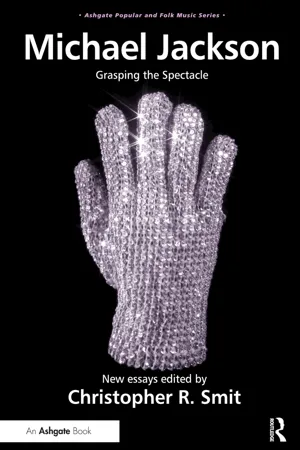
Throughout his 40-year career, Michael Jackson intrigued and captivated public imagination through musical ingenuity, sexual and racial spectacle, savvy publicity stunts, odd behaviours, and a seemingly apolitical (yet always political) offering of popular art. A consistent player on the public stage from the age of eight, his consciousness was no doubt shaped by his countless public appearances, both designed and serendipitous. The artefacts he left behind - music, interviews, books written by and about him, and commercial products including dolls, buttons, posters, and photographs, videos, movies - will all become data in our cultural conversation about who Michael Jackson was, who he wanted to be, who we made him to be, and why. Michael Jackson: Grasping the Spectacle includes essays that aim to understand Jackson from multiple perspectives: critical cultural theory, musicology, art history, media studies, cultural anthropology, sociology, philosophy, religious studies, literary theory, gender studies, performance studies, disability studies, film studies, and African-American studies. Intended for classroom use as well as research and general interest, this book expands our understanding both of this fascinating figure himself and of gender, sexuality, celebrity, and popular culture.
Information
PART I
Mythology and Identity
Chapter 1
Freaks
(from On Michael Jackson)
Margo Jefferson
Written before his death, Jefferson’s book On Michael Jackson is without a doubt the most cited study on the star. Stemming from a background in journalism, her investigative approach is brilliantly blended with a real interest in cultural and political ramifications of African-American aesthetics. This excerpt from her book begins this collection because it sets the tone of the larger conversation being had in the following pages. Indeed, issues of history, physicality, gender, race, sexuality, and the performance of these things, is at the heart of her work, all of which are being reworked and investigated by the authors writing for this collection.1
Every mind is a clutter of memories, images, inventions and age-old repetitions. It can be a ghetto, too, if a ghetto is a sealed-off, confined place, or a sanctuary, where one is free to dream and think whatever one wants. For most of us it’s both—and a lot more complicated. A ghetto can be a place of vitality; a sanctuary can become a prison. Michael Jackson escaped the ghetto of Gary, Indiana, and built the sanctuary of Neverland. It’s become a circuslike prison, emblematic of his mind.
Think of Michael Jackson’s mind as a funhouse, and look at some of the exhibits on display: P.T. Barnum, maestro of wonders and humbuggery; Walt Disney, who invented the world’s mightiest fantasy-technology complex; Peter pan (“He escaped from being human when he was seven days old”); a haggard Edgar Allan poe (he was the only character besides Peter Pan that Michael Jackson planned to play in a movie); the romping, ever-combustible Three Stooges; a friendly chimpanzee named Bubbles who has his own wardrobe of clothes; and a python lying coiled between placid white llamas.
Tears roll down the gnarled lizard cheeks of E.T. as he dreams of home; Charlie Chaplin sits alone on a stoop, his Little Tramp chin in his hands. A knife gleams in a darkened alley; a panther stalks through and disappears; ghouls and werewolves dance in a crumbling mansion; Captain Eo wears silver when he comes down from outer space to save children from the evils of our planet. Now lines of song-and-dance men kick, strut and turn in perfect unison. Children of all nations float happily through the night sky like Wynken, Blynken and Nod, then come down to earth and sing of peace in high, sweet voices; a colossal statue of Michael Jackson himself in military dress bestrides the world to the rapturous attack chords of “Carmina Burana.”
Here is Elvis Presley, who is one of himselves; Diana Ross, who is one of himselves; Elizabeth Taylor, who is one of himselves; wee, nut-brown Emmanuel Lewis and pert, milky-white Macaulay Culkin, both parts of himself; Joseph Jackson, the father who believes in whippings but not beatings; Katherine Jackson, the mother who is always supportive and always elusive. See photos from childhood onward and videos of Michael; they are mirrors reflecting each stage of his life.
Let’s begin our tour.
Phineas T. Barnum? A model for Michael. The ringmaster of American entertainment. Fantasy, fakery and touches of uplift. No one knew better than Barnum how to thrill audiences, give them raw sensation and a stirring, not especially accurate education. Barnum’s first spectacular success came in 1835, when he bought the rights to exhibit an ex-slave named Joice Heth at his Connecticut theater. Servitude had left her a near cripple; the showman saw promise in those gnarled limbs and stooped shoulders. Barnum put her in a clean gown and a fresh white cap, sat her down and introduced eager crowds to the 161-year-old nurse of George Washington. “To use her own language when speaking of the illustrious Father of his Country, ‘she raised him’ ” his advertisements proclaimed.
When Heth died the next year, Barnum ordered a public autopsy. An unexpectedly honest doctor revealed that, far from being born in 1674, Heth was no more than eighty years old. Barnum professed astonishment. He’d been conned by Heth and her ex-master, he declared. Then his business partner upped the ante and declared that Barnum had found Heth on a plantation and trained her himself to pass for Washington’s nurse. The public enjoyed both tales, and Barnum enjoyed spreading both tales. People wanted to believe and know they’d be conned, as long as they didn’t know when or how.
In 1842, Barnum opened his a merican Museum on lower Broadway in New York City. It cost twenty-five cents to get in, not an inconsiderable sum in those days: “One ticket guaranteed admission to lectures, theatrical performances, an animal menagerie and a glimpse of human curiosities, living and dead.” An exhibit features Madame Clofullia from Europe. Madame was born in s witzerland. In a photograph she stands quietly in her black ruffled gown, resting a hand gently on her husband’s shoulder. There is a bunch of white lace at her throat. But it is partially hidden by her long, dark, bushy beard. An angry museum patron takes her to court. She is a man, he protests. The suit is free advertising for Barnum. He takes a group of physicians to court with him; together they offer medical proof that Madame Clofullia is biologically female. She goes on working at the museum.
It isn’t always easy to find genuine human wonders like Madame Clofullia. As a man of the theater, Barnum knows how to turn a startling visual effect into an adventure yarn. Put a tattooed man in a loincloth and he becomes Prince Constentenus of Greece. The prince was kidnapped by the Khan of Kashagar: that is why he has 185 tattoo patterns on his body, each one cruelly carved into his flesh with needles.
Michael Jackson read Barnum’s autobiography fervently (at least one of the eight versions) and gave copies to all his staff, telling them, “I want my career to be the greatest show on earth.” So he became both producer and product. The impresario of himself. Who among us can’t recall at least one of the stunts that followed: Michael sleeping in a hyperbaric chamber like a handsome young pharaoh in his tomb or the lovely Snow White in her glass casket? He was obsessed with the Elephant Man; he claimed he saw the movie thirty-five times, never once without weeping all the way through! He made repeated attempts, offered millions of dollars, to buy the bones from The British Museum. He appeared in public wearing a surgical mask: he could have been the doctor in an old horror film, looming over the evil or tragic man about to have his identity and destiny changed forever. Then we see him without the mask, onstage, at an awards ceremony, in court, and realize he has been that man for a long time.
He became a one-man conglomerate with global reach: his own records and videos; the Beatles’ catalog; Pepsi commercials; world tours. He was transnational. He re-enacted his supremacy in video after video. “If you wanna be my baby / don’t matter if you’re black or white.” If you want to dance with me, don’t matter if you’re Indian, Russian, African or Native American. You can morph into anything (pudgy Eskimo into buff, white American lad with straight, honey-blond hair; American lad into slim brown-skinned lass with dark brown frizzy hair); you can be any age, race or gender. Global idealism is at one with global marketing. If you want to buy my records, don’t matter who, what or where you are.
Barnum’s museum exhibits, ethnological curiosities and circus sideshows also set the pattern for our daytime talk shows. The difference between then and now? Barnum’s people were supposed to be freaks of nature, outside the boundaries of The Normal. Ours are marketed as lifestyle freaks. Psychology and sociology have played as big a part as biology; that’s the point of those long confessional interviews with the host and those fraught exchanges with the audience. Nighttime shows like Fear Factor are recreational sideshows. Eating slug sandwiches and jumping into sealed tanks turn the old carnival tricks (sword swallowing, biting chickens’ heads off) into middle-class pranks. Everyday people indulge their whims and get their hit of fame. More and more, they involve playacting and wish fulfillment: this week you make deals Donald Trump respects; you’re the “average Joe” the right woman picks over the handsome stud; your “extreme makeover” turns you from a dog to a babe.
More and more of these shows are updates of the old talent contest. Now, though, the backstage tale, the life story, matters as much as the performance. Maybe more. It’s about watching the struggle to be the best that you can be, even when you’re preposterous; it’s about living out your dream. These stories follow— or long to follow—the arc of Michael’s early life. You start small, but you have the talent; you work night and day; you make your way to the big city at last, audition for the right talent scouts and producers. You win a contract and your shot at fame. Star Search. American Idol. So You Think You Can Dance.
But Michael Jackson became world-famous because he was a world-class talent. His 1983 performance of “Billie Jean” at the televised tribute Motown: Yesterday, Today, Forever placed Michael Jackson against the backdrop of his show-business childhood. The other performers were aging; they looked like they were barely surviving liquor and drug crises, feuds, plain old illness and career lapses. Michael looked like a pristine creation, untainted by that past.
Michael was in profile as the bass line of “Billie Jean” rumbled up: legs apart, knees bent in demi-plié, one hand lightly touching his fedora. A hoofer cavalier in high-water pants. Eight counts of pelvic thrusts turned him into a soul-man cavalier. A quick kick and thigh slap on each side, then he faced the audience and—smack on the beat—threw his hat into the wings. Song-and-dance man. Then he mimicked a fifties bad boy, giving his hair a quick comb.
All the elements of the persona we would come to know were on display. The wardrobe that joined severity (black pants, fedora, loafers) with glitter, sparkle and eccentricity (sweater jacket and shirt, white socks, single white glove). Passion that stirred the audience, yet felt private and mysterious. The intense theatricality and how he stretched small gestures into long lines of movement. Every choreographer has signature moves and combinations. Here was the core of Jackson’s style: the angled feet and knock-knees of the Funky Chicken (gritty) and the Charleston (more soigné); various runs and struts; the corkscrew kicks forward (as fast as judo kicks); the spin turns; the moonwalk and the sudden crouch when, instead of falling to his knees, he rises on his toes. It’s a ballet moment. And a small variation on that move shifts the tension. When he rises with feet and knees together, he looks powerful. With knees together and feet apart, he looks vulnerable, even stricken.
“Billie Jean” is a song about anxiety and guilt, desire and resentment; fathering a child and being a child. In the bridge, when he sang of how Mama warned him, “Be careful what you do / because a lie becomes the truth,” he jumped straight into the air three times. The genie in the bottle is a young man who can’t control his energies. In the repeat bridge, as he recalled “the smell of sweet perfume / She brought me to her room,” he jumped from foot to foot with his knees up, like a boy having a tantrum.
And finally, as he sang, the expressive arms: arms outstretched, hands pleadingly open (musical theater melodrama); then an emphatic fist or sudden wrist curl; an index finger piercing the air (chitlin’ circuit bravado). He brought one hand across his face when he sang “his eyes were like mine,” about the mystery child; we saw his round dark eyes through spread-out fingers (Motown mime). He ended stage center, right arm in the air, looking drained but exalted. He created the show; he was the show. Idea man, song-and-dance man, money man. But by the mid-1980s he had a lot of us paying more attention to the freak than to the artist. The producer in him knew something had to be done. The outlet he chose was the daytime talk show, media home for our culture’s freaks. The place that invites them in to explain and display their lives to regular folk; justify, flaunt, challenge and beguile. In 1993, when the public questions about Michael Jackson’s whitening skin had become clamorous, he appeared on The Oprah Winfrey Show to explain that he had vitiligo, a disease that drained the pigment from his skin, leaving white blotches. That’s why he had to even it out with thick white makeup.
His was a downward spiral after that. By 2003, when he stood on a hotel balcony high above a crowd of cheering fans and held up his new baby for them to see, people thought he had gone mad—or mad enough to be staging a Fear Factor publicity stunt. Actually, if you look closely at the picture, he is holding the baby firmly; there’s no real danger of his dropping him. Still, why hold a baby over a balcony for cheering throngs, like royalty showing off a new prince to its subjects? By then only true Michael f...
Table of contents
- Cover
- Half Title
- Dedication
- Title
- Copyright
- Contents
- List of Figures and Tables
- List of Contributors
- General Editor's Preface
- Acknowledgments
- Introduction Chasing the Spectacle of Michael Jackson
- PART I MYTHOLOGY AND IDENTITY
- PART II MUSIC AND IMAGE
- PART III BODY AND DEATH
- Bibliography
- Index
Trusted by 375,005 students
Access to over 1.5 million titles for a fair monthly price.
Study more efficiently using our study tools.
Frequently asked questions
Yes, you can cancel anytime from the Subscription tab in your account settings on the Perlego website. Your subscription will stay active until the end of your current billing period. Learn how to cancel your subscription
No, books cannot be downloaded as external files, such as PDFs, for use outside of Perlego. However, you can download books within the Perlego app for offline reading on mobile or tablet. Learn how to download books offline
Perlego offers two plans: Essential and Complete
- Essential is ideal for learners and professionals who enjoy exploring a wide range of subjects. Access the Essential Library with 800,000+ trusted titles and best-sellers across business, personal growth, and the humanities. Includes unlimited reading time and Standard Read Aloud voice.
- Complete: Perfect for advanced learners and researchers needing full, unrestricted access. Unlock 1.5M+ books across hundreds of subjects, including academic and specialized titles. The Complete Plan also includes advanced features like Premium Read Aloud and Research Assistant.
We are an online textbook subscription service, where you can get access to an entire online library for less than the price of a single book per month. With over 1.5 million books across 990+ topics, we’ve got you covered! Learn about our mission
Look out for the read-aloud symbol on your next book to see if you can listen to it. The read-aloud tool reads text aloud for you, highlighting the text as it is being read. You can pause it, speed it up and slow it down. Learn more about Read Aloud
Yes! You can use the Perlego app on both iOS and Android devices to read anytime, anywhere — even offline. Perfect for commutes or when you’re on the go.
Please note we cannot support devices running on iOS 13 and Android 7 or earlier. Learn more about using the app
Please note we cannot support devices running on iOS 13 and Android 7 or earlier. Learn more about using the app
Yes, you can access Michael Jackson by Christopher R. Smit,ChristopherR. Smit in PDF and/or ePUB format, as well as other popular books in Media & Performing Arts & Music. We have over 1.5 million books available in our catalogue for you to explore.