- 292 pages
- English
- ePUB (mobile friendly)
- Available on iOS & Android
eBook - ePub
Music after Hitler, 1945-1955
About this book
The political control of music in the Third Reich has been analysed from several perspectives, and with ever increasing sophistication. However, music in Germany after 1945 has not received anything like the same treatment. Rather, there is an assumption that two separate musical cultures emerged in East and West alongside the division of Germany into two states with differing economic and political systems. There is a widely accepted view of music in West Germany as 'free', and in the East subject to party control. Toby Thacker challenges these assumptions, asking how and why music was controlled in Germany under Allied Occupation from 1945-1949, and in the early years of 'semi-sovereignty' between 1949 and 1955. The 're-education' of Germany after the Hitler years was a unique historical experiment and the place of music within this is explored here for the first time. While emphasizing political, economic and broader social structures that influenced the production and reception of different musical forms, the book is informed by a sense of human agency, and explores the role of salient individuals in the reconstruction of music in post-war Germany. The focus is not restricted to any one kind of music, but concentrates on those aspects of music, professional and amateur, live and recorded, which appeared to be the mostly highly charged politically to contemporaries. Particular attention is given to 'denazification' and to the introduction of international music. Thacker traces the development of a divide between Communist and liberal-democratic understandings of the place of music in society. The contested celebrations of the Bach Year in 1950 are used to highlight the role of music in the broader cultural confrontation between East and West. Thacker examines the ways in which central governments in East and West Germany sought to control and influence music through mechanisms of censorship and positive support. The book will therefore be of interest not only
Introduction
This book explores the connections between music and politics in Germany in the ten-year period between the defeat of Hitler’s ‘Third Reich’ in 1945 and the formal ending of the Allied occupation in 1955. It focuses on efforts to promote or censor music considered to have political meaning or influence, and to favour or disfavour individual musicians on grounds of their political affiliations, real or supposed. The first half of the book deals primarily with music as part of the ‘re-education’ project of the occupiers, and the second half with the evolution of musical culture in a divided Germany. The first half is concerned, therefore, with the intentions of the wartime Allies, and their twofold aspiration of ‘denazifying’ German music and creating something new in its place. If it overlooks to a significant degree the contribution of Germans themselves to post-war musical culture, this is intended to counter the absence of Allied music officers from existing accounts of music in this period in Germany. The second half restores Germans to centre stage, and places the wartime Allies, now Cold War enemies, in the background.
There is a huge literature on music in post-war Germany, which falls broadly into two significant categories. The first is preoccupied with musical analysis, and rigorously excludes anything outside its self-imposed framework. The second is a literature of memoir and biography. This, for the most part, follows the well-established conventions that separate music from politics, suggesting that to transgress in this area is a sign of poor taste, and somehow irremediably vulgar. Countless biographies and autobiographies of famous composers and performers recount their lives in a studiously apolitical manner. Any reference to politics usually suggests an unworthy contamination of the abstract beauties of music by worldly concerns. This perception is replicated in popular consciousness. Until very recently, even for those involved in and interested in music, the idea that music was politically controlled in Germany after 1945 has often come as a surprise. In the specialist academic literature devoted to ‘culture’ in post-war Germany, music is typically most present in its absence. Sometimes, an author may point to this, apologetically, but more often than not, there is an unspoken assumption that somehow music, by its very nature, is resistant to political machinations and social currents, and not therefore suited to analysis in the way that literature, theatre, film, or the visual arts are. At one end of the aesthetic scale, purists might concede that popular music can be linked to trends in society,1 but at the other is the citadel of abstract artistic integrity: classical instrumental music. In between, certain musical forms, like song and opera, have been included in cultural analysis by being treated as literary texts, but this leaves their recalcitrant musical elements out as fit only for internal structural analysis, or the kind of metaphysical description exemplified by Burckhardt in the nineteenth century.2
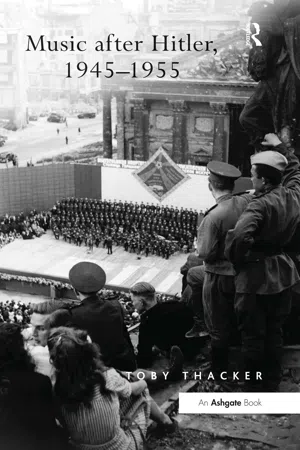
The result is an imbalance in the treatment of different art forms in Germany after 1945. Music, if referred to, is treated in generalisations, typically couched in an impersonal, passive narrative form. Thus Reiner Pommerin, introducing a recent collection of essays on culture in the Federal German Republic with a survey of the post-war musical scene, says: ‘[The] music of composers such as Igor Stravinsky, Paul Hindemith and Carl Orff was played again.’3 Aside from the striking inaccuracy of the statement, which perpetuates the myth of Orff as an anti-Nazi figure when in fact his music was very popular and frequently performed in Nazi Germany, particularly between 1940 and 1944, this style of writing begs many questions. Whose idea was this? Was it a German or an Allied initiative? Who authorised these performances? Where did the actual music come from? As we shall see, all public performances of music in Germany after May 1945 had to be licensed by the local Military Government: they could not take place as some kind of spontaneous cultural manifestation. At its worst, this general ‘cultural history’ uses music as a kind of decoration, substituting photographs or other visual images for sustained analysis. Powerful images of musicians performing in ruined buildings, for rapt but subdued audiences, have taken on an iconic role in our imagining of post-war Germany. Cinema has, not surprisingly, exploited music’s metaphorical strength in its representations.
In the last few years, a third category of writing on music in post-war Germany has emerged as part of the larger analysis of cultural reconstruction there under Allied control. Much of it is still confined to individual essays in obscure publications, or has reached only a tiny audience, particularly outside Germany. I will comment further on this subsequently. Separately, there is now a large and growing body of academic literature on music in Nazi Germany and in the Soviet Union that explores links with political systems. In so doing, this literature implicitly confirms the idea of music as inherently apolitical, suggesting that this kind of analysis is only possible or worth undertaking as part of a study of dictatorship or totalitarianism. As far as Germany is concerned, this historiography stops at 1945, like the war. By the time music reappears in the cultural histories of Germany after 1945, it has reassumed its apolitical guise as a free-floating art form. It is assumed that there has been some kind of caesura, and, more quickly and easily than the other arts, that German musical culture was able to resume its apolitical course. Music, seen in this way, has proven itself particularly suited to a language of redemption and renewal.
It is a commonplace that after the horrors of Nazism and the shock of total defeat, many German people turned to elements of their cultural past in an effort to salvage something from the ruins of their national inheritance. Nothing was better suited to this than the music of the ‘great composers’, most of them German. The rapid reconstruction of musical life in Germany after May 1945, its flourishing in the ruins, moral and physical, was from that time held up as a metaphor for the birth of a new Germany which could draw on the best elements of its artistic and spiritual past.4 This results in an often perfunctory and unsatisfactory treatment. The political divisions amongst the Occupiers, which resulted in 1949 in the partition of Germany into two client states, had consequences for music. In the early 1950s, as the world divided into two ideological blocks, music was part of this wider intellectual and ideological schism. In the East music, like all the arts, was to be owned and produced by the people, for the people. In the West, the idea of music as an abstract art form, resistant to and free from political manipulation, was strongly upheld. In the Federal Republic, these were the ‘golden years’, when the great German orchestras and performers resumed their former position of supremacy, and radio stations became the pioneers of the avant-garde.5 From this perspective, music in the East, behind the ‘Iron Curtain’, was – like the other arts – a prisoner. There was no point in even trying to consider it as something worthy of analysis in its own right. As an art form, it was necessarily debased by political demands and an assumed subservience, or as Wolfgang Geiseler put it, ‘obviously in bed with politics’.6
This neglect is doubly unfortunate, because music allows so many diverse approaches to aspects of society and politics. In different forms, music reaches almost the entire population. In its most intellectual European forms, as part of a wider religious and literary culture, music is also distinct in that it demands an act of re-creation every time it is performed. The great composers, unlike the great painters, need fresh generations of musicians and singers to bring every note and phrase to life. Each performance, as Burckhardt noted, brings with it a re-interpretation,7 and this provokes a continuous interaction with contemporary ideas. Any re-interpretation is, furthermore, not just in the hands of an elite body of virtuoso performers and other professionals. In Germany in mid-century, it was something that also extended to amateurs, or lay musicians, from every class and part of society. Music was found in the churches, and as a constituent part of all levels of education. Workplaces and institutions in Germany typically had their own choirs and orchestras. Music was a symbol of village as well as of municipal pride. In an advanced industrial society, engaged after 1945 in a unique historical exercise of forced re-evaluation, music took on symbolic and representative roles of great importance, involving larger ideas about German history and identity, and it is these roles that are the focus of attention here. The goal is to understand those meanings (rather than any current ones), to see where they came from, and what consequences this had.
Quite coincidentally, this ten-year period was also one of rapid and far-reaching technological and stylistic change. In technological terms, it witnessed the introduction of long-playing records, magnetic tape recorders, electronic musical instruments, and transistor radios. As for the music itself, at one end of the cultural scale neo-classicism was supplanted by dodecaphony, by serialism, and by aleatory music. Ideas about musical notation, organisation, and the role of the performer were dramatically changed. At the other end of the scale there were equally rapid changes in popular music. These developments took place not only in the particular context of Germany after the ‘Third Reich’, but also at a time when the intellectual and artistic confrontation between capitalist and communist ideologies was at its most intense.
The appearance of music in so many artistic and social forms makes it impossible to treat all of these manifestations with equal depth in an overview. I have thus paid attention here to those forms which appeared most politically charged in Germany between 1945 and 1955, and which, as a consequence, were the subject of most contemporary attention. This results inevitably in a neglect of certain kinds of music, and certain aspects of musical activity, including some which had their origins in the period under consideration here, but which were of greater significance later. One example is that of the cult of Handel in the GDR. The improbable meeting between the cultures of eighteenth-century England and the early German Democratic Republic (GDR), which took shape after the start of the Händel Festspiele in Halle in 1952, is a subject of great interest, but took on particular importance only after the Handel anniversary in 1958, when the SED declared work with Britain a focus of its cultural foreign policy.8 Similarly, the reader will not find here a treatment of military music in the nascent armed forces of either the Federal Republic or the GDR. Adenauer himself in 1954 took a personal interest in the question of what music would be appropriate for the Bundeswehr, seeking specialist advice on suitable music that would be martial but not overly nationalist, but both in the Federal Republic and in the GDR, military music was developed largely after 1955.9 Of greater significance, I do not examine musical education in schools and universities in any detail. This is a large and complex field, which merits study in its own right.
The existing literature on music in the ‘Third Reich’ has provided intellectual inspiration as well as a wealth of valuable background information that I have relied on in the preparation of this book. Above all, the detailed and nuanced work of Michael Kater should be mentioned.10 Writers such as Josef Wulf, Fred Prieberg, Michael Meyer, and Erik Levi have also contributed to a broader understanding of music and musicians in the ‘Third Reich’.11 More recently, Willem de Vries, Michael Kaufmann, Pamela Potter, and Anselm Gerhard have illuminated hitherto unexplored areas of German musical culture between 1933 and 1945.12 Frederic Spotts, historian of the Bayreuth Festival, has put Hitler back into the centre of debate.13 Music in the ‘Third Reich’ has thus become an exciting and sophisticated field of historiography. Insofar as a central theme of this body of work has been to suggest continuities in German musical history, and to counter the idea of 1933 as a complete break with the past, this book might be seen as an extension of that literature – one which seeks similar continuities beyond 1945. The literature on music and politics in the Soviet Union has, perhaps surprisingly, been less helpful. This literature covers a much larger chronological span, as the Soviet Union lasted considerably longer than Nazi Germany, but its focus on the Soviet Union has had unfortunate consequences for the study of East and Central European countries after 1945.14 As one of the Soviet Union’s ‘satellite’ or ‘puppet’ states, the musical culture of the GDR has only been regarded very recently in the West as worthy of academic attention in its own right. Since the collapse of the Soviet Union, and the opening of many formerly closed archives, a reappraisal has begun. In the last decade, the first serious treatments of music in the early GDR have been published.15
This new historiography – returning t...
Table of contents
- Cover Page
- Half Title
- Series Page
- Title Page
- Copyright
- Table Of Content
- Abbrevations
- Introduction
- Bibliography and Sources
- index
Trusted by 375,005 students
Access to over 1.5 million titles for a fair monthly price.
Study more efficiently using our study tools.
Frequently asked questions
Yes, you can cancel anytime from the Subscription tab in your account settings on the Perlego website. Your subscription will stay active until the end of your current billing period. Learn how to cancel your subscription
No, books cannot be downloaded as external files, such as PDFs, for use outside of Perlego. However, you can download books within the Perlego app for offline reading on mobile or tablet. Learn how to download books offline
We are an online textbook subscription service, where you can get access to an entire online library for less than the price of a single book per month. With over 1.5 million books across 990+ topics, we’ve got you covered! Learn about our mission
Look out for the read-aloud symbol on your next book to see if you can listen to it. The read-aloud tool reads text aloud for you, highlighting the text as it is being read. You can pause it, speed it up and slow it down. Learn more about Read Aloud
Yes! You can use the Perlego app on both iOS and Android devices to read anytime, anywhere — even offline. Perfect for commutes or when you’re on the go.
Please note we cannot support devices running on iOS 13 and Android 7 or earlier. Learn more about using the app
Please note we cannot support devices running on iOS 13 and Android 7 or earlier. Learn more about using the app
Yes, you can access Music after Hitler, 1945-1955 by Toby Thacker in PDF and/or ePUB format, as well as other popular books in History & World History. We have over 1.5 million books available in our catalogue for you to explore.