eBook - ePub
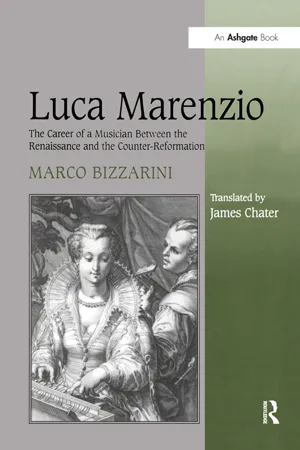
Luca Marenzio
The Career of a Musician Between the Renaissance and the Counter-Reformation
- 396 pages
- English
- ePUB (mobile friendly)
- Available on iOS & Android
eBook - ePub
Luca Marenzio
The Career of a Musician Between the Renaissance and the Counter-Reformation
About this book
Regarded by his contemporaries as the leading madrigal composer of his time, Luca Marenzio was an important figure in sixteenth-century Italian music, and also highly esteemed in England, Flanders and Poland. This English translation of Marco Bizzarini's study of the life and work of Marenzio provides valuable insights into the composer's influence and place in history, and features an extensive, up-to-date bibliography and the first published list of archival sources containing references to Marenzio. Women play a decisive role as dedicatees of Marenzio's madrigals and in influencing the way in which they were performed. Bizzarini examines in detail the influence of both female and male patrons and performers on Marenzio's music and career, including his connections with the confraternity of SS Trinit nd other institutions. Dedications were also a political tool, as the book reveals. Many of Marenzio's dedications were made at the request of his employer Cardinal d'Este who wanted to please his French allies. Bizzarini examines these extra-musical dimensions to Marenzio's work and discusses the composer's new musical directions under the more austere administration of Pope Clement VIII.
Information
Chapter 1
Competition and pre-eminence
At the beginning of 1588 a Brescian soldier, Count Marc’Antonio Martinengo, conceived a remarkable idea. He sent the most celebrated composers of Italy a poem he had written, with the request that they should set it to music ‘with the same words and in the same mode’ (‘con l’istesse parole e nel medesimo tuono’). Seventeen composers took part in this competition (it would be safe to call it such), each of them bringing to bear his portfolio of professional experiences gained at the various courts and musical establishments of Italy. The count, an amateur musician, set a good example by himself composing the first madrigal of the series. Once the commissioned pieces had arrived in Brescia, they were collected in a musical print titled L’amorosa Ero, one of the most fascinating madrigal collections of the entire Cinquecento, an authentic ‘group exhibition’ of the period’s most acknowledged masters. In this publication composers whose fame has endured rub shoulders with minor figures or ones whose glory has since faded into oblivion. Their names are Bertani, Cavaccio, Gastoldi, Giovannelli, Ingegneri, Nanino, Zoilo, Marenzio, Barera, Luzzaschi, Virchi, Striggio, Merulo, Porta, Fiorino, Morsolino and Ferrabosco.1
We do not know who the winner of the competition was. Nor do we know if an actual prize was put up, perhaps a sum of money, or a red damask cloak, as was the custom with wrestling contests. However, a moral victor among those numerous masters was in fact proclaimed. In the last years of the century, Adriano Banchieri, a knowledgeable musician and a shrewd observer of the society of his time, indicated Luca Marenzio (who was still living) as the most representative composer of the contemporary madrigal, the one who had brought to a peak the art of writing secular music for four, five and more voices.2 Nor did Banchieri’s testimony remain isolated.
Normally, the great masters of the sixteenth century came to be counted among the group of outstanding musicians during the course of their own lifetime. Their ‘classical’ status passed into historiographical tradition as a matter of course, reaching us without drastic reversals. (However, allowance should be made for adjustment and supplementation resulting from a clearer overall vision of unfolding history, which is why Monteverdi, Marenzio’s junior by ten years, does not yet figure in the canons of the late sixteenth century, even though he certainly qualifies; only later was the ‘divino Claudio’ counted as one of the greatest madrigal composers – if not the very greatest.)
The case of L’amorosa Ero bears obvious witness to the colourful individualists who crowded the madrigalian arena in the period when Marenzio was most active as a composer, in other words in the two decades between the late 1570s and the late 1590s. This was an extremely fertile period for vocal music, both sacred and secular, and especially the latter, at least where Italy is concerned. More madrigals were composed and published than at any time before or since, by more authors, whether professional or amateur, from Italy or elsewhere.
Not everything that was produced in that period has come down to us, but what remains is so abundant that it has (up to now at least) overwhelmed the best efforts of individual scholars to gain a satisfactory perspective. Even after drastically sifting the amount of music to be examined, one risks being faced with a volume of composers and music that is difficult to encompass. When discussing the period in question in his unsurpassed and classic study of the Italian madrigal as a whole, Alfred Einstein chooses only Marenzio’s music for close examination;3 only briefly does he refer to that of Luzzaschi, Gastoldi, Ingegneri, Striggio and Merulo. Among the ‘celebri autori’ of L’amorosa Ero, Einstein avoids in-depth consideration of Giovannelli, Nanino, Bertani and Virchi, even though, historically speaking, they count for something.
We rely on the judgement of early authors because this seems the wisest course given the perplexing impossibility of knowing the repertory in its entirety. Why, among several hundred madrigalists, did late sixteenth-century writers on music decide to award the palm to Marenzio? Part of the answer certainly lies within the musical texts, but another part lies in the historical and social context. A key concept in this period is esemplarità – the function of a composition or musical style as a paragon or exemplum – a necessary precondition of which is public recognition. In its turn this recognition had to be capable of propagating itself on a large scale and of maintaining its capacity to persuade. In such cases the market for music publishing benefited, while the composer was constantly being asked for new music.
By its very nature, this mechanism presupposed that compositional fertility could be considered a clear sign of excellence and ‘classical’ status, at least in this period. Palestrina composed over 100 masses, Marenzio published more than 20 books of secular music, and Philippe de Monte was even more prolific. It is true that Marenzio’s fame as a madrigalist is commonly held to exceed Monte’s, but the latter was also numbered among the better composers of his time.4
Prolificity depends on an ability to work at speed, and we know that a fast composer was highly regarded. In 1593 Sebastián Raval, a Spanish ex-soldier with strong musical ambitions, issued a public challenge to the best contrapuntists in Rome. Two of them, Giovanni Maria Nanino and Francesco Soriano, agreed to take part in the composition contest. A poetic text was handed to the three competitors for musical setting: it is recorded that when Soriano had finished the work, Raval had not yet reached the end of the first line. The ability to be at ease with technical difficulties, the fruit of long practice (and also of a certain natural predisposition), is a quality that immediately distinguishes the acknowledged professional from the pretentious dilettante. But despite his humiliating defeat Raval did not lose heart, issuing a further musical challenge a few years later, this time in Sicily. In the end Raval had the better of his competitor, Achille Falcone, but not without the support of a jury that clearly leaned in the direction of Spain.5 Once again the anecdote is instructive as it shows that judgement at that time could be corrected (if not corrupted) by private interests, diplomatic relations or political forces. In the last analysis, rivalry between composers could reflect that between their respective patrons and their opposing factions.
In fact a decisive element in determining the fortunes of a musician was patronage. Without sufficient forms of patronage – whether private or institutional – the musician lacked means of support. Without patrons, his compositions never reached the printing press and could not therefore be disseminated. Whoever published had to be in a position to claim the support of influential protection.
Stylistic esemplarità, compositional fecundity, adequate support through patronage: the harmonious confluence of these disparate factors was needed to establish the reputation of a musician of the late Renaissance, one eventually crowned with universally recognized pre-eminence.
_____________
Notes
1 L’amorosa Ero rappresentata da’ più celebri musici d’Italia con l’istesse parole et nel medesimo tuono (RISM 158817). Modern edition in Lincoln (ed.), The Madrigal Collection ‘L’Amorosa Ero’.
2 Banchieri, La nobilissima, anzi asinissima compagnia delli briganti della Bastina … (Vicenza, 1597). The book contains a bizarria in versi sdruccioli written by a fictitious ‘signor Zizoletto Cocolini’, in which the protagonist boasts to his mistress of his expertise in all the arts and sciences. In the field of music he compares his merits to those of the ‘great Zarlino’ as regards ‘theory’, to Claudio Merulo in the playing of chromatic keyboard works and to Luca Marenzio in the field of the madrigal: ‘Ne i Madrigai da camera / Son un Luca Marentio / … Mi sono può ne l’Organo / Francese stringatissime / E nel toccar Cromatico / Avanzo Claudio Merulo … / E quando entro in Teorica … al gran Zerlin me aprossimo’. See Bizzarini, ‘Musica, maschere e “Theatro del mondo”’.
3 Einstein, The Italian Madrigal, vol. 2, pp. 608–88.
4 See for example Vincenzo Giustiniani, Discorso sopra la musica, in id., Discorsi, ed. Banti, p. 20: ‘le composizioni dell’Archadelt, di Orlando Lassus, dello Strigio, Cipriano de Rores e di Filippo di Monte [erano] stimate per le migliori di quei tempi, come in effetto erano’ (‘The compositions of Arcadelt, Orlando Lassos, Striggio, Cipriano de Rore and Philippe de Monte [were] regarded as the best of their period, which in fact they were’).
5 Casimiri, ‘Sebastian Raval’; Bianconi, ‘Sussidi bibliografici’, pp. 8 ff.
Chapter 2
First fruits of genius on the world stage
As with other musicians of this period, we have no record of the date of Luca Marenzio’s birth, since it was only after the Council of Trent that Italian parishes began to keep regular baptismal records. By contrast, we know the precise moment when he consigned to print his first collection of compositions. A native of Coccaglio, a small town located in the countryside west of Brescia (see Pl. 1), Marenzio had recently completed his twenty-sixth year when his first book a 5, a work destined to enjoy an extraordinary success (with at least eight reprints), appeared with a dedication to Cardinal Luigi d’Este.1 The dedication was signed in Rome on 8 August 1580;2 for all practical purposes, this is the real ‘birth date’ of the prince of madrigalists.
Thus we can place Marenzio, as a protégé of Cardinal Luigi d’Este, in Rome in the year 1580. For some years Marenzio had enjoyed the protection of this exceptional prince of the Church, one of the most powerful figures of the papal city. It is therefore not surprising that he chose to pay homage to his own patron with his first music collection. What is less clear is the cardinal’s objective in promoting the publication. One way of viewing any madrigal book is to see it as the outcome of the play of numerous forces dictated by the complex political strategies of patrons or the private aspirations of the author himself. It is the role of the historian to untangle this knot, to reveal the underlying relationship of the work to its context, as far as the fragmentary documentation and the eternal game of dissimulation typical of the Cinquecento allows.
With the deference customary of the period, in the dedication of his first book a 5 Marenzio calls his madrigals ‘first fruits’ (‘primizie’) and imperfect efforts: he trusts that the cardinal’s greatness will impart to them that spirit which the author’s ‘small intellect’ (‘poco intelletto’) was unable to give them. The musician has turned to his patron ‘not only because of the obligation of service, but also of [my own] will, and to reciprocate countless undeserved favours’.3
Every music print, especially ones containing madrigals, was normally prefaced by a dedicatory letter addressed to a chosen protector. Hence it is natural for the music historian to wish to understand how the cultural milieu of the dedicatee, and perhaps also his poetico-musical tastes, may have influenced the composition of the print itself. It is open to discussion, even to some doubt, whether we can show exact or profound correlations between patrons’ supposed musical tastes and the works associated with them; it is all the more difficult to uncover some of the mechanisms behind a musician’s career, the diffusion of his works, or his eventual inclusion among the number of ‘autori eccellenti’. Nevertheless, the patron stands at the centre of a web of crucial relationships between other musicians and figures from the world of culture and literature.
The relationship between an author and a dedicatee is not always clear, and the series of individual cases can be complex. We can usefully distinguish b...
Table of contents
- Cover
- Half Title
- Title Page
- Copyright Page
- Table of Contents
- List of Plates
- List of Musical Examples
- Preface
- Acknowledgements
- Translator’s Note
- A Note on Transcriptions
- A Note on Currencies
- Abbreviations and Sigla
- 1 Competition and pre-eminence
- 2 First fruits of genius on the world stage
- 3 Cardinal d’Este
- 4 Maestro di cappella
- 5 Secular music for a prince of the Church
- 6 The ‘buon compagno’ pope
- 7 The Ferrarese interlude
- 8 ‘Gentildonne’
- 9 Roman confraternities
- 10 Homeland and compatriots
- 11 ‘Musici di Roma’
- 12 ‘Stravaganze d’amore’
- 13 The new pope
- 14 A job in Mantua?
- 15 ‘His heart in France’
- 16 A ‘new aria’
- 17 The grand duke’s wedding
- 18 Orsini and Montalto
- 19 The peak of his career
- 20 From Vatican Palace to Polish court
- 21 Repentance?
- 22 The ‘Wise Fool’
- 23 The Platonic spirit
- 24 A new style
- 25 Order and significance
- 26 Seconda prattica and second Renaissance
- Bibliography
- Index of Compositions by Marenzio
- General Index
Trusted by 375,005 students
Access to over 1.5 million titles for a fair monthly price.
Study more efficiently using our study tools.
Frequently asked questions
Yes, you can cancel anytime from the Subscription tab in your account settings on the Perlego website. Your subscription will stay active until the end of your current billing period. Learn how to cancel your subscription
No, books cannot be downloaded as external files, such as PDFs, for use outside of Perlego. However, you can download books within the Perlego app for offline reading on mobile or tablet. Learn how to download books offline
Perlego offers two plans: Essential and Complete
- Essential is ideal for learners and professionals who enjoy exploring a wide range of subjects. Access the Essential Library with 800,000+ trusted titles and best-sellers across business, personal growth, and the humanities. Includes unlimited reading time and Standard Read Aloud voice.
- Complete: Perfect for advanced learners and researchers needing full, unrestricted access. Unlock 1.5M+ books across hundreds of subjects, including academic and specialized titles. The Complete Plan also includes advanced features like Premium Read Aloud and Research Assistant.
We are an online textbook subscription service, where you can get access to an entire online library for less than the price of a single book per month. With over 1.5 million books across 990+ topics, we’ve got you covered! Learn about our mission
Look out for the read-aloud symbol on your next book to see if you can listen to it. The read-aloud tool reads text aloud for you, highlighting the text as it is being read. You can pause it, speed it up and slow it down. Learn more about Read Aloud
Yes! You can use the Perlego app on both iOS and Android devices to read anytime, anywhere — even offline. Perfect for commutes or when you’re on the go.
Please note we cannot support devices running on iOS 13 and Android 7 or earlier. Learn more about using the app
Please note we cannot support devices running on iOS 13 and Android 7 or earlier. Learn more about using the app
Yes, you can access Luca Marenzio by Marco Bizzarini,James Chater in PDF and/or ePUB format, as well as other popular books in Media & Performing Arts & Music. We have over 1.5 million books available in our catalogue for you to explore.