- 608 pages
- English
- ePUB (mobile friendly)
- Available on iOS & Android
eBook - ePub
Jean Cras, Polymath of Music and Letters
About this book
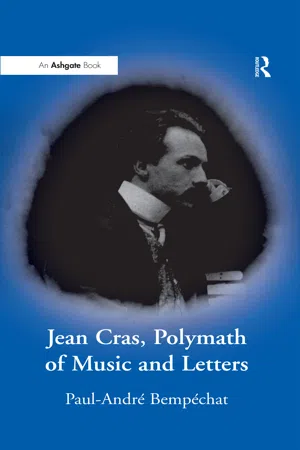
Jean Cras (1879-1932) was a remarkable man by anyone's measure. Twice a decorated hero of the Great War, this Rear-Admiral of the French navy, scientist, inventor and moral philosopher, was also a highly esteemed composer during his lifetime, enjoying the same stature and celebrity as Faur Debussy and Ravel. Since his death, however, both Cras and his music have been almost completely overlooked. In this, the first critical biography of Cras, Paul-Andre Bempechat situates Henri Duparc's proteg's a missing link between the French post-Romantic generation of composers and the Impressionists. The book explores, both historically and analytically, the methodology by which Cras evolved his eclectic brand of Impressionism, striking the delicate balance between Celtic folk idioms and exoticisms inspired by his travels. Cras' creative legacy extends beyond the world of music to the world of science. His five patented inventions include the navigational gyrocompass, which bears his name, still in use to this day by the French navy, coast guard and boating afficionados. Bempechat draws special attention to the humanist Jean Cras and his distinguished military career - he is credited with saving the Serbian army from extinction - drawing on primary source material such as family correspondence and wartime diaries to reaffirm this composer as a true Renaissance man of the twentieth century.
Information
Part I The Life of Jean Cras
Homme libre, toujours tu chériras la mer!
Free Man, forever will you cherish the sea!
– Charles Baudelaire
1 Background
Each nation, with its temples, its divinities, its poesy, its heroic traditions, its fantastic beliefs, its laws and its institutions, represents a unity, its own way of understanding life, a separate tone in humanity, a distinctive faculty of the great soul.
– Ernest Renan
*
Kentoc’h mervel eget bezañ saotret
Potius mori quam foedari
Plutôt la mort que la souillure
Better death than dishonour
– Brittany’s motto
Kant bro, Kant giz, Kant parrez, Kant iliz1
COMPOSER, scientist, inventor, philosopher and Rear-Admiral Jean (Emile Paul) Cras was a French musician. But this French musician was also Breton. He was born on 22 May 1879 in Brest, the most westerly city of France’s most westerly province, in its most westerly département, le Finistère, derived from the Latin, finis terra, or, ‘the end of the earth’. Cras was raised in Brest, and on 14 September 1932, died in Brest. His is a relatively common Breton name and, dialect depending, is generally accepted to mean ‘the sun-burnt one’. Proper Breton pronunciation dictates that the a must be slightly elongated and the 5 pronounced z; the name transliterates as Yann Kraz. From the outset, one might assume that against this provincial backdrop – despite Brest’s being France’s most strategic military and commercial port, and window onto the North Atlantic – would limit, or even inhibit any sort of sophisticated creativity. Yet the life we are about to examine represents a paradox as complete, complex and unique to musical history as the societal dichotomies and anomalies of the Breton province, and of Brest itself. Therefore, it is imperative that this study begin with a brief survey of Brittany’s complex history and review the political subtleties of her relationship with her eastern neighbour, France. In so doing, understanding the paradox that is Jean Cras will become increasingly clear.
At the time of Jean Cras’ birth, Breton identity and nationalism were approaching the crest of their modern resurgence, their roots steeped in antiquity. Flanked strategically by the Atlantic Ocean and the English Channel at the most westerly point of the European continent, the peninsula, la Petite Bretagne (‘Lesser Britain’), as opposed to la Grande Bretagne (‘Great Britain’), had, since the third century ce, been settled by Celts from Cornwall and Wales. Initially, they had been welcomed by the Romans to guard the sparsely populated coastlines of the province they had called Armorica.2 Armor, now l’Armorique, was the Latin name for Brittany, when France was Roman Gaul. Adapted into Breton, ar mor, or ar vor, in Breton, means ‘against the sea’. By 410, Roman law and civilization in Great Britain ended swiftly as the army departed. Subsequent foreign invasions, together with the fall of the Empire in 476, provoked a tidal wave of Celtic Christian emigration into Armorica; only by the ninth century did France gradually adopt the faith. La Petite Bretagne developed into a nation of seafarers, farmers and merchants, a nation whose fervent Catholicism continued to be enhanced by the riches of Celtic music and bardic tales. Sustained by Breton,3 a Celtic language completely independent of French, this robust hybrid of ethnic and pagan cultures, of religious as well as Druidic traditions had evolved into a civilization distinct unto itself. Today, Breton, is spoken by roughly a half-million, mostly elderly people who live west of a linguistic border extending from St-Brieuc to Vannes (Map 1).
Toward the end of the fifteenth century, the Duchy of Brittany was flourishing so vibrantly that the young Duchess Anne (1477–1514), daughter of the heirless and last Duke of Brittany, François II (1435–1488), had become a most sought-after young lady, albeit, an in facto commodity. Relations between the duchy and her neighbours, France and England, were hardly idyllic, and numerous wars had been fought on both fronts. upon her father’s death, the eleven-year-old child became the prey of a political tug-of-war between branches of the Breton aristocracy at Rennes (Roazhon) and Nantes (Naoned). Originally betrothed, and actually married by proxy to the Holy Roman Emperor and Habsburg ruler of Austria, Maximilian I (1459–1519), she was forced to marry her enemy, the King of France, Charles VIII (1470–1498); upon his death, she was obliged to enter into a marriage of convenience to his cousin King Louis XII (1462–1515), whom she had always liked. Now twice Queen of France, la bonne duchesse Anne, as she is affectionately called, possessed the requisite savvy to guard the freedoms and interests of her native province. She was a great patroness of music4 and the arts, and her persona and legacy have attained the stature of myth and legend, oft recounted through tales, folk songs and, as recently as 2001, opera.5 In contrast, her daughter, Claude de France (1499–1524), proved unable to control the territorial appetite of her husband, the future King, François I (1494–1547), and in 1532, Brittany, now annexed, would devolve into a province of France, retaining little more of her heraldic past than the Breton language and a rather lame parliament at Rennes, the ancient capital.
For over two centuries, the Bretons survived this marriage of convenience relatively free of repression. When revolts did erupt, chiefly over economic issues, they were often met with vigourous, at times ferocious, retaliatory measures. The ancestral Breton language and culture, protected by the Church – a force organic to life across France – remained quite ignored but not repressed by Paris. All would change with the Revolution of 1789. Torn by conflicting loyalties, Brittany’s Parisian delegation alternately praised and criticized the political dispositions of the ‘new’ France, anxious to put an end to l’Empire des Prêtres (‘The Empire [or Domain] of the Priests’).6 When notions of separation of church and state led to religious persecution, a profoundly pious Brittany, steeped in devotional Catholicism for well over a millennium, morally, ethically and sentimentally attached to its clergy, felt besieged. Besieged also by laws suddenly enacted to enforce military conscription upon the young, obliging them to leave their homeland – which, until well after World War I many still considered their country – and abandon their mother tongue to fight extra-territorial wars for a power they deemed foreign. These developments, even more than Louis XVI’s (1754–1793) execution at the guillotine, exacerbated latent political and social tensions, and engendered a chronic malaise between Brittany and the French Republic, of which Brittany was now an ex-province.
We say ex-province because the egalitarian ideology of the new French Republic – ‘one and indivisible’ – had supplanted the concept of the province per se. In 1790, Brittany, like the rest of France’s provinces, was divided into départements, or administrative regions, without taking into account linguistic differences, religious affiliations, established economic relationships and local traditions. The five contrived départements one recognizes today emerged as the Finistère, the Morbihan (‘Little Sea’, in Breton), Ille-et-Vilaine (after its two main rivers), Côtes-du-Nord, which came to be called Côtes d’Armor, and Loire-Inférieure, later renamed Loire-Atlantique (Map 2). And as testimony to how much attention the French Republic actually affords her history, in 1941, prompted by wartime paranoia – Hitler having promised Breton nationalists political autonomy in exchange for their co-operation – the Décret de Vichy (No. 2727, 30 June 1941) amputated the Loire-Atlantique from Brittany. Its ancient regional capital, the strategic port city of Nantes, so vitally entrenched in the cultural, economic and political history of Brittany, and where the Duchess Anne had reigned (and had been married for the second time at the Château des Ducs de Bretagne à Nantes), remains administratively severed from the rest of the province. This dissection, and the possibility of reunification, remain the subject of intense debate today.7
From 1792, the new French Republic, with its self-ordained mission civilisatrice underway, began to impose a single language, a lingua franca, literally, and not only as its conduit toward ‘mutual understanding’.8 French was to be used exclusively at all levels of government, and to be taught exclusively throughout the public and therefore secular education system. Examined from the perspective of history, and the fact that over half the population of what is now French territory spoke little or no French, the administration almost achieved its dazzling, ultimate objective:
.. not merely the diffusion of french through france, but the transformation of french itself into a perfectly pure, clear and rational tongue, purged of aristocratic corruptions and of all grammatical and lexical irregularities and confusions.9
The Breton clergy, encouraged by the Vatican to preach in Breton, were incensed and referred to these secular, Republican schools as les écoles du Diable (‘the Devil’s schools’). As a result, Brittany, with its long, iconoclastic history, quite separate from that of france, found itself progressively marginalized, its economy maligned, and consequently depressed at the very crest of the Industrial Age (ca. 1750–1900). But for any federalist zealot stalking the halls of the Parisian administration, eradicating Breton, entrenched and intertwined in an eternal confluence of local cultures, could not be accomplished without traumatic consequences. The Breton educated class was often bilingual, and in the Breton cities and towns, most less-than-well-educated understood french. But in the countryside, Breton was spoken universally: at home, among friends and colleagues, at the workers’ guilds and, of course, in church, where it was sung naturally and gracefully in all manner of religious discourse: festivals (les pardons bretons), christenings, baptisms, communions, weddings and funerals.
Understanding this complex society, with its identity deeply rooted in antiquities both Celtic and Greco-Roman, was and is still not for the faint of heart. Even among Bretons, defining precise ancestral origins remains a challenge, despite their enduring attachment to an ancestry that evolved little until the Revolution. Breton identity is formally tiered according to both region and language or dialect. the Breton pays (in Breton, bro), or ‘the homeland’, at its most basic level, corresponds to local geographical subdivisions; pays can therefore be defined as the smallest geographical unit for which a linguistic or cultural distinctiveness is recognizable by Bretons.10 the four regional dialects of the ancestral language, Leoneg, Tregerieg, Gwenedeg, and Kerneveg (respectively, the léonard, from the Pays du Léon (Bro Leon), the trégorrois, from Pays du Trégor (Bro Treger), the vannetais, from the Pays de Vannes (Bro Gwened), and the cornouaillais, from the Pays de Cornouaille (Bro Kerneveg), or Breton Cornwall, act as demarcation zones for diversity within this minority culture. In extenso, folk songs and dances vary from region to region and are accepted as variants rather than as adaptations.11 Added into this mix is Gallo (la langue gallaise, or gallèse), a diale...
Table of contents
- Cover Page
- Title Page
- Copyright Page
- Tabula Gratulatoria
- List of Figures
- List of Maps and Plates
- List of Music Examples
- Introduction to an introduction
- Acknowledgements
- Part I The Life of Jean Cras
- Part II The Works: Struggle and Evolution
- Conclusion to an introduction . . .
- A Chronological List of Jean Cras’ Compositions
- B Précis to the Unpublished Violin Sonata, L’esprit (‘The Mind’), May 1900
- C Précis to the Unpublished Viola Sonata, L’Âme (‘The Soul’), September 1900
- D La Régle-Rapporteur Cras
- Bibliography
- Index
Trusted by 375,005 students
Access to over 1.5 million titles for a fair monthly price.
Study more efficiently using our study tools.
Frequently asked questions
Yes, you can cancel anytime from the Subscription tab in your account settings on the Perlego website. Your subscription will stay active until the end of your current billing period. Learn how to cancel your subscription
No, books cannot be downloaded as external files, such as PDFs, for use outside of Perlego. However, you can download books within the Perlego app for offline reading on mobile or tablet. Learn how to download books offline
Perlego offers two plans: Essential and Complete
- Essential is ideal for learners and professionals who enjoy exploring a wide range of subjects. Access the Essential Library with 800,000+ trusted titles and best-sellers across business, personal growth, and the humanities. Includes unlimited reading time and Standard Read Aloud voice.
- Complete: Perfect for advanced learners and researchers needing full, unrestricted access. Unlock 1.5M+ books across hundreds of subjects, including academic and specialized titles. The Complete Plan also includes advanced features like Premium Read Aloud and Research Assistant.
We are an online textbook subscription service, where you can get access to an entire online library for less than the price of a single book per month. With over 1.5 million books across 990+ topics, we’ve got you covered! Learn about our mission
Look out for the read-aloud symbol on your next book to see if you can listen to it. The read-aloud tool reads text aloud for you, highlighting the text as it is being read. You can pause it, speed it up and slow it down. Learn more about Read Aloud
Yes! You can use the Perlego app on both iOS and Android devices to read anytime, anywhere — even offline. Perfect for commutes or when you’re on the go.
Please note we cannot support devices running on iOS 13 and Android 7 or earlier. Learn more about using the app
Please note we cannot support devices running on iOS 13 and Android 7 or earlier. Learn more about using the app
Yes, you can access Jean Cras, Polymath of Music and Letters by Paul-André Bempéchat in PDF and/or ePUB format, as well as other popular books in Media & Performing Arts & Music. We have over 1.5 million books available in our catalogue for you to explore.