- 264 pages
- English
- ePUB (mobile friendly)
- Available on iOS & Android
eBook - ePub
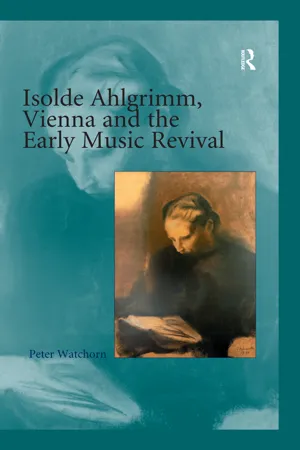
Isolde Ahlgrimm, Vienna and the Early Music Revival
About this book
Isolde Ahlgrimm (1914-1995) was an important pioneer in the revival of Baroque and Classical keyboard instruments in her native city, Vienna, and later, throughout Europe and the United States. She trained as a pianist at the Musikakademie in Vienna under the instruction of Viktor Ebenstein, Emil von Sauer and Franz Schmidt. In 1934 she met the musical instrument collector, Dr Erich Fiala, whom she married in 1938. His activities opened up the world of early instruments to her. Using a 1790 fortepiano by Michael Rosenberger, Isolde Ahlgrimm began her career as a specialist on early keyboard instruments with the first in her notable series of Concerte fur Kenner und Liebhaber, given in Vienna's Palais Palffy in February 1937. Ahlgrimm's career as a harpsichordist also began in 1937, when a new instrument was commissioned from the Ammer brothers in Eisenberg, Germany. In 1943 Ahlgrimm performed her first all-harpsichord programme, which consisted of the Goldberg Variations by J.S. Bach. From 1949 to 1956, she devoted herself to performing and recording nearly all of Bach's harpsichord music for the newly-founded Dutch label, Philips, presenting her new approach to the harpsichord to a wider audience. Ahlgrimm's performances of Baroque music represented a radical departure from the distinctly twentieth-century interpretations by the much more famous Wanda Landowska and her followers. Most obviously, Ahlgrimm's harpsichord performances eliminated frequent registration changes (her instrument had hand stops rather than pedals to change registers), and largely eschewed the massive ritardandi and other anachronistic performance practices that were hallmarks of Landowska's essentially Romantic style. Ahlgrimm researched and emphasized rhetorical traditions on which the music was based. This became more pronounced throughout the course of her later performing, writing and teaching career, and it was the beginning of an approach to the performance of eighteenth-century musi
Information
Table of contents
- Cover
- Half Title
- Title
- Copyright
- Dedication
- Contents
- List of Figures
- Acknowledgements
- Foreword
- Preface
- Introduction: Early Music, Vienna and the Missing Link
- 1 Early Education and Influences
- 2 Instrument Collecting, Erich Fiala and the Concerte für Kenner und Liebhaber, 1934–1956
- 3 Isolde Ahlgrimm, Philips Phongraphische Industrie and J. S. Bach: The Complete Works for Harpsichord
- 4 After the Deluge: Artistic Independence. The Years 1956–1984
- Appendices
- Bibliography
- Index
Trusted by 375,005 students
Access to over 1.5 million titles for a fair monthly price.
Study more efficiently using our study tools.
Frequently asked questions
Yes, you can cancel anytime from the Subscription tab in your account settings on the Perlego website. Your subscription will stay active until the end of your current billing period. Learn how to cancel your subscription
No, books cannot be downloaded as external files, such as PDFs, for use outside of Perlego. However, you can download books within the Perlego app for offline reading on mobile or tablet. Learn how to download books offline
Perlego offers two plans: Essential and Complete
- Essential is ideal for learners and professionals who enjoy exploring a wide range of subjects. Access the Essential Library with 800,000+ trusted titles and best-sellers across business, personal growth, and the humanities. Includes unlimited reading time and Standard Read Aloud voice.
- Complete: Perfect for advanced learners and researchers needing full, unrestricted access. Unlock 1.5M+ books across hundreds of subjects, including academic and specialized titles. The Complete Plan also includes advanced features like Premium Read Aloud and Research Assistant.
We are an online textbook subscription service, where you can get access to an entire online library for less than the price of a single book per month. With over 1.5 million books across 990+ topics, we’ve got you covered! Learn about our mission
Look out for the read-aloud symbol on your next book to see if you can listen to it. The read-aloud tool reads text aloud for you, highlighting the text as it is being read. You can pause it, speed it up and slow it down. Learn more about Read Aloud
Yes! You can use the Perlego app on both iOS and Android devices to read anytime, anywhere — even offline. Perfect for commutes or when you’re on the go.
Please note we cannot support devices running on iOS 13 and Android 7 or earlier. Learn more about using the app
Please note we cannot support devices running on iOS 13 and Android 7 or earlier. Learn more about using the app
Yes, you can access Isolde Ahlgrimm, Vienna and the Early Music Revival by Peter Watchorn in PDF and/or ePUB format, as well as other popular books in Media & Performing Arts & Music. We have over 1.5 million books available in our catalogue for you to explore.