- 554 pages
- English
- ePUB (mobile friendly)
- Available on iOS & Android
eBook - ePub
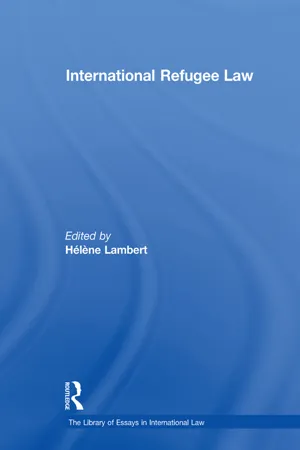
International Refugee Law
About this book
The essays selected and reproduced in this volume explore how international refugee law is dynamic and constantly evolving. From an instrument designed to protect mostly those civilians fleeing the worse excesses of World War II, the 1951 Refugee Convention has developed into a set of principles, customary rules, and values that are now firmly embedded in the human rights framework, and are applicable to a far broader range of refugees. In addition, international refugee law has been affected by international humanitarian law and international criminal law (and vice versa). Thus, there is a reinforcing dynamic in the development of these complementary areas of law. At the same time, in recent decades states have shown a renewed interest in managing migration, thereby raising issues of how to reconcile such interests with refugee protection principles. In addition, the emergence of concepts of participation and responsibility to protect promise to have an impact on international refugee law.
Part I
Historical Perspective
[1]
WE REFUGEES
Hannah Arendt was born in Königsberg in 1906, studied philosophy in Germany during the 1920s, and fled to Paris in 1933, where she worked in relief organizations helping Jews emigrate to Palestine and providing legal aid to anti-Fascists. She emigrated to New York in 1941, where she assumed a leading role among German exiles and became one of the most influential political and philosophical voices in postwar America.
In the first place, we don’t like to be called “refugees.” We ourselves call each other “newcomers” or “immigrants.” Our newspapers are papers for “Americans of German language”; and as far as I know there is not and never was any club founded by Hitler-persecuted people whose name indicated that its members were refugees.
A refugee used to be a person driven to seek refuge because of some act committed or some political opinion held. Well, it is true we have had to seek refuge; but we committed no acts and most of us never dreamt of having any radical political opinion. With us the meaning of the term “refugee” has changed. Now “refugees” are those of us who have been so unfortunate as to arrive in a new country without means and have to be helped by Refugee Committees.
Before this war broke out we were even more sensitive about being called refugees. We did our best to prove to other people that we were just ordinary immigrants. We declared that we had departed of our own free will to countries of our choice, and we denied that our situation had anything to do with “so-called Jewish problems.” Yes, we were “immigrants” or “newcomers” who had left our country because, one fine day, it no longer suited us to stay, or for purely economic reasons. We wanted to rebuild our lives, that was all. In order to rebuild one’s life one has to be strong and an optimist. So we are very optimistic.
Our optimism, indeed, is admirable, even if we say so ourselves. The story of our struggle has finally become known. We lost our home, which means the familiarity of daily life. We lost our occupation, which means the confidence that we are of some use in this world. We lost our language, which means the naturalness of reactions, the simplicity of gestures, the unaffected expression of feelings. We left our relatives in the Polish ghettos and our best friends have been killed in concentration camps, and that means the rupture of our private lives.
Nevertheless, as soon as we were saved—and most of us had to be saved several times—we started our new lives and tried to follow as closely as possible all the good advice our saviors passed on to us. We were told to forget; and we forgot quicker than anybody ever could imagine. In a friendly way we were reminded that the new country would become a new home; and after four weeks in France or six weeks in America, we pretended to be Frenchmen or Americans. The more optimistic among us would even add that their whole former life had been passed in a kind of unconscious exile and only their new country now taught them what a home really looks like. It is true we sometimes raise objections when we are told to forget about our former work; and our former ideals are usually hard to throw over if our social standard is at stake. With the language, however, we find no difficulties: after a single year optimists are convinced they speak English as well as their mother tongue; and after two years they swear solemnly that they speak English better than any other language—their German is a language they hardly remember.
In order to forget more efficiently we rather avoid any allusion to concentration or internment camps we experienced in nearly all European countries—it might be interpreted as pessimism or lack of confidence in the new homeland. Besides, how often have we been told that nobody likes to listen to all that; hell is no longer a religious belief or a fantasy, but something as real as houses and stones and trees. Apparently nobody wants to know that contemporary history has created a new kind of human being—the kind that is put in concentration camps by its foes and in internment camps by its friends.
Even among ourselves we don’t speak about this past. Instead we have found our own way of mastering an uncertain future. Since everybody plans and wishes and hopes, so do we. Apart from these general human attitudes, however, we try to clear up the future more scientifically. After so much bad luck we want a course as sure as a gun. Therefore, we leave the earth with all its uncertainties behind and we cast our eyes up to the sky. The stars tell us— rather than the newspapers—when Hitler will be defeated and when we shall become American citizens. We think the stars more reliable advisers than all our friends; we learn from the stars when we should have lunch with our benefactors and on what day we have the best chances of filling out one of these countless questionnaires which accompany our present lives. Sometimes we don’t rely even on the stars but rather on the lines of our hand or the signs of our handwriting. Thus we learn less about political events but more about our own dear selves, even though somehow psychoanalysis has gone out of fashion. Those happier times are past when bored ladies and gentlemen of high society conversed about the genial misdemeanors of their early childhood. They don’t want ghost stories any more; it is real experiences that make their flesh creep. There is no longer any need of bewitching the past; it is spellbound enough in reality. Thus, in spite of our outspoken optimism, we use all sorts of magical tricks to conjure up the spirits of the future.
I don’t know which memories and which thoughts nightly dwell in our dreams. I dare not ask for information, since I, too, had rather be an optimist. But sometimes I imagine that at least nightly we think of our dead or we remember the poems we once loved. I could even understand how our friends of the West Coast, during the curfew, should have had such curious notions as to believe that we are not only “prospective citizens” but present “enemy aliens.” In daylight, of course, we become only “technically” enemy aliens—all refugees know this. But when technical reasons prevented you from leaving your home during the dark hours, it certainly was not easy to avoid some dark speculations about the relation between technicality and reality.
No, there is something wrong with our optimism. There are those odd optimists among us who, having made a lot of optimistic speeches, go home and turn on the gas or make use of a skyscraper in quite an unexpected way. They seem to prove that our proclaimed cheerfulness is based on a dangerous readiness for death. Brought up in the conviction that life is the highest good and death the greatest dismay, we became witnesses and victims of worse terrors than death—without having been able to discover a higher ideal than life. Thus, although death lost its horror for us, we became neither willing nor capable to risk our lives for a cause. Instead of fighting—or thinking about how to become able to fight back — refugees have got used to wishing death to friends or relatives; if somebody dies, we cheerfully imagine all the trouble he has been saved. Finally many of us end by wishing that we too could be saved some trouble, and act accordingly.
Since 1938—since Hitler’s invasion of Austria—we have seen how quickly eloquent optimism could change to speechless pessimism. As time went on, we got worse—even more optimistic and even more inclined to suicide. Austrian Jews under Schuschnigg were such a cheerful people—all impartial observers admired them. It was quite wonderful how deeply convinced they were that nothing could happen to them. But when German troops invaded the country and gentile neighbors started riots at Jewish homes, Austrian Jews began to commit suicide.
Unlike other suicides, our friends leave no explanation of their deed, no indictment, no charge against a world that had forced a desperate man to talk and to behave cheerfully to his very last day. Letters left by them are conventional, meaningless documents. Thus, funeral orations we make at their open graves are brief, embarrassed, and very hopeful. Nobody cares about motives, they seem to be clear to all of us.
* * *
I speak of unpopular facts; and it makes things worse that in order to prove my point I do not even dispose of the sole arguments which impress modern people—figures. Even those Jews who furiously deny the existence of the Jewish people give us a fair chance of survival as far as figures are concerned—how else could they prove that only a few Jews are criminals and that many Jews are being killed as good patriots in wartime? Through their effort to save the statistical life of the Jewish people we know that Jews had the lowest suicide rate among all civilized nations. I am quite sure those figures are no longer correct, but I cannot prove it with new figures, though I can certainly with new experiences. This might be sufficient for those skeptical souls who never were quite convinced that the measure of one’s skull gives the exact idea of its content, or that statistics of crime show the exact level of national ethics. Anyhow, wherever European Jews are living today, they no longer behave according to statistical laws. Suicides occur not only among the panic-stricken people in Berlin and Vienna, in Bucharest or Paris, but in New York and Los Angeles, in Buenos Aires and Montevideo.
On the other hand there has been little reported about suicides in the ghettoes and concentration camps themselves. True, we had very few reports at all from Poland, but we have been fairly well informed about German and French concentration camps.
At the camp of Gurs, for instance, where I had the opportunity of spending some time, I heard only once about suicide, and that was the suggestion of a collective action, apparently a kind of protest in order to vex the French. When some of us remarked that we had been shipped there “pour crever” in any case, the general mood turned suddenly into a violent courage of life. The general opinion held that one had to be abnormally asocial and unconcerned about general events if one was still able to interpret the whole accident as personal and individual bad luck and, accordingly, ended one’s life personally and individually. But the same people, as soon as they returned to their own individual lives, being faced with seemingly individual problems, changed once more to this insane optimism which is next door to despair.
We are the first nonreligious Jews pers...
Table of contents
- Cover
- Half Title
- Title Page
- Copyright Page
- Table of Contents
- Acknowledgements
- Series Preface
- Introduction
- Part I Historical Perspective
- Part II The 1951 Refugee Convention: Key Provisions and Implementation
- Part III Refugee Law and Its Relationship with International Human Right Law, International Humanitarian Law and International Criminal Law
- Part IV EU Dimension of Refugee Law
- Part V Challenges and Perspectives on the Future
- Name Index
Trusted by 375,005 students
Access to over 1.5 million titles for a fair monthly price.
Study more efficiently using our study tools.
Frequently asked questions
Yes, you can cancel anytime from the Subscription tab in your account settings on the Perlego website. Your subscription will stay active until the end of your current billing period. Learn how to cancel your subscription
No, books cannot be downloaded as external files, such as PDFs, for use outside of Perlego. However, you can download books within the Perlego app for offline reading on mobile or tablet. Learn how to download books offline
Perlego offers two plans: Essential and Complete
- Essential is ideal for learners and professionals who enjoy exploring a wide range of subjects. Access the Essential Library with 800,000+ trusted titles and best-sellers across business, personal growth, and the humanities. Includes unlimited reading time and Standard Read Aloud voice.
- Complete: Perfect for advanced learners and researchers needing full, unrestricted access. Unlock 1.5M+ books across hundreds of subjects, including academic and specialized titles. The Complete Plan also includes advanced features like Premium Read Aloud and Research Assistant.
We are an online textbook subscription service, where you can get access to an entire online library for less than the price of a single book per month. With over 1.5 million books across 990+ topics, we’ve got you covered! Learn about our mission
Look out for the read-aloud symbol on your next book to see if you can listen to it. The read-aloud tool reads text aloud for you, highlighting the text as it is being read. You can pause it, speed it up and slow it down. Learn more about Read Aloud
Yes! You can use the Perlego app on both iOS and Android devices to read anytime, anywhere — even offline. Perfect for commutes or when you’re on the go.
Please note we cannot support devices running on iOS 13 and Android 7 or earlier. Learn more about using the app
Please note we cannot support devices running on iOS 13 and Android 7 or earlier. Learn more about using the app
Yes, you can access International Refugee Law by H�l�ne Lambert, Hélène Lambert,H�l�ne Lambert, H�ne Lambert in PDF and/or ePUB format, as well as other popular books in Law & Immigration Law. We have over 1.5 million books available in our catalogue for you to explore.