eBook - ePub
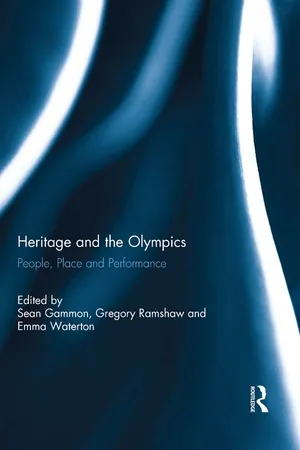
Heritage and the Olympics
People, Place and Performance
- 136 pages
- English
- ePUB (mobile friendly)
- Available on iOS & Android
eBook - ePub
Heritage and the Olympics
People, Place and Performance
About this book
The Olympic Games have evolved into the most prestigious sport event on the planet. As a consequence, each Games generates more and more interest from the academic community. Sociology, politics, geography and history have all played a part in helping to understand the meanings and implications of the Games. Heritage, too, offers invaluable insights into what we value about the Games, and what we would like to pass on to future generations. Each Olympic Games unquestionably represents key life-markers to a broad audience across the world, and the great events that take place within them become worthy of remembrance, celebration and protection. The more tangible heritage features are also evident; from the myriad artefacts and ephemera found in museums to the celebratory symbolism of past Olympic venues and sites that have become visitor attractions in their own right. This edited collection offers detailed and thought-provoking examples of these heritage components, and illustrates powerfully the breadth, passion and cultural significance that the Olympics engender.This book was published as a special issue of the International Journal of Heritage Studies.
Introduction
Examining the Olympics: heritage, identity and performance
Sport is undoubtedly a central part of culture. As MacGregor (2006, p. ix) states, ‘it is impossible to know a people until you know the game they play. To understand America, you need to know football. To understand Brazil, soccer’. It would therefore be quite tempting to encapsulate the entirety of a people in terms of a sport: rugby union is an essential aspect of New Zealand culture, just as ice hockey is in Canada, and cricket in India. As we know, however, American, Brazilian, New Zealand, Canadian and Indian cultures are far more complex than their sports alone; thus, it would seem foolish to exclude other cultural practices from an understanding of these nations and their societies.
This, for us, presents a clear rationale for considering the nexus between sport, identity and performance, which, we suggest, can be viewed through the lenses offered by a range of heritage and cultural practices. Indeed, it strikes us as odd that, until recently, few discussions of heritage and its relationships to sport could be found within academic circles. Perhaps, though, this should not come as too great a surprise, given that sport seemingly sits so uncomfortably within wider heritage concerns. Indeed, as Moore (2008) points out, in places such as the UK, sport is not readily accepted within the ‘heritage-scape’, in large part due to the tensions that continue to swirl around and between popular culture and the ‘high culture’ of traditional heritage sites like museums. This is a conclusion shared by Gammon (2007, p. 3), who has argued that ‘there may well be an air of triviality connected to sports and indeed a perception of its apparent ubiquity that renders it unworthy of protection and consideration’. The heritage field is by no means alone in this assumption. Historians, too, have often taken umbrage with sport heritage, arguing that public representations are primarily concerned with celebration, veneration and nostalgia, rather than a critical examination of complex sporting pasts (Kidd 1996). Perhaps this discomfort stems from the fact that sport heritage is ‘recent’ and thus falls victim to a broader propensity to eschew and ignore contemporary pasts in traditional heritage circles. Or, perhaps, it is because sport is susceptible to what Snyder (1991) calls ‘flashbulb memories’, the saturation of sports’ coverage in line with our willingness, desire even, to ‘re-live’, memorialise and nostalgise sporting pasts that reside outside of personal living memories.
Like many contemporary heritage constructions, sport heritage is imagined largely within the parameters offered by its tourism potential and output. Sites such as sport halls of fame and museums (Redmond 1973, Snyder 1991, Kidd 1996, Springwood 1996, Vamplew 1998, Adair 2004, Ramshaw 2010), sports stadia and sporting venues (Friedman et al. 2004, Gammon 2004, 2011, Friedman 2007, Gammon and Fear 2007, Ramshaw and Gammon 2010), sport fantasy camps (Gibson 1998, Gammon 2002) and heritage sporting events (Bale 1993, 1994, Hinch and de la Barre 2005, Ramshaw and Hinch 2006) are but a few examples of tourist attractions that are largely or exclusively sport heritage focused. Yet whilst it is clear that sport heritage is a genuine tourist attraction, and its tourism development role should be of primary importance, sport heritage undoubtedly has many more contemporary purposes than simply the turnstile. Indeed, the increasing cultural importance of sport and the mounting commitment of many communities to recognise and enshrine their sporting pasts is testament to this, with sport heritage continuing to emerge in ever sharper relief within the more discerning heritage literature. This burgeoning of interest has triggered a number of recent scholarly explorations, such as Timothy’s (2011) concise overview of the long history of sporting traditions across cultures, and Ramshaw and Gammon’s (2007) observations of sport’s created and inherited legacies (both positive and negative), which mean it can no longer be viewed exclusively through nostalgic lenses. Even some sport historians have had to take a second glance at sport heritage, noting the significant and valuable role that sports museums and halls of fame in particular can play in the creation, collection and dissemination of sporting pasts (Murray 2011). In addition, analyses of sport’s role within cultural policy have continued to emerge, evidenced most acutely by Rowe’s (2008) positioning of the cultural practices of sport within wider processes of urban renewal. Wrapped up together, what this suggests is a renewed role for sport as an important and popular aspect of contemporary social life, where it exists not only as a physical trigger for developing infrastructure, investment and spectatorship, but as a more ephemeral phenomenon that intersects with heritage and culture imaginatively, bodily and literally, too.
Perhaps one of the events where sport and heritage most explicitly overlap is the Olympic Games. Today, the Games pay homage to many beginnings, whether to the ancient Games of Greece or the philosophies and ideals laid down by the father of the modern Olympics, Pierre de Coubertin: either way, its development and progress have always been highly heritage-conscious and, as a consequence, somewhat self-referential. Because of this, Olympic heritage can be viewed either from within the Olympic movement itself, offering more traditional analyses, as well as from outside, which often involves more critical and less obvious interpretations and observations – some of which will be covered in the articles in this issue. In any event, beyond the fact that the modern Olympics are, in a sense, a type of reclaimed and resurrected heritage, the event itself overtly employs heritage symbols, traditions and rituals (particularly those of the host country). The pre-Olympic phase, for example, which includes bidding for the Games as well as providing a public justification for the event, frequently invokes (and attempts to operationalise) heritage terms such as ‘legacy’. Similarly, post-Games strategies attempt to position those legacies within the specific terms of heritage, be they the built heritage of the Games through venues, the renewed iconography of host cities, the athletic traditions launched as a consequence of the Games or the sensuous engagement of tourist experiences of place in these urban transformations (see Degen 2004). When taken together, what this means is that the Olympic Games are one of the few events where heritage can be celebrated, created and memorialised, almost simultaneously.
At the same time, the scale and scope of the Olympics – not to mention the investment, from many circles, to have the Games perceived as successful and, most importantly, issue-free – means that some heritages will be ignored, marginalised, forgotten, discarded or, at the very least, irreversibly changed. Not only are host cityscapes altered as old buildings are demolished to make way for new venues, but so do associated communities undergo significant changes, with the meanings of such locations inalterably changed as well. Normally, we would view this transition in terms of a dichotomy: the before, which is normally an area viewed as needing a form of ‘regeneration’ (part of the ubiquitous ‘legacy’ discourse of Olympic bids), and the after, which is spectacular, representing a new Olympic space. From a heritage perspective, the before is not necessarily viewed as being heritage at all. Even if there is some form of heritage, it is often viewed as unimportant, common and easily discarded – particularly in comparison with the after, which is often seen as spectacular, world-class and capable of generating new heritages. Few studies, however, have critically considered the temporal spaces in between. The first paper in this special issue does exactly that, with Anton et al. considering the liminal heritage of London’s waterways and arguing that there is a type of heritage – a heritage of transition – between the before and the after. This transition tells us much about what is perceived as valuable heritage, and what becomes easily discarded, particularly for globally consumed events such the Olympics. Day et al. similarly explore the ‘before’ and the ‘after’, but in this case through the more intangible lenses of British coaching practices. Here, the authors critically review resistance to professionalise coaching in Britain, arguing that the heritage of volunteering and amateurism continues to influence the coaching philosophies across many Olympic sports. Whist the 2012 Games are seen as an opportunity to embrace a new dawn in coaching practices in Britain, Day et al. are not convinced that such developments are sustainable and realistic.
As has been powerfully argued in recent literature, heritage often acts as a prism through which we can view those pasts (and their associated narratives, actors, values and assumptions) that have been prioritised and pushed forward within broader discursive terrains, often based upon our contemporary needs and aspirations. Lingering concerns with ‘race’, ethnicity and national belonging, for example, are pivotal topics within sport heritage, though they are not frequently discussed in terms of sport heritage spectacles and events like the Olympics. White’s article examines issues of national belonging within the context of post-colonial Australia, reflecting on the power and impact of Cathy Freeman at the 2000 Sydney Olympics, and finds that moments thought by many to be transitional were, in fact, transitory. Though White acknowledges that there have been some changes in Aboriginal and non-Aboriginal relations since Freeman’s historic win, many complex and racially ignited issues still remain. As such, White is able to aptly highlight how powerful a tool heritage can be, particularly if utilised in a sporting mega event, though she cautions us not to overestimate heritage’s ability for long-term transformational change. Similarly, reflections provided by Brittain et al. on the Paralympics lead us to question why it is that such events have yet to be included in the canon of Olympic or sport heritage, further demonstrating the complexity and exclusionary relations of power implicit within dominant conceptualisations of heritage and their associated industry. The Paralympics are an integral part of the contemporary Olympic movement and they have most certainly generated a significant sporting legacy though, as Brittain et al. explain, this heritage has been largely ignored and forgotten. It will be interesting to see, particularly as the Paralympics become more widely known and its heritage becomes more integrated with broader Olympic narratives, whether the people, places and achievements of the Paralympic movement will be recognised and enshrined. This is important not only for acts of recognition, but also for rendering more explicit the role of Paralympic heritage in broader attempts at advocacy.
Any Olympic Games will generate many different heritages. For Strohmayer, those in need of further investigation are the legacies associated with the bidding process. Certainly, heritage and legacy are central tenants of any Olympic bid, though to what degree heritage is considered in terms of multiple bids – particular for unsuccessful bids – requires consideration. Strohmayer’s examination of three of Paris’ Olympic bids reveals several important heritages and their emergence, two of which are worth mentioning here. First, Strohmayer suggests that we ought to understand Olympic bids in and of themselves as a form of heritage; there is a ‘heritage of bidding’, if you like. Second, and perhaps more importantly, he suggests that there is an imperative to understand how such bids conceive of and include (or not) built heritage. Olympic cities, he argues, will often have a significant and recognisable built heritage – heritage that, in terms of global viewership, ought to be front and centre. After all, the Olympics are, if nothing else, a grandiose advertisement for a particular destination. On the other hand, Olympic bids require massive amounts of new infrastructure and, though Olympic facilities are almost certainly ‘new’ heritage, they nevertheless often come to occupy the same space as other historical structures. Recent Olympics in Athens, Beijing and London have had to find a balance between retaining heritage structures for the global gaze, whilst also conducting a major sporting event, and Strohmayer’s discussion reminds us that though cities like Paris may be viewed as world-class and have both the size and amenities to host an Olympics, they may be incompatible with hosting a modern Games.
Finally, the Olympics have often been about modernisation. Introducing a city to the globe and transforming a location from a local or regional community to a global metropolis has been one of the central benefits of hosting an Olympics. Bou-kas et al. examine the legacies of the 2004 Athens Olympics, finding that a Janus-head approach to its Olympic heritage – where both ‘ancient’ and ‘modern’ are part-and-parcel of the same attraction – could be a way of modernising tourism. Furthermore, the multiple Olympic heritages position Athens as a unique destination vis-à-vis other post-Olympic hosts. Although many other cities can claim to have hosted multiple Olympics, only Athens can claim the ancient Games, the first modern Olympics and a recent Olympic Games. In a globally competitive tourism market, it is challenging for destinations to position their cultural products as truly exceptional. In the case of Athens, an ongoing connection with the Olympics – in essence, a continual re-enforcement that Athens is its true ‘home’ – could be a distinctive selling point for the city.
There is little doubt that the size, complexity and ubiquity of the Games stir a multiplicity of voices, all of which have their own perspectives on what constitutes Olympic heritage. This special issue alone illustrates well this diversity, including discussions related to the heritage of transition, coaching, indigeneity, disability and image affirmation. But there still remains much to investigate, as the Games continue to encompass the entire spectrum of the sport and heritage interface. With all this in mind, we hope that the current special issue will act as a catalyst for future studies that consider Games heritage, which will in turn shed more light on broader issues and aspects of the sport heritage landscape.
Notes on contributors
Sean Gammon is based at the University of Central Lancashire, in the School of Sport, Tourism and the Outdoors. He has widely published in the area of sport tourism, focusing predominantly upon consumer motivation and the social psychological interactions between visitors and sports plac...
Table of contents
- Cover
- Half Title
- Title Page
- Copyright Page
- Table of Contents
- Citation Information
- 1. Introduction: Examining the Olympics: heritage, identity and performance
- 2. London’s Olympic waterscape: capturing transition
- 3. The Olympics, amateurism and Britain’s coaching heritage
- 4. Cathy Freeman and Australia’s Indigenous heritage: a new beginning for an old nation at the Sydney 2000 Olympic Games
- 5. The marginalisation of Paralympic heritage
- 6. Non-events and their legacies: Parisian heritage and the Olympics that never were
- 7. Olympic legacy and cultural tourism: exploring the facets of Athens’ Olympic heritage
- 8. Conclusion: Olympic heritage: past, present and future
- Index
Trusted by 375,005 students
Access to over 1.5 million titles for a fair monthly price.
Study more efficiently using our study tools.
Frequently asked questions
Yes, you can cancel anytime from the Subscription tab in your account settings on the Perlego website. Your subscription will stay active until the end of your current billing period. Learn how to cancel your subscription
No, books cannot be downloaded as external files, such as PDFs, for use outside of Perlego. However, you can download books within the Perlego app for offline reading on mobile or tablet. Learn how to download books offline
Perlego offers two plans: Essential and Complete
- Essential is ideal for learners and professionals who enjoy exploring a wide range of subjects. Access the Essential Library with 800,000+ trusted titles and best-sellers across business, personal growth, and the humanities. Includes unlimited reading time and Standard Read Aloud voice.
- Complete: Perfect for advanced learners and researchers needing full, unrestricted access. Unlock 1.5M+ books across hundreds of subjects, including academic and specialized titles. The Complete Plan also includes advanced features like Premium Read Aloud and Research Assistant.
We are an online textbook subscription service, where you can get access to an entire online library for less than the price of a single book per month. With over 1.5 million books across 990+ topics, we’ve got you covered! Learn about our mission
Look out for the read-aloud symbol on your next book to see if you can listen to it. The read-aloud tool reads text aloud for you, highlighting the text as it is being read. You can pause it, speed it up and slow it down. Learn more about Read Aloud
Yes! You can use the Perlego app on both iOS and Android devices to read anytime, anywhere — even offline. Perfect for commutes or when you’re on the go.
Please note we cannot support devices running on iOS 13 and Android 7 or earlier. Learn more about using the app
Please note we cannot support devices running on iOS 13 and Android 7 or earlier. Learn more about using the app
Yes, you can access Heritage and the Olympics by Sean Gammon, Gregory Ramshaw, Emma Waterton, Sean Gammon,Gregory Ramshaw,Emma Waterton, Sean Gammon in PDF and/or ePUB format, as well as other popular books in Business & Hospitality, Travel & Tourism Industry. We have over 1.5 million books available in our catalogue for you to explore.