- 362 pages
- English
- ePUB (mobile friendly)
- Available on iOS & Android
eBook - ePub
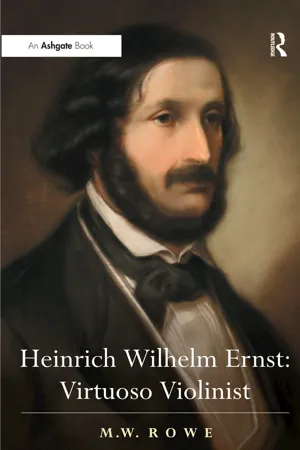
Heinrich Wilhelm Ernst: Virtuoso Violinist
About this book
From 1840-57, Heinrich Ernst was one of the most famous and significant European musicians, and performed on stage, often many times, with Berlioz, Mendelssohn, Chopin, Liszt, Wagner, Alkan, Clara Schumann, and Joachim. It is a sign of his importance that, in 1863, Brahms gave two public performances in Vienna of his own and Ernst's music to raise money for the now mortally ill violinist. Berlioz described Ernst as 'one of the artists whom I love the most, and with whose talent I am most sympathetique', while Joachim was in no doubt that Ernst was 'the greatest violinist I ever heard; he towered above the others'. Many felt that he surpassed the expressive and technical achievements of Paganini, but Ernst, unlike his great predecessor, was also a tireless champion of public chamber music, and did more than any other early nineteenth-century violinist to make Beethoven's late quartets widely known and appreciated. Ernst was not only a great virtuoso but also an accomplished composer. He wrote two of the most popular pieces of the nineteenth century - the Elegy and the Carnival of Venice - and he is best known today for two solo pieces which represent the ne plus ultra of technical difficulty: the transcription of Schubert's Erlking, and the sixth of his Polyphonic Studies, the variations on The Last Rose of Summer. Perhaps he made his greatest contribution to music through his influence on Liszt's outstanding masterpiece, the B minor piano sonata. In 1849, Liszt conducted Ernst playing his own Concerto Path que, a substantial single-movement work, in altered sonata form, using thematic transformation. Soon after this performance, Liszt wrote his Grosses Konzertsolo (1849-50), his first extended single-movement work, using altered sonata form, and thematic transformation. This is now universally acknowledged to be the immediate forerunner of the sonata, which refines and develops all these techniques. Liszt made his debt clear when, three years after completi
Information
Chapter 1
Introduction
I
For Joachim, Ernst was ‘the greatest violinist I ever heard; he towered above the others … [He] became my ideal of a performer, even surpassing in many respects the ideal I had imagined for myself’ [GV:519, 533]; for Berlioz, he was ‘one of the artists whom I love the most, and with whose talent I am most sympathetique’. [CGB:III:628] For Schumann, he was the only violinist able ‘to win over all parties whenever he pleases’ [SMM:162]; for liszt, his playing was ‘admirable’ [LOFL: I:65–6]; for Heine, he was ‘perhaps the greatest violinist of our time.’ [HS:380] Several reviewers with recent memories of Paganini preferred Ernst to the great Italian, and in 1884, reviewing over thirty years of concert-going, the Reverend H.R. Haweis wrote: ‘[IF], looking back and up to the present hour, I am asked to name off hand, the greatest players – the very greatest I ever heard – I say at once Ernst, Liszt, Rubinstein.’ [MML:34]
Besides being one of the most expressive and technically gifted of all nineteenthcentury violinists, there are several other reasons for thinking Ernst important. He successfully advised Schumann to take up music professionally, and saved the career of the young Joachim. He performed with Mendelssohn, Chopin, Liszt, Wagner, Alkan and Clara Schumann, and gave five pioneering performances of Harold in Italy with Berlioz. He developed several new violin techniques – particularly in the areas of left-hand pizzicato and artificial harmonics. He was the first Jewish touring violin virtuoso of any importance; the form and pattern for countless others. He composed two of the nineteenth-century’s best loved pieces – the burlesque variations on the Carnival of Venice, and the Elegy – and two other pieces of more lasting consequence: a set of studies which leads directly into Ysaÿe’s Sonates pour violon seul; and a concerto that was a profound influence on Liszt’s B minor piano sonata, and still in the repertoires of Enescu, Szigeti, Heifetz, Milstein, Menuhin and Stern in the first half of the twentieth century. Finally, Ernst was the early nineteenthcentury violinist who did most to make Beethoven’s late quartets widely known and appreciated. This was especially true in England where he led many performances at the Beethoven Quartet Society, the Musical Union and the Manchester Classical Chamber Concerts in the 1840s and ’50s.
This naturally raises the question: why have only violin specialists and the best informed musicologists heard of Ernst? The main reason is lack of evidence about his life and character. The problem is not of recent origin because even his closest colleagues seem to have known little about him. ‘At the moment of writing,’ wrote Ernst’s friend chorley in the violinist’s obituary, ‘we are without any biographical data,’ [A: 21/10/1865:541] and the situation never improved: ‘Few precise documents exist regarding this eminent violinist,’ lamented Alberto Bachmann in his Les grands violonistes du passé in 1913. [GVP:82]
Perhaps the most telling symptom of this almost universal ignorance is the entry for Ernst in George Dubourg’s The Violin. The book is well informed – it contains information about some players ignored by similar texts – and was first published in 1853 when Ernst was one of the most famous living violinists. But in his chapter, ‘The German School,’ when he reaches the moment for his entry on Ernst, Dubourg turns to poetry:
Vainly, oh Pen! expectant here thou turn’st
To trace the doings of Teutonic ERNST –
To show what praise he won, what hearts he moved,
What realms he traversed, and what trials he proved.
Wanting the records that should speak his fame,
Prose fails – and Verse, alas! but gives his name.
So, in life’s common round, when just aware
That one whom we have longed to know is near –
To see him, hear him, chat with him, prepared,
We find he’s gone, and has but left his card!
To trace the doings of Teutonic ERNST –
To show what praise he won, what hearts he moved,
What realms he traversed, and what trials he proved.
Wanting the records that should speak his fame,
Prose fails – and Verse, alas! but gives his name.
So, in life’s common round, when just aware
That one whom we have longed to know is near –
To see him, hear him, chat with him, prepared,
We find he’s gone, and has but left his card!
[DV:185]
There are many reasons for this lack of evidence. Ernst did not like writing, did not teach, and had no children; and apart from his student days and a few unhappy weeks in Hesse-Kassel and Hanover, he was never a member of an orchestra, ensemble or institution. In addition, being a rich, agreeable and independent man who liked to avoid disputes, he had only one protracted public row, and never made a court appearance of any kind. All these facts deprive us of immediate memories and documentation.
These problems are compounded by two further difficulties. First, the old Austrian Empire saw the birth of many famous musicians, and clearly these absorbed the interest of musicologists in the region. More minor figures, who might have been written about elsewhere, consequently languished. Second, by the time of his death, Ernst had gone severely out of fashion, not appeared on a public stage for eight years, and been playing below his best for at least three years before that. Accordingly, obituaries were few, and his entries in the first serious histories of the violin – written towards the end of the nineteenth and the beginning of the twentieth century – are scant and less than generous. [VIM:475–6]
It sometimes seems as if history itself were conspiring to keep Ernst’s name out of view. The most obvious and terrible manifestation of this is the Nazi holocaust which slaughtered most of European Jewry, killed Ernst’s surviving family, and scattered and destroyed their possessions. Until the Second World War, Ernst’s name was kept alive by his family and other members of the Jewish community in Brno. After the war, there was no family and virtually no Jewish community to recall him.
There has also been a certain amount of quotidian bad luck. His English friends, J.W. Davison (music critic of The Times) and Edward Bulwer Lytton (the novelist), were famous men in their day, but their reputations have sunk with few traces, and only a handful of scholars are interested in their friends and associates. Some contemporaries, like Julius Benedict, died before they could discuss Ernst in their memoirs; others, like Hallé, unaccountably omitted important events relating to him. All the documents from the early years of the Vienna Conservatoire have been lost, and in 1964 a serious fire consumed the archives of his English publisher, Chappell. His birthplace was destroyed during the Second World War, and when the war ended, the street in Nice named after him was renamed.
More than most, he has been subject to the erasures of political geography. Ernst was a cosmopolitan creature who felt deeply at home in borderlands, and as states wax and wane, institutions are changed and records thrown away. Brno, where he was born, was part of the Austrian Empire but became part of Czechoslovakia and then the Czech Republic. Nice, where he died, was once part of Piedmont-Sardinia but became part of France. Alsace, where his wife came from, was once part of France, then became part of Germany, and then became part of France again. Even the village of Narford in Norfolk, where he stayed for several months in the 1860s, has a peculiarly remitting existence. It is shown on some maps but not on others, and signposts to it run out in an altogether baffling way, so that even the most committed Ernst-researcher finds himself heading off into East Anglian vacancy.
II
Ernst’s character, and the cultural background which formed it, must also be held partially responsible for his present invisibility, and they are worth looking at in their own rights.
He knew from childhood that he would eventually have to leave his birthplace permanently – because of the Moravian Familiant law – and this knowledge prevented the formation of any patriotic feeling and, more importantly, any sense of home. Even when he was married and terribly ill, he never abandoned the nomadic form of life which he established in the late 1830s, moving from one hotel room or rented apartment to another every few months at most. This lifestyle undoubtedly helped undermine his health, and it also meant that he never stayed in one place long enough, either to compose a good deal himself, or collaborate with another composer on an important violin composition. For the biographer, it means that even his best friends were rarely in his company for long, and surviving documents are scattered throughout northern Europe.
But the cultural influence went deeper than this. In much of early nineteenth-century Europe, the Jews were harshly persecuted. Their lives were hedged around with legal restrictions, they were subject to punitive taxation, and they were frequently victims of abuse. Life had been like this – and worse – for centuries.
Given the severity of this anti-Semitism, it was foreseeable that more fortunate Jews would begin to develop a habit of elusiveness, enjoy the prosperous present, avoid documentation, cover their traces, and never give more information about themselves than was strictly necessary. These habits soon became second nature. A recent historian of the Rothschild family remarks that, although spectacularly rich, they were not deeply interested in their own past or future: ‘They kept no muniment room. They were not interested in their own history. They were respectful towards their ancestors, as a matter of good form, and they prudently thought about tomorrow. But they lived for the present and did not care deeply about past or future.’ [HJ:314]
Ernst assimilated the same outlook. He was impulsive and spontaneous, reacting with powerful emotion to the present moment, but he gave little thought to his own future (he never, for example, saved any money), and he seems to have cared little about posterity. Nor did he seem particularly interested in his own past. Friends were told very little about it, and his letters almost never mention an event which happened more than a few years before. Such details as he was prepared to give away, like those on his marriage certificate, become a little vaguer and more elevated. His father, who was a retired café-owner, becomes a ‘gentleman’; his own profession becomes ‘Artist’; and his wife, and probably he himself, revised their ages downwards. [MC]
Ernst had all the equipment necessary to survive in a hostile world. His livelihood depended on superior talent and education, and he ensured that his dependency on other musicians or administrators was minimal. He had virtually no physical property which could be taken from him, his obsessively peripatetic style of living ensured that prejudice could never effectively build against him, and he was ready to move on at a moment’s notice. He was therefore as invulnerable to anti-Semitism was it was possible to be. In addition, his wit, self-deprecating charm, generosity and kindness meant he was rarely likely to be the target of hatred or animosity, and allowed him to be friendly with an enormous number of people, many of whom hated one another. To a certain extent these virtues made him harder to know because the inner man was shrouded by a bright miasma of sympathetic and elusive charm.
People’s responses to Ernst were deeply personal: ‘While talking of Ernst, i have entirely lost sight of the editorial plural’, wrote a critic in the Musical World [MW:12/1/50:18], and the violinist had an extraordinary ability to turn attention away from himself and back onto the people with whom he was interacting. This is clear in his letters, which frequently say nothing about himself or his affairs, but are full of extravagant sympathy and interest in his correspondent. It is also striking how frequently reports speak less of Ernst than of his effects on others. This is even reflected in the titles of the few books and theses written about him: Ernst in the Opinion of his Contemporaries, ‘The life and Works of Heinrich Wilhelm Ernst with Emphasis on his reception as Violinist and composer’. Somehow, Ernst blends into his reception.
This is all too evident when the people writing are recounting their own experiences of his playing. When critics describe the playing of Vieuxtemps, they talk about his imposing tone, his splendid staccato, the accuracy of his intonation; when they describe Ernst, they soon become wholly absorbed in their own fantasies. Berlioz’s account of the effect of Ernst’s music on his own experiential memory, with its invocation of E.T.A. Hoffmann, is a good case in point. (See p.155.) Heine takes off into world of fanciful Arthurian romance while listening to Ernst; and there is a most extraordinary passage in one of Haweis’s books that recounts the visions conjured up by the violinist’s playing. (See pp.125–26 and 206–7.) In all these cases, hard and interesting facts about him and his playing dissolve into whimsical and emotional day-dreaming. Dubourg’s poem is emblematic of the way Ernst is recalled: the shift to the more emotional medium of verse; the emphasis on the writer’s feelings of great friendliness and warmth; Ernst’s mannerly absence; the complete lack of facts. One sometimes has the impression of a man who politely abstained from history. 1
Some of Ernst’s elusiveness must also be ascribed to his artistic nature. contemporaries were agreed that Ernst was distinguished from most of his fellow violinists by being able to excel at both virtuoso and classical music. (‘classical music’ for the mid-nineteenth century meant the works of Haydn, Mozart, Beethoven, Hummel and Spohr, particularly their chamber music). The critic of the Morning Post put the matter naively and pithily: ‘Ernst is the greatest living violinist, for he can do everything.’ [MW:5/1/50:2]
Contemporaries were also surprised at the kind of differentiation which Ernst could make between one kind of chamber music and another. Davison wrote: ‘It was a real treat to connoisseurs to hear Herr Ernst’s fine and expressive reading of [Mendelssohn’s quartet in E♭ op.12] and to remark the entire distinction which he made between it and the more primitive work of the genial and prolific Mozart. [Quartet in B♭, probably K.458]. Herr Ernst, in short, is a subtle actor; and the various quartets, etc, of the great masters to him are much the same as the different characters of Shakespeare to such a comedian [i.e. actor] as Macready.’ 2 [MW:17/2/55:107]
The actor’s ability to project himself sympathetically into any kind of work or personality is characteristic of a certain kind of artistic nature. The poet, observed Keats, is a man ‘without identity’ [KL:157–8], a man who is simply a ‘thoroughfare for all thoughts’. [KL:326] Unlike the self-sufficient ‘man of power’, the artist does not impose his personality on others, but takes on another person’s personality and imaginatively entertains their feelings and circumstances. The artist is without identity because there are an infinite number he can assume. Perhaps the reason why Ernst did not want to be an orchestral leader or a teacher was that these roles would force him to act like a man of power; both musical roles demand a fixed and definite identity which has to be asserted on and against other people. One suspects that, like Keats and Wordsworth, he found wise passiveness the key to self-understanding and to the understanding of others. [KL:53]
We can see the same disposition of mind in his sense of humour. Invariably, in the few examples that have come down to us, this involves Ernst projecting an imagined identity onto a person or set of circumstances, and then acting as if that identity were real. He treats the young and unqualified Reinecke as if he were a venerable Kapellmeister; he pretends to Schindler that another friend’s house is a restaurant; he persuades Bulwer Lytton that the visiting piano virtuoso Sigismond Thalberg is a magician; he pretends that a curl of hair can be reattached to his head. This is also the core of his irony, since irony (unlike sarcasm) requires the creation of an entertained persona or circumstance which can then be discreetly signalled and lightly discarded.
It is also the core of his sympathy, since this too requires one to entertain the circumstances of another, experience the world as he does, and want to relieve his misfortunes. Ernst was a modest man who was famously sympathetic and generous to those he knew. He hugged and comforted Berlioz in St Petersburg when the latter was overcome by excitement and nerves; he gave up a large part of his fortune to his half-brother who had run into serious debt; he thought nothing of taking sixty people to a restaurant. [EUZ:56] He was also famously sympathetic to people he did not know, and his charitable work was frequently cause for comment in the press. He gave money to the victims of the Hamburg fire and other public disasters, and even at the end of his life, when he was severely impoverished himself, he still regularly gave money to the poor of Nice. As in the case of his artistic virtues, it is natural to speak of his moral virtues in terms of the self and denial of the self: we call a modest man ‘self-effacing’; we call a charitable man ‘selfless’. In all cases, an egotistic hardness of outline is avoided.
Although witty, sympathetic and intelligent, Ernst was not an intellectual. His life at one period, according to Hallé, was ‘the same eating and drinking parties, the same chess and whist parties,’ [LLCH:244] and it is reasonable to assume that it was like this most of the time. His letters rarely discuss music; the only book he ever mentions is a book on whist; and the only poetry he quotes is a passage from Schiller which was recited, in his presence, by his wife a short time before. Judaism as a religion seems to have meant nothing to him, and he showed no haste to convert to christianity either. Only in the late 1850s or early ’60s did he convert to Catholicism, but this was entirely under the influence of his deeply religious wife. Moral and political ambitions seem to have been equally lacking. He writes on one occasion to his half-brother: ‘I don’t offend anyone when I only benefit myself and do no harm. I desire no more than that.’ [EOC:11]
With illness and age, wise passiveness turned into passivity. In a letter to ...
Table of contents
- Cover
- Half Title
- Dedication
- Title
- Copyright
- Contents
- List of Illustrations and Figures
- List of Music Examples
- References and Abbreviations
- Preface
- Permissions and Acknowledgements
- 1 Introduction
- Part I Apprenticeship
- Part II Early Tours
- Part III Later Tours
- Part IV Retirement
- Appendix: The Main Themes of Ernst's Lost A Major String Quartet
- List of Works bv H. W. Ernst
- H. W. Ernst: Discography
- Bibliography of Works Quoted or Referred to in the Text
- Index
Trusted by 375,005 students
Access to over 1.5 million titles for a fair monthly price.
Study more efficiently using our study tools.
Frequently asked questions
Yes, you can cancel anytime from the Subscription tab in your account settings on the Perlego website. Your subscription will stay active until the end of your current billing period. Learn how to cancel your subscription
No, books cannot be downloaded as external files, such as PDFs, for use outside of Perlego. However, you can download books within the Perlego app for offline reading on mobile or tablet. Learn how to download books offline
Perlego offers two plans: Essential and Complete
- Essential is ideal for learners and professionals who enjoy exploring a wide range of subjects. Access the Essential Library with 800,000+ trusted titles and best-sellers across business, personal growth, and the humanities. Includes unlimited reading time and Standard Read Aloud voice.
- Complete: Perfect for advanced learners and researchers needing full, unrestricted access. Unlock 1.5M+ books across hundreds of subjects, including academic and specialized titles. The Complete Plan also includes advanced features like Premium Read Aloud and Research Assistant.
We are an online textbook subscription service, where you can get access to an entire online library for less than the price of a single book per month. With over 1.5 million books across 990+ topics, we’ve got you covered! Learn about our mission
Look out for the read-aloud symbol on your next book to see if you can listen to it. The read-aloud tool reads text aloud for you, highlighting the text as it is being read. You can pause it, speed it up and slow it down. Learn more about Read Aloud
Yes! You can use the Perlego app on both iOS and Android devices to read anytime, anywhere — even offline. Perfect for commutes or when you’re on the go.
Please note we cannot support devices running on iOS 13 and Android 7 or earlier. Learn more about using the app
Please note we cannot support devices running on iOS 13 and Android 7 or earlier. Learn more about using the app
Yes, you can access Heinrich Wilhelm Ernst: Virtuoso Violinist by Mark Rowe in PDF and/or ePUB format, as well as other popular books in Media & Performing Arts & Music. We have over 1.5 million books available in our catalogue for you to explore.